Why We All Care About Right and Wrong: Where Morality Exists and How Human Ethics Origin Explains It
People disagree about politics, religion, and ideology—but they still experience “wrong” as something more than personal preference. This article explores why morality exists, how human ethics origin can be traced through evolution and culture, and why arguments for objective morality (including C.S. Lewis’s “ought” and presupposed rules) explain the persistence of moral reality in everyday life.
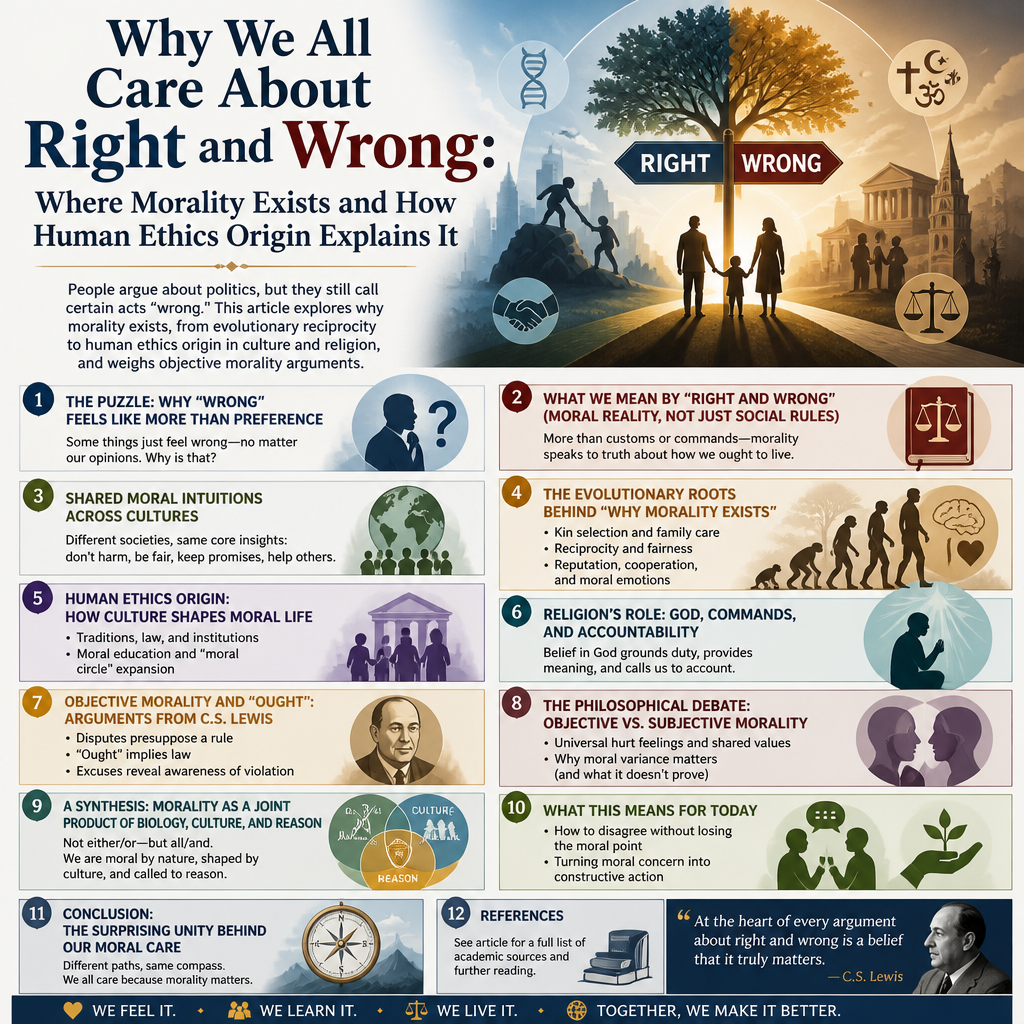
1) The Puzzle: Why “Wrong” Feels Like More Than Preference
Most of us can debate opinions all day: what music is best, which team deserves to win, or which lifestyle is most convenient. But when it comes to right and wrong, the tone changes. People don’t usually say, “I just prefer that to happen” or “This is only my taste.” They say things like: “That’s wrong.” “That’s unfair.” “You shouldn’t do that.”
This is the puzzle behind the keyword why morality exists. Morality isn’t experienced like a hobby. It feels like a kind of reality—something binding on us, even when we disagree about the details.
2) What We Mean by “Right and Wrong” (Moral Reality, Not Just Social Rules)
To understand human ethics origin, we first need to clarify what morality is. Moral claims often go beyond “the rules in my society.” They typically imply at least three things:
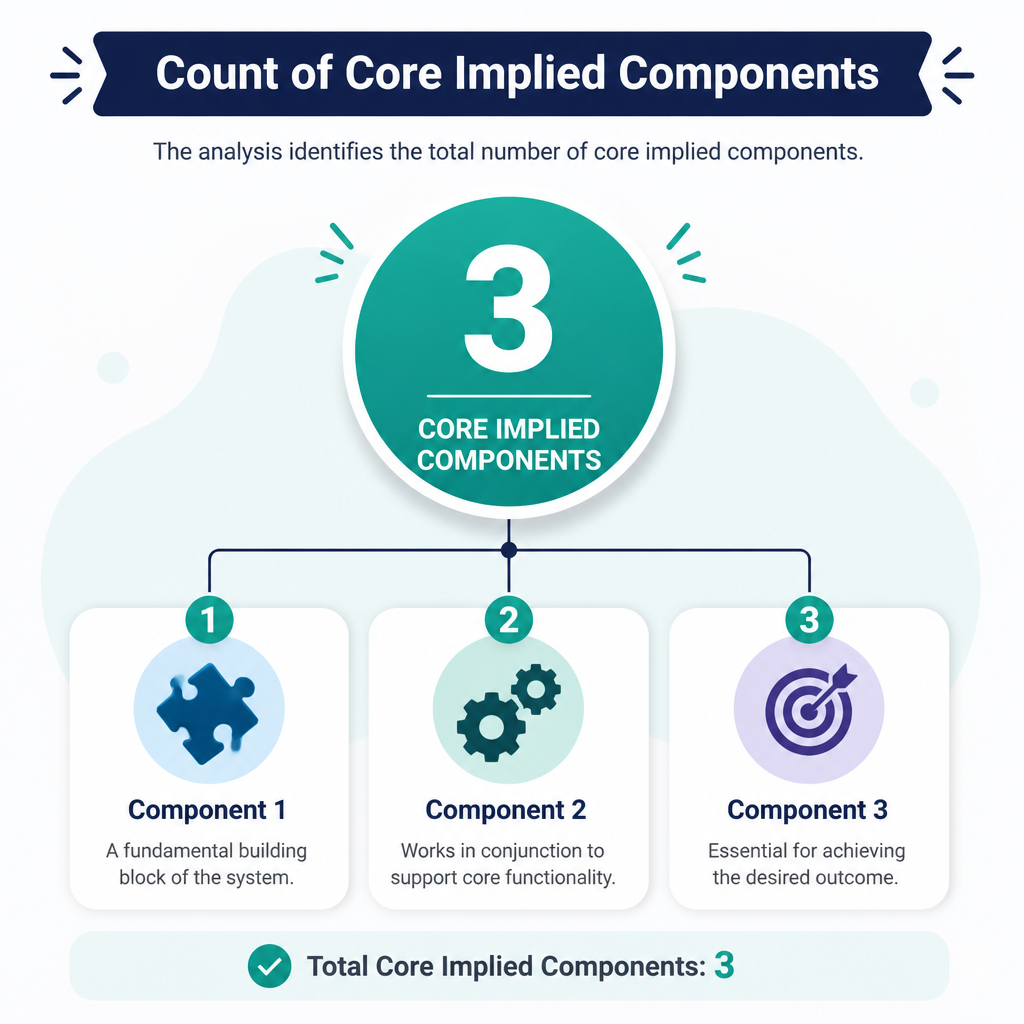
- Authority: the belief that wrongdoing is not merely disliked, but should be rejected.
- Universality: the sense that some wrongs (e.g., cruelty for fun) count as wrong even if a group approves.
- Accountability: the idea that people can be rightly blamed or held responsible.
So morality is not only etiquette. It is closer to a standard for action—one that makes conflict intelligible and gives moral language its characteristic seriousness.
3) Shared Moral Intuitions Across Cultures
Human moral disagreement is real. Cultures vary in dress, family structures, political values, and religious law. Yet even across major differences, people repeatedly converge on certain themes.
Many societies treat harm and suffering as serious, especially when:
- the harm is unnecessary,
- it’s intentional or exploitative,
- it violates care for the vulnerable (children, dependents),
- or it breaks commitments in ways that undermine trust.
Even when the “why” differs—God’s commands, social cohesion, human flourishing, natural law—moral life often contains similar building blocks.
This matters because if morality were only arbitrary convention, you would expect no recurring patterns. Instead, we find something more like a common human foundation, later expressed in many different ways.
4) The Evolutionary Roots Behind “Why Morality Exists”
One powerful way to answer why morality exists is to ask what morality does for human beings. Evolution doesn’t produce “moral philosophy”; it produces behaviors that help organisms survive and reproduce. But moral emotions, norms, and institutions can function as tools for social life.
4.1) Kin Selection and Family Care
Humans are dependent for a long time. We survive in groups, and we often protect those who share our genetic interests. That can help explain why moral concern often begins with:
- caring for children,
- protecting close family,
- and nurturing the future generation.
From the standpoint of human ethics origin, early “moral” instincts may be deeply connected to attachment and caregiving—then widened over time.
4.2) Reciprocity and Fairness
Surviving together requires ongoing cooperation. But cooperation needs enforcement mechanisms. A basic evolutionary model is reciprocal altruism: help someone when they help you, and withhold help when they cheat you.
This can generate something like fairness norms. Over time, “fairness” becomes a moral idea rather than a mere strategy—because moral emotions (anger at cheating, resentment at unfairness) reliably track when social trust is being broken.
That is part of why wrong feels like more than opinion. It is tied to the experience of betrayal, not just personal preference.
4.3) Reputation, Cooperation, and Moral Emotions
Humans also care about how we are seen. If others observe your actions, you are more likely to behave cooperatively—because reputation affects future interactions.
Modern research discusses how moral emotions such as empathy, guilt, contempt, indignation, and shame can be adaptive signals. They motivate behavior and help coordinate group life.
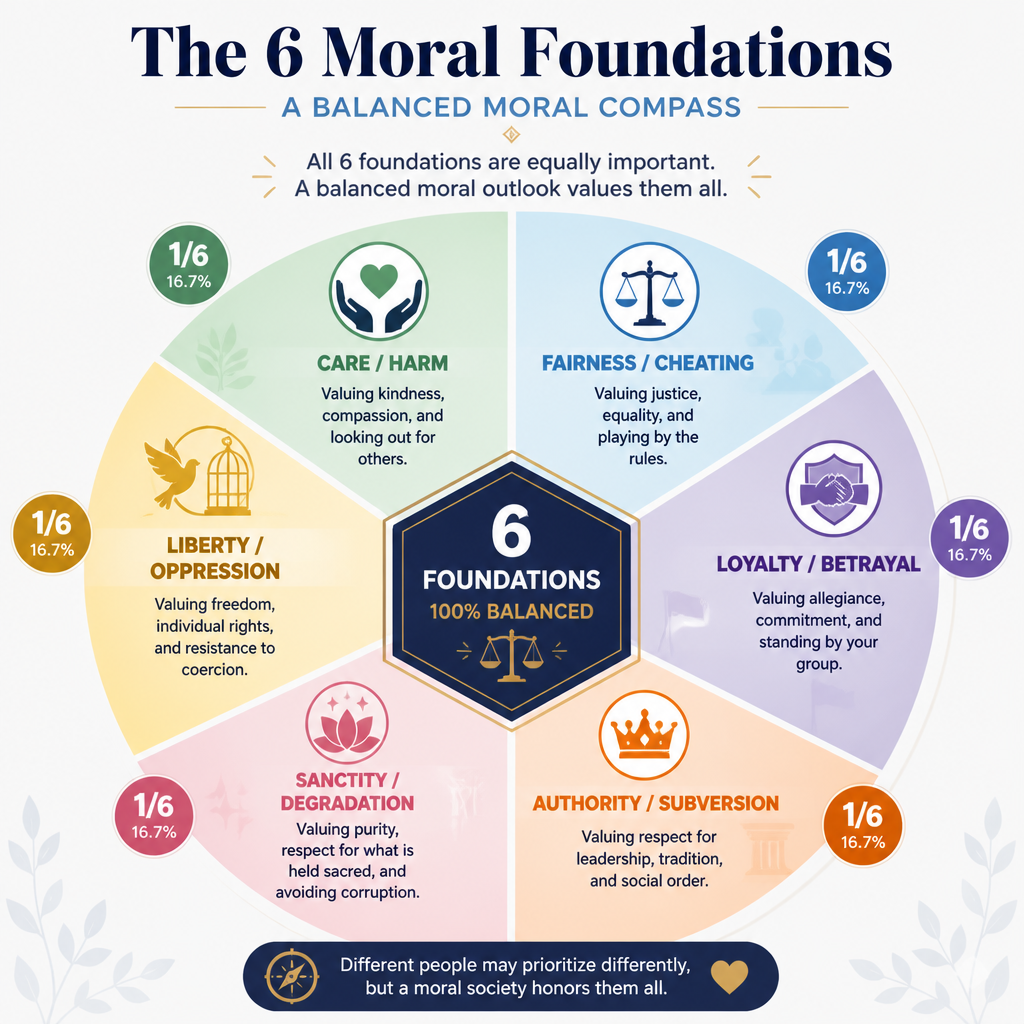
Related frameworks (like Haidt’s “moral foundations”) highlight that people tend to organize moral judgment into recurring categories—care/harm, fairness/cheating, loyalty/betrayal, authority/subversion, sanctity/degradation, liberty/oppression.
Importantly, these evolved tendencies don’t automatically settle every debate. They provide pressures and instincts that culture then refines into specific moral rules.
5) Human Ethics Origin: How Culture Shapes Moral Life
Evolution can explain why humans are able to care about morality; it doesn’t fully determine what counts as right in every situation. That is where human ethics origin in culture becomes crucial.
5.1) Traditions, Law, and Institutions
Every society has institutions that teach people what to do: families, schools, religious communities, courts, and political structures. These institutions:
- define acceptable behavior,
- encode consequences,
- create shared narratives about good and evil,
- and transmit norms to the next generation.
Over time, morality becomes more stable than individual preference. People learn that some actions reliably bring harm to communal life, and others preserve trust.
5.2) Moral Education and the Expansion of the Moral Circle
Another key feature of why morality exists is that moral concern seems to expand. Many historical shifts look like expansions of the “moral circle”—the range of beings considered worthy of protection and respect.
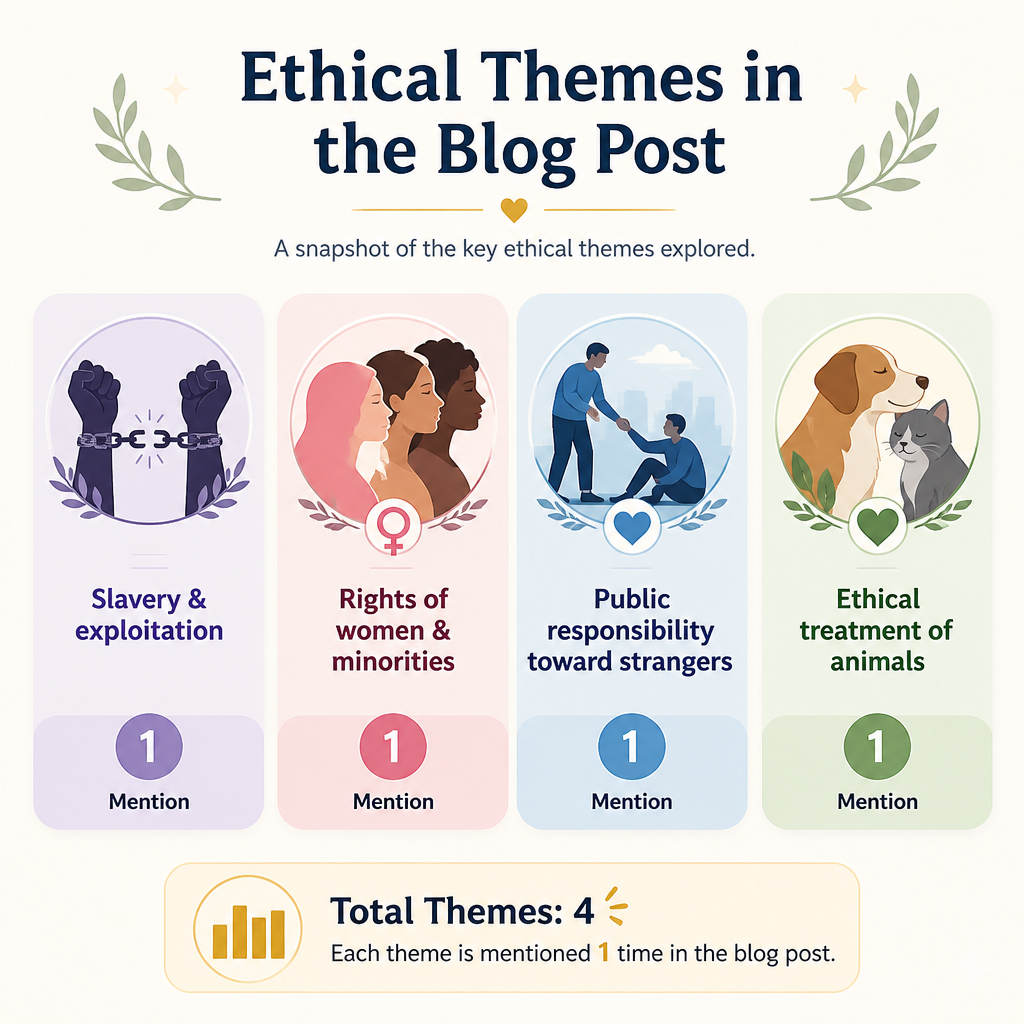
In practice, you can see this in changing views about:
- slavery and exploitation,
- the rights of women and minorities,
- public responsibility toward strangers,
- and increasingly, the ethical treatment of animals.
Moral evolution doesn’t mean morality becomes meaningless. It often means morality becomes more inclusive and more coherent with its own stated principles.
6) Religion’s Role: God, Commands, and Accountability
Religion is one of the most influential drivers of moral life. It often provides moral structure through:
- divine authority (God as the source of obligation),
- accountability (judgment beyond social approval),
- motivation (hope, repentance, love),
- and community (rituals that shape character).
From this angle, morality isn’t only a social agreement; it’s a response to a reality higher than the self.
At the same time, critics argue religion can be used to justify cruelty. That’s a real concern—and it highlights why moral truth must be examined, not merely asserted. Still, religion remains one major channel through which societies cultivate virtues like compassion, honesty, and self-control.
7) Objective Morality and “Ought”: Arguments from C.S. Lewis
Some people believe morality is objective: right and wrong exist as real standards, not just changing preferences. One of the clearest popular arguments comes from C.S. Lewis.
Lewis’s case for objective morality doesn’t depend on whether you’re religious first. It begins with how we talk and argue about morality.
7.1) Disputes Presuppose a Rule
When people argue about “what should be done,” they assume a standard that both sides are trying to obey. Otherwise, the argument resembles debating referees about fouls without having rules for what counts as a foul.
7.2) “Ought” Implies Law
In moral debates we don’t just say, “I like X.” We say, “You ought not to do Y.” That word carries something like law: it suggests obligation that binds regardless of our mood.
7.3) Excuses Reveal Awareness of Violation
When someone does something wrong, they often feel compelled to justify themselves (“It wasn’t my fault,” “I didn’t mean it,” “I had no choice”). That pattern suggests they recognize a rule being broken, not merely an opinion being violated.
7.4) Moral Progress Requires a Fixed Target
When we call something “progress,” we usually mean the moral direction is toward a better standard—not just toward a different preference. That implies a target worth calling “better,” not a purely subjective shift.
In short, Lewis’s approach treats morality as something closer to objective reality, which—if true—would explain why morality feels binding.
8) The Philosophical Debate: Objective vs. Subjective Morality
Even if morality feels objective, philosophers disagree about whether it is objective. A useful debate frame compares two views:
- Subjective morality: moral claims are ultimately expressions of preference, emotion, or cultural agreement.
- Objective morality: moral claims track real facts about how we ought to live.
8.1) Why Variance Matters (And What It Doesn’t Prove)
It’s true that moral judgments vary. People can disagree about euthanasia, abortion, lying, punishment, sexual ethics, and so on. Some argue this variation undermines objectivity.
But variance doesn’t automatically show “nothing is objective.” People disagree about math and physics too; disagreement can reflect lack of information, confusion, competing values, or different assumptions—not necessarily the absence of truth.
8.2) Shared Moral Emotions as Evidence of Common Moral Detection
Some arguments for objectivity point to shared human responses. For example, if people across cultures reliably react to certain forms of cruelty (especially toward the vulnerable) with deep “hurt feelings,” that suggests humans detect moral wrong in something more stable than pure preference.
8.3) Middle Ways: Objective Within Traditions, or Objective as a Developing Process
There are also hybrid positions. Some thinkers argue morality is objective within a community tradition (because practices create standards) while other aspects—like global consensus—develop over time.
In that view, moral reality is real, but our grasp of it grows as societies interact and learn.
9) A Synthesis: Morality as a Joint Product of Biology, Culture, and Reason
The most practical synthesis for why morality exists is this:
- Biology gives humans capacities—empathy, fairness sensitivity, reciprocity instincts, and social learning.
- Culture supplies content—laws, customs, moral education, and moral institutions.
- Reason allows reflection—debating principles, correcting errors, and arguing for better standards.
On this model, human ethics origin is not a single cause. It is a process. Morality begins in human nature and social interdependence, then becomes articulated, criticized, refined, and—sometimes—grounded in religion or metaphysical claims about what “ought” really means.
10) What This Means for Today
If we understand that moral concern has deep roots, we can disagree more intelligently.
10.1) How to Disagree Without Losing the Moral Point
- Separate people from principles: focus on what you believe is right, not what you believe about the other person’s character.
- Ask what standard is being used: is it harm, rights, duty, compassion, justice, or tradition?
- Distinguish facts from values: some disputes are “what is true?” while others are “what should matter most?”
10.2) Turning Moral Concern into Constructive Action
Morality shouldn’t stay trapped in arguments. Once you see that moral instincts are meant to coordinate human flourishing, you can channel them into:
- reforming harmful policies,
- helping victims and preventing cruelty,
- building fair institutions,
- and cultivating virtues like honesty and self-restraint.
In other words: if morality exists because we live together, it must also be expressed in how we treat each other.
11) Conclusion: The Surprising Unity Behind Our Moral Care
So why do we all care about right and wrong?
Because morality isn’t merely a private preference or a random social trick. It is an emergent human reality rooted in how we survive, cooperate, and form communities. Our human ethics origin can be traced through biology (empathy and reciprocity), culture (education and institutions), and reason (reflection and argument). And even when philosophers debate whether morality is objectively true, everyday life keeps revealing something deeper: people act as if wrong is more than taste.
That’s the unity behind moral concern—shared by believers and skeptics, liberals and conservatives, across time and place. It is a reminder that our moral life is not an accident. It is one of the clearest ways we show we are more than animals trying to get our way.
References
- Rational Badger, “Where Does Morality Come From? Tracing the Roots of Right and Wrong” (Medium). https://medium.com/@RationalBadger/where-does-morality-come-from-6f0d41c069a5
- Stephen S. Jordan, “C. S. Lewis and 8 Reasons for Believing in Objective Morality” (Moral Apologetics). https://www.moralapologetics.com/wordpress/2019/1/18/c-s-lewis-and-8-reasons-for-believing-in-objective-morality
- Philosophy Now Contributors, “Is Morality Objective?” https://philosophynow.org/issues/115/Is_Morality_Objective