Why We All Ask the Same Questions About Life: Meaning, Purpose, and Existential Answers
Have you noticed how people from every background keep circling the same inner questions? Whether we’re a teenager staring at the ceiling, an adult stuck in routine, or someone facing loss, we tend to ask variations of the same prompts:
- What is the meaning of life?
- What is the purpose of life?
- Why are we here?
- Do we matter—or is it all absurd?
These meaning of life questions aren’t just online debates or poetic clichés. They’re a recurring human pattern: our minds reaching for structure, direction, and significance. And while philosophers, psychologists, and religions approach the answers differently, the questions keep returning because the need behind them is real.
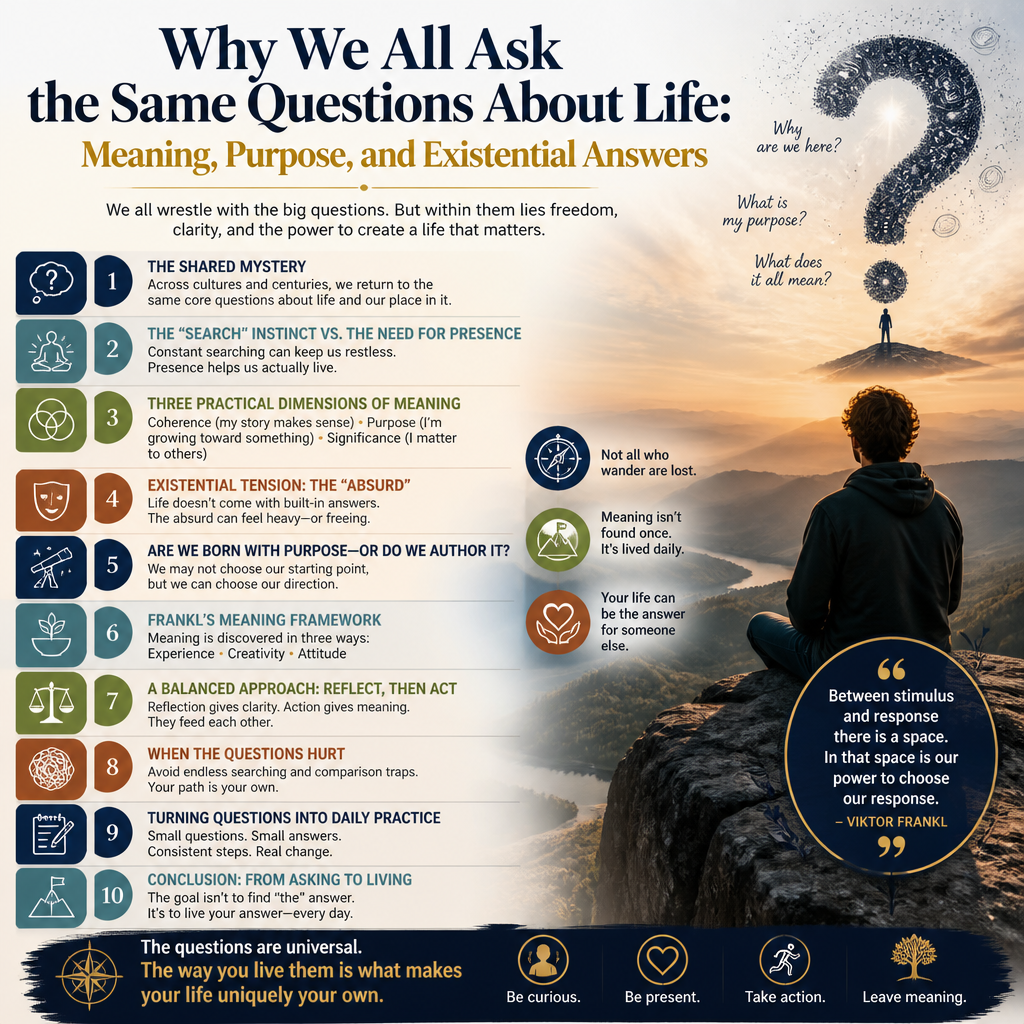
1. The shared mystery: why meaning-of-life questions keep returning
Life has seasons—good days, painful days, moments that feel meaningful, and stretches that feel flat. Over time, most people notice a strange mismatch:
- We can do tasks, meet goals, pay bills, build careers—yet still feel an ache for “something more.”
- We can explain facts, but we still need a reason why we’re living those facts.
- We can plan the future, yet we can’t fully escape questions about what the future is for.
That’s why existential questions return. They’re not merely curiosity—they’re attempts to answer a deeper need: How should I live, and what should I believe my life is about?
2. The “search” instinct vs. the need for presence
It’s tempting to think that meaning comes only from finding the “one correct answer.” So we search: we read, watch, compare, question, and re-question. And yes—reflection matters. But there’s a catch.
When we’re constantly searching, meaning can slip away. There’s a difference between:
- Searching with intention (to learn, clarify, and decide)
- Searching compulsively (to avoid living, committing, or experiencing)
Some of the most helpful frameworks suggest that meaning doesn’t only come from “more thinking.” Often it comes from a balance of reflection and presence: interpreting your life while also stepping into it.
3. Three practical dimensions of meaning: coherence, purpose, significance
One reason we keep asking the same questions is that the human mind seems to need at least three ingredients for meaning. Consider three dimensions—call them the “macronutrients” of meaning:
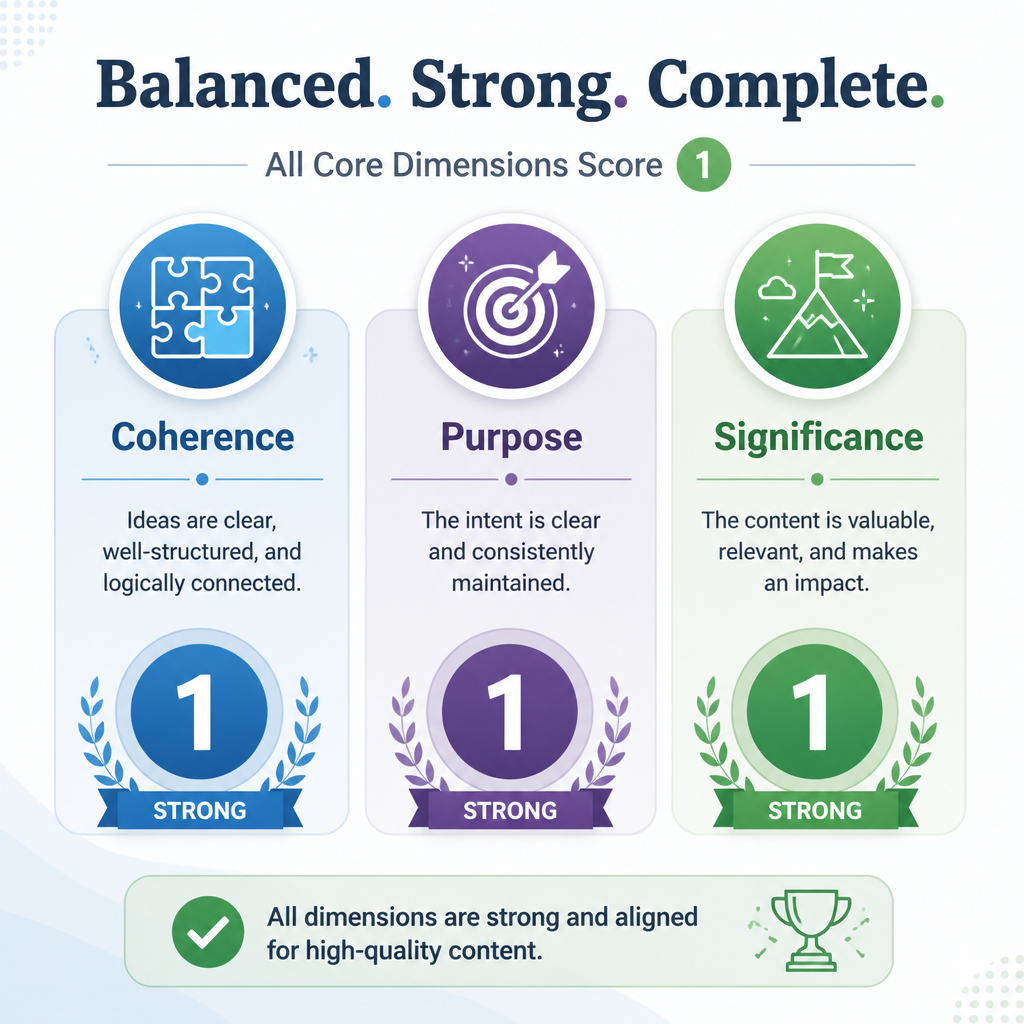
Coherence: making sense of the story
Coherence is the sense that your life events connect into a narrative. Not every chapter is pleasant, but it feels understandable—even if you don’t fully like it yet.
When coherence is missing, life can feel random. That’s when people start asking: Why did this happen? What does it add up to? Those are core meaning of life questions.
Purpose: having goals that energize you
Purpose of life doesn’t have to mean a grand cosmic mission. Purpose can mean having goals and commitments that pull you forward—work, family, service, learning, craft, faith, healing.
When purpose collapses, days feel like repetition. Then “Why are we here?” isn’t a philosophical slogan—it’s a genuine cry from an unfilled inner direction.
Significance: feeling that your existence matters
Significance is the conviction that you matter to other people and to the world in some way. It’s the sense that your life is not disposable.
Without significance, existential questions can turn heavy: Is there any point? Do my actions change anything?
When people feel a deficit in one of these areas, they tend to intensify their searching. The good news is that these dimensions can be strengthened through practice—not just debate.
4. Existential tension: the “absurd” and why it can be freeing
Another reason we ask the same questions is that human seriousness meets a universe that may not answer back.
Some thinkers describe this as the absurd: the tension between:
- How seriously we invest in love, work, morality, and relationships
- How detached the universe seems from those investments
One response to the absurd is despair—“Nothing matters.” But an alternative response is liberation: if the universe doesn’t provide meaning automatically, then you are not waiting for permission. You can value what is valuable because you choose to.
In that sense, accepting the absurd doesn’t erase love or ethics. It can shift your focus from “What is the cosmic justification?” to “What kind of life will I live right now?”
5. Are we born with purpose—or do we author it?
This is one of the biggest divides behind the existential questions people ask.
Some believe there is a purpose built into reality—given by God, nature, or design. Others believe meaning is created by human beings—through the way we respond to life.
Interestingly, even if you disagree about where meaning comes from, you can agree on something practical:
- We can’t live only in theory.
- We need lived experience to test what we believe.
- We need action to give meaning shape.
Meaning often becomes real only after it has been practiced.
6. Frankl’s meaning framework: experience, creativity, and attitude
Viktor Frankl—famous for his work in logotherapy—offers a compelling answer to the “meaning of life questions.” His core insight is not that suffering proves meaning, but that meaning can be found through how we respond.
Frankl’s framework is often summarized in three ways to find meaning:
1) Through experience (encountering life)
Meaning can be discovered by engaging deeply with others and the world. Love, awe, nature, friendship, art, service—these are not distractions from meaning. They are ways meaning arrives.
2) Through creativity (making something)
Meaning can be shaped through what you build or contribute. That may be a career, a project, teaching, parenting, learning a craft, improving a community, or creating beauty.
3) Through attitude (responding to what you can’t change)
This is the most difficult and most powerful. Some circumstances can’t be controlled—loss, illness, injustice. Frankl’s claim is that we retain freedom of attitude: the choice of how we stand, how we interpret, and how we behave.
In other words: even when life doesn’t give the purpose you wanted, it still gives you the chance to respond in a way that’s humane, courageous, and meaningful.
7. A balanced approach to meaning of life questions: reflect, then act
So how do you handle the questions without getting trapped in endless searching?
A simple rhythm works well:
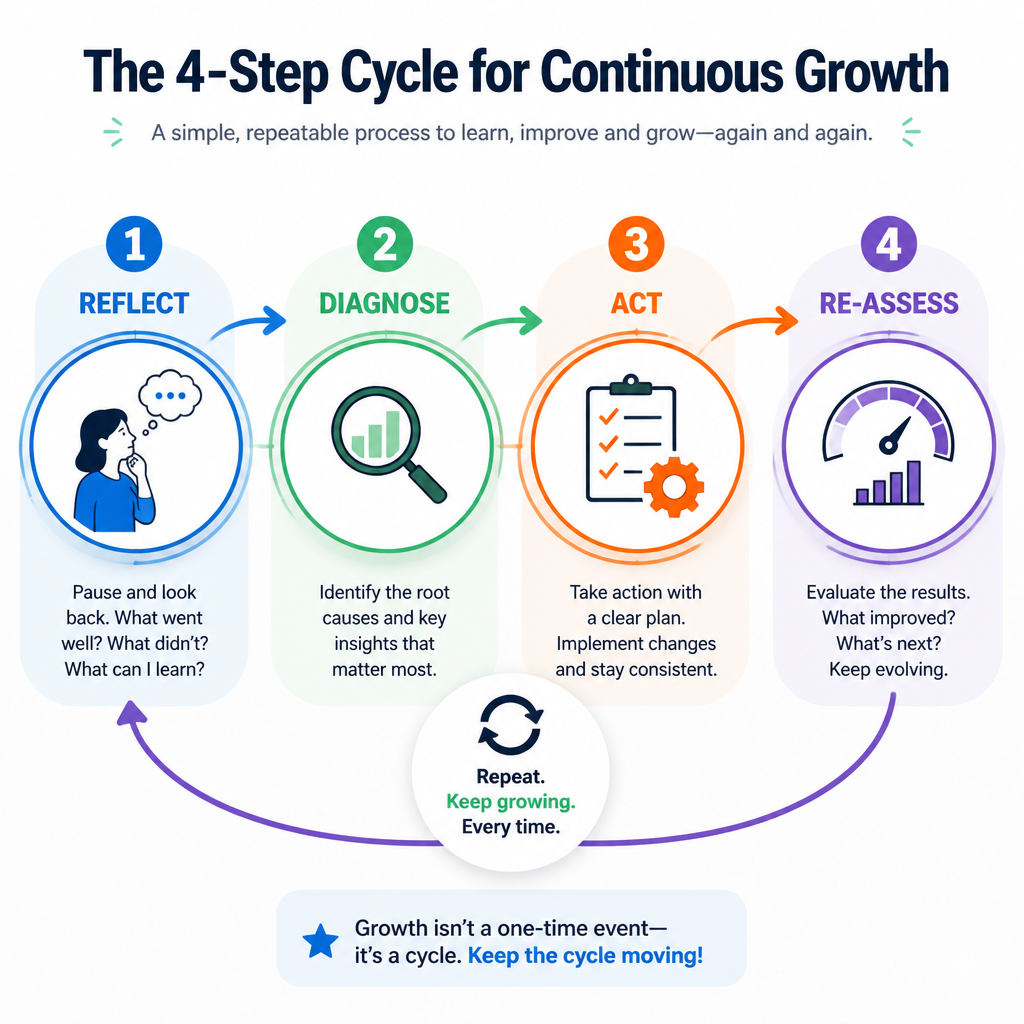
- Reflect (ask clarifying questions, read, journal, pray, meditate).
- Diagnose which dimension feels deficient: coherence, purpose, or significance.
- Act with small commitments that test whether meaning grows.
- Re-assess after time—meaning is often something you confirm by living it.
Instead of asking only “What is the meaning of life?” ask:
- What would make my days more coherent?
- What would give me purpose this week?
- Who could my life be significant to today?
8. When the questions hurt: avoiding endless searching and comparison traps
Sometimes existential questioning becomes painful. That’s common—especially when the mind tries to solve meaning through:
- Comparison (“Their life has meaning; mine doesn’t.”)
- Optimization (“If I find the perfect answer, I’ll finally feel okay.”)
- Delay (“Once I understand everything, then I’ll act.”)
A helpful warning in meaning-seeking is that too much searching can become its own problem—like endlessly switching playlists instead of listening to one song long enough to feel it. Meaning often grows through staying, not constantly switching.
If you’re stuck, try returning to what is already present: relationships you can nurture, duties you can perform well, a skill you can develop, or a suffering you can meet with compassion.
9. Turning existential questions into daily practice (small questions, small answers)
You don’t have to solve “why are we here” overnight. Consider a daily practice that makes the question livable.
Daily micro-questions
- Coherence: What happened today that connects to who I’m becoming?
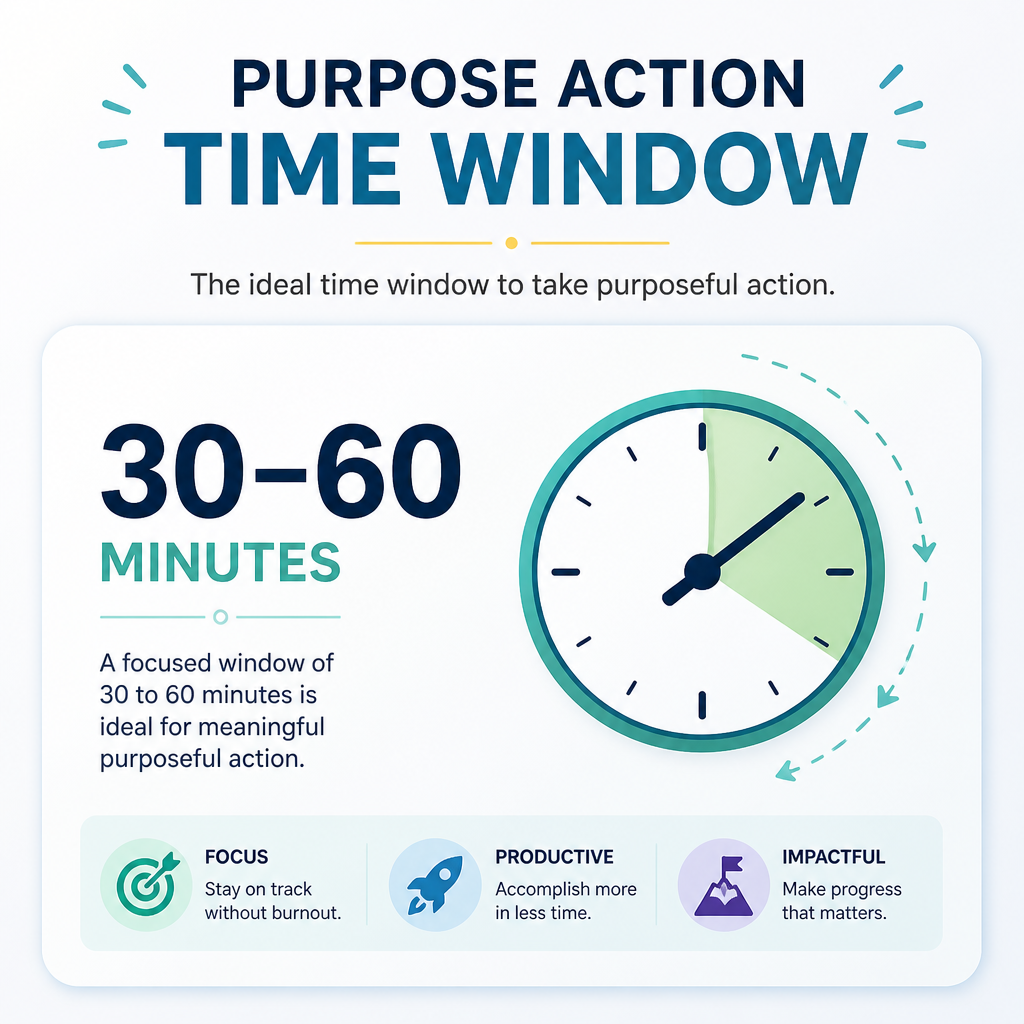
- Purpose: What is one meaningful action I can do within 30–60 minutes?
- Significance: Who can I serve, encourage, or genuinely listen to today?
Small answers, repeated
Meaning often emerges like a path: you don’t see the whole trail at the start, but repeated steps create a direction. Over time, your purpose of life becomes less like a mystery and more like a lived pattern.
10. Conclusion: from asking to living—how purpose of life becomes personal
So why do we all ask the same questions about life?
Because we’re built to seek coherence, purpose, and significance. Because we feel the tension between our seriousness and the universe’s silence. And because we crave a way to say, with our whole lives: “This matters to me, and I will respond accordingly.”
Ultimately, you don’t have to choose between thinking and living. The best answers to meaning of life questions usually don’t come from one final explanation—they come from a faithful rhythm of reflection and action.
Question to take with you: If you had to live today without fully solving the big mystery of why are we here, what would you do—how would you love, work, create, or endure—in a way that makes life feel more coherent, purposeful, and significant?
References
-
Arthur C. Brooks, The Meaning of Life Is Surprisingly Simple, The Atlantic (2021). https://www.theatlantic.com/family/archive/2021/10/meaning-life-macronutrients-purpose-search/620440/
-
Lawrence Yeo, The Meaning of Life Is Absurd, More to That (blog post). https://moretothat.com/the-meaning-of-life-is-absurd/
-
Neel Burton, What Is the Meaning of Life?, Psychology Today (2018). https://www.psychologytoday.com/us/blog/hide-and-seek/201803/what-is-the-meaning-of-life