1) Introduction: Why misconceptions about Islam spread
Ask many non-Muslims what they “know” about Islam and you’ll often hear a familiar set of phrases—half-sentences, headlines, or bold claims that sound confident but rarely come from careful study. This is how misconceptions about islam reproduce themselves: one person repeats what they saw, another person assumes it must be true, and soon the story becomes “common knowledge.”
There’s also a modern filter at work. When people encounter Islam mainly through breaking news, viral clips, or sensational commentary, what they end up seeing is not the full religion—it’s a narrow slice. Many have called this phenomenon “media Islam”: a caricature created by what performs well on screens rather than what is faithful to scripture, history, or lived religious practice.
The good news is that most Islam myths can be corrected. Not by winning arguments, but by asking better questions: Where does this claim come from? What exactly do the primary sources say? Is the claim about doctrine, law, or culture? How is translation used? When we do that, the picture becomes far more accurate—and far more human.
2) What fuels “media Islam” misunderstandings
a) Limited knowledge, cultural distance, and language barriers
Islam is not a monolith with one culture. Muslims live in many countries, speak many languages, and practice Islam in diverse ways. Yet many non-Muslims are introduced to Islam through a small number of examples—often from contexts far away. Add language barriers—especially around Arabic terms like shariah, jihad, or quran—and it becomes easy for misunderstandings to harden into certainty.
When people don’t know the original terms, they often rely on simplified translations. That’s not always wrong—but it is frequently incomplete. Incomplete information creates myths.
b) How extremist actions get generalized
Extremists are loud. They also commit crimes that may be wrapped in religious language. The mistake is to treat these actions as representative of Islam as a whole.
Islamic law and ethics include strict moral limits on violence, strong requirements for justice, and comprehensive protections for civilians. A religion’s authentic teachings cannot be reduced to the worst behavior of a few individuals—just as Christianity cannot be reduced to every act committed by “Christians” in history, and Judaism cannot be reduced to every act committed by “Jews.”
c) Historical conflicts and political agendas
Many people inherit the language of past conflicts—colonial histories, wars, and ideological propaganda. Those narratives can make it easier to believe that Islam is inherently oppressive or violent, even when the specific claim has little to no grounding in Islamic primary texts.
Political agendas also play a role. It’s often useful (for some audiences) to portray a religion as a single threat, because that portrayal simplifies complex social problems into something easier to condemn.
d) Social media and selective storytelling
On social media, stories are selected for attention. Content that highlights exceptions, sensational claims, or short clips tends to spread faster than patient explanations. Even when a correction exists, it often doesn’t receive the same reach as the original post.
That’s “media Islam” in action: the loudest narrative replaces the most accurate one.
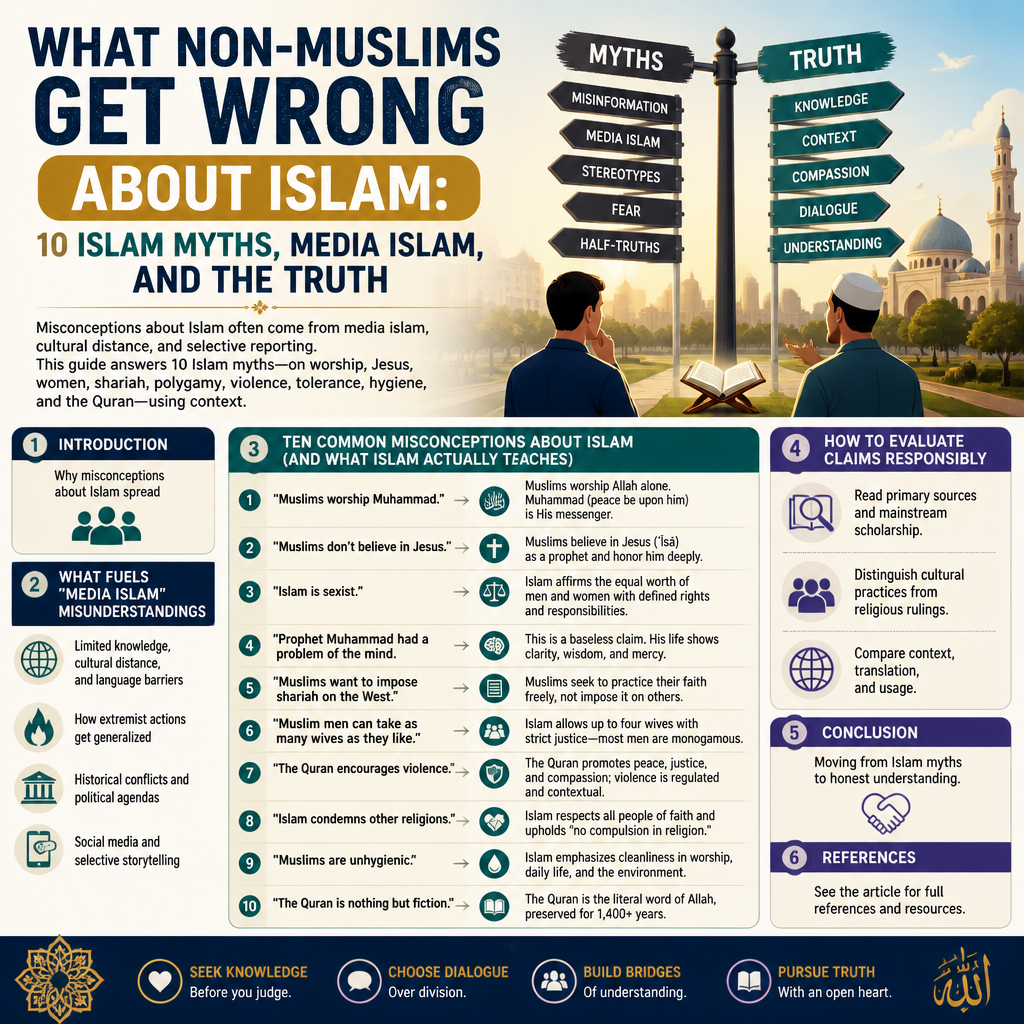
3) Ten common misconceptions about Islam (and what Islam actually teaches)
Below are ten widely repeated islam myths. The goal is not to insult anyone’s background, but to replace assumptions with clarity.
1. “Muslims worship Muhammad.”
This is one of the most persistent misconceptions. In Islamic belief, Muslims worship Allah alone. Prophet Muhammad (peace be upon him) is honored as a prophet—someone sent to deliver God’s message—but not worshiped.
Islam explicitly rejects worship of any person. Muhammad is described as a human messenger whose purpose is guidance. This distinction is central: Islam differentiates between devotion to God and respect for prophets.
2. “Muslims don’t believe in Jesus.”
Islam affirms Jesus (Isa) as the Messiah and the Word of God, and it acknowledges his miraculous birth. Muslims also believe in his status as a prophet with divine message.
The difference is doctrinal: Muslims do not accept that Jesus is God incarnate. Islam teaches God’s oneness (tawhid) and therefore rejects worship of anyone besides God. So, while Muslims absolutely honor Jesus, they interpret his role differently than Christians do.
3. “Islam is sexist.”
Claims of sexism often mix up two issues: religious principles and cultural behavior. Islamic scripture emphasizes moral accountability for all people and establishes principles of justice and dignity.
Islam also grants women significant rights—rights related to inheritance, marriage, consent, and education. At the same time, modest dress is often misunderstood. Modesty is commonly treated in Islam as a form of respect and spiritual discipline, not as a symbol of inferiority. Different regions practice modesty differently, which can create confusion when people generalize from culture rather than doctrine.
It’s also worth noting that many non-Muslims have never actually read Islam’s core teachings on family and ethics; they’ve only seen controversial practices out of context.
4. “Prophet Muhammad had a problem of the mind.”
Another myth: that Muhammad’s revelations were the result of illness or “mental problems.” This accusation is usually presented without historical evidence, and it overlooks Muhammad’s role as a trusted leader before prophethood, the consistency of his message, and the transformation it produced in the communities that followed him.
Islam’s view is that revelation came from God. Muhammad is portrayed as truthful and trustworthy throughout his life. Any serious evaluation would require dealing with the historical record respectfully—rather than relying on psychological speculation.
5. “Muslims want to impose shariah on the West.”
First, it helps to clarify terms. Shariah is an Arabic concept often translated as “Islamic law,” but in practice it includes guidance for worship, ethics, family life, and legal principles shaped by Islamic jurisprudence.
The myth frames shariah as a single political program designed for forced takeover. Most Muslims who live in non-Muslim countries are focused on living their faith responsibly and integrating peacefully with the society around them.
Where Islamic law is discussed publicly, scholars also distinguish between different legal frameworks: majority-minority contexts, citizenship, and human rights. In other words, shariah is not simply “a switch” that could be imposed overnight by any group.
6. “Muslim men can take as many wives as they like.”
Islam addresses marriage and family structure with rules meant to restrain injustice. Polygamy—specifically having up to four wives—is not an “open license” but a tightly regulated allowance.
Classical rules require fairness and responsibility. If fairness cannot be maintained, then marriage to more wives is not permitted. In modern life, polygamy is relatively uncommon in many Muslim-majority contexts, and cultural practices vary widely.
So the real issue isn’t whether Islam includes a rule—it does. The myth is that Muslims “can” do it without restriction or obligation. The scripture and legal tradition treat it as constrained, accountable, and not a default lifestyle choice.
7. “The Quran encourages violence.”
This claim often comes from selective reading. The Quran addresses conflict in a historical context of warfare and defense, but it also sets strict ethical boundaries.
Islamic scripture distinguishes between aggression and defense, and Islamic jurisprudence includes rules that limit harm and require justice. The myth collapses the complexity of these distinctions into a single slogan.
A responsible reading pays attention to context: what verse is being discussed, what situation it addressed, and what principles the Quran repeatedly emphasizes—such as mercy, restraint, and the sanctity of life.
8. “Islam condemns other religions.”
Many people encounter Quranic language referring to belief and disbelief and interpret it as hatred toward people. But theology is not always the same thing as personal hostility. Islam also encourages truth-seeking and moral responsibility.
It’s true that the Quran discusses ultimate spiritual truth. Yet spiritual disagreement is different from endorsing violence or oppression. Muslims are taught to live with justice and moral conduct toward people, even when beliefs differ.
When non-Muslims see the word “disbelievers” in translation, it’s often missing nuance. In many verses, the term relates to accountability and rejection of truth—not permission to harm others.
9. “Muslims are unhygienic.”

This myth is easily disproven by observing Islamic practices. Islam includes systematic teachings about cleanliness. Many Muslims perform ritual washing before prayer—known as wudu—which includes washing the hands, mouth, nose, face, arms, and feet.
Islam also encourages cleanliness in daily life: keeping garments clean, maintaining hygiene, and caring for physical and spiritual purity. Hygiene is not an afterthought in Islam; it is integrated into worship.
Misconceptions may arise when outsiders judge cleanliness in a specific local area, not the religious teaching itself. Cultural conditions vary; religion’s guidance does not.
10. “The Quran is nothing but fiction.”
This is less a factual claim and more a conclusion people reach without studying the text or its history. The Quran presents itself as divine revelation, and Muslims believe it reflects truth and guidance.
From an academic angle, claims about the Quran being “fiction” should be evaluated carefully. Are critics engaging with the text, its composition, and its historical transmission? Are they understanding Arabic language features and interpretive traditions?
A fair assessment compares what is claimed with evidence and scholarship. Blanket dismissal without engagement is not analysis—it’s prejudice in the form of certainty.
4) How to evaluate claims responsibly
If you want to move beyond misconceptions about islam, here are practical steps you can apply to any contentious topic—Islam included.
- Read primary sources (or credible translations) instead of relying on summaries alone. If you don’t read Arabic, look for translations with explanations.
- Distinguish doctrine from culture. A cultural practice in one country is not automatically a required religious ruling.
- Check context and translation. One verse or one phrase can be misunderstood without the surrounding passage and historical situation.
- Use mainstream scholarship. Reputable scholars—Muslim and non-Muslim—often provide different lenses than internet commentators.
- Ask who benefits from the claim. Some narratives are designed to inflame, not inform.
5) Conclusion: Moving from Islam myths to honest understanding
Most people don’t wake up wanting to misunderstand Islam. Misconceptions spread because media Islam rewards shortcuts: sensational stories over careful study, slogans over context, and generalizations over human complexity.
When you remove those shortcuts, the picture changes. You discover that Islam is a religious tradition with a full ethical framework, a rich scripture, and a wide variety of lived experiences. And you also discover something else: many common claims are less about truth and more about repetition.
Honest understanding doesn’t require pretending there aren’t Muslims with flaws or disagreement within communities. It requires the willingness to ask for evidence, to read responsibly, and to separate scripture and scholarship from the loudest headlines.
Reference
Studio Arabiya, “10 Misconceptions About Islam”