Opening Question: The Stakes of “What if god exists?”
It’s easy to treat the question “what if god exists” as an abstract debate—something for philosophers, theologians, or late-night internet arguments. But the question has a strange power because it forces a person to confront possibility, uncertainty, and meaning. It asks: if there is more to reality than we currently believe, what would that change?
“What if you’re wrong about God?” isn’t only a tactic for converting skeptics. It can also be a mirror for believers who know, deep down, that their faith could be shallow, performative, or fearful. Under uncertainty, the best we can do is not pretend we have perfect evidence—we can decide responsibly and aim at what is most coherent and loving.
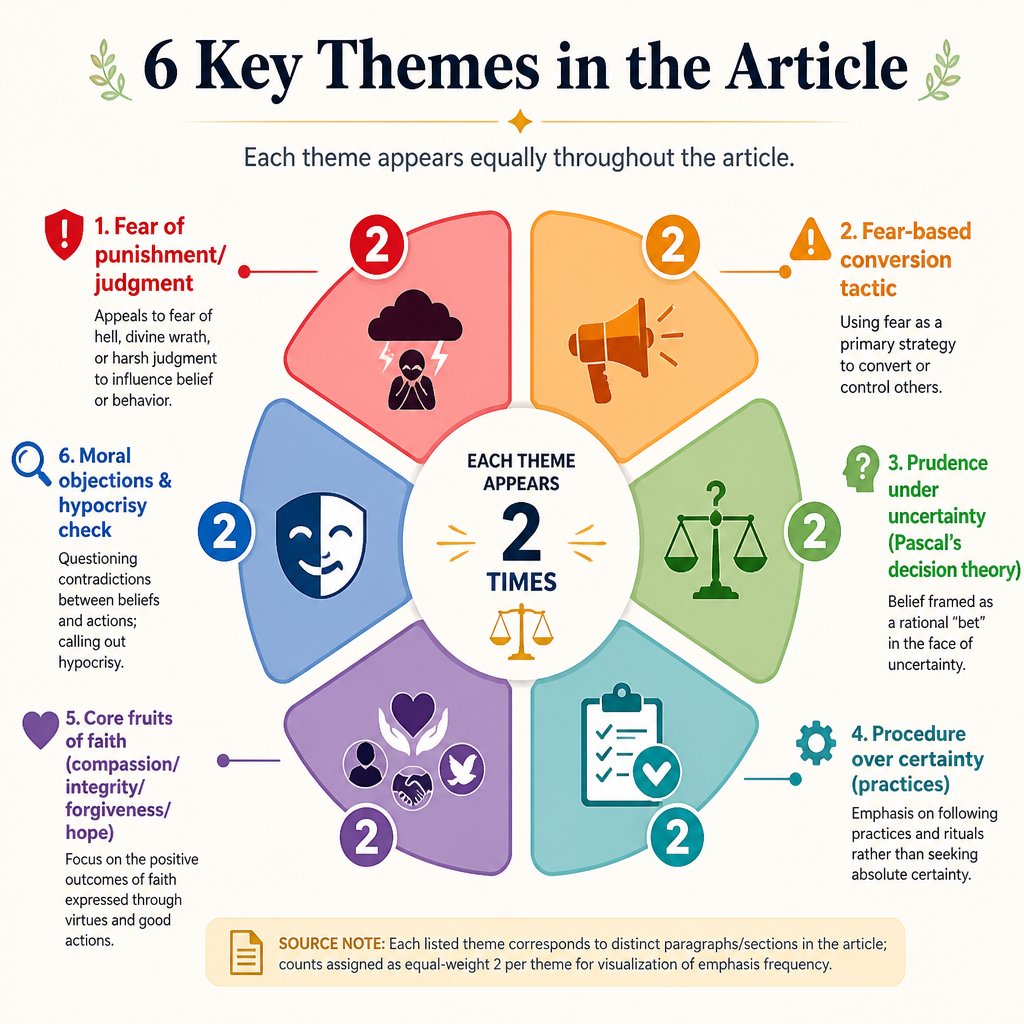
Reframing the Fear: From terror to reflective belief reflection
Many people associate religion with fear: fear of punishment, fear of judgment, fear of being “on the wrong side.” But a more mature question sounds different: What if there is a God, and what kind of person would love look like in that case?
This is where belief reflection matters. Instead of asking only, “Am I right?” consider also, “Am I becoming the kind of human I would want to be if truth were kind and real?” In other words, the aim is not to win an argument—it’s to align your heart with goodness you can recognize, even before full certainty arrives.
Pascal’s Wager, Explained Clearly (and What It Isn’t)
One of the most commonly discussed responses to what if god exists is Pascal’s Wager. But it’s often misunderstood. Let’s clarify what it is—and what it is not.
The core idea of a decision under uncertainty
Pascal invites you to imagine a choice where:
- You can’t verify the truth with certainty right now.
- You can’t escape the question because your worldview influences your actions.
- The consequences are asymmetrical if God exists (infinite or ultimate stakes).
So the reasoning isn’t: “Believe because it’s easy.” It’s: “When you face uncertainty with high stakes, prudence matters.”
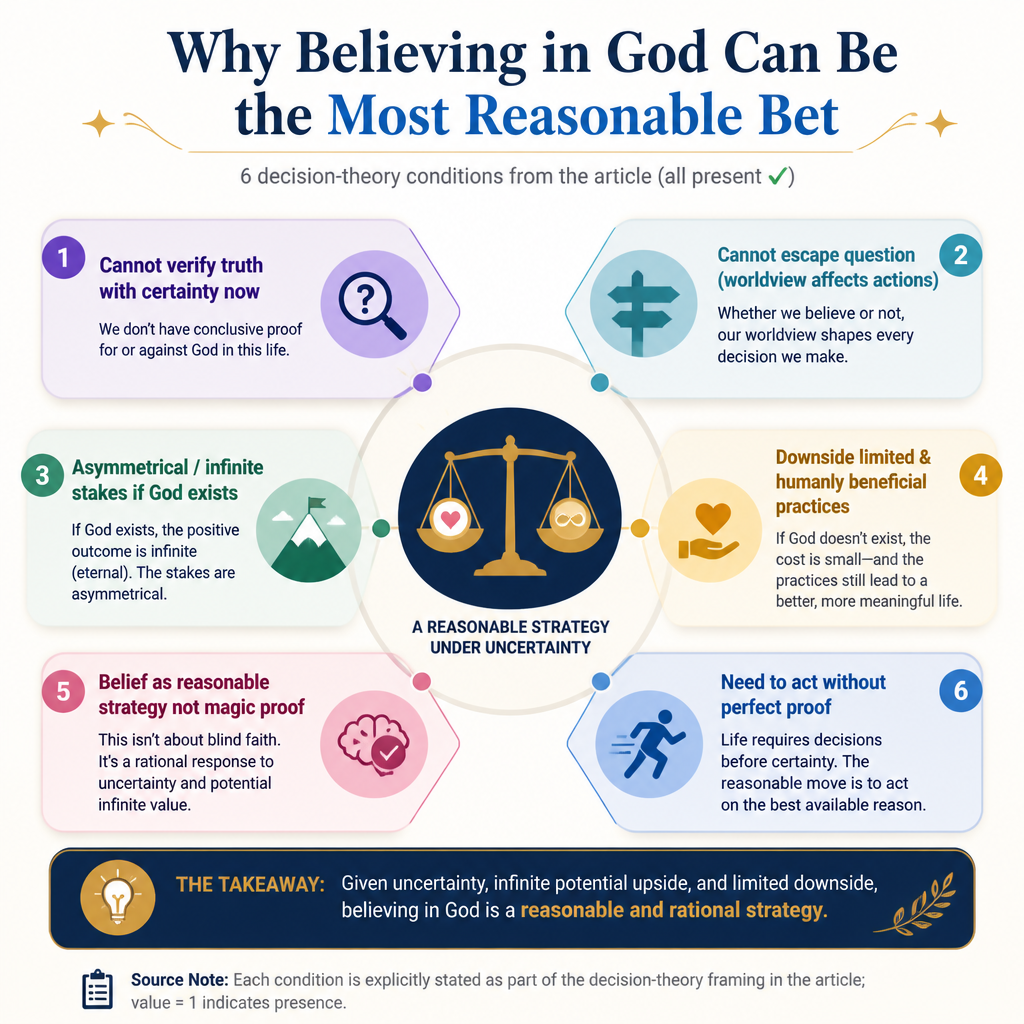
Decision-theory framing: infinite upside, minimal downside
In many presentations, Pascal’s argument uses decision theory: even if the probability you assign to God is not high, the payoff of being right could be infinitely better than the payoff of being wrong. Meanwhile, the “downside” of living a faithful life—practicing humility, service, repentance, and moral discipline—may be limited and humanly beneficial.
This doesn’t magically produce truth. It produces a kind of reasonable strategy under uncertainty.
Why humans can’t wait for perfect proof
Notice a practical point: human life is full of commitments made without mathematical certainty. You invest in relationships, careers, and responsibilities without guaranteed outcomes. If we waited for perfect proof before acting, we would freeze. Pascal’s deeper insight is that belief and life are intertwined—your “bet” shows up in your behavior.
Addressing Common Objections
If you’re going to take what if god exists seriously, you also have to take objections seriously. A faithful approach doesn’t fear questions; it answers them honestly.
The intellectualist objection: “Can you force yourself to believe?”
One classic critique is: you can’t simply decide to believe the way you decide to pick a shirt. Belief isn’t always under direct control.
That’s a fair concern. But Pascal’s wager (as modern discussions often emphasize) can be read more carefully: you may not be able to flip belief like a light switch, but you can choose practices that cultivate belief—prayer, reading, attending with humility, moral repair, and honest conversation. In that sense, the “wager” can be a procedure, not a button.
Belief may be formed through actions that shape attention, character, and openness to reality.
The many-gods objection: “What if the ‘right’ God is different?”
Another challenge is the pluralism problem: if you “bet” on God, which God? Different religions and sects interpret truth differently. If you choose the wrong tradition, your wager might backfire.
Some replies suggest that the practical move is not “choose a random label,” but “pursue the most loving and sincere form of faith you can.” Pascal’s framework can be adapted into run-off decision procedures: you consider competing possibilities and adopt a posture of sincerity and moral seriousness rather than a smug certainty.
The evidentialist objection: “Is prudential belief reasoning morally wrong?”
Critics also argue that it may be immoral to believe for the sake of outcomes rather than evidence. If truth is sacred, shouldn’t belief track reality, not advantage?
Here the most helpful distinction is between believing as a strategy and living as a seeker. Even if we admit we lack perfect evidence, we can still orient our lives toward what we genuinely find trustworthy and morally good. In that framing, prudential reasoning is not a betrayal of truth—it’s a recognition that humans must act before certainty arrives.
Moreover, even if God were absent, many faithful practices build character: forgiveness, discipline, generosity, restraint, and community.
The paradox objection and the limits of ‘wager’ logic
There’s also a deeper logical issue: if there are infinitely many versions of God or if “infinite utility” creates weird outcomes, the decision matrix can become messy. In other words, the wager isn’t a perfect mathematical proof.
But notice again: Pascal’s aim is prudential rationality, not a courtroom standard of proof. The wager is best treated as a nudge: if ultimate stakes are imaginable and your best “bet” is a life of love and integrity, then your conscience may invite you to move toward that direction.
Moving Beyond Ritual: What if God exists—and God cares about love?
Suppose what if god exists is true. What kind of God would that be?
Even many believers instinctively reject a caricature of God as a cosmic accountant who only tallies rituals. If God is real, it’s reasonable to expect that God’s priorities would align with goodness itself—love, compassion, justice, and mercy.
Moral authenticity over fear-based compliance
Here’s a painful possibility: some people follow religion primarily to avoid punishment or gain social status. If God exists, such motivations may be less meaningful than people assume. A faith that produces hypocrisy, cruelty, or contempt for others doesn’t look like the fruit of divine love.
Belief reflection asks: What is my faith doing to me? Is it making me more patient? More honest? More able to forgive? Or is it turning me into a judge who uses God as a weapon?
Critiquing hypocrisy and cruelty in religion
It’s not hard to find examples of religious communities where people behave in ways that contradict the ethics they claim to cherish. In such moments, the question isn’t just, “Is religion true?” It’s also, “Does this reflect the kind of heart a real God would want?”
If God exists and cares about love, then hypocrisy is not a small issue. It’s a sign that faith may have been distorted into control.
Genuine goodness as the heart of faith
What if God exists—and God values love over mere religious branding? Then goodness would not be a costume worn for public approval. It would be an internal transformation that shows up in actions: mercy to the weak, truthfulness with the powerful, humility in disagreement, and patience with human frailty.
In that case, the question becomes less about whether you can produce the “right” argument and more about whether your life is becoming more loving.
If God Exists, What Would That Mean for Daily Life?
Belief is never only a belief. It shapes how you spend your time, treat other people, and respond when life hurts.
How belief changes compassion, integrity, and forgiveness
If God exists, the practical effect of faith can include:
- Compassion: You see others as more than obstacles or enemies.
- Integrity: You tell the truth even when it costs you.
- Forgiveness: You resist the addictive desire to punish.
- Hope: You can endure suffering without concluding life is pointless.
These are not guarantees—faith can be misused. But they are the kinds of fruits many faith traditions aim to cultivate.
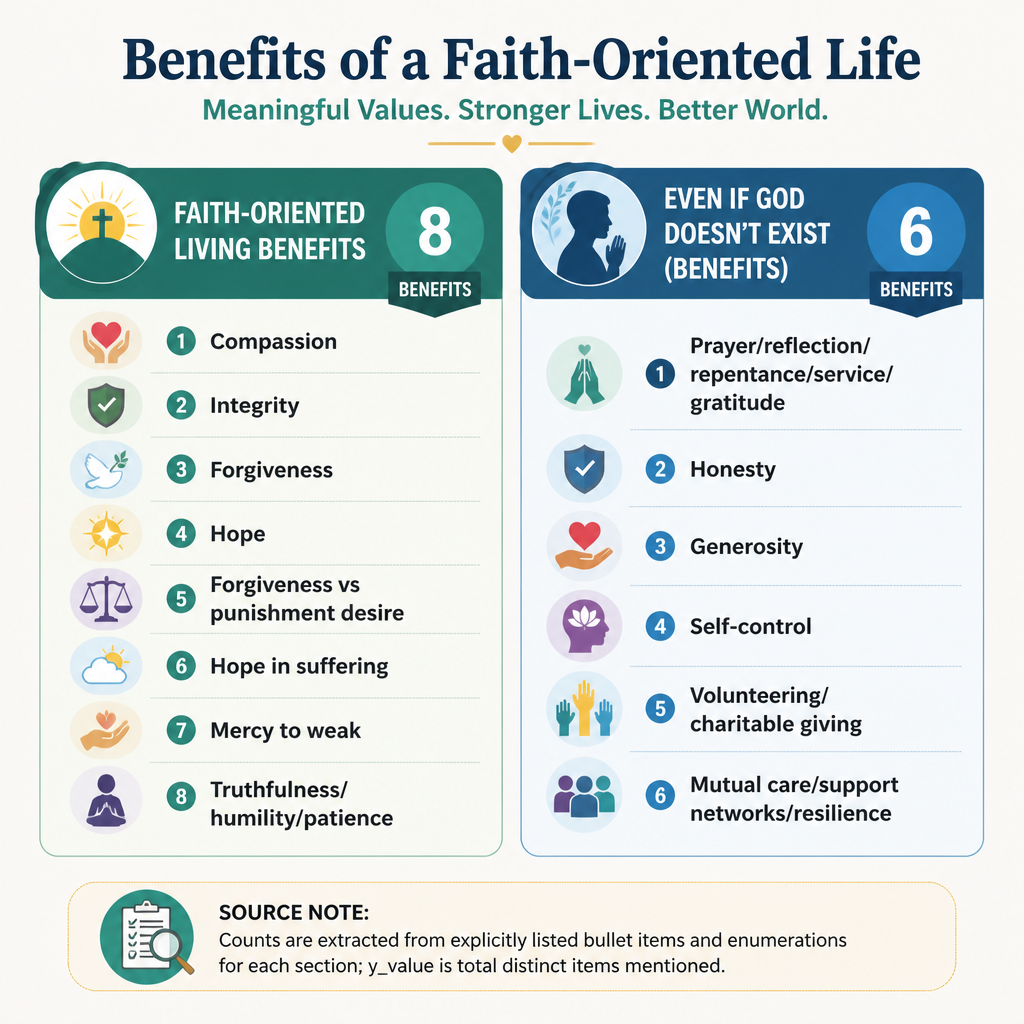
How to live as though “goodness matters” regardless of labels
Even if you’re unsure about theology, you can still practice goodness. You can treat people with dignity. You can avoid scapegoating. You can examine your heart when you’re tempted to be cruel.
In other words, what if god exists doesn’t only ask you to hold a concept. It asks you to hold love as a serious orientation.
If God Doesn’t Exist, What Do You Still Gain?
Now consider the honest counterpart: what if God doesn’t exist?
Even then, many benefits of faith-oriented living can still be real—because they are often human and social goods.
Shared moral practice and character formation
Practices like prayer, reflection, repentance, service, and gratitude can form a person’s character. You may not need metaphysics to benefit from virtues such as honesty, generosity, and self-control.
Community benefits of religious practice (even when uncertain)
Faith communities—at their best—provide support networks. They can encourage volunteering, charitable giving, and mutual care. Even if you remain uncertain about God’s existence, participating in healthy community life can reduce loneliness and strengthen resilience.
So belief reflection has another dimension: you can look for moral and psychological fruit, not just metaphysical claims.
A Practical Path: How to decide responsibly
If you want a decision procedure rather than an argument, here is a practical path you can follow. This is not a shortcut to certainty—it’s a responsible way to move forward with integrity.
Reflection practices, reading, conversation, and honest self-examination
- Reflect: Ask yourself what “God” even means to you, and whether your current beliefs are shaped by evidence or by emotion.
- Read: Explore both critical and constructive arguments. Don’t only consume content that confirms your starting point.
- Talk: Speak with people who are sincere—people whose faith produces compassion rather than hostility.
- Examine your motives: Are you seeking truth, or are you seeking comfort and control?
“Run the procedure” ideas: cultivate belief-through-action
Instead of trying to force belief overnight, consider cultivating the conditions under which belief can grow:
- Try a season of prayer or meditation with honesty: “If you are real, help me seek you without pretending.”
- Practice service without performance. Let goodness stand on its own.
- Observe how your heart changes over time—do you become more loving, or more defensive?
- Be willing to update your worldview as you learn.
This approach respects the limits of human psychology while still taking what if god exists seriously.
Conclusion: Choose the most loving, most coherent option under uncertainty
“What if you’re wrong about God?” ultimately isn’t only about winning a philosophical contest. It’s about how you respond to uncertainty with humility rather than arrogance.
If God exists, a life oriented toward love—truth, mercy, integrity, and repentance—makes sense. If God doesn’t exist, you still benefit from practicing those virtues in community. Either way, the most coherent option is often the one that produces the healthiest kind of human life.
So let your belief reflection be courageous and honest. Don’t reduce faith to fear. Don’t reduce doubt to cynicism. Let the question shape you into someone whose goodness is not a performance, but a sincere response to reality.
References
- Quora: “What if you’re wrong, and God does exist?” https://www.quora.com/What-if-youre-wrong-and-God-does-exist
- Navigating by Faith: “Understanding Pascal’s Wager” https://navigatingbyfaith.com/2025/11/08/understanding-pascals-wager/
- Internet Encyclopedia of Philosophy: “Pascal’s Wager about God” https://iep.utm.edu/pasc-wag/