What Drives Us to Believe—or Not Believe?
Why do some people believe in God while others don’t? And why does belief rise or fall across cultures and historical periods? The short answer is that belief is rarely the result of a single factor. “Why people believe in god” (or stop believing) is usually a combination of how the mind works, what people are motivated by, and how societies organize trust, morality, and meaning.
In this article, we’ll connect these layers—cognition, motivation, and social life—then address the most common atheism reasons people give today. We’ll also explore why many people who leave religion don’t simply flip a switch, but instead move through a process of deconstruction, lingering “religious residue,” and eventual reconstruction of meaning.
1) The Puzzle of Belief in God: Why Belief Varies Across People and Time
If belief were purely “logical,” we might expect smarter people—or people with the same evidence—making the same conclusion. If it were purely “emotional,” we might expect it to track mostly temperament. Yet real life shows something more complex: people with similar information can diverge, and people with different temperaments can still arrive at shared faith.
Belief also changes over history. Religiosity tends to be higher where people face threats that are hard to control and where communities rely on strong moral enforcement. It tends to decline in wealthy, secure societies—though not always in a simple “more safety equals less belief” way.
So, the question becomes: what human pressures—internal and external—push people toward faith or toward atheism?
2) Big-Picture Causes: Ultimate vs. Proximate Explanations for Faith and Atheism
Psychologists and researchers often distinguish between:
- Ultimate “why” (evolutionary or long-term explanations): what pressures shaped human tendencies over time.
- Proximate “why” (immediate psychological explanations): how the mind and brain generate beliefs now.
Both levels matter. Humans may be naturally predisposed to interpret the world in agency-and-purpose terms (ultimate/proximate roots), but individual experiences (crises, trauma, community, doctrine, relationships) determine which beliefs take hold and which collapse.
3) Why People Believe in God (Cognitive “Why”)
Even before emotions or social forces enter the picture, the human mind has built-in habits that make belief in God feel meaningful, plausible, or even obvious.
3.1 Pattern-seeking and purpose: minds infer design and agency
One reason people believe in God is that humans are pattern detectors. When we notice events—especially meaningful ones—we naturally ask: What caused this? Who intended this? What is it for?
Evolutionary psychologists describe this as a kind of over-sensitive agency detection. When you misread agency (thinking there is a threat when there isn’t), the cost may be tolerable compared with missing real threats. The same tendency—interpreting signs as intentional—can support religious explanations: storms, coincidences, moral order, life events, and prayers that “seem answered.”
When a person experiences order or “fit” in the world, the mind can interpret that fit as evidence of purpose.
3.2 Memory for counterintuitive ideas: supernatural claims stick
Religious ideas often involve what researchers call counterintuitive concepts (e.g., “a talking burning bush,” “a spirit in a body,” “a soul surviving death”). Interestingly, humans tend to remember and transmit stories that are memorable and slightly surprising—especially when they include minimal “mental friction.”
That doesn’t mean religious belief is automatically true. But it does suggest why, once introduced, spiritual concepts can persist and become culturally sticky.
3.3 “Theory of mind” and the mind’s social circuitry
Another cognitive driver is theory of mind—our ability to model other minds. We effortlessly attribute intentions and feelings to people. In religious contexts, God can function as the ultimate “mind” who observes, knows, and responds.
So belief can feel natural because it extends an already-developed mental ability: thinking in terms of persons and intentions.
4) Faith Motivations (Psychological “Why”)
Even if the mind can form supernatural hypotheses, why do those hypotheses become emotionally compelling? This is where faith motivations come in.
4.1 Motivation under uncertainty: isolation, death salience, lack of control
Belief often becomes stronger when life becomes harder to predict or control. Research and cultural observations frequently show heightened religiosity during:
- isolation (needing an ever-present companion or moral witness),
- death salience (seeking meaning beyond the end of life),
- uncertainty (wanting a reliable order),
- crisis (searching for comfort, protection, or guidance).
In these moments, belief can function like a cognitive anchor: it offers a story that organizes fear, risk, and hope.
4.2 Emotional and motivational differences: analytical vs. emotionally resonant styles
People differ in cognitive style and emotional resonance. Some individuals are drawn to religion through its emotional texture—prayer, awe, repentance, gratitude, ritual rhythm. Others are drawn through moral community, identity, or intellectual coherence. Still others experience the same ideas as emotionally false or personally unsafe.
Importantly, differences in belief aren’t necessarily evidence that one side is “irrational.” They may reflect differing weights given to different kinds of evidence: intellectual arguments, lived experience, emotional intuition, moral testimony, and community formation.
4.3 Comfort and moral order: belief as an organizing framework
Many people believe because religion provides a structured way to interpret life:
- Why suffering happens (or how to endure it)
- What a “good life” looks like
- How to reconcile failure, guilt, forgiveness, and redemption
- Why morality matters even when nobody is watching
In this view, God is not only a hypothesis about reality; God is also a framework for meaning and ethical living.
5) Social Drivers: Why Religion Scales—and Why It Declines
Religion also spreads because it does something powerful at the social level: it can coordinate trust and cooperation.
5.1 Agriculture, larger anonymous societies, and “watchful gods” for cooperation
One influential argument is that when early societies grew beyond close-knit kin groups, social life required new enforcement mechanisms. If you can’t rely on reputation spreading through your small community, you need other ways to promote fairness and discourage cheating.
Belief in “watchful gods” can act as a moral surveillance system: the idea that someone sees what you do—even when nobody human does.
This can increase prosocial behavior, reduce opportunism, and strengthen norms. In economic games and behavioral studies, activating God concepts has sometimes increased generosity toward strangers.
5.2 Safety nets and wealth: religiosity tends to drop where existential threats feel managed
Researchers frequently observe that religiosity is higher where existential threats feel harder to manage and where communities lack strong institutional support. Where families and governments reliably protect people, the perceived need for supernatural protection or intervention may decrease.
That said, belief doesn’t disappear automatically in wealthy contexts. Some people continue to value religion for meaning, ritual, identity, and moral formation.
5.3 Secular substitutes: when communities replace some functions of religion
As societies change, people may still seek the psychological functions religion offered: purpose, belonging, moral grounding, and coping with death. Some replace those functions with:
- community secular ethics
- spiritual-but-not-religious practices
- therapy and wellness cultures
- personal meaning projects
So a decline in institutional religion does not necessarily mean the decline of all “belief-like” functions.
6) Why Atheism: The Main Atheism Reasons People Give Today
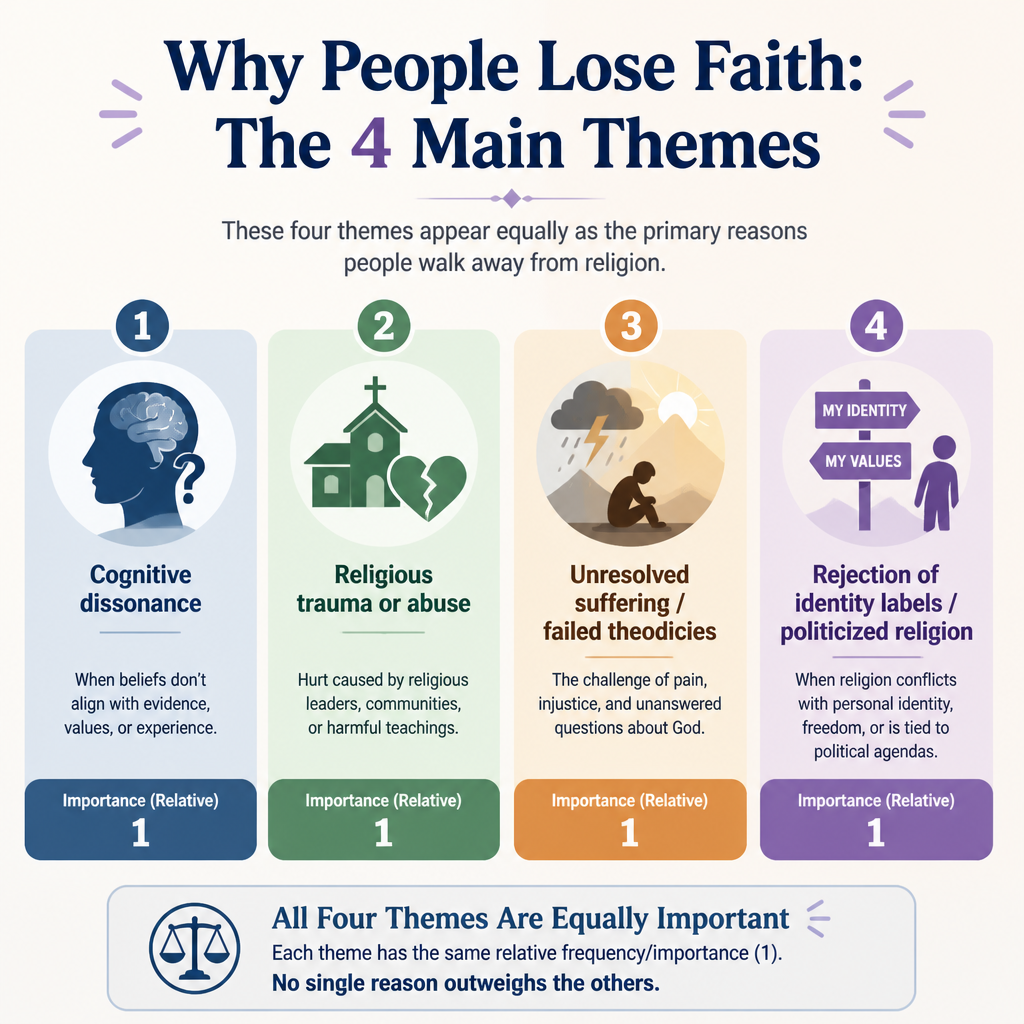
Atheism has many forms—philosophical atheism, secular humanism, agnosticism that never hardens into belief, or disaffiliation after leaving religion. But the atheism reasons people cite often cluster into a few themes.
6.1 Cognitive dissonance and outgrowing incompatible doctrines
One of the most common reasons people stop believing is cognitive dissonance. When a person’s lived experience or moral understanding conflicts with doctrine, they may begin to feel that “belief” requires emotional or intellectual sacrifice.
Sometimes the conflict is about ethics (how to treat others, sex, power, justice). Sometimes it’s about science and historical claims. Either way, the mismatch grows until the person can’t keep both realities inside their mind.
6.2 Religious trauma or abuse
For many, nonbelief follows direct experience of religious harm: abuse, manipulation, coercion, or unsafe power dynamics. Even when the theology is not explicitly attacked, the institutional environment can make God feel unavailable—or make faith feel dangerous.
In these cases, leaving isn’t simply “thinking differently.” It’s also a safety response and an attempt to heal.
6.3 Unresolved suffering and failed explanations
Some people try to hold onto belief through suffering, but theodicies (explanations of why a good God allows pain) fail to satisfy. If a religious framework can’t coherently address suffering—or if prayers seem unanswered—belief may erode.
Notably, people often struggle most with the gap between:
- claims of divine goodness
- observations of injustice
- the emotional experience of loss
6.4 Rejection of identity labels and politicized religion
Another factor is that some religious labels become politicized. When a community’s public behavior seems to contradict a person’s moral instincts, the person may reject the label even if they once found spiritual comfort in the ideas.
For some, it’s not only “God vs. no God.” It’s “belonging and integrity vs. tribal identity.”
7) The Leaving Process: Deconstruction, Reconstruction, and Deidentification
When people leave religion, it rarely happens in a single moment. Many go through:
7.1 Deconstruction: questioning beliefs and identity
During deconstruction, people examine claims they once assumed were true. They may experience intense emotions—guilt, grief, fear, relief. Some feel as though they are losing a part of themselves.
7.2 Religious residue: why belief can fade without disappearing
Even after someone stops believing intellectually, religious habits can remain. This is sometimes called religious residue: the lingering cognitive and moral conditioning (language, expectations, reflexive guilt, prayer habits, moral instincts) that can continue for years.
It’s also why people who leave sometimes describe feeling “in-between”—no longer inside the belief, but not yet free of its echoes.
7.3 Reconstruction: rebuilding meaning and identity post-religion
After leaving, some people reconstruct in a new direction—sometimes returning with a revised faith, and sometimes fully moving into atheism or secular spirituality. Common pathways include:
- redefining identity around values rather than labels
- setting boundaries with religious loved ones
- finding transcendence in nature, relationships, or ethical service
- building community that supports meaning without coercion
8) Persistence and Complexity: Belief Is Neither Purely Irrational Nor Purely Reason-Based
It’s tempting to frame this debate as:
- believers = irrational
- atheists = rational
But real humans use multiple systems at once. Evidence, emotion, social identity, memory, moral intuition, and coping needs all interact. For a believer, faith may be the most coherent meaning-world. For a nonbeliever, disbelief may be the most honest meaning-world.
Both sides may be drawing from different kinds of evidence and different psychological priorities.
That doesn’t settle the truth question. But it does help explain why disagreement can be so persistent—and why respectful conversation matters.
9) Conclusion: Competing Pressures, Shared Human Needs, and Respectful Conversation
So what drives us to believe—or not believe? People move toward faith or atheism because:
- the mind naturally interprets the world through agency, purpose, and memorable stories
- motivation under uncertainty makes spiritual frameworks feel comforting or organizing
- societies use religion (and sometimes replace it) to coordinate moral behavior and belonging
- nonbelief often arises from cognitive dissonance, trauma, unresolved suffering, or politicized identity
- leaving can be gradual, leaving “religious residue,” followed by reconstruction of meaning
When we understand these dynamics, we can move from “Who’s right?” to “What’s happening in people?”—without giving up on the deeper questions.
Respectfully asking why someone believes (or doesn’t) can reveal shared human needs: meaning, safety, belonging, moral clarity, hope, and integrity.
If you’re open to it, consider starting a conversation with a simple prompt: “What was the turning point for you—what made belief feel possible, or impossible?”