What Believers and Doubters Actually Share: Believers vs Atheists Similarities in Values, Compassion, and Justice
1. The real question: not God vs no God, but what people genuinely share
Most arguments about religion end up sounding like a debate between “God” and “no God.” But everyday life rarely runs on slogans. It runs on whether people show up for one another, tell the truth, treat others fairly, and stand by the vulnerable.
That’s why the more honest question is this: What do believers and doubters actually share? Not identical theology—often not even identical metaphysics. But shared moral instincts and shared human hopes.
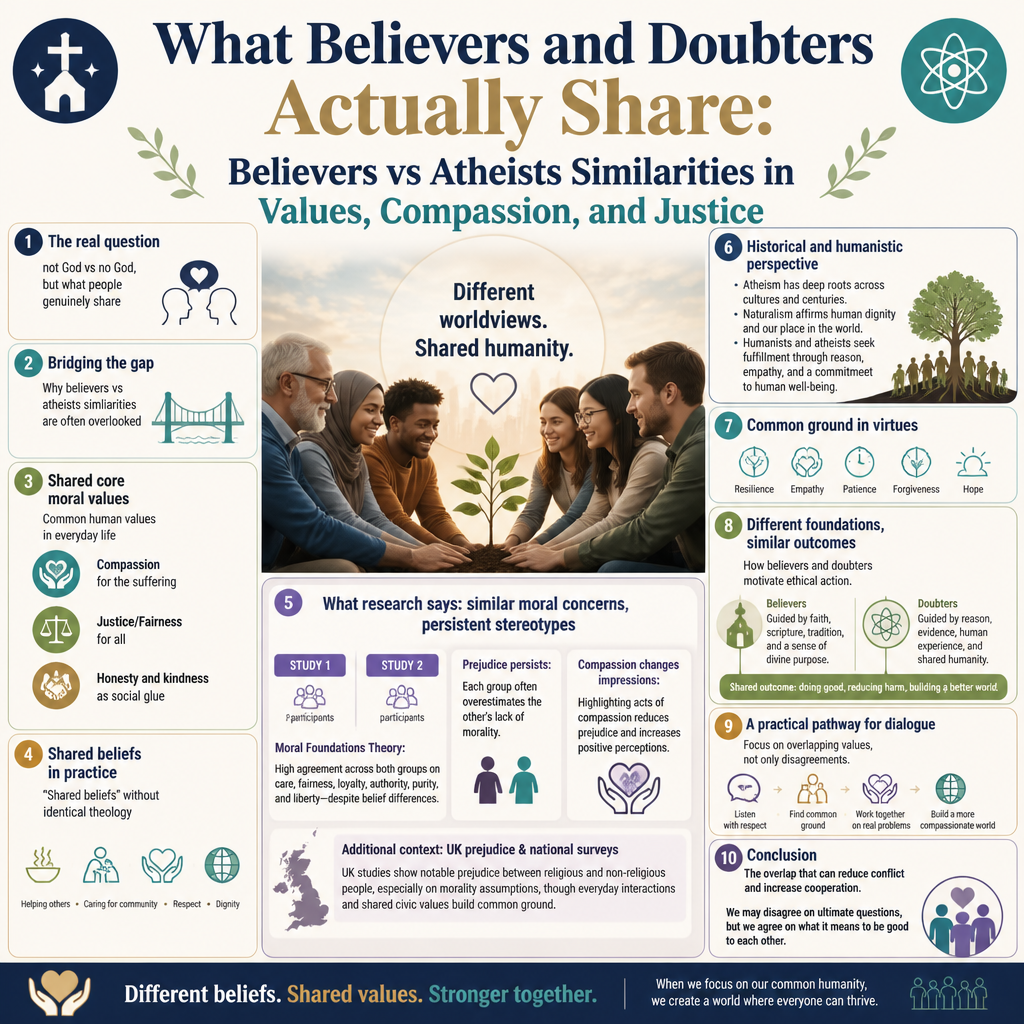
2. Bridging the gap: why believers vs atheists similarities are often overlooked
It’s easy to miss overlap when conversations are framed as conflict. Media stories amplify caricatures: the “angry atheist,” the “judgmental believer.” Meanwhile, many atheists and believers are busy living ordinary virtues—helping family members, protecting children, volunteering, and choosing honesty when it’s costly.
So the gap is less about “what people are capable of” and more about what we assume based on stereotypes and selective exposure. Research even shows that people’s impressions of the other group’s morals can persist despite evidence of similarity.
3. Shared core moral values (common human values in everyday life)
Let’s start with the part that is easiest to observe: common human values. Different foundations can lead to similar outcomes.
Compassion for the suffering
Believers often ground compassion in divine command or the example of spiritual figures. Doubters may ground it in human dignity, empathy, or the recognition that suffering is real and deserves response.
But in practice, the shared behavior looks alike: caring for the sick, helping the poor, comforting grief, and refusing to shrug at cruelty.
Justice and fairness for all
Another point of convergence is justice/fairness—the sense that people should not be treated as disposable, and that wrongdoing should matter.
Whether someone believes justice comes from God or from human obligations, fairness tends to show up in similar ways: equal treatment, anti-bullying, support for a just legal system, and concern for victims.
Honesty and kindness as social glue
Honesty is not just a “religious” trait. Kindness is not just a “secular” trait. Both groups typically share a basic moral expectation: don’t manipulate people, don’t exploit weakness, and don’t use power as if it’s permission to harm.
In daily life, these values are the glue of trust—between friends, spouses, coworkers, neighbors, and strangers.
4. Shared beliefs in practice: “shared beliefs” without identical theology
Here’s a subtle but important distinction. When people talk about “shared beliefs,” they often mean shared doctrines—like the existence of God, the truth of specific scripture, or the nature of salvation.
But there is another kind of “shared belief” that matters just as much: beliefs that show up as shared commitments in life—toward human flourishing, toward moral growth, and toward reducing harm.
So believers and doubters can hold different answers to “ultimate reality” and still converge on “how we should treat people.” That convergence is real—and it’s more common than most debates admit.
5. What research says: similar moral concerns, persistent stereotypes
Research doesn’t just describe opinions; it also reveals how bias forms and why it persists.
Study-based insight: similar core moral values
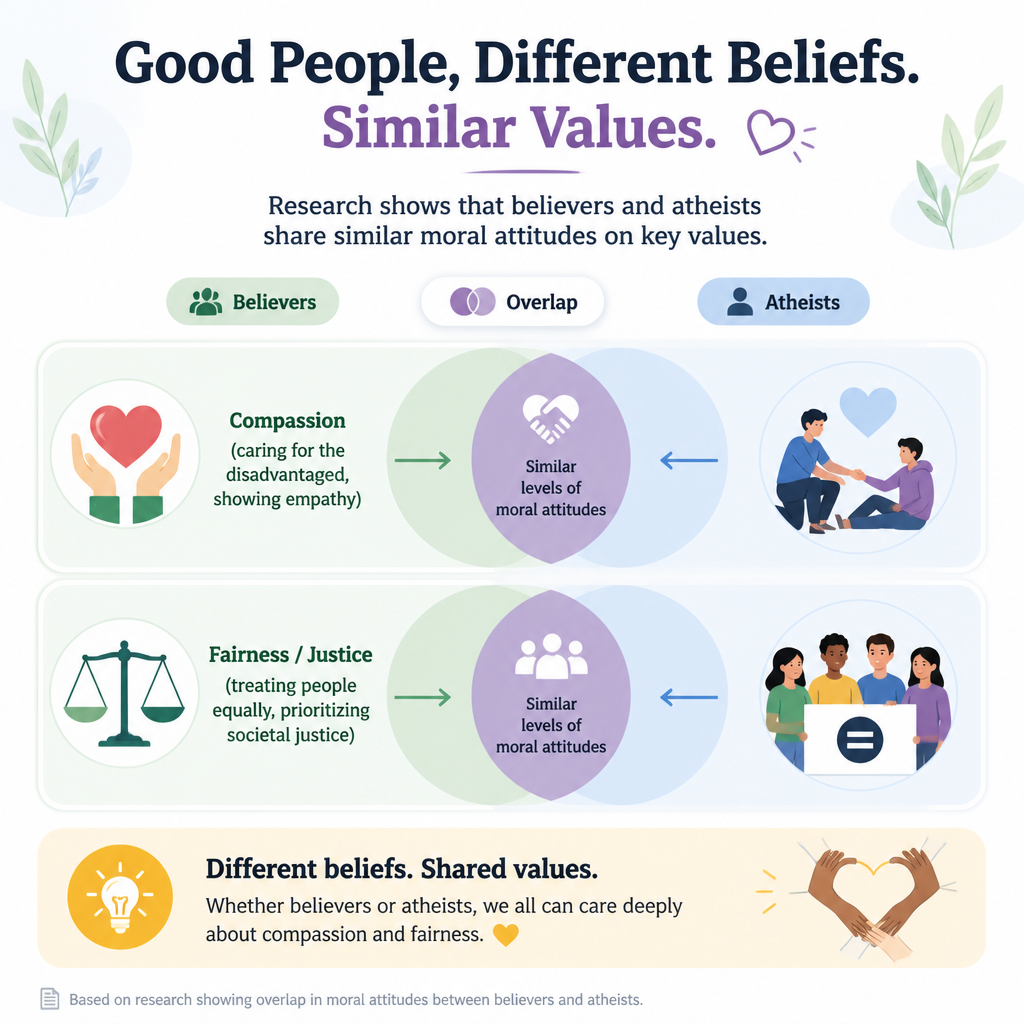
One report drawing on research (including surveys by Ain Simpson and Kimberly Rios) highlights that atheists and Christians often show similar levels of moral attitudes—particularly regarding:
- compassion (caring for the disadvantaged, showing empathy)
- fairness/justice (treating people equally, prioritizing societal justice)
In other words, the stereotype that religion produces morality while atheism produces coldness doesn’t match the data.
But prejudice persists: impressions of the other group’s morals
Even when moral concerns are similar, people can still believe the opposite about the “outgroup.” Why? Because people may project their own moral framework onto their group, while underestimating the outgroup’s priorities.
The result is a culture war dynamic: we misunderstand the other side’s motives, and then we act as if misunderstanding were proof.
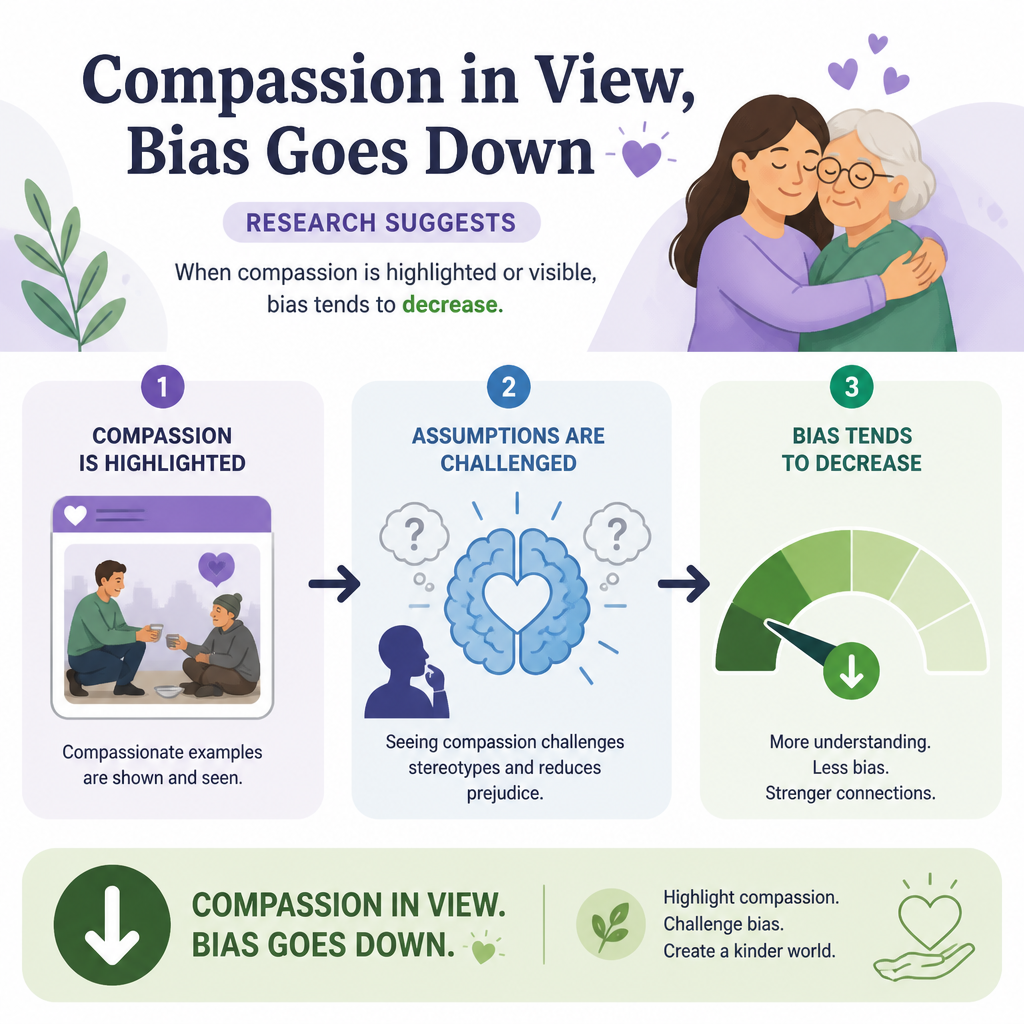
How bias changes when compassion is highlighted
Interestingly, the same research line suggests a practical remedy: when people are shown that atheists (or believers) are compassionate, prejudice tends to drop.
That points to a wider truth: if you want dialogue, don’t start with the argument. Start with the virtues.
Additional context: bias is not limited to one society
Prejudice can exist in multiple directions and in different national contexts, including settings where religion is relatively informal. That means the goal isn’t to “blame one side,” but to recognize a common human weakness: we simplify people into categories.
6. Historical and humanistic perspective: atheism’s long roots and ethical humanism
To understand what “doubters” share, it helps to see atheism and secular ethics as part of a much longer human story—not a recent rebellion against morals.
Atheism has deep historical roots
Across cultures and centuries, nonbelief and skepticism have appeared in many forms. The American Humanist Association emphasizes that atheism isn’t new, and that human doubt about supernatural claims has long accompanied the search for truth.
This matters because it challenges the idea that atheists are simply “angry” or “empty.” Many are ethical thinkers motivated by reality, human dignity, and the desire to live well.
Naturalism and human dignity
Ethical humanism typically argues that we can build meaning and moral responsibility without supernatural assumptions. Instead of commandments from beyond, moral guidance comes from:
- reasoning about consequences
- empathy and shared vulnerability
- experience and social learning
These are not “less moral” tools. They are moral tools.
Humanists and atheists also aim at fulfillment through reason and empathy
In this view, flourishing is still real—just grounded in human life, not afterlife fantasies. The emphasis is often on resilience, patience, forgiveness, and hope—virtues that look familiar to believers.
7. Common ground in virtues: resilience, empathy, patience, forgiveness, hope
One of the simplest ways to find believers vs atheists similarities is to list the virtues most people admire.
- Empathy (feeling with others)
- Resilience (staying steady through hardship)
- Patience (not rushing to cruelty or contempt)
- Forgiveness (breaking cycles of retaliation)
- Hope (believing change is possible)
Notice what’s happening. These virtues are not exclusive categories. They are human outcomes—and both believers and doubters can pursue them.
8. Different foundations, similar outcomes: how believers and doubters motivate ethical action
Believers and atheists can motivate moral action differently:
- Believers may act from faith, worship, conscience, and responsibility before God.
- Doubters may act from human responsibility, moral reasoning, empathy, and responsibility to society.
But the practical overlap can be striking. People volunteer for similar reasons: because others matter. People tell the truth for similar reasons: because relationships depend on it. People resist injustice for similar reasons: because harm is harm, regardless of metaphysical framing.
9. A practical pathway for dialogue: focus on overlapping values, not only disagreements
If you want cooperation—and fewer emotional trench wars—try this:
Start with what both sides already do
Instead of leading with “Where do you get morality?” ask: Where does compassion show up in your life? Or: How do you support justice when it costs you something?
Don’t argue from caricatures
Caricatures are seductive because they make debate easy. But they also make peace impossible. Look for real people, real kindness, and real moral seriousness.
Highlight compassion to reduce bias
When you show someone a compassionate example, you challenge their assumptions. Research suggests that bias decreases when compassion becomes visible.
Agree on the shared goal
Even if believers disagree with atheists on ultimate questions, they can often agree on intermediate goals: reducing suffering, protecting families, educating children, and building a more humane community.
10. Conclusion: the overlap that can reduce conflict and increase cooperation
The debate “believers vs atheists” is often treated like a battlefield about doctrines. But the reality is more hopeful: believers and doubters actually share many of the same moral concerns—common human values like compassion and justice, plus overlapping virtues like empathy, resilience, patience, forgiveness, and hope.
Stereotypes persist, and misunderstandings can harden into culture war narratives. Yet when people focus on shared values and compassionate examples, bias drops and dialogue becomes possible.
Because beneath the theological differences, many of us are trying to live decently in the same world—caring about others, wanting fairness, and hoping to make life better.