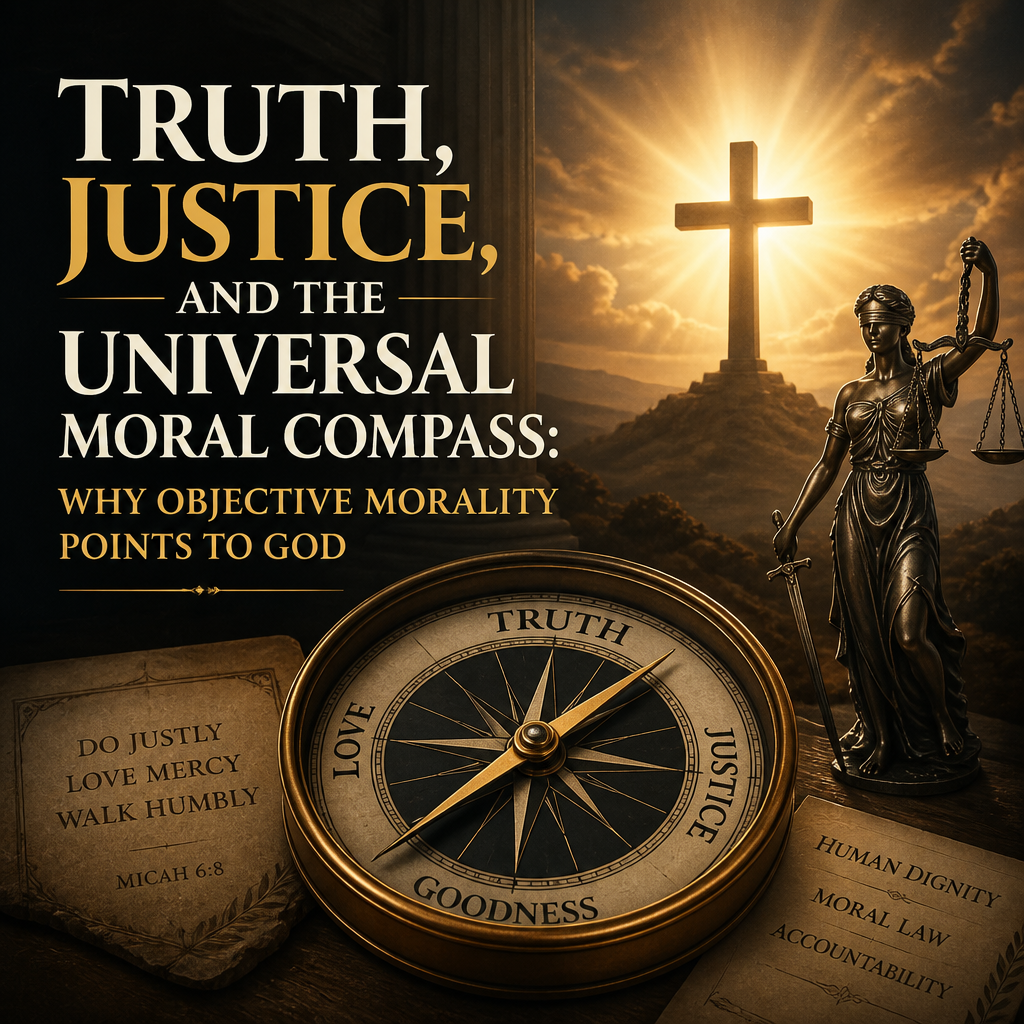
Truth, Justice, and the Universal Moral Compass: Why Objective Morality Points to God
“Good” and “bad” don’t feel like inventions we can revise at will. They feel like discoveries—claims about reality. So what makes moral truth possible at all? In this article, we’ll explore how the idea of objective morality works as a philosophical and practical moral compass, and why moral truth naturally presses toward a transcendent source—often understood as God—rather than toward mere opinion or cultural agreement.
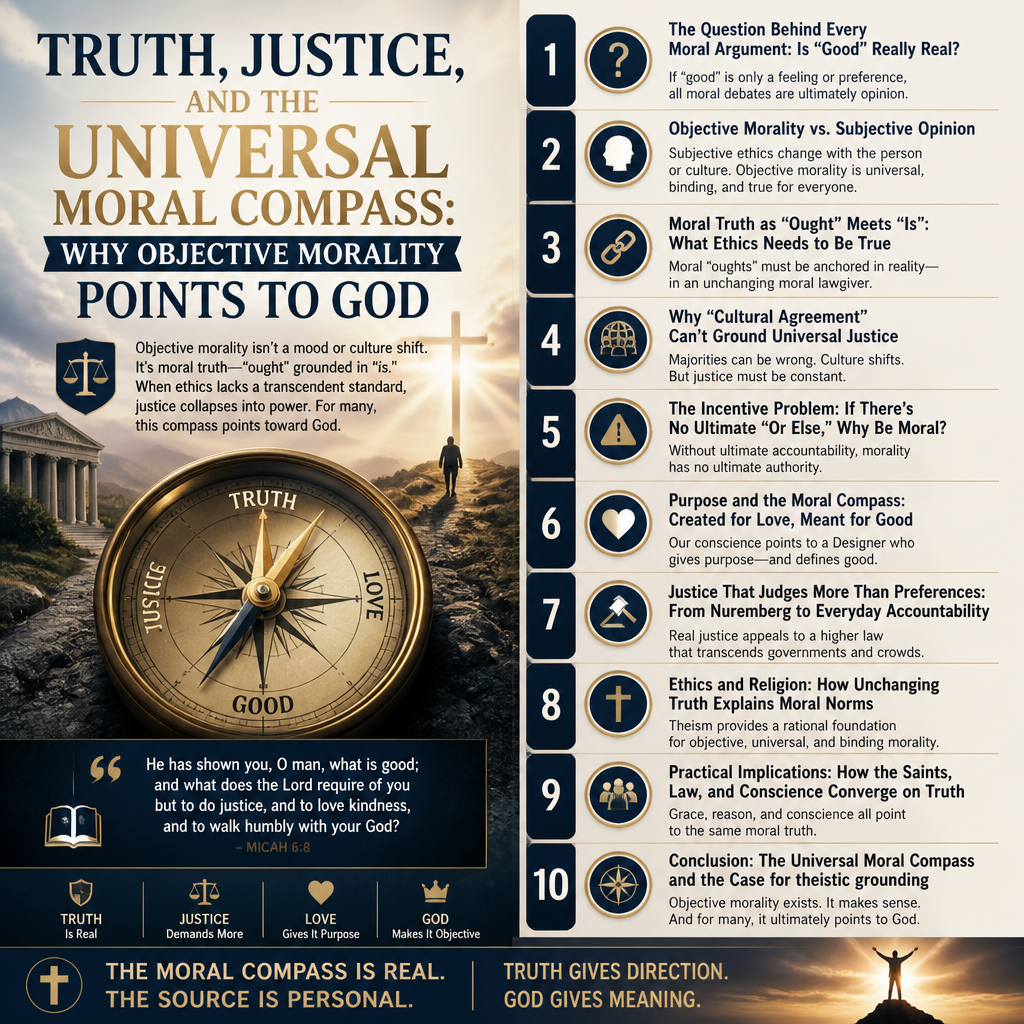
1. The Question Behind Every Moral Argument: Is “Good” Really Real?
Every time someone argues about injustice, tort law, war crimes, racism, or abuse, they implicitly treat morality as more than personal preference. Even when people disagree, they still speak as if:
- Right means something more than “what I happen to like.”
- Wrong means something more than “what my group dislikes.”
- Justice is not just retaliation or convenience, but an alignment with what truly ought to be.
That instinct raises the meta-ethical question: Is moral truth really out there? Or is it only inside us—produced by culture, biology, or emotion?
In other words, is there a universal moral compass, or are moral “directions” just subjective currents?
2. Objective Morality vs. Subjective Opinion
We often hear that morality is “relative,” meaning it varies by:
- individual preference (“you do you”),
- social consensus (“what we agree on”),
- cultural tradition (“that’s just how we do it”).
But notice what happens when we push that view. If morality is merely subjective, then the same act could be both right and wrong depending on perspective. That collapses the point of moral judgment, because moral judgment is supposed to judge, not merely report feelings.
Objective morality, by contrast, claims that some acts really are wrong or right regardless of what people believe, want, or vote.
This isn’t a call to be harsh. It’s a call to be honest about reality: moral truth is either real or it isn’t.
3. Moral Truth as “Ought” Meets “Is”: What Ethics Needs to Be True
To see why this matters, consider the structure of moral language:
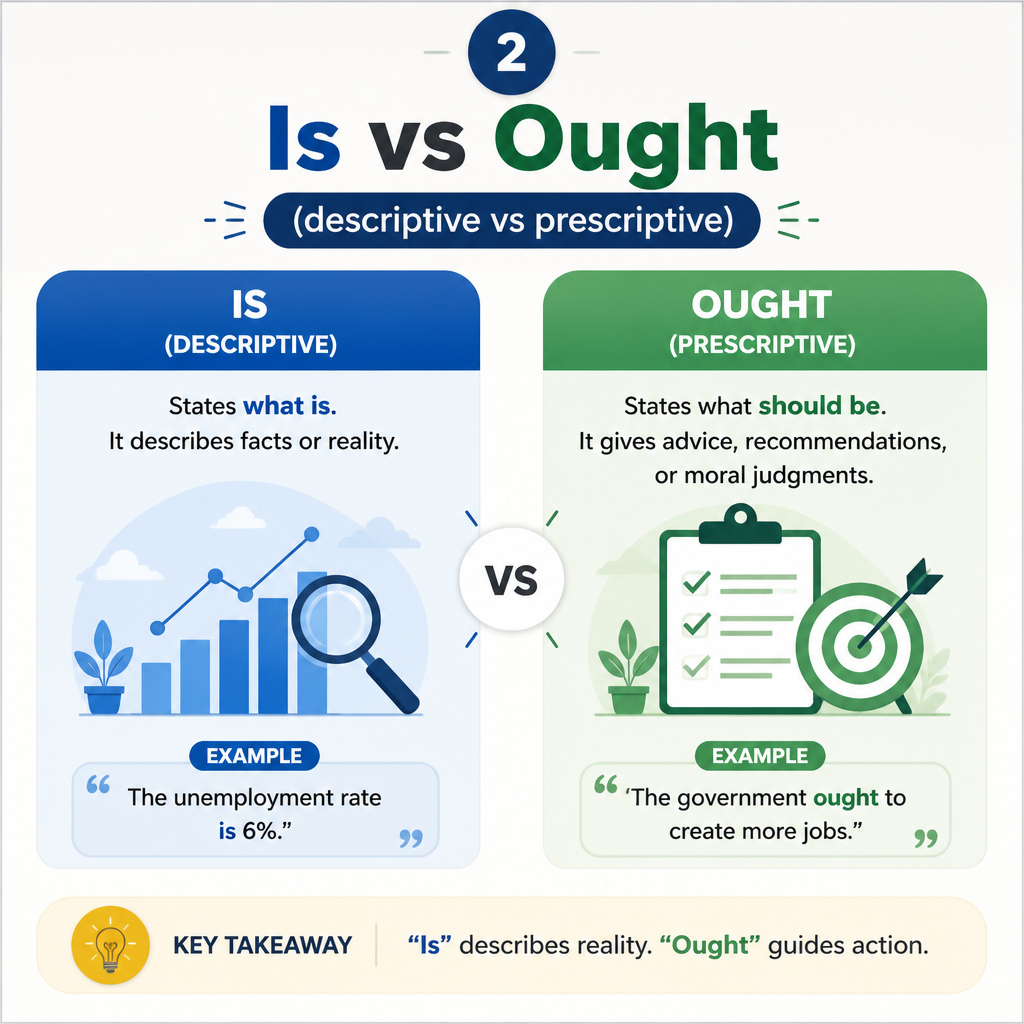
- Is (descriptive reality): what is actually happening
- Ought (prescriptive obligation): what should happen, what should not happen
Moral claims fuse these two. When we say “cruelty is wrong,” we’re not only reporting an emotion. We’re claiming something about reality that imposes an obligation.
If morality is only subjective, then “ought” is not genuinely binding. It’s just a preference dressed up as authority.
So objective morality asks: What could ground moral “oughts” in “is”? What makes moral claims true in a way that binds everyone—without collapsing into contradiction?
4. Why “Cultural Agreement” Can’t Ground Universal Justice
Perhaps morality is decided by culture. Maybe “objective morality” just means “the majority opinion.”
But cultural agreement struggles with at least three problems:

A. Majority rules turns justice into power
If what is right is whatever a society approves, then “might makes right.” But justice is supposed to restrain power, not sanctify it.
Historic reformers often fought against the majority. Martin Luther King Jr. opposed segregation even though it was socially defended. If morality were only cultural consensus, then reform itself would be morally illegitimate by definition.
B. Relativism can’t explain why some wrongs feel permanently wrong
Across cultures, many people recognize certain acts as wrong even before hearing “local rules.” For example, many find it morally repugnant to kill “for the fun of it.” That intuition suggests moral truth is not merely a local fashion.
C. History shows “law above the law” exists in moral reasoning
Consider the logic behind the post–World War II Nuremberg trials. Nazi leaders often argued that their actions were legal under their regime and accepted within their system. Yet the judgments appealed to a “higher law” than the laws of the state.
The moral force of that appeal is difficult to explain if morality is only cultural agreement. If morality is merely local convention, there’s no principled reason to condemn what “everyone agreed to” at the time.
5. The Incentive Problem: If There’s No Ultimate “Or Else,” Why Be Moral?
Some people reply: “Even if morality is objective, why would anyone care?” This becomes an incentive problem.
Imagine a worldview where:
- there is no transcendent purpose for human life,
- no ultimate accountability exists,
- and all humans share the same final fate (however bleak or indifferent it is).
In such a framework, moral claims can become oddly weightless. You can still say “Mother Teresa was good,” but “good” starts to sound like a description of admiration rather than a truth that ultimately matters.
One might even ask: what is the decisive difference between preferring the good and preferring evil, if both end the same and there is no final “or else” that reveals the true stakes?
Objective morality, if real, should carry ultimate seriousness. Otherwise, morality risks becoming aesthetics: “I like what I like.”
6. Purpose and the Moral Compass: Created for Love, Meant for Good
One of the most compelling ways to ground objective morality is through purpose. Not purpose as a vague sentiment, but purpose as a real design: what a thing is made for.
On a theistic view, humans are not cosmic accidents. They are created beings with a real end: communion with God and love of neighbor. In that context, moral truth becomes intelligible as alignment with purpose.
For example, “good” life choices are not random moral preferences; they are those that train, heal, and direct the person toward the true good they were made to seek.
This idea also addresses an important challenge: moral truth can’t be merely “brute” facts that float unconnected to explanation.
If morality is objective, it seems to require more than a list of “don’ts.” It seems to require a source and a meaning—a reason why “good” exists as a real standard for rational agents.
7. Justice That Judges More Than Preferences: From Nuremberg to Everyday Accountability
Objective morality is not only about grand historical trials. It’s also about the everyday experience of justice.
When we say “that was unjust,” we typically mean at least two things:
- The victim’s wrong was real—not merely disliked by an observer.
- The wrongdoer is accountable—not merely unfortunate or socially inconvenient.
These are not the tones of mere preference. They are tones of moral reality.
And that is why “moral truth” feels like something that can expose us. It doesn’t just describe what people believe; it challenges what people should be.
8. Ethics and Religion: How Unchanging Truth Explains Moral Norms
Here the conversation naturally turns toward ethics and religion. Not because religion automatically wins by authority, but because objective moral truth needs an unchanging standard.
If the good changes with culture or mood, then moral norms become unstable. Yet human beings do not simply want rules; they want truth—something that can correct us even when we resist it.
In many Christian frameworks, that standard is God’s character. God is not just a lawgiver who arbitrarily declares rules. Rather, divine nature grounds the meaning of moral goodness: what God is, what God wills, and what moral truth is are not disconnected.
So moral truth is not just a social contract. It is a reality that binds persons because persons are real—and because love, justice, and truth are not illusions.
That is why many argue that objective morality and religion are not enemies. They are partners in explaining why moral language has genuine authority.
9. Practical Implications: How the Saints, Law, and Conscience Converge on Truth
Even if someone never takes up formal philosophy, human life provides evidence of the moral compass at work.
A. Conscience behaves like recognition
Conscience is not only a feeling. It often functions like a witness—something that confronts us with “you should not” and “you must” even when convenient options remain.
B. Saints show morality is more than strategy
History includes people who sacrificed comfort for love—people whose lives look like moral truth made flesh. The point is not to romanticize everyone. It’s to recognize that objective morality, if real, will manifest in transformed lives.
C. Religious practices form moral perception
Religious communities often preserve a moral vision through worship, moral teaching, confession, and service. These practices do not create moral truth from nothing; they train the soul to perceive it more clearly and to live it more consistently.
10. Conclusion: The Universal Moral Compass and the Case for Theistic Grounding
Objective morality insists that “good” and “wrong” are not merely invented or negotiated. Moral truth is not only an opinion; it is an aspect of reality that judges all people.
And when we ask what can ground moral truth—beyond culture, beyond preferences, beyond power—the compass begins to point toward a transcendent source.
That doesn’t guarantee that every debate ends the same way. But the direction is clear: if justice is truly justice, if moral truth truly binds, then ethics needs more than human votes. It needs a foundation strong enough to make “ought” real.
For many, that foundation is God—the unchanging ground of moral truth, the only explanation that makes universal justice intelligible.
Suggested Readings
- Tim Stratton, “Does an Objective Moral Compass Point to God?” CrossExamined.org
- GotQuestions.org, “What is moral truth?” GotQuestions.org
- J. Warner Wallace, “Are Objective Moral Truths Merely a Matter of Cultural Agreement?” ColdCaseChristianity.com