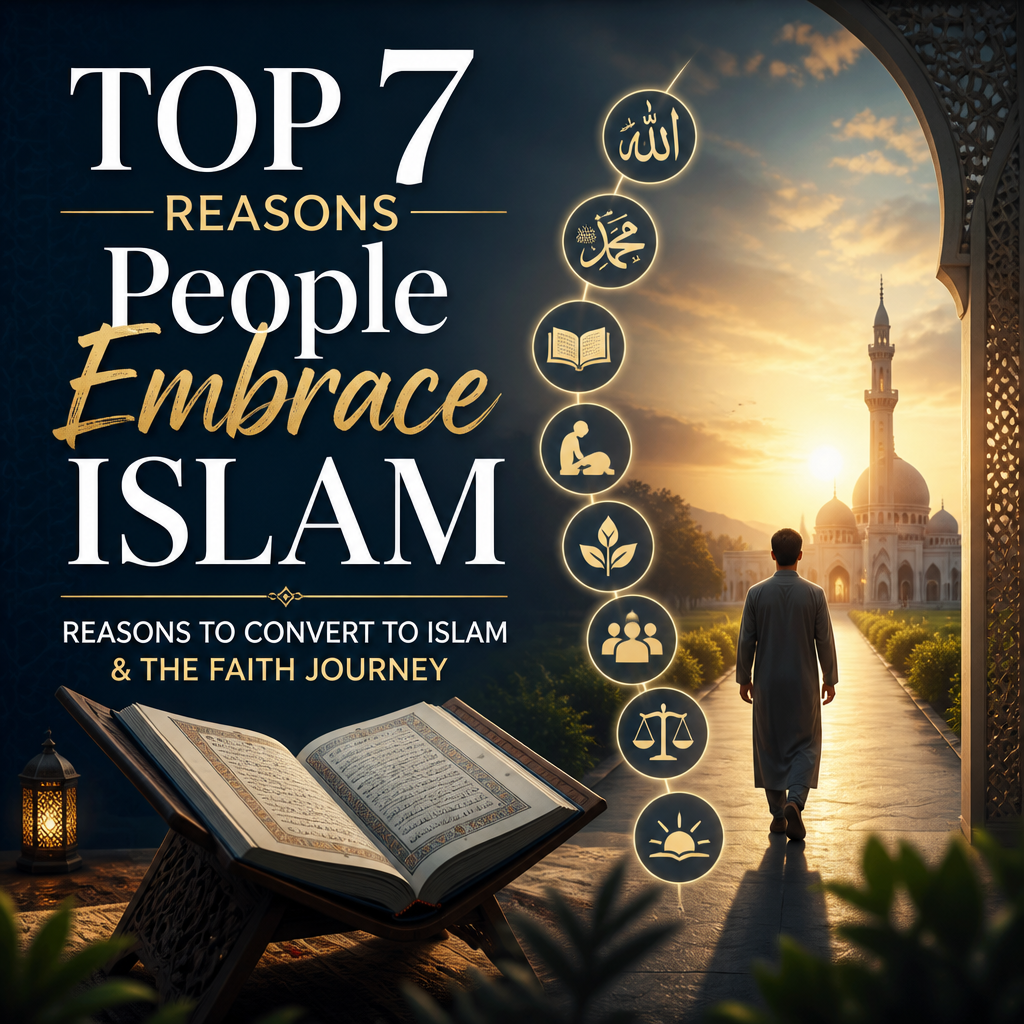
Introduction: Why People Search for “Reasons to Convert to Islam”
It’s common for sincere seekers to pause and ask, “Why convert to Islam?” Whether you’re exploring Islam for the first time, comparing faiths, or already feeling a personal pull toward the deen, the question usually becomes more specific: What makes Islam compelling? What answers does it offer? How does it change a life?
Across hundreds of conversion stories, the same themes appear again and again—faith that is simple yet profound, worship that shapes daily habits, moral guidance that actually works, and a community that helps people live with dignity. In this article, we’ll explore Top 7 Reasons People Embrace Islam—the most common reasons to convert to Islam and the deeper elements behind why Islam is growing.
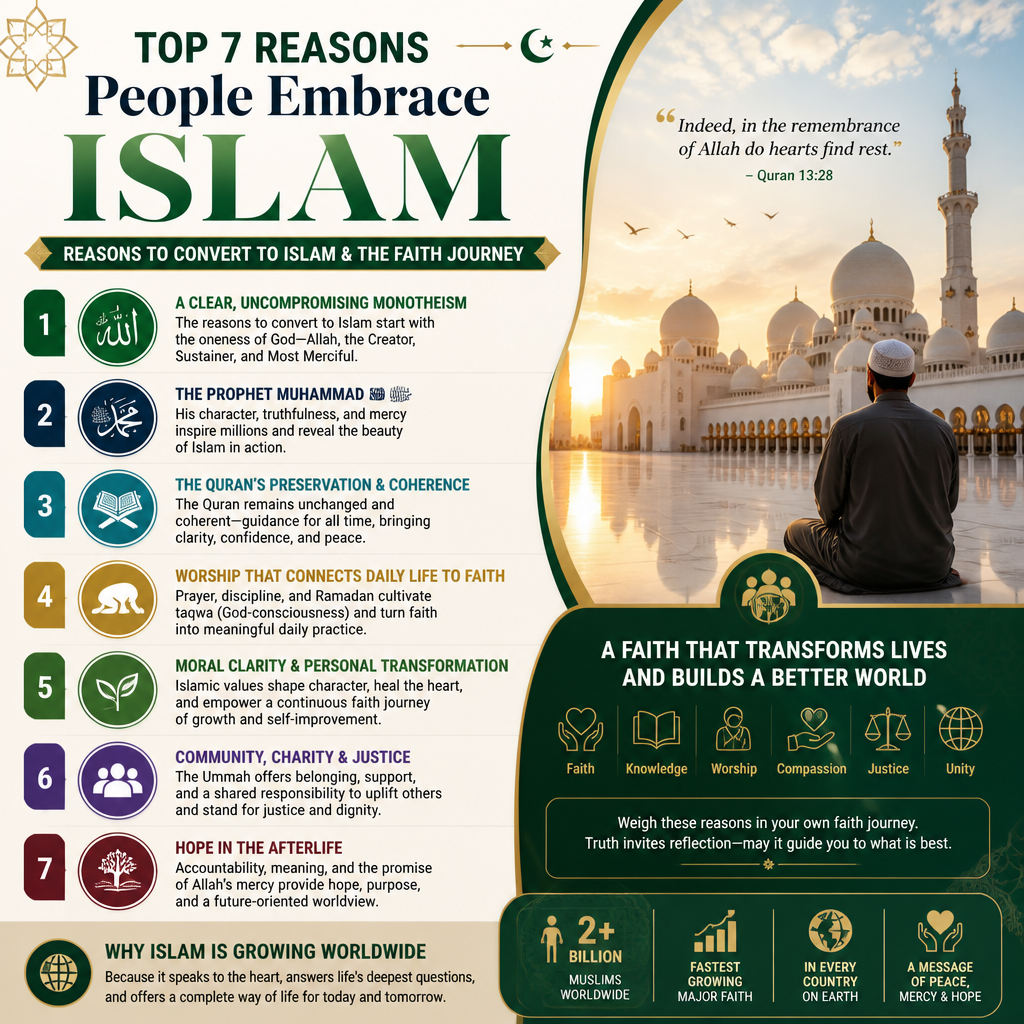
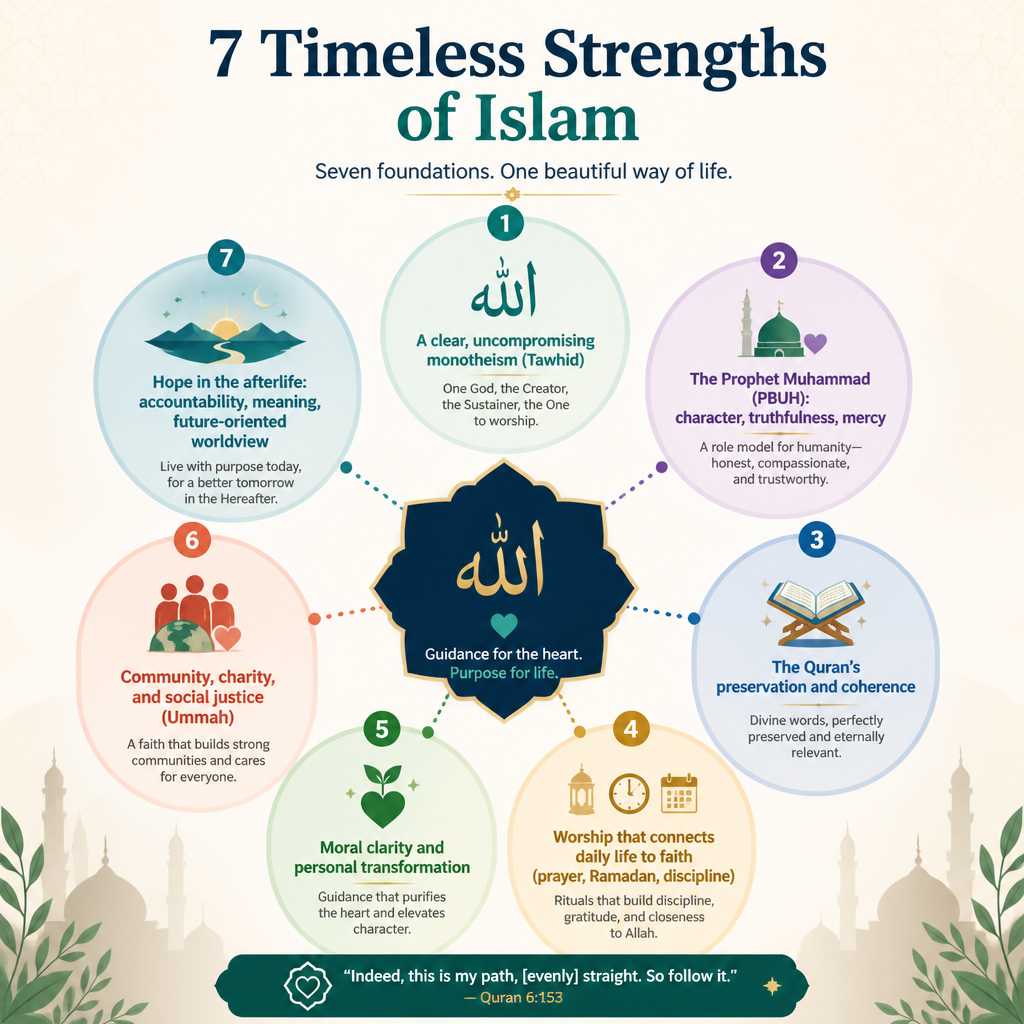
1) A Clear, Uncompromising Monotheism (Tawhid)
The most foundational reasons to convert to Islam start with tawhid: the oneness of God. Islam presents God as one—unique, eternal, and without partners. There is no need for intermediaries, no competing deities, and no confusing divisions in who God is.
Why seekers find this compelling
- God is understandable: Islam’s view of God is direct—He is the Creator, Sustainer, and Judge.
- Worship becomes coherent: Prayer, intention, and moral effort align with the belief that God alone is worthy of devotion.
- Faith is not diluted: Islam’s monotheism is not flexible or negotiable—it is built into the entire worldview.
For many converts, clear monotheism feels like spiritual “clarity.” It reduces confusion and makes the faith journey feel like a return to the simplest truth: There is One God.
2) The Prophet Muhammad (Peace Be Upon Him): Character, Truthfulness, Mercy
Another major reason people embrace Islam is the impact of the Prophet Muhammad (peace be upon him). Converts often describe an Islam appeal that goes beyond scholarship: they feel drawn to a messenger known for truthfulness, mercy, and integrity.
What converts commonly notice
- Consistency: The Prophet’s life matches the message he taught.
- Mercy and restraint: Even in difficulty, character remains a priority.
- Practical example: His teachings show how faith applies to real human relationships.
When people read the Prophet’s biography (sīrah), they often come away impressed not only by events, but by the moral texture of his actions. For many, this becomes a turning point in their faith journey.
3) The Quran’s Preservation and Coherence
Many seekers ask: Is the message preserved? In conversion stories, the Quran’s preservation and coherence is frequently mentioned as a reason to convert to Islam because it offers confidence that the core revelation is protected and accessible.
Why this matters to converts
- Confidence in the text: converts report feeling trust that the Quran they read today is the same message Muslims revere worldwide.
- Internal consistency: many describe the Quran as logically connected—its themes reinforce one another.
- Clarity of guidance: it speaks to belief, worship, ethics, and purpose, without feeling scattered.
For many, the Quran doesn’t just sound beautiful—it feels coherent and emotionally true, like guidance meant for hearts and minds.
4) Worship That Connects Daily Life to Faith (Prayer, Ramadan, and Discipline)
One of the most attractive aspects of Islam is that worship isn’t confined to one moment in time. It flows through the day. Many converts describe how prayer creates structure, accountability, and a living connection to God.
How worship reshapes routine
- Salah (prayer) builds discipline: it becomes a rhythm that slows life down and reminds the soul of its purpose.
- Ramadan trains the heart: fasting builds empathy, patience, and self-control.
- Practice reinforces belief: doing what Islam teaches gradually makes belief feel lived, not merely learned.
This is where Islam appeal often becomes personal: people don’t just agree with concepts—they begin to experience how worship changes their habits, mindset, and character.
5) Moral Clarity and Personal Transformation
Islam is not only about understanding; it’s also about becoming. Many people exploring Islam look for a faith that improves character, not just gives information. In conversion stories, one consistent theme is moral clarity—clear guidance about right and wrong that feels workable in everyday life.
What transformation often looks like
- Better relationships: faith encourages honesty, kindness, and responsibility.
- Less inner confusion: rules and principles provide direction when emotions pull people off course.
- Growth over perfection: Islam teaches continuous striving (tawbah and improvement), which reduces hopelessness.
Many converts describe a genuine faith journey where Islam becomes a path toward emotional healing, self-respect, and moral strength. In their stories, practice steadily refines who they are.
6) Community, Charity, and Social Justice (The Ummah)
It’s difficult to overstate how much converts value community. Islam isn’t meant to be lived in isolation. The Ummah (community of believers) offers belonging, support, and a shared mission.
Why community and charity become a “pull”
- Charity as a spiritual duty: giving is not optional—it’s part of worship, supporting those in need.
- Dignity for people: Islam emphasizes justice and the inherent value of human beings.
- Real support: converts often find a network that helps them learn, grow, and feel accepted.
This community-centered approach is also one reason why Islam is growing: Islam has a universal message, but it’s supported by systems of care—prayer gatherings, mutual support, and charitable institutions.
7) Hope in the Afterlife: Accountability, Meaning, and a Future-Oriented Worldview
In many conversion stories, the belief in the afterlife brings profound relief. Islam teaches that human life is purposeful and that actions matter—not only in society, but before God.
What afterlife belief gives seekers
- Meaning beyond the present: life isn’t random—it has a direction and an ultimate end.
- Accountability without despair: God’s justice motivates growth while His mercy gives hope.
- Motivation to improve: faith encourages righteous living with long-term perspective.
For many, this becomes the emotional core of reasons to convert to Islam: Islam offers not only a moral code, but a coherent universe where every deed has significance.
Conclusion: Weighing These Reasons in Your Own Faith Journey
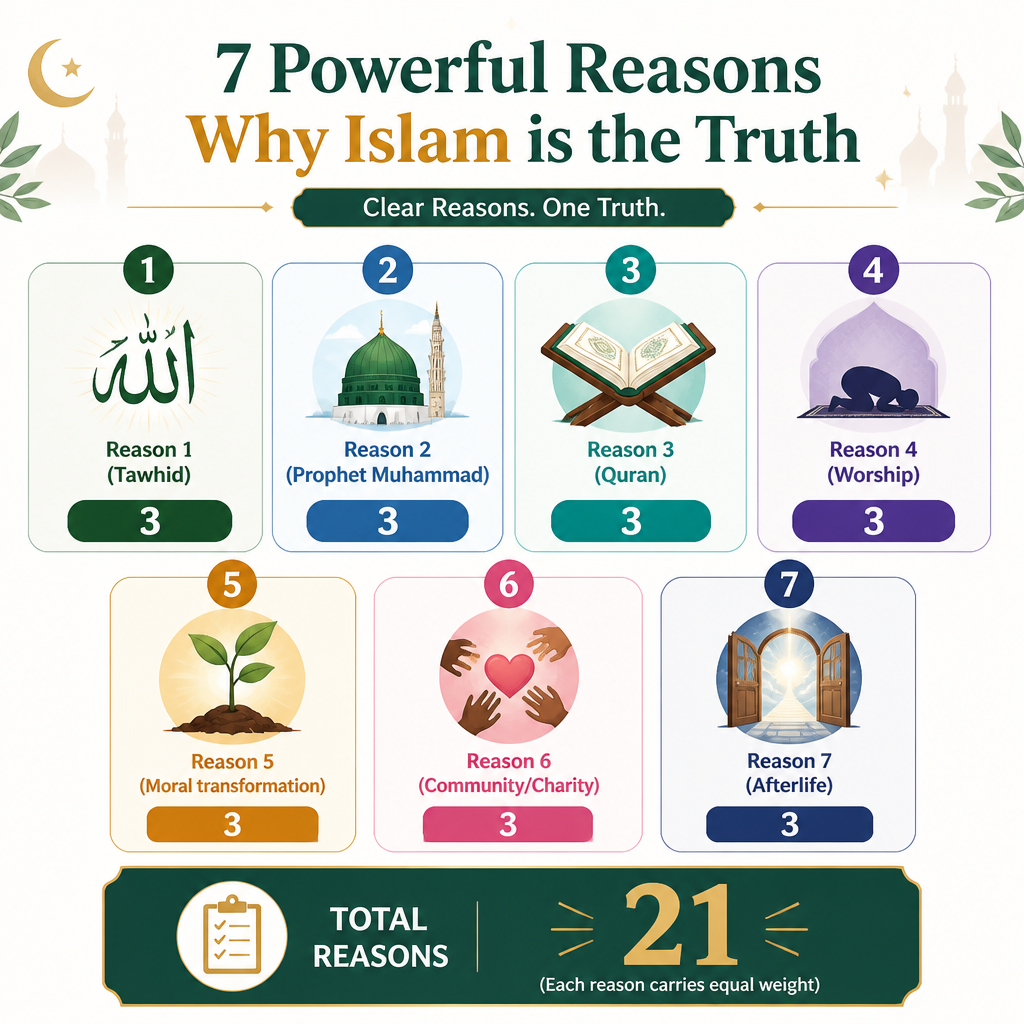
The top 7 reasons people embrace Islam—tawhid, the Prophet’s exemplary character, Quran preservation, daily worship, moral transformation, community and justice, and afterlife hope—are themes that appear again and again across conversion stories.
When you connect these reasons, a bigger picture emerges: Islam provides a complete faith journey that engages the mind, shapes the heart, and transforms daily living. It’s also one reason why Islam is growing globally: Islam’s message is universal, its practices are structured and meaningful, and its community offers real-life support.
Further Reading / References
- Muslim Ink – “106 Reasons: ‘Why I Converted to Islam’” (personal conversion testimonies): https://www.muslimink.com/islam/dawah/why-convert-to-islam/
- IslamiCity – “Islam becoming the largest and most popular faith in the world” (growth drivers and Pew-related context): https://www.islamicity.org/104228/islam-becoming-the-largest-and-most-popular-faith-in-the-world/
- Reddit (r/islam) – “15 Reasons Why I Converted to Islam” (additional conversion reasons): https://www.reddit.com/r/islam/comments/zbcay4/15_reasons_why_i_converted_to_islam/
Have you been exploring Islam? If you’d like, share what you’re learning—or what question brought you closest to a decision—in the comments. Your experience may encourage someone else’s faith journey.