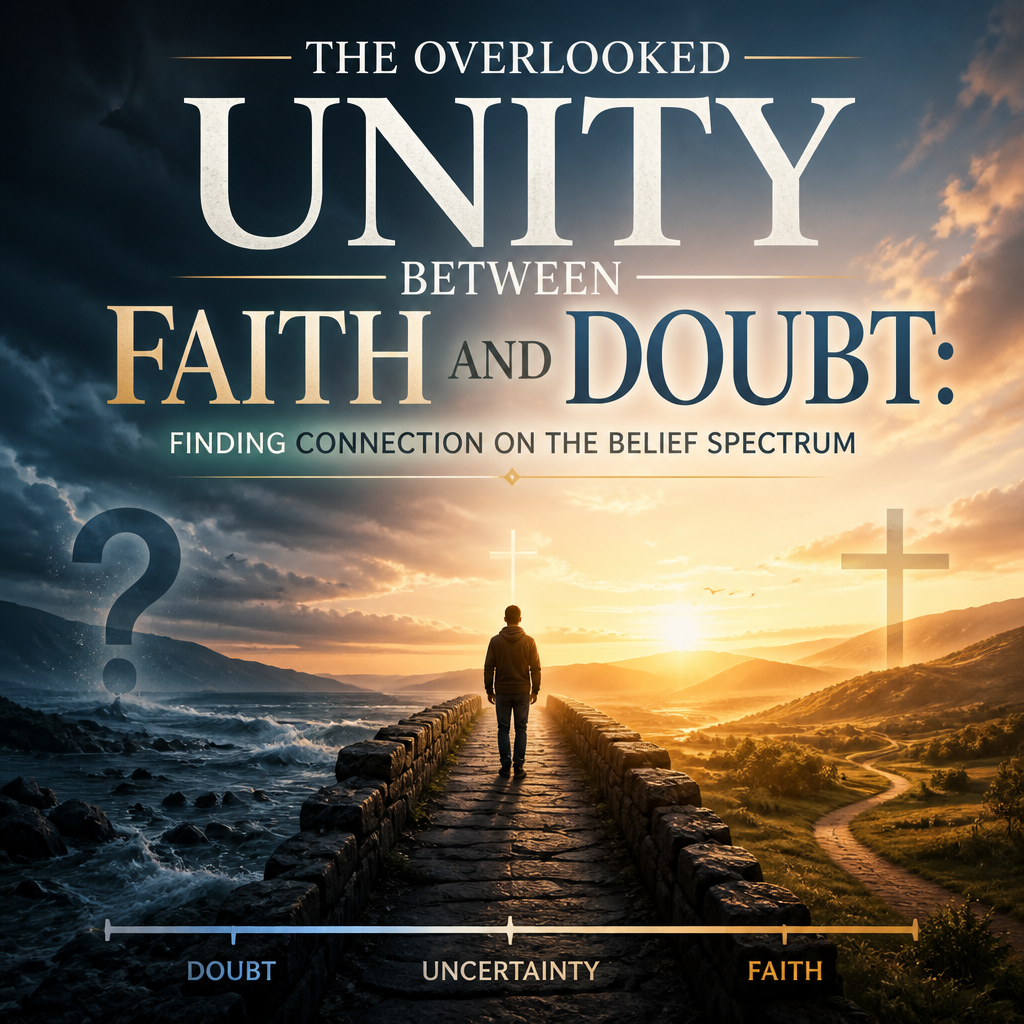
The Overlooked Unity Between Faith and Doubt: Finding Connection on the Belief Spectrum
Modern life trains us to sort people into camps: faith or doubt, believer or skeptic, certainty or failure. But Scripture and lived experience suggest something quieter and more humane: there is a belief spectrum, and the faith and doubt connection can be real and even fruitful.
In other words, doubt is not automatically the enemy of faith. And faith is not automatically the cure for doubt. The mature path is learning how to hold the tension without turning it into a war—because both extremes can deform the heart. Healthy faith includes real questions; healthy doubt eventually asks for real hope.
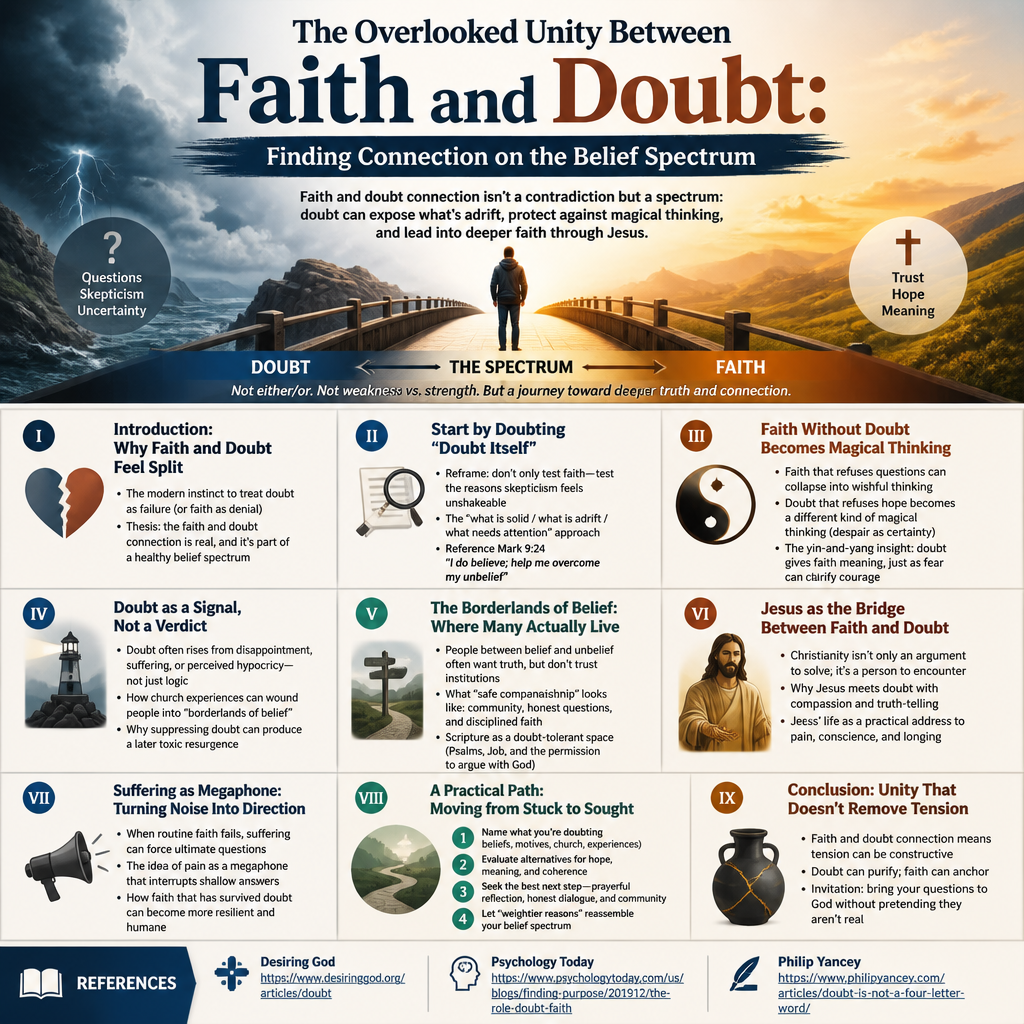
I. Why Faith and Doubt Feel Split
The instinct to treat doubt as failure (or faith as denial) is understandable. Many of us associate doubt with embarrassment, rebellion, or spiritual danger. Others associate faith with blind optimism or “don’t ask, just obey.” When those stereotypes harden, people stop speaking honestly—then wonder why their inner lives feel fractured.
Thesis: The faith and doubt connection is not a paradox to escape, but a unity to understand. It belongs to a belief spectrum where truth is pursued, emotions are processed, and the heart is reshaped over time.
II. Start by Doubting “Doubt Itself”
A powerful question is not, “Is faith true?” but, “What is making my skepticism feel unshakeable?” Sometimes doubt is honest. Sometimes it is inherited. Sometimes it is a defensive strategy created by pain.
One writer describes moving from skepticism toward Christianity by interrogating doubt—not pretending it doesn’t exist, but asking whether it rests on solid ground. That approach helps you move from “doubt as verdict” to “doubt as investigation.”
A helpful framework is to ask:
- What is solid? What beliefs, experiences, or reasons are actually strong?
- What is adrift? What parts of your doubt depend on disappointment, hurt, or assumptions?
- What needs attention? What questions are you refusing to ask—or what evidence are you avoiding?
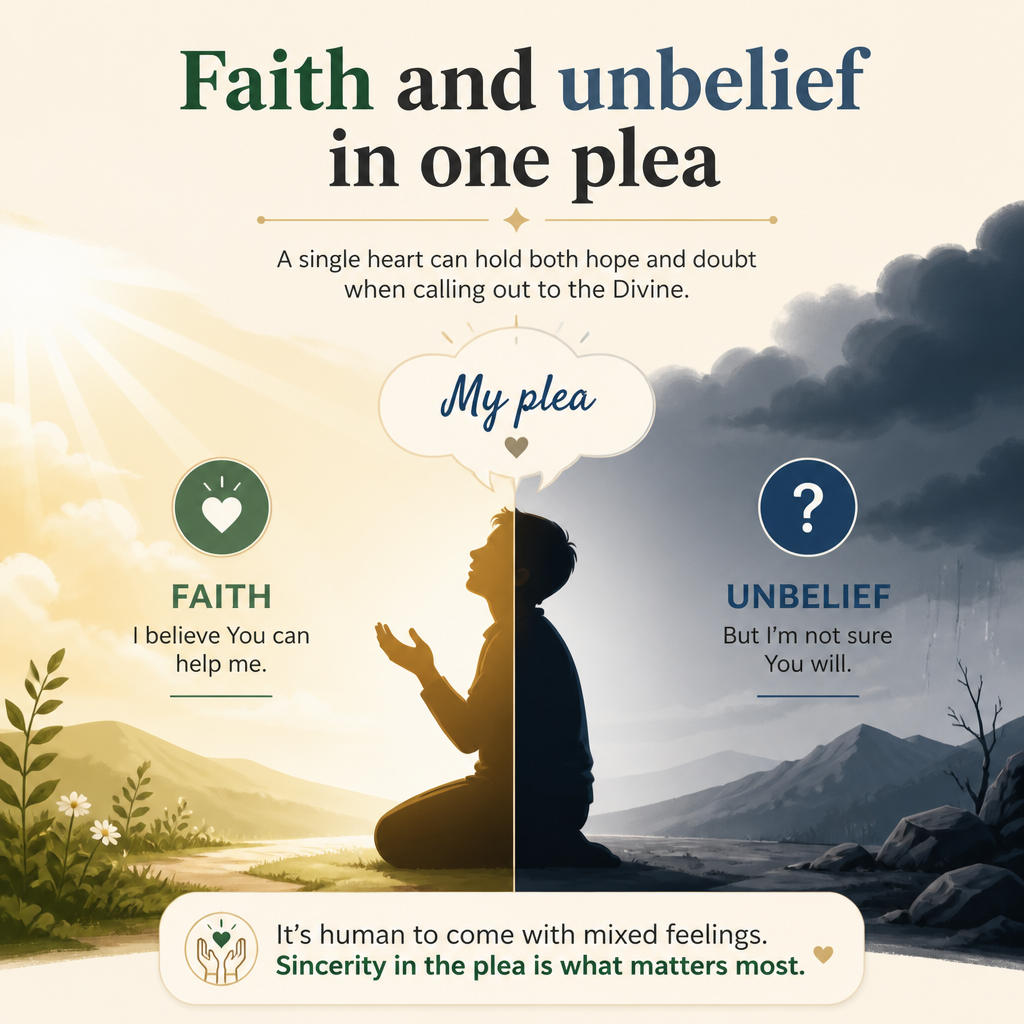
In the middle of that investigation is a line that should feel remarkably familiar to anyone trying to be honest before God:
“I do believe; help me overcome my unbelief.” (Mark 9:24)
This prayer doesn’t deny the reality of struggle. It treats faith not as a switch but as a journey—one that can coexist with trembling.
III. Faith Without Doubt Becomes Magical Thinking
There is a form of faith that doesn’t ask questions—not because it is certain, but because it is afraid. That kind of faith can become wishful thinking. It may “feel” peaceful, yet it has no internal life. When pressures come, it often collapses or hardens.
And there is an opposite distortion: doubt that refuses hope. If faith is reduced to denial, doubt can be reduced to despair—certainty that nothing can be trusted. That too can become a kind of magical thinking: the fantasy that the absence of belief is equivalent to truth.
Some commentators describe this as a dynamic balance. Faith and doubt are like voices on either side of the same human mind—capable of improving each other when they are heard in the right order. Doubt can clarify what’s real; faith can anchor what matters.
So the goal is not to silence one voice. The goal is to keep both in conversation until the heart can see more clearly.
IV. Doubt as a Signal, Not a Verdict
Many people assume their doubts come only from logic. Often they come from a different source: disappointment, suffering, perceived hypocrisy, or a church experience that felt less like Jesus and more like performance.
That’s why doubt can be a signal. It may be telling you:
- “Something feels unaddressed—like grief without language.”
- “I was promised something, and it didn’t happen.”
- “I saw faith used as control, not compassion.”
- “I’ve been hurt by people who claimed God.”
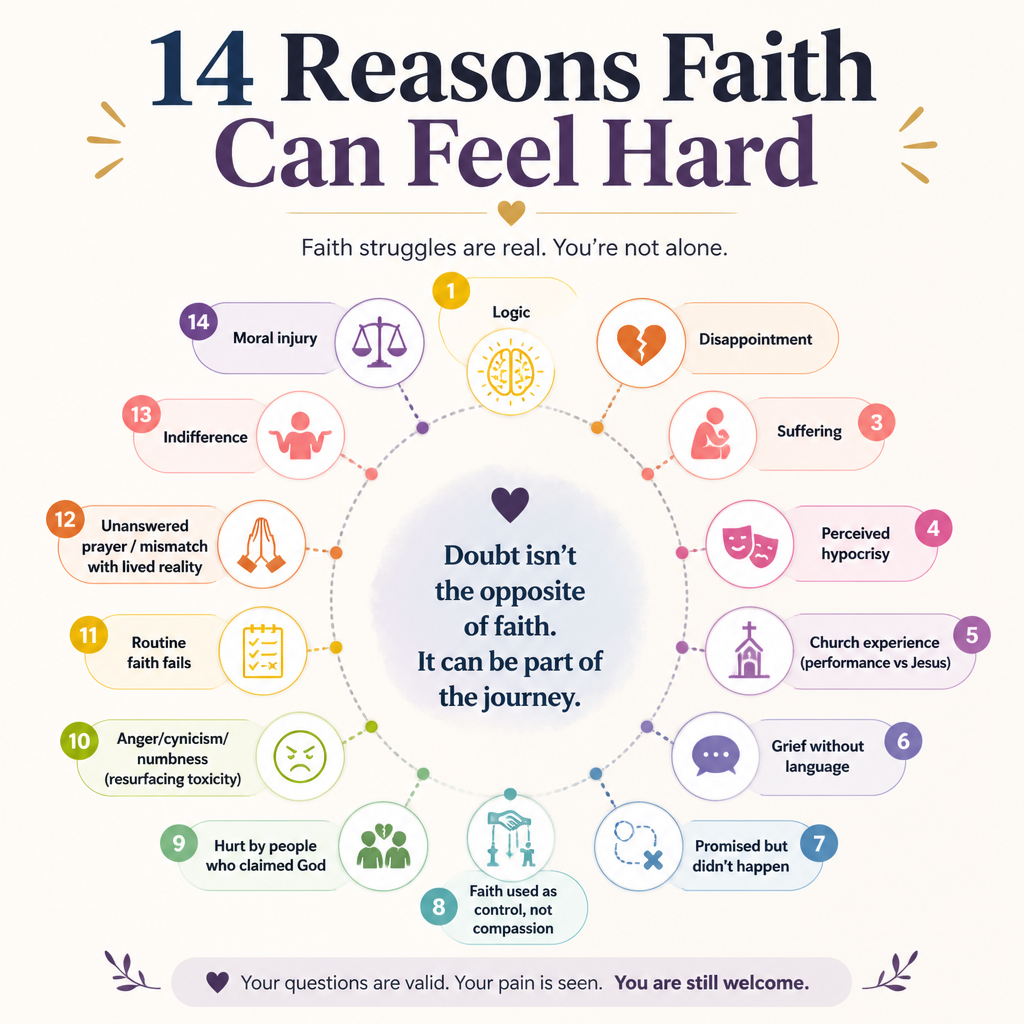
In some cases, suppressing such signals doesn’t remove them—it delays them. One Q&A perspective emphasizes that when doubt is pushed out of sight rather than processed, it can later resurface as spiritual toxicity: not only questions, but anger, cynicism, and numbness. The heart doesn’t stop needing truth; it adapts.
Doubt, then, is not automatically a verdict. It can be a signal that invites a deeper, more humane kind of searching.
V. The Borderlands of Belief (Where Many Actually Live)
There is a place between belief and unbelief—often called the “borderlands”—where people genuinely want truth but don’t trust institutions, or they distrust the versions of God they’ve been offered. They may be surrounded by religious language, yet lonely in their private struggle.
This is why the belief spectrum matters. It explains something essential: many people are not “anti-faith” so much as “wounded by faith as practiced.”
What might “safe companionship” look like for someone living on the spectrum?
- Community where questions are not treated as betrayal.
- Honest dialogue that distinguishes between intellectual objections and emotional wounds.
- Disciplined faith that doesn’t demand blind certainty, but also doesn’t settle for laziness.
And Scripture itself is doubt-tolerant in a way modern stereotypes often miss. The Psalms and Job do not paper over struggle with easy answers. They make room for argument, grief, and confrontation.
VI. Jesus as the Bridge Between Faith and Doubt
One of the most important shifts is to move from treating Christianity as only a puzzle to solving, to recognizing it as a Person to encounter.
Christianity meets doubt with compassion and truth-telling. It does not merely say, “Here are the facts.” It also asks, “What is your conscience saying? What do you want? What do you fear? What do you long for?”
Philip Yancey’s perspective emphasizes that doubt often lives alongside sincerity. People search for God not because their doubts have vanished, but because their longing has not died. And Jesus—through His life, His care for the suffering, and His willingness to engage real human mess—becomes the bridge where both honesty and hope can meet.
This is not “faith as denial.” It’s faith as encounter.
VII. Suffering as a Megaphone: Turning Noise into Direction
Sometimes doubt rises because routine faith fails. Prayers don’t seem to land. Explanations don’t match lived reality. The universe feels indifferent. In that moment, suffering can act like a megaphone: it interrupts shallow answers and forces ultimate questions to the surface.
One writer captures this idea by describing pain as a megaphone—because it calls attention to what matters most. When life is stable, you can postpone the deepest questions. When life breaks, you can’t.
Yet suffering is also where faith can become more resilient and more humane. Faith that has survived doubt is often less performative. It can become more patient with others. It can stop pretending that everyone should be fine and start learning how to be faithful in real human conditions.
VIII. A Practical Path: Moving from Stuck to Sought
If you’re trying to work through the faith and doubt connection rather than simply fight it, consider a simple path.
Step 1: Name what you’re doubting
Be specific. Are your doubts about:
- beliefs (arguments, doctrines, history)?
- motives (fear, resentment, pride)?
- church (hypocrisy, institutional failures)?
- experiences (loss, unanswered prayer, moral injury)?
Clarity is kindness. Vague doubt often keeps you trapped.
Step 2: Evaluate alternatives—honestly
Ask whether your alternatives truly offer coherence, hope, and meaning. Are they just the newest version of denial? Do they address suffering and moral responsibility, or do they merely hide them?
Step 3: Seek the best next step
Move from private wrestling to supported searching:
- prayerful reflection (including “I don’t know” prayers)
- honest dialogue with trustworthy people
- community that can hold questions without panic
Step 4: Let “weightier reasons” reassemble your belief spectrum
Sometimes faith returns not all at once, but like gravity: slowly, then suddenly. As you examine what is solid, what is adrift, and what needs attention, you may find your internal map of belief changing in healthier ways.
Return again to Mark 9:24: “I do believe; help me overcome my unbelief.” Faith and doubt connection isn’t a problem to solve by suppressing one half—it’s a relationship to manage with truth.
IX. Conclusion: Unity That Doesn’t Remove Tension
The overlooked unity between faith and doubt is that they can coexist without canceling each other. Tension can be constructive. Doubt can purify. Faith can anchor.
If you’re on the belief spectrum, you don’t need to pretend you’re finished. You need to keep moving toward truth with integrity. Bring your questions to God. Don’t hide your uncertainty behind spiritual performance. And don’t mistake silence for certainty.
Because the faith and doubt connection—held well—may be exactly what leads you from stuckness to searching, from argument to encounter, and from borrowed beliefs to lived faith.