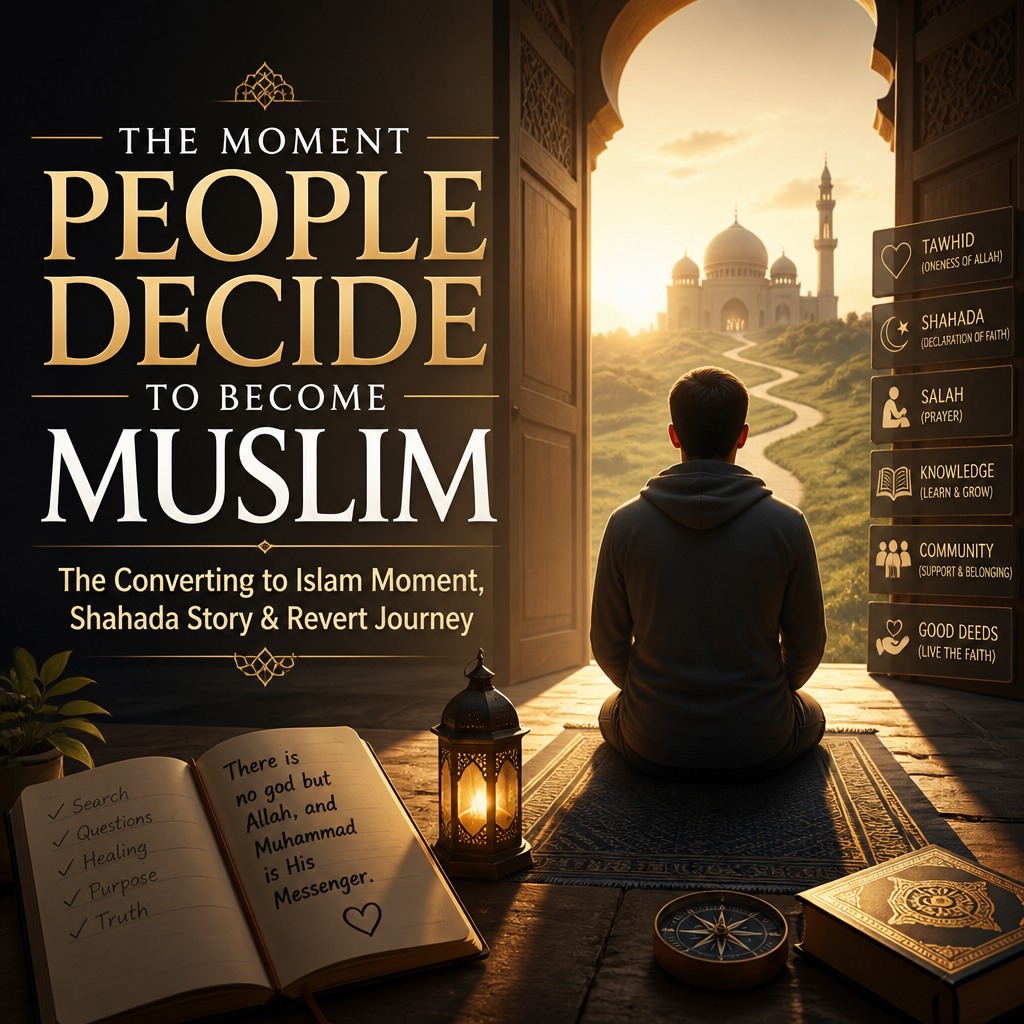
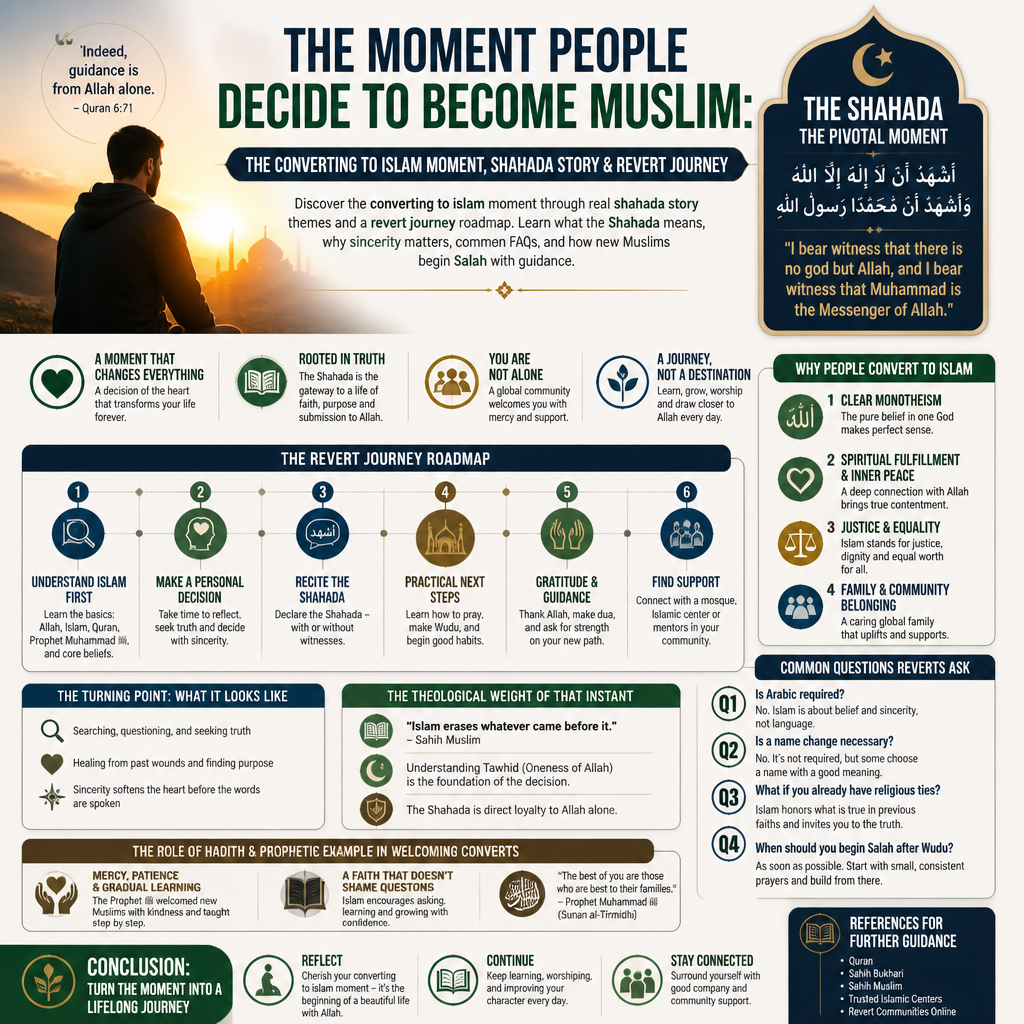
The Moment People Decide to Become Muslim: The Converting to Islam Moment, Shahada Story & Revert Journey
Discover what the “converting to islam moment” really looks like—from the first questions to the sincerity behind the Shahada. Explore the meaning of Tawhid, why that instant carries spiritual weight in Islam, and what practical steps typically begin the revert journey: reciting the Shahada, starting worship, and finding community support.
1. Introduction: Why the “converting to islam moment” feels unforgettable
There are moments in life that don’t just change a schedule—they change the direction of the heart. For many people, the converting to islam moment is exactly that: a turning point so vivid it feels like a door closing behind them and opening in front of them.
Sometimes it arrives quietly: a few late-night readings, a calm conversation, a feeling of being understood for the first time. Other times it comes after a season of searching—after heartbreak, loss, or a spiritual hunger that no explanation could silence. But regardless of the path, the moment of commitment often carries a shared quality: clarity.
In Islam, that clarity finds its most defining expression in the Shahada—the declaration of faith. People call their experience a shahada story not because it’s dramatic for the sake of drama, but because it marks the beginning of something new.
2. Understanding the turning point
Before words are spoken, there is usually an inner process. The decision to become Muslim rarely forms overnight. It forms through repeated moments of reflection, learning, and—most importantly—coming to terms with what you truly believe.
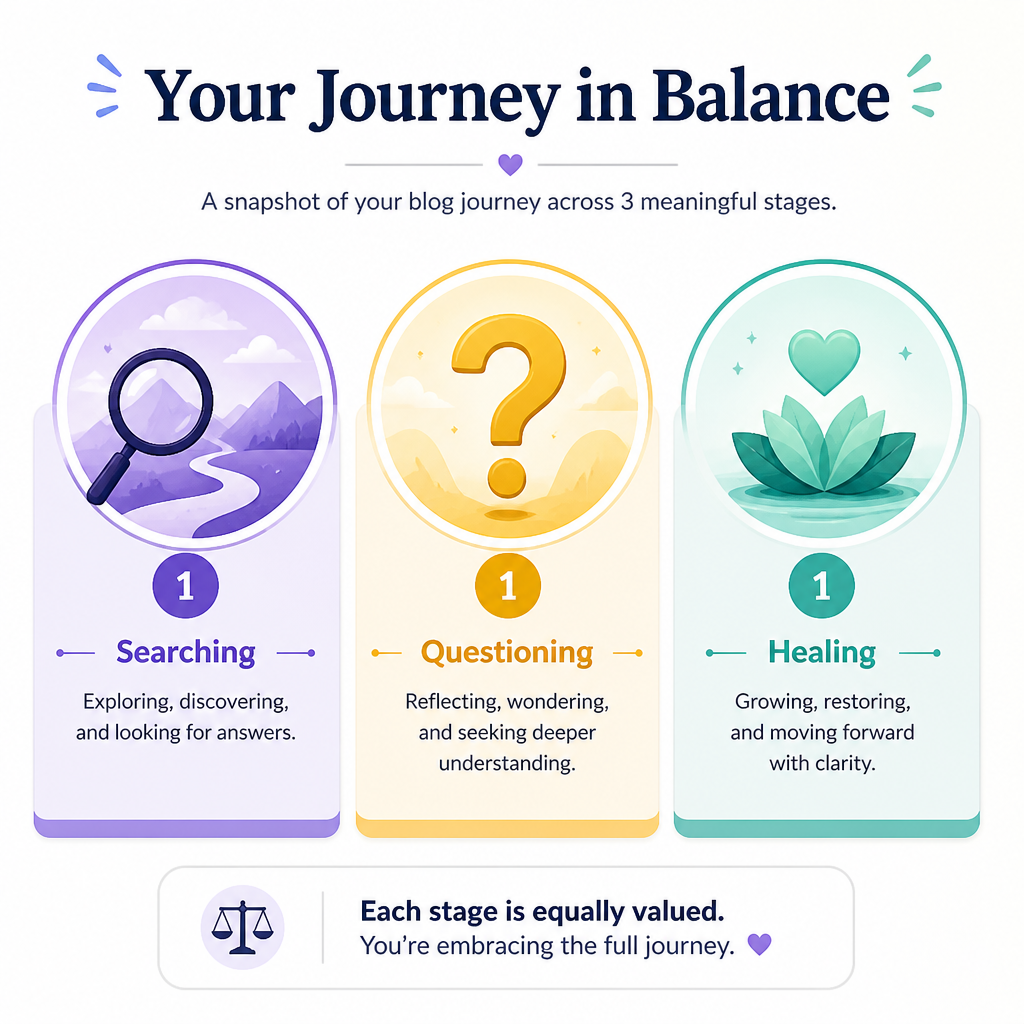
2.1 What “deciding” usually looks like (searching, questioning, healing)
Many reverts describe similar stages:
- Searching: looking for answers about God, purpose, and how to live.
- Questioning: asking honest questions without feeling mocked or rushed.
- Healing: realizing you don’t need to “perform” for God—you need to be sincere before Him.
In this sense, the converting to islam moment is often the end of confusion—not the end of learning. That’s a crucial difference. Islam doesn’t ask you to have everything figured out before you begin; it asks you to turn to Allah with conviction.
2.2 How sincerity reshapes the heart before the words are spoken
One reason the Shahada can feel so powerful is that it is not merely a phrase. It is a surrender. The heart is reshaped by sincerity—by the realization: “This is the truth, and I want my life to belong to Allah.”
For many people, the emotional intensity comes from that surrender. The words are spoken, but the deeper event is happening inside: accountability before Allah, hope replacing fear, and direction replacing drifting.
3. The Shahada as the pivotal conversion moment
If the converting to islam moment had a “center point,” it would be the Shahada.
3.1 What the Shahada is
The Shahada is the Islamic declaration of faith. It affirms:
- Monotheism (there is no god worthy of worship except Allah)
- Prophethood (Muhammad is the messenger of Allah)
When spoken with sincere belief, it marks the beginning of Islam in a person’s life.
3.2 The two parts of the declaration (Tawhid and Muhammad as Messenger)
The Shahada is commonly recited as:
“Ashhadu an la ilaha illallah, wa ashhadu anna Muhammadan rasulullah.”
Meaning: “I bear witness that there is no deity worthy of worship except Allah, and I bear witness that Muhammad is the messenger of Allah.”
- Tawhid is the first part: Allah alone is worthy of worship.
- The second part establishes Muhammad (peace and blessings be upon him) as Allah’s messenger—one whose guidance shapes Muslim worship, character, and community.
3.3 Meaning behind the shahada: direct loyalty to Allah
People often underestimate how transformative a simple declaration can be. Yet Tawhid changes everything:
- It removes intermediaries in worship.
- It brings you into direct relationship with Allah.
- It clarifies what you center your life around.
This is why many reverts describe their Shahada moment not only as “entering a religion,” but as choosing a true Lord and aligning their entire life toward Him.
4. The theological weight of that instant
The Shahada is not only a personal promise; it’s a spiritual turning point recognized in Islamic teachings.
4.1 “Islam erases whatever came before it” (Sahih Muslim)
One of the most comforting realities for many people is that Islam welcomes them with mercy. A well-known meaning supported by hadith is:
“Islam erases whatever came before it.” (Sahih Muslim)
This principle often becomes a key part of the shahada story theme: the sense that the past is not denied, but it is not the final chapter either. The revert journey begins with hope, not with permanent shame.
4.2 Why understanding monotheism (Tawhid) matters in the decision
For the decision to feel real, it helps to understand the core meaning of Tawhid:
- Worship is for Allah alone.
- Allah has no partners—neither in divinity nor in ultimate authority.
- True faith is sincerity, not only tradition.
When Tawhid becomes clear, the decision stops being theoretical. It becomes an inner commitment: “I will live as Allah is the real center.”
5. The revert journey doesn’t start “later”—it starts immediately
Many people assume their Islam begins at some future milestone: when they learn everything, when they “feel ready,” when life settles. But in practice, the revert journey begins almost instantly.
5.1 Turning from confusion to clarity: beginning a new life direction
After the Shahada, the mind may still feel like it’s catching up—but the life direction changes. You begin to notice:
- How worship shapes you
- How ethics become clearer
- How prayer becomes a conversation, not a task
This is why the converting to islam moment is often described as the start of a “new orientation.” The person is still the same human being, but their loyalty has shifted.
5.2 Connecting faith to everyday choices (ethics, worship, character)
Islam is not only spirituality—it is also character. As people begin their revert journey, many notice that faith touches daily life:
- Speech and honesty
- How you treat others
- How you manage anger, temptation, and responsibility
Learning can be gradual, but sincerity tends to make the whole day feel different.
6. Step-by-step: what the process often includes
Every person’s story is unique, but the steps below reflect what many reverts experience when converting to Islam.
6.1 Understanding Islam first (learning the basics)
Before taking the Shahada—or even while preparing—most people spend time learning the basics, such as:
- What Tawhid means
- What Islam believes about Allah and worship
- The purpose of the Five Pillars
You don’t need to become an expert overnight. But you do want your decision to be informed and sincere.
6.2 Making a personal decision
At some point, the searching becomes a commitment. In the converting to islam moment, the person chooses to align their life with what they now believe.
That decision is personal, but it isn’t lonely. Many reverts find support through Islamic centers, knowledgeable friends, and compassionate educators.
6.3 Reciting the Shahada (with or without witnesses)
In many cases, the Shahada is recited in front of people. In some situations, it can be spoken privately first and then followed by the community’s confirmation and guidance.
The key is sincere belief and understanding of its meaning to the extent possible.
6.4 Performing Shahada and practical next steps
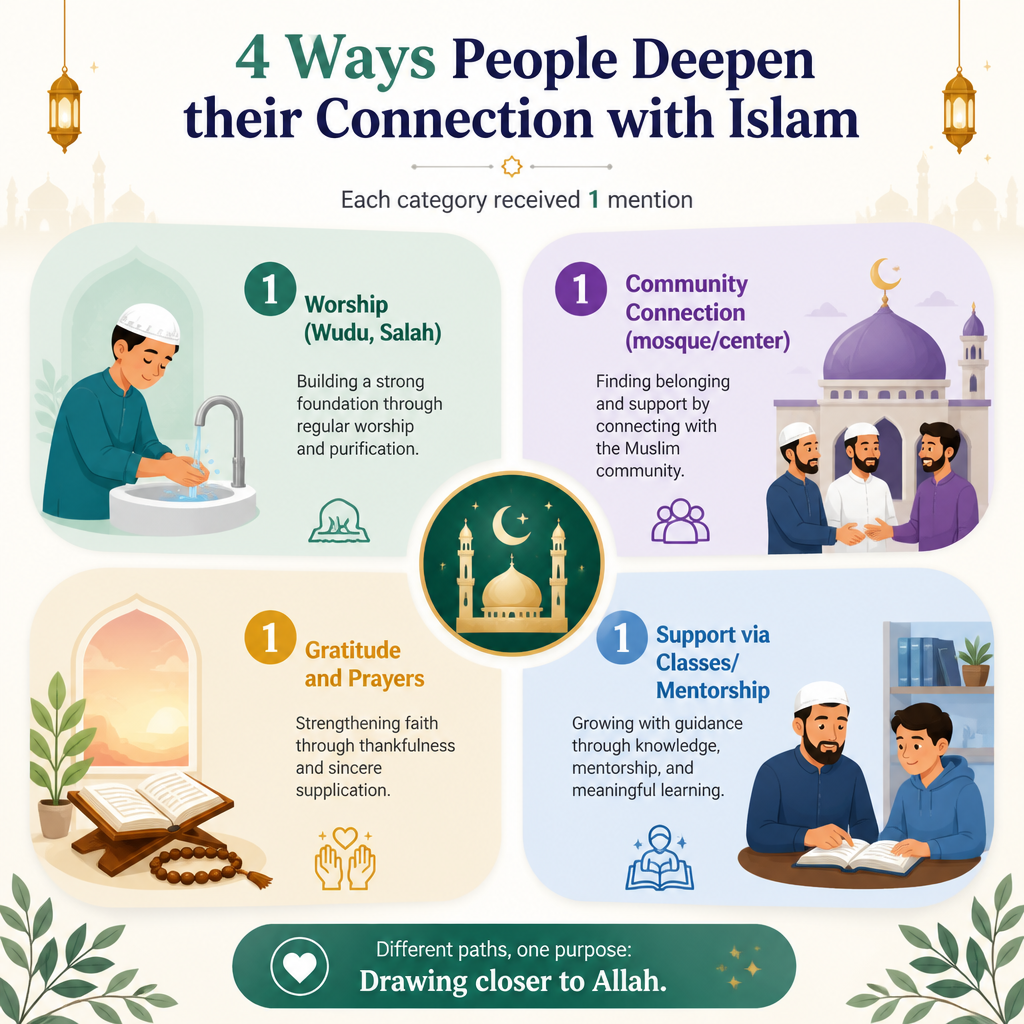
Once the Shahada is made, many reverts focus immediately on worship. Practical next steps often include:
- Learning how to do Wudu (ablution)
- Learning the basics of Salah (prayer)
- Finding a local mosque or Islamic center
6.5 Gratitude, prayers, and asking for guidance
Many converts describe feeling both nervous and grateful. It’s normal. The best mindset is simple:
- Thank Allah
- Ask for firmness and guidance
- Accept that learning takes time
Your revert journey is not a one-day exam; it’s a lifelong companionship with Allah.
6.6 Finding support through mosques/Islamic centers
Community support matters. A good mosque doesn’t just “confirm” your Shahada; it helps you grow. Look for:
- New Muslim classes or mentorship
- Weekly halaqas (lessons)
- Friendly introductions to others who are also learning
Learning is easier when the environment is kind and patient.
7. The role of Hadith and Prophetic example in welcoming converts
Islam is not a faith of harshness toward those who are starting. The Prophet Muhammad (peace and blessings be upon him) demonstrated mercy, patience, and practical care for new believers.
7.1 Mercy, patience, and gradual learning
Many reverts are surprised by how often they hear messages of patience and gradual growth. That’s not accidental. New Muslims need time to absorb knowledge, adjust habits, and build routines.
Mercy in Islam means you’re not expected to become “perfect” immediately—you’re expected to keep moving toward Allah.
7.2 New beginnings: a faith that doesn’t shame questions
Questions are part of becoming Muslim. The revert journey frequently includes:
- Seeking answers about worship
- Understanding Islamic history and theology
- Learning how to live with sincerity and balance
If your heart is sincere, you are already on a path. The community’s role is to guide, not to judge.
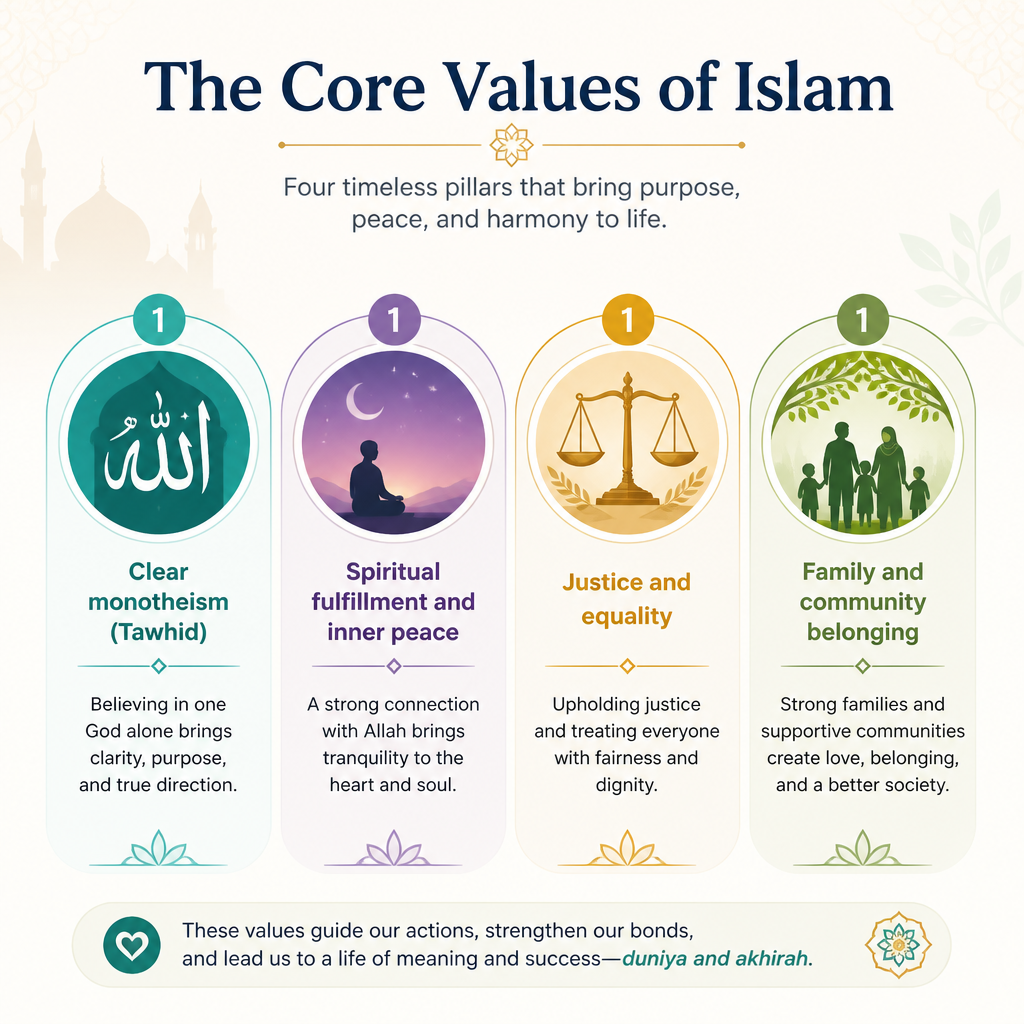
8. Why people convert to Islam (common themes)
People don’t convert for only one reason. But certain themes appear again and again in shahada stories and revert journeys.
8.1 Clear monotheism
Many converts are drawn to Tawhid because it is simple to understand and profound in meaning. Worship is directed to Allah alone.
8.2 Spiritual fulfillment and inner peace
For many, Islam provides emotional and spiritual steadiness—especially after uncertainty. Prayer becomes a place where anxiety softens and trust grows.
8.3 Justice and equality
Islam’s emphasis on equality before Allah is also a recurring theme. Faith is not tied to social status, nationality, or background.
8.4 Family and community belonging
Some reverts describe Islam as finding “home.” They feel welcomed into a community that values mercy, learning, and mutual support.
9. Common questions reverts ask at the start
It’s normal to have practical questions—especially at the beginning when everything feels new.
9.1 Is Arabic required?
No. While learning Arabic phrases can be helpful, Arabic is not required to enter Islam. What matters is understanding and sincerity. Many reverts start reciting the Shahada in English (with meaning) or in transliteration while continuing to learn.
9.2 Is a name change necessary?
In many cases, a name change is optional. Some keep their original names; others choose Islamic names. Your decision can be personal and guided by your circumstances.
9.3 What if you already have religious ties?
Islam doesn’t erase your humanity or your relationships overnight. You may still have family and connections. What changes is how you practice your faith and how you orient your life toward Allah.
It’s often wise to balance honesty with kindness while learning how to navigate family dynamics.
9.4 When should you begin Salah after Wudu?
Many reverts begin praying as soon as they can learn the basics of Salah and Wudu. It’s best to learn from a local teacher or class. Even if your prayer is imperfect at first, sincerity and improvement matter.
10. Conclusion: turning the moment into a lifelong revert journey
The converting to islam moment is powerful because it is the moment a person commits their faith to Allah with sincerity. The Shahada is the landmark—but it’s not a finish line. It’s the start.
In Islam, that beginning comes with mercy: the meaning reflected in Sahih Muslim that Islam erases what came before. And from there, the revert journey unfolds in real time—through worship, community, learning, and growth.
If you’re standing near the threshold, know this: you don’t have to become someone else before you become Muslim. Bring your questions. Bring your sincerity. Bring your willingness to learn.
Further reading / reference: NikahOnline.co.uk — The Shahada and Converting to Islam: A Comprehensive Guide
Reference hadith used in this article: Sahih Muslim (meaning: Islam erases whatever came before it).
If you’d like, share your own shahada story or the moment you realized Islam was the truth—your experience may become encouragement for someone else walking toward the same decision.