
Peace in Islam: Real Experiences of Finding Inner Tranquility (and How to Start Today)
When people search for peace in islam, they often picture a life without storms. But real Islamic inner peace is different: it’s the calm that can exist inside the storm. It’s the steadiness that comes when the heart is reconnected to Allah—through remembrance, prayer, patience, and forgiveness.
In this article, you’ll read real experiences from Muslims and reverts, and you’ll get a practical, beginner-friendly plan you can start today to build inner peace religion—not as a slogan, but as a lived, daily practice.
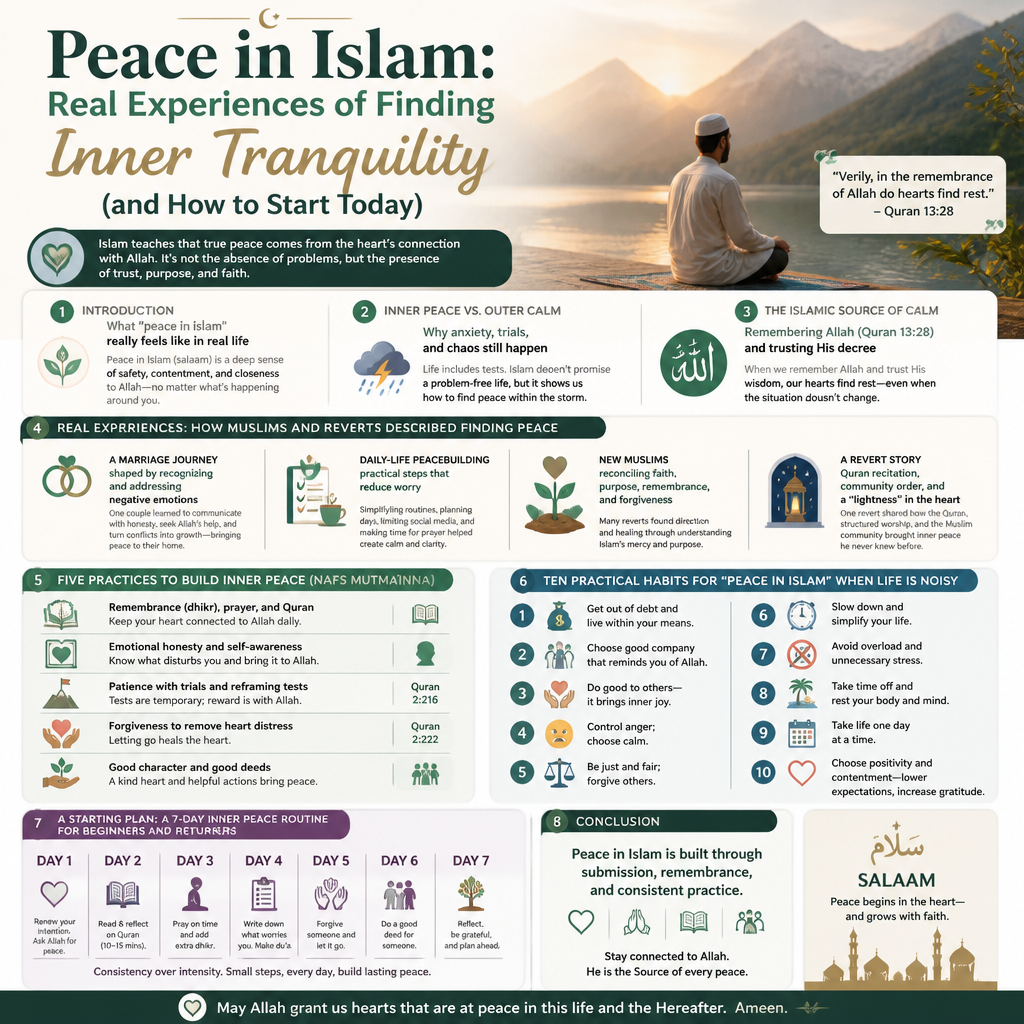
1) Introduction: What “peace in Islam” really feels like in real life
Islam doesn’t promise an easy external life. Instead, it points to a specific kind of stability: inner tranquility—a heart that doesn’t panic every time life gets loud.
Many people describe peace in Islam as:
- Lightness after reciting Quran or making dua
- Order in chaos—knowing what to do next
- Hope even when outcomes are uncertain
- Less reactivity (anger, jealousy, worry) and more response
- Trust that Allah is managing what you can’t manage
In short: peace in Islam is not the absence of problems; it’s the presence of Allah in your coping.
2) Inner peace vs. outer calm: why anxiety, trials, and chaos still happen
It’s important to be honest: even practicing Muslims can feel anxious. The Qur’an describes believers being tested. Real life includes debt, conflict, health issues, family stress, immigration uncertainty, and financial pressure.
So what changes?
Inner peace religion teaches that you don’t only work on circumstances—you also work on the heart. External conditions can shake your life, but nafs mutma’inna (the reassured soul) is built through faith-based practices.
One Muslim writer notes that negative emotions often act like warnings: if they’re ignored, they can quietly block growth and happiness. Peace doesn’t mean “no feeling.” It means knowing what your feelings are telling you and turning them back toward Allah.
3) The Islamic source of calm: remembering Allah (Quran 13:28) and trusting His decree
Allah gives us a direct anchor for calm. In the Qur’an:
“Verily, in the remembrance of Allah do hearts find rest.” (Qur’an 13:28)
This verse is not theoretical—it explains why many people feel peace when they connect to Allah consistently:
- Qur’an recitation calms the nervous system and the soul
- Prayers give structure to your day and direction to your mind
- Dua interrupts despair and turns “what if” into “O Allah”
- Trust (tawakkul) reduces the need to control everything
And when trials feel unfair, Islamic guidance reframes them as tests. One well-known Qur’anic message teaches believers to respond to hardship with patience and hope—not denial. (See also the meaning of: Qur’an 2:216 about hardship and what Allah may grant through it.)
4) Real experiences: how Muslims and reverts described finding peace
A marriage journey shaped by recognizing and addressing negative emotions
One personal story describes a Muslim woman who faced years of marital unhappiness after early struggles. Her insight was not simply “my spouse was difficult.” Instead, she discovered how unrecognized negative emotions can keep a person stuck. Over time, she emphasized that peace is a core requirement for being a successful Muslim—second in importance to having a strong relationship with Allah.
Her turning point included practical strategies:
- emotional self-awareness (not pretending everything is fine)
- dua during problems
- keeping inner peace as a goal
- patience through Qur’an and prophetic reminders
What changed? She describes how restoring inner calm helped her life, and—importantly—helped the relationship improve after long tension.
Daily-life peacebuilding: practical steps that reduce worry
Another discussion on finding peace in a turbulent world highlights that inner peace is achievable even when external life is difficult. It points to practical daily life measures—like changing habits, relationships, and emotional responses—because worry often grows in predictable areas.
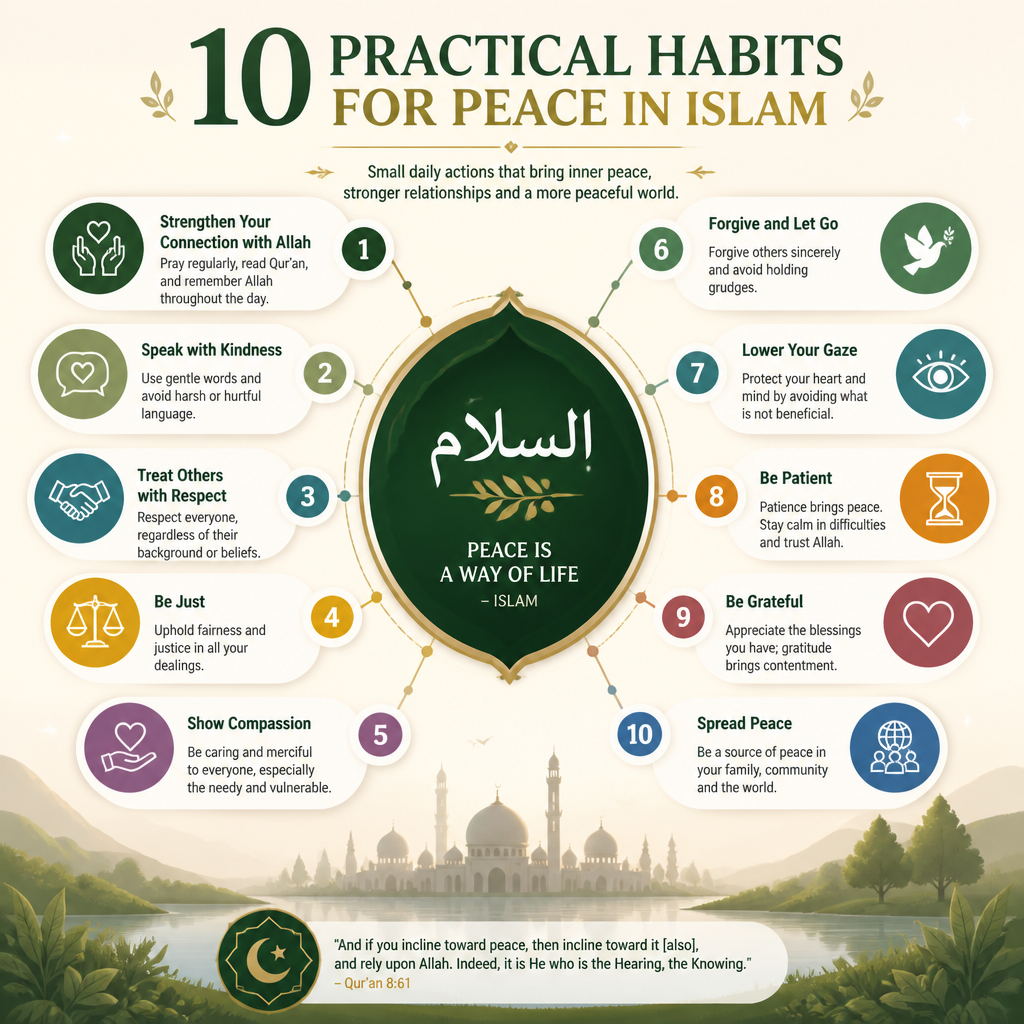
Examples include:
- Getting out of debt to reduce constant stress
- Keeping good company so your heart is not poisoned by negativity
- Doing good to others to shift focus from self-spiraling
- Controlling anger and practicing forgiveness
- Slowing down (avoiding overload and burnout)
- Taking time off and taking life “one day at a time”
- Being content by lowering expectations and increasing gratitude
This is peace in Islam as daily construction: you rebuild the heart by rebuilding your routine.
New Muslims: reconciling faith, purpose, remembrance, and forgiveness
For converts and new Muslims, inner peace can feel both exciting and confusing—especially when you’re learning faith while also carrying old emotional patterns.
One article aimed at new Muslims describes peace in Islam as freedom from disturbance—not merely calm moods, but a stable heart under Allah’s guidance. It highlights key methods:
- Understand “peace” in Islamic terms (aligned life under Allah)
- Identify obstacles like anger, jealousy, or greed
- Discover your purpose beyond jobs or status
- Strengthen remembrance: prayer, dhikr, and Qur’an
- Practice forgiveness to remove heart distress
In other words, peace comes when faith becomes practice—and practice becomes character.
A revert story: Quran recitation, community order, and a “lightness” in the heart
One revert story shares how peace appeared unexpectedly amid chaotic life events—immigration stress, family concerns, and uncertainty. The person noticed a different kind of order in Muslim spaces and felt calm after listening to Qur’an recitation, even without understanding every word.
That “lightness” mattered. Some commenters interpreted it as a form of guidance and the natural pull of fitrah (human disposition toward truth). Their advice included:
- reading Qur’an with translation (such as via quran.com)
- visiting the local mosque
- learning from real people, not only social media
- allowing time—conversion is a process
The shared theme: peace can start through connection—through sound, community, and consistent steps toward Allah.
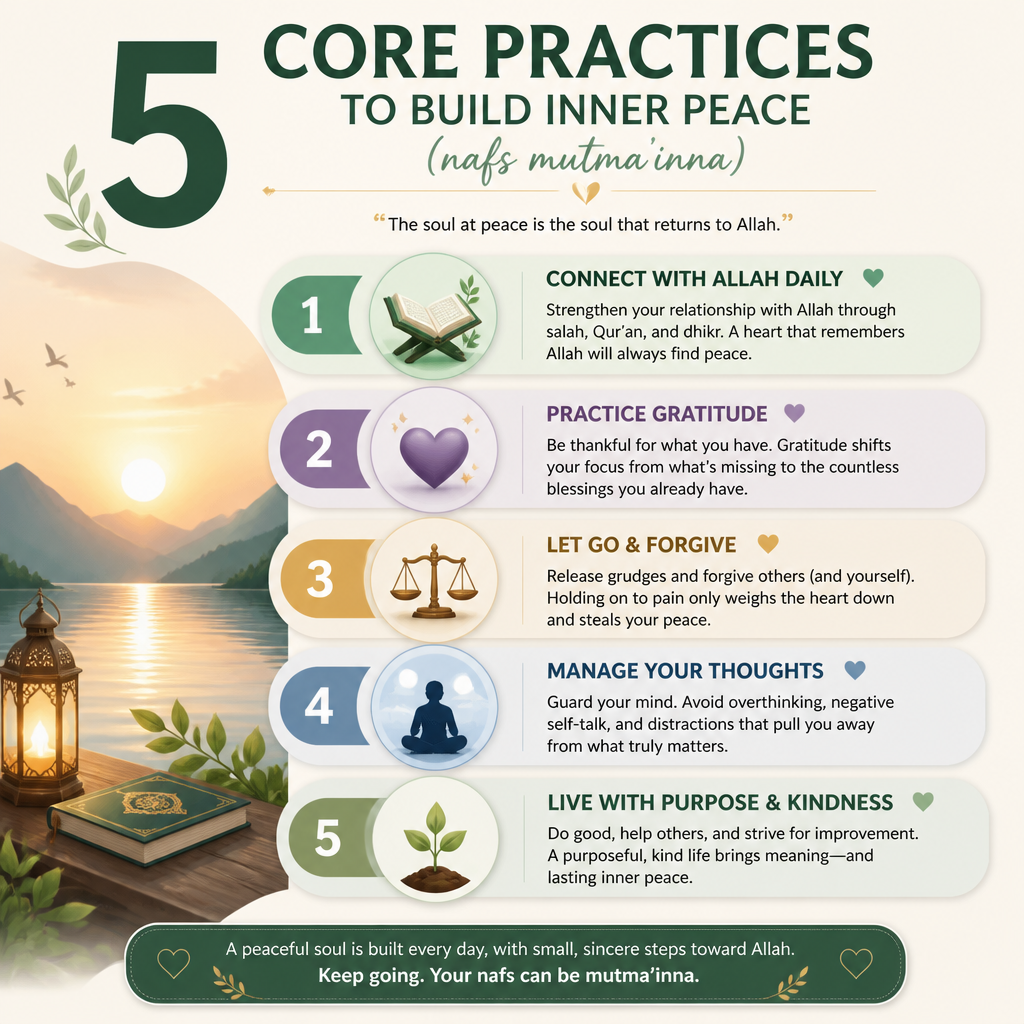
5) Five practices to build inner peace (nafs mutma’inna)
True inner peace is not accidental. It is cultivated. Here are five Islamic anchors that repeatedly show up in how believers find tranquility:
1. Remembrance (dhikr), prayer, and Qur’an
Start where you can. Consistency beats intensity. Even a short routine—Qur’an recitation and dhikr after salah—can stabilize your heart.
2. Emotional honesty and self-awareness of what disturbs you
Ask: What situation triggers my anxiety? What thought loops steal my sleep? What emotion do I keep suppressing?
Peace grows when you name the problem before you react to it.
3. Patience with trials and reframing tests (Qur’an 2:216)
Patience in Islam isn’t passive. It’s a disciplined response: you keep praying, keep learning, and keep taking wise steps while trusting Allah’s wisdom.
4. Forgiveness to remove heart distress (Qur’an 2:222)
Holding onto grudges creates ongoing pressure inside the heart. Forgiveness releases that pressure. It doesn’t always mean ignoring harm—it means choosing Allah’s standard over endless self-torment.
5. Good character and good deeds as peace anchors
Acts of goodness soften the heart. Good character reduces conflict. When you do good consistently, your life becomes less about self-protection and more about Allah’s pleasure.
6) Ten practical habits for “peace in Islam” when life is noisy
Here are ten habits drawn from Islamic practical guidance—because peace often improves when your environment and behaviors improve:
- Get out of debt (or create a realistic plan to reduce it).
- Choose good company and limit constant exposure to negativity.
- Do good to others (small acts count).
- Control anger—pause, breathe, and respond later.
- Be just and forgive where you can.
- Slow down and avoid overload.
- Take time off to rest your mind and reset your heart.
- Take life one day at a time (don’t rent tomorrow’s stress).
- Look at the positive side without denying reality.
- Be content: lower expectations, increase gratitude.
These are not “quick fixes.” They are peace-building behaviors that align with faith.
7) A starting plan: a 7-day inner peace routine for beginners and returners
If you want peace in Islam, don’t wait until you feel calm. Build calm by practicing it. Here’s a simple week you can begin today:
Day 1: Choose your peace anchor
- After one salah, make a short dua about your biggest worry.
- Write one sentence: “Today I will seek peace through Allah.”
Day 2: 10 minutes of Qur’an (with meaning if possible)
- Recite or listen to Qur’an for at least 10 minutes.
- If you can, read a translation to connect meaning to emotion.
Day 3: Emotional self-check
- Ask: What emotion is loudest today—anger, fear, jealousy, grief?
- Respond with a dua and one small action you can control.
Day 4: Forgiveness practice
- Choose one person (or one incident) and make istighfar for yourself.
- Ask Allah to remove heart distress.
Day 5: One act of goodness
- Do one helpful deed—send a kind message, help someone, donate if you can.
Day 6: Reduce one stress trigger
- Cut one source of overload: limit social media doomscrolling, postpone one nonessential task, or plan your finances for a clearer next step.

Day 7: Reset your intention
- Review the week: what made you feel even 5% calmer?
- Decide what to repeat next week (don’t overhaul everything at once).
That’s it. Consistency creates inner peace over time.
8) Conclusion: peace is built through submission, remembrance, and consistent practice
Finding peace in islam is not about pretending life is easy. It’s about learning how the heart becomes steady when Allah becomes the center.
Real experiences—marriage journeys, daily habit changes, convert stories, and revert awakenings—share one core lesson:
Inner peace is built through submission, remembrance, patience, forgiveness, and good character.
If you’re starting now, begin small: one dua, a portion of Qur’an, and one habit that reduces stress. Insha’Allah, peace will grow—not as a moment, but as a way of living.