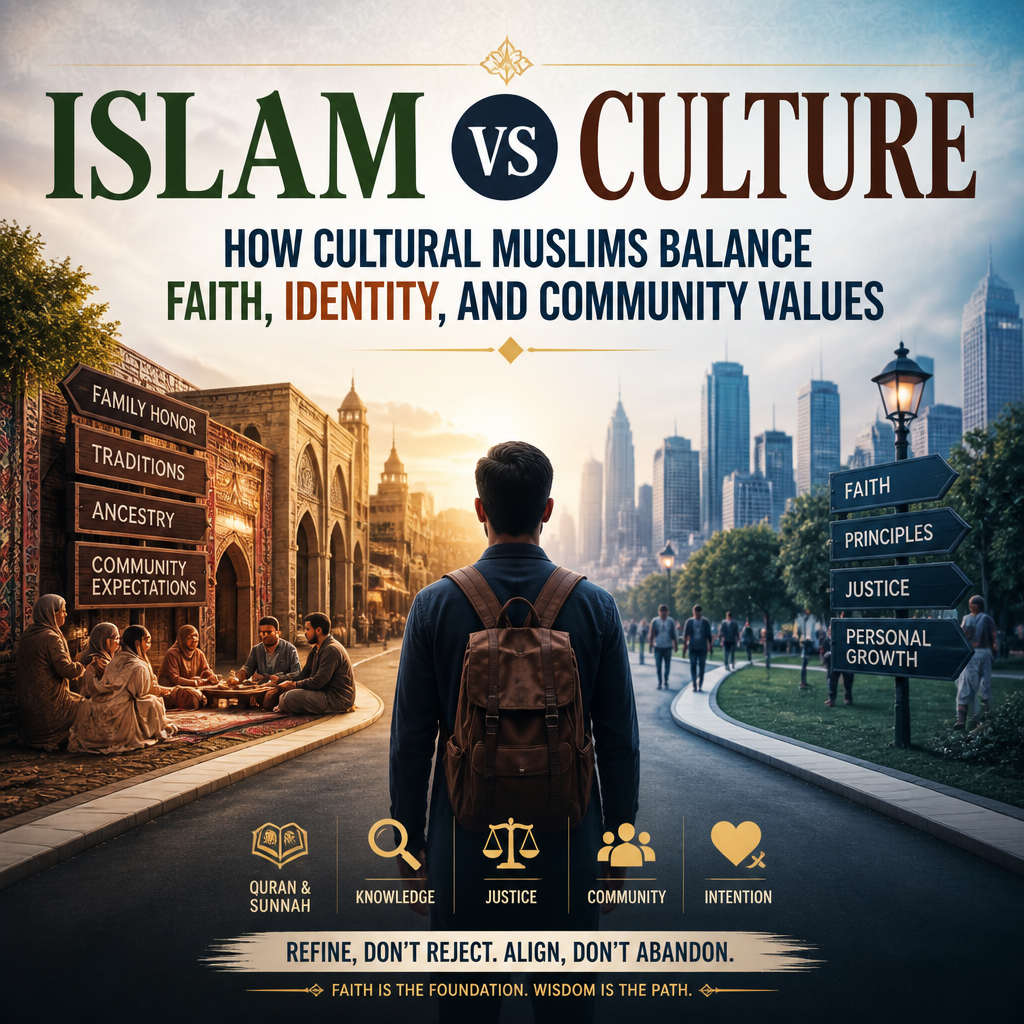
Islam vs Culture: How Cultural Muslims Balance Faith, Identity, and Community Values
“Is it cultural or is it religious?” For many cultural Muslims, that question isn’t theoretical—it comes up at home, in community gatherings, and in the daily negotiations of belonging. Some customs feel sacred because they were practiced by your family for generations. Others feel non-negotiable because they seem to protect identity. But Islam makes a clear demand: to prioritize Quran and Sunnah over inherited habits when they conflict.
This article explores islam vs culture in a practical, non-inflammatory way. You’ll learn how Islam relates to culture, how to spot common friction points, and how cultural Muslims can build a balanced identity—especially in Western contexts—without losing either faith or family.
1) Why “culture vs religion” debates feel personal for many cultural Muslims
Unlike academic arguments, “culture vs religion” debates can feel like a verdict on your family, your upbringing, and your community. When someone says, “That’s not Islam,” it may sound like, “Your people were wrong.” When someone says, “That’s our tradition,” it may sound like, “Revelation is optional.”
For cultural Muslims, the challenge is emotional as well as intellectual:
- Identity pressure: Culture is how you recognize yourself—language, food, celebrations, etiquette, family roles.
- Relational ties: Customs are carried by elders and connected to love, respect, and belonging.
- Religious accountability: Islam asks for sincerity, worship, and moral boundaries rooted in revelation.
The goal, then, is not to “pick a side” like a sports team. The goal is to clarify what Islam affirms, what it refines, and what it corrects.
2) Define the terms: what we mean by “culture” in everyday Muslim life
In everyday conversation, culture can mean many things. For most cultural Muslims, it includes:
- Customs and habits (how families celebrate, speak, greet, or gather)
- Ethnicity and ancestry (shared history, regional practices, inherited worldview)
- Social expectations (what is “appropriate” regarding marriage, gender roles, education, or authority)
- Informal rules (taboos, unspoken “musts,” and norms that spread through family stories)
To understand islam vs culture, it helps to ask: Which of these are Islam’s principles, and which are simply inherited patterns? Islam is not blind to culture—it knows humans live within societies. But Islam does insist that some boundaries come from revelation.
3) Islam’s stance toward culture: preservation, refinement, and limits
Islam’s relationship with culture can be summarized as a filter, not an eraser approach:

- Preserve what is beneficial, dignifying, or compatible with Islamic moral values.
- Refine what can be improved—redirecting intention and aligning practices with Quran and Sunnah.
- Limit or reject anything that contradicts tawheed (God’s oneness) or Islamic ethics.
Important point: Islam doesn’t treat culture as the source of truth. Islam treats revelation as the standard, while culture is a tool that may be shaped by that standard.
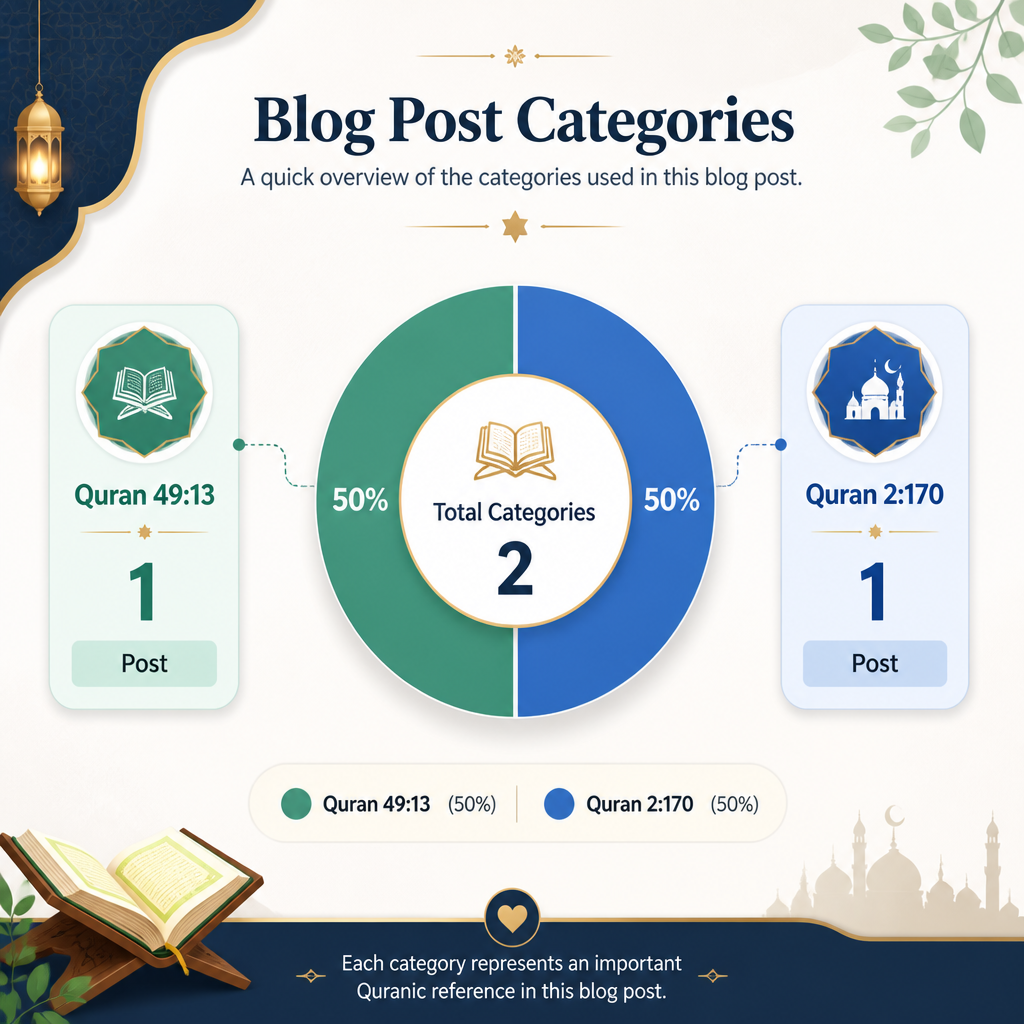
The Quran affirms the diversity of peoples—“We made you nations and tribes that you may know one another”—yet it also warns against prioritizing forefathers’ practices over divine guidance (see Quran 49:13; Quran 2:170). In other words: identity and diversity matter, but they are not immune from correction.
4) Common friction points: when cultural expectations conflict with Quran and Sunnah
In many households and communities, the clash is not usually about food or language—it’s about moral authority. Here are common categories where cultural expectations can drift into religious claims:
Marriage and family authority
Culture may define marriage as “family control,” or treat women’s consent as negotiable. Islam, by contrast, upholds justice and legitimate consent while encouraging kindness between spouses and respect toward parents.
Rituals and religious symbolism
Sometimes cultural rituals gain religious gravity—people begin to treat “how we do it” as if it were a command from God. Islam may allow the celebration, but it will not allow religious meaning to be invented.
Gender norms and moral boundaries
Cultural rules about modesty, leadership, and participation can become harsher or broader than what Islam prescribes—or sometimes even replace Islamic ethics with social hierarchy. Islam asks believers to treat people with justice and to distinguish what is moral from what is merely traditional.
Education and moral priorities
Culture can sometimes push status, reputation, or “fitting in” above character, worship, and learning. A thriving Islamic identity should produce both competence and worship, not only social legitimacy.
5) The “filter, not eraser” approach: keep what Islam affirms; correct what Islam rejects
So what should a cultural Muslim do when culture and Islam collide? A helpful framework is the filter, not eraser approach:
- Ask: Does this practice align with Quran and Sunnah?
- Separate: What is intention and worship vs. what is tradition and habit?
- Retain: Keep what Islam affirms—dignity, hospitality, community bonding.
- Refine: Adjust the practice where Islam provides a clearer moral direction.
- Reject: Remove anything that contradicts Islamic principles.
This is not cultural cowardice and it’s not cultural arrogance. It’s tawheed-centered thinking—placing God’s guidance at the center and treating culture as something that can be re-shaped.
6) Avoiding blind loyalty: why inherited practices can become a moral blind spot
One danger is blind loyalty—treating inherited practices as untouchable because they are old. The Quran warns against this kind of thinking: when forefathers are elevated into a moral authority that competes with revelation, people lose the ability to evaluate practices ethically.
In practical terms, blind loyalty can show up as:
- “We’ve always done it this way” replacing “Where is the evidence?”
- “Don’t question elders” substituting for seeking Islamic guidance
- Selective justification where only comfortable parts of Islam are emphasized
Islam honors elders and parents, but it does not allow human authority to override God’s guidance.
7) Building a balanced identity in diaspora: islam vs culture in Western contexts
In Western societies, the tension can become sharper. Cultural Muslims may feel:
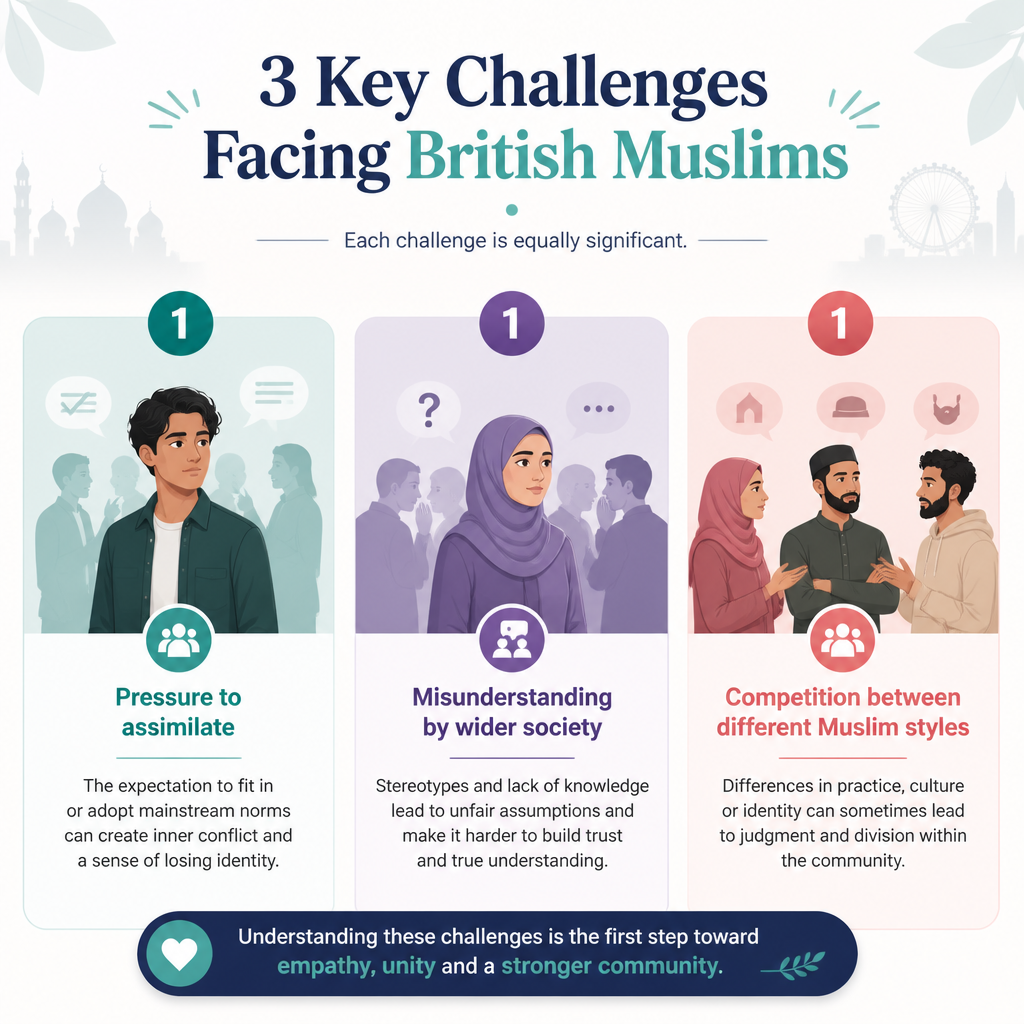
- Pressure to assimilate socially and morally
- Misunderstanding by the wider society due to stereotypes and media framing
- Competition between different Muslim “styles” (ethnic traditions, immigrant norms, and varying interpretations)
Research on Islam and Western culture notes that Muslim diaspora communities often develop adaptation strategies that maintain faith without full assimilation. This can include building community networks, using media, and developing parallel “lifeworlds” where Islamic values are protected while still navigating the host society.
The key is not to hide. The key is to live Islam authentically—while communicating with wisdom and staying firmly grounded.
8) Media, secularism, and enclave strategies: preserving values while adapting
One way communities respond to perceived cultural invasion is through “enclave” strategies—creating environments where Islamic norms are reinforced. This can look like religious programming, community centers, faith-based education, and digital spaces that offer continuity of values.
At the same time, there’s a balancing act. Enclaves can protect faith, but they can also harden identity into rigid “us vs. them.” A balanced cultural Muslim approach keeps the community strong while ensuring:
- Learning continues (not only tradition-preservation)
- Reform is possible (culture is evaluated, not worshipped)
- Engagement remains respectful (Islam calls to good, not to hostility)
In short: adaptation should not mean dilution; preservation should not mean stagnation.
9) From conflict to clarity: using knowledge to distinguish faith principles from cultural add-ons
Clarity rarely arrives through emotions alone. It arrives through knowledge, especially knowledge that helps you distinguish:
- What is a principle (binding moral or worship-related guidance)
- What is a custom (non-binding social practice)
- What is a local adaptation (regionally common ways of doing permissible things)
A valuable mindset is that culture and Islam are not enemies by default. The enemy is confusion—the inability to tell when a tradition is merely inherited vs. when it is truly Islamic.
Practical steps for cultural Muslims include:
- Learn fundamentals (tawheed, worship, core ethics)
- Develop discernment (what’s evidence-based vs. anecdote-based)
- Ask qualified questions with adab (respectful approach)
- Observe outcomes (does this practice cultivate good character or hidden harm?)
10) Reform from within: practical examples (marriage, rituals, gender norms, education)
Reform does not mean rebellion against family. It means aligning community life more closely with revelation—gradually, wisely, and with compassion. Here are common areas where reform is often needed.
A) Marriage: from tradition-based pressure to values-based justice
Islam can affirm celebrations and community involvement, but reform may be needed when customs override:
- Consent and mutual respect
- Character and compatibility over status
- Kindness over control
A cultural Muslim can keep the warmth of family support while ensuring the marriage process is consistent with Islamic ethics.
B) Rituals: keeping beauty without adding religious weight
Many traditions bring joy and meaning. The reform question is: Are we treating cultural rituals as religious mandates?
Islam generally allows permissible customs, but it discourages attaching invented religious authority to them. You can preserve celebration while maintaining correct belief.
C) Gender norms: moving from hierarchy to Islam’s justice
Cultural Muslims may inherit gender expectations that are harsher than Islam or that confuse modesty with disrespect. Reform can focus on:
- Adab and respect toward all people
- Practical involvement consistent with Islam’s guidance
- Education for both women and men, grounded in authentic Islamic learning
D) Education: replacing reputation with worship and character
Some cultures measure success primarily through social standing. Islamic reform emphasizes:
- Worship as the anchor
- Learning as an obligation
- Good character as a visible outcome
11) Justice and empowerment: when culture becomes a barrier (ancestral knowledge and resistance)
While we discuss the risk of culture overpowering religion, there’s another important dimension: justice. Sometimes communities struggle not because culture conflicts with Islam, but because culture has been reshaped by power dynamics—often in ways that marginalize certain groups.
Research influenced by ideas like Ancestral Knowledge (AK) highlights how Islam historically interacted with diverse practices and how immigrant cultural norms can become unfair standards—sometimes sidelining Black, Latino, and Indigenous Muslims. In these situations, the issue isn’t “religion vs culture” but rather which forms of knowledge and identity are treated as legitimate.
Empowerment can mean reclaiming knowledge traditions that support moral clarity and social justice—especially when communities face systemic harms like the school-to-prison pipeline. The broader lesson is that Islamic reform includes both spiritual fidelity and ethical courage.
12) A constructive conclusion: toward unity through tawheed, wisdom, and gradual reform
To balance islam vs culture, the answer is not to reject your heritage or to romanticize it. The answer is to place tawheed and revelation at the center and treat culture as something that can be:
- Kept where Islam affirms it
- Corrected where it conflicts with Quran and Sunnah
- Reformed with knowledge, adab, and patience
If you are a cultural Muslim, you can honor your family while still holding onto Islamic truth. You can preserve beauty and community while refusing blind loyalty. And you can build a confident identity that is neither trapped in tradition nor detached from faith.
Bottom line: Culture shapes how we live Islam—but Islam determines what we worship, how we practice, and how we judge what is right.
References (top resources used)
- Kennedy Center / BYU. Islam and Western Culture. https://kennedy.byu.edu/alumni/bridges/features/islam-and-western-culture
- Yaqeen Institute. Is it Cultural or Religious? The Role of Culture in Islam. https://yaqeeninstitute.org/read/paper/ancestral-knowledge-and-american-muslims-rooting-cultural-resistance-in-islam
- Al-Furqaan Foundation. When culture clashes with Islam, what should you follow? https://furqaan.org/when-culture-clashes-with-islam-what-should-you-follow/