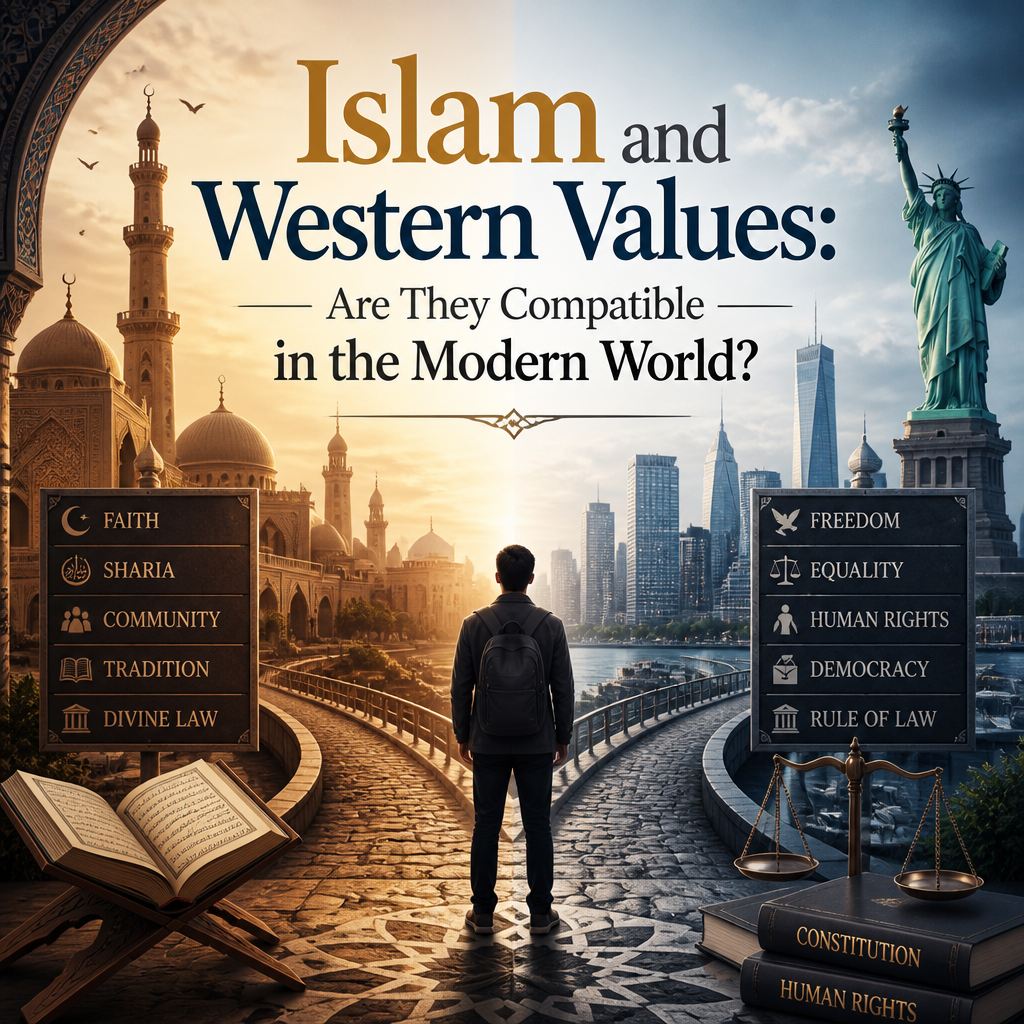
Framing the Question: “Islam and Western Values” in the Islam Modern World
The question “islam and western values compatible?” is asked with different motives. Some people ask it to promote harmony and mutual understanding. Others ask it to argue that one civilization should dominate the other. Still others ask it because public debates—on law, gender roles, immigration, or religious freedom—feel increasingly polarized.
To answer responsibly, we must define what we mean by “values.” In many Western contexts, “western values” refers to a bundle of ideas often associated with secular civil law, individual rights, equality, and freedom of religion understood as voluntary belief protected by the state. In many Islamic contexts, “values” are expressed through religious law (commonly summarized as sharia) and a worldview in which public life and moral obligations are tied to divine revelation.
A first tension appears immediately: if a society treats law as primarily a human contract among individuals, it will lean toward secular frameworks. If it treats law as divine guidance that orders the whole life of the community, it will lean toward religious frameworks. This is why compatibility is not merely cultural—it is jurisprudential and philosophical.
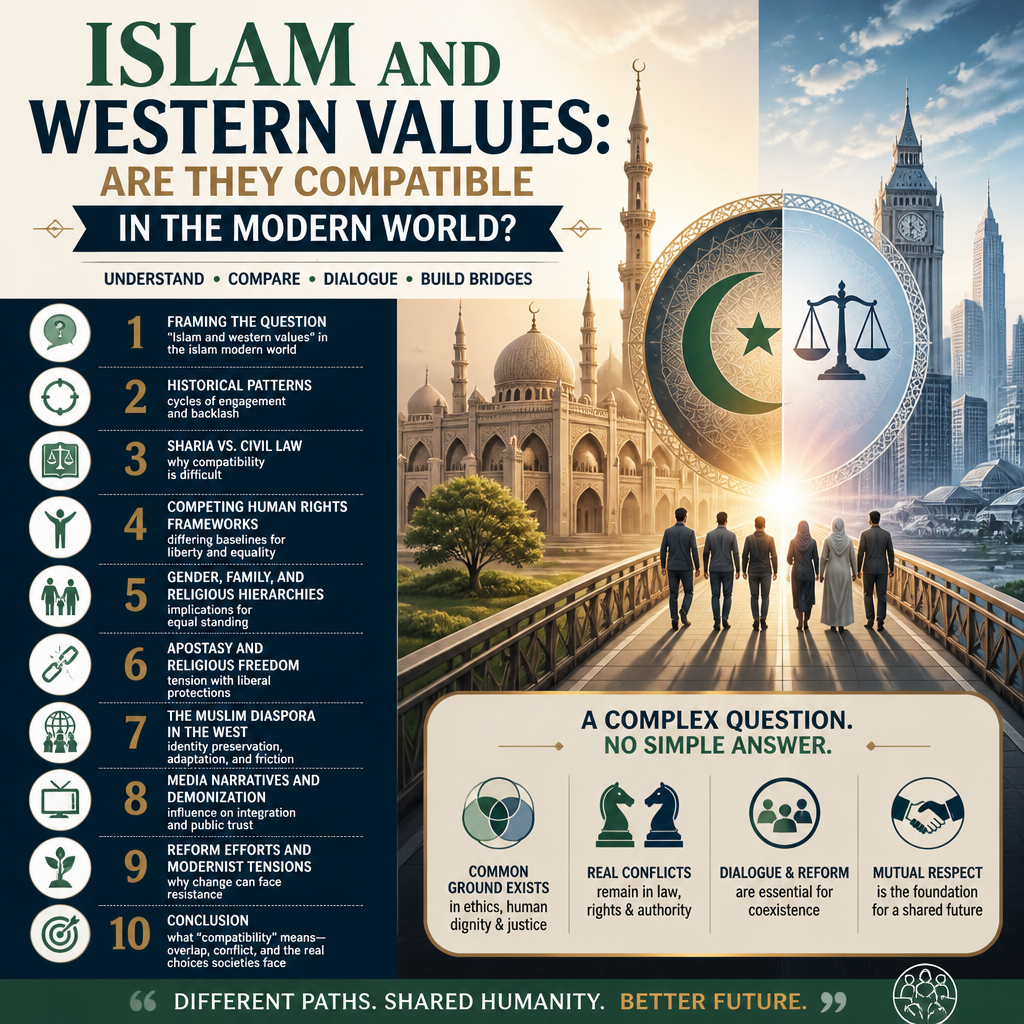
Historical Patterns: cycles of engagement and backlash
Modern debates often assume today’s conflict is entirely new. Yet history shows recurring patterns. Islamic societies have periodically engaged with outside knowledge—through translation movements, universities, and learning from neighbors—followed by cycles of identity-protecting backlash aimed at preserving Islamic distinctiveness.
One recurring theme is that openness to ideas can coexist with boundaries: external learning may be welcomed in science or medicine, while core religious law and moral order face resistance to being “redefined” by foreign political models. In other words, engagement does not always translate into wholesale acceptance of Western liberalism.
This historical rhythm helps explain why the relationship between islam and western values can look like “progress” in one domain and “retreat” in another—especially when Western institutions claim jurisdiction over religion, family law, or moral norms.
Sharia vs. Civil Law: why compatibility is difficult
The heart of many conflicts is the question of legal authority.
1) Different sources of legitimacy
In many Western liberal states, the legitimacy of law is rooted in democratic procedures and the principle that civil law governs all citizens regardless of religion. By contrast, classical Islamic jurisprudence treats sharia as a comprehensive divine legal framework covering worship, personal status, ethics, and more.
2) Parallel systems and jurisdictional friction
When states attempt to accommodate religious law informally (through arbitration, councils, or community-based practices), a tension can persist: the civil system may say “rights belong to individuals under one uniform law,” while religious frameworks may say “personal status and moral obligations are ordered by God’s law.”
The result can be parallel expectations that do not fully harmonize—especially when controversies involve testimony, inheritance, family discipline, or penalties.
3) A compatibility test: equality under a single legal roof
A practical way to assess compatibility is to ask whether the state can apply the same legal principles to everyone, including in matters traditionally regulated by religion. If the answer is “yes,” then the society is likely moving toward a model where religious belief remains private and voluntary. If the answer is “no,” and religious law is treated as the decisive standard for public outcomes, compatibility with Western liberal civil equality becomes harder.

Competing Human Rights Frameworks: differing baselines for liberty and equality
Western human-rights discourse typically assumes a baseline of individual autonomy: individuals should be free to choose beliefs, lifestyle, and identity, and the state should not coerce religion or enforce a religious moral code.
In classical Islamic legal reasoning, human well-being is pursued through obedience to God. That does not automatically mean “no rights” or “no dignity,” but it changes the baseline. Rights may be balanced against duties to the religious order.
This is why clashes can arise on issues such as:
- religious freedom (freedom from coercion vs. religious boundaries on acceptable belief/behavior),
- public morality (what the state should promote),
- freedom of expression (limits when expression is seen as religiously offensive).
These differences are not merely “opinion.” They are rooted in what counts as legitimate authority and what a society believes it is for.
Gender, Family, and Religious Hierarchies: implications for equal standing
One of the most visible points of disagreement concerns gender and family.
Western values often emphasize that women and men should have equal standing before the law and equal access to civic and political life. Classical Islamic jurisprudence, as commonly interpreted, has historically described different roles, responsibilities, and legal implications for men and women. Even when modern Muslim thinkers argue for reform, the underlying debate remains about how much classical rules can be reinterpreted and by what method.
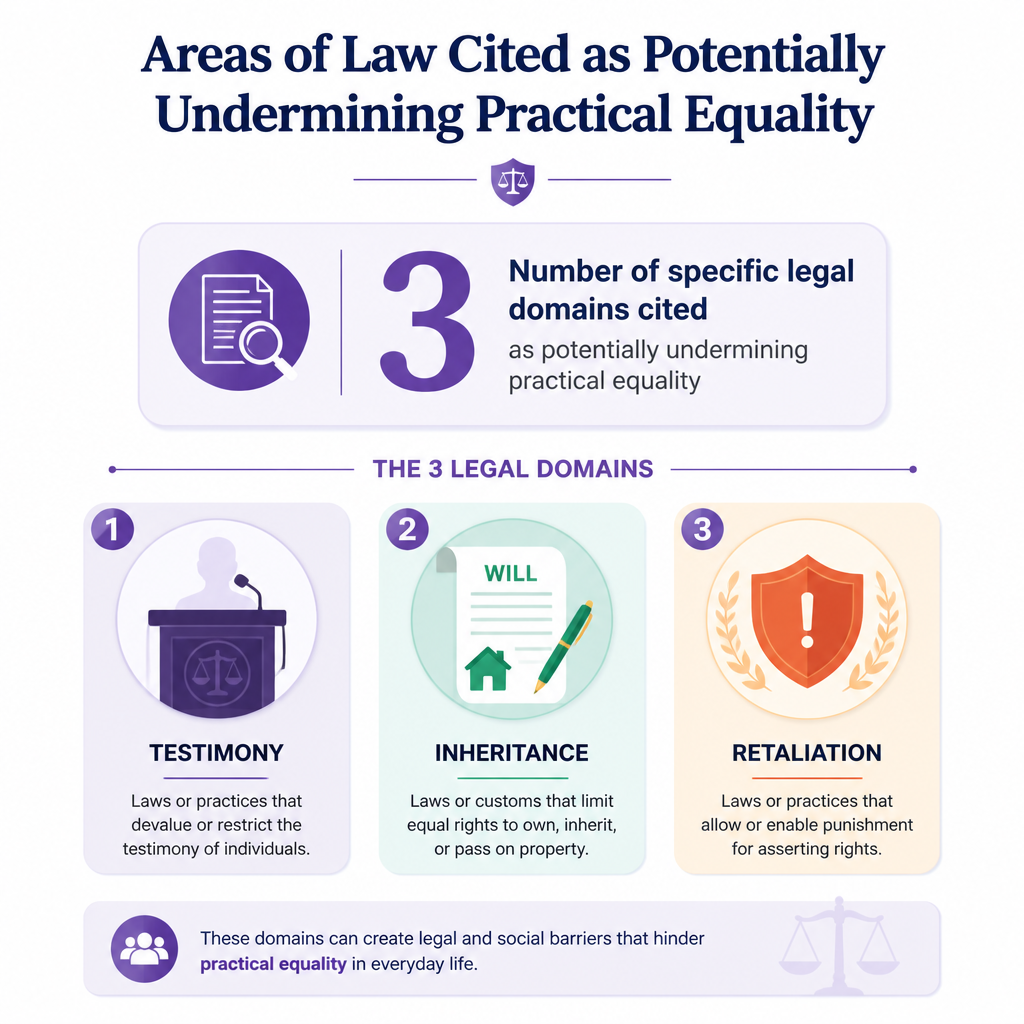
Critics argue that certain legal consequences—for example, in areas like testimony, inheritance rules, or retaliation frameworks—can undermine practical equality. Supporters often respond that those rules are contextual, culturally affected, or guided by a moral vision of family and social order.
In short, islam and western values may overlap in shared moral language—justice, compassion, family stability—but diverge in how those moral goals are operationalized in law.

Apostasy and Religious Freedom: tension with liberal protections
Another high-stakes area is apostasy—leaving Islam—or converting from one religion to another. In many Western liberal frameworks, state neutrality means the government generally protects the right to change religion.
In classical Islamic jurisprudence, apostasy has historically been treated as a severe offense, not simply a private belief change. The compatibility question therefore becomes: will a Western state protect apostasy as a fully protected liberty, even when a community’s religious-legal tradition considers it illegitimate?
This is where discussions can become uncomfortable. If a society fully affirms apostasy as a right under civil law, it is moving away from traditional legal premises. If it treats apostasy as socially or legally constrained, it is moving away from key liberal assumptions about individual conscience.
The Muslim Diaspora in the West: identity preservation, adaptation, and friction
Compatibility is not only a theoretical question; it is a lived experience. For Muslims living in Europe and North America, public debates about assimilation, discrimination, and security shape how communities respond.
Research and commentary on Muslim experience in Western culture highlight several patterns:
- Identity preservation through community institutions (mosques, schools, associations).
- Adaptation to Western opportunities alongside selective distance from certain norms.
- Friction when cultural expectations clash with public rules—especially around gender, schooling, or religious expression.
- Media pressures that can stigmatize Muslims, making integration feel riskier.
Some commentators note that satellite and transnational media can strengthen religious-lifeworlds and reduce the pressure to assimilate into a purely secular identity.
Even with good intentions on both sides, these dynamics can create a “mismatch”: the host society expects gradual liberalization of public identity, while some religious communities expect religious continuity.
Media Narratives and Demonization: influence on integration and public trust
Public trust is a major factor in whether multicultural societies can manage disagreement. Yet Western media narratives sometimes portray Muslims primarily through conflict-related frames. When terrorism or extremism becomes the dominant lens, it can reduce willingness to distinguish between different beliefs and communities.
This matters for compatibility because social hostility can push minority communities into defensive cohesion—reinforcing the very identity boundaries that make dialogue harder.
In response, advocacy and civil-rights organizations sometimes emerge to challenge stereotyping and protect Muslim civil liberties. But the underlying question of how islam and western values relate legally and morally remains.
Reform Efforts and Modernist Tensions: why change can face resistance
It would be inaccurate to claim that Muslim societies are static. Many Muslims—scholars, activists, and ordinary believers—work to interpret Islam in ways that engage modern life. They may argue for ethical evolution, reinterpretation of sources, or new understandings of rights.
However, reform efforts often face two opposing pressures:
- From traditionalists, who may see reform as abandoning core teachings.
- From outside critics, who may treat reform as inherently suspicious—an attempt to “fit into” Western expectations rather than remain faithful.
This can produce a modern dilemma: if compatibility requires abandoning classical legal premises, reformers may be accused of betraying Islam; if reform does not abandon them, critics may argue that compatibility cannot be achieved. The disagreement is therefore both moral and political.
Conclusion: what “compatibility” means—overlap, conflict, and the real choices societies face
So, are islam and western values compatible in the modern world? The most honest answer depends on the meaning of “compatible.”
1) Overlap is real. Islam and Western societies can share values like compassion, charity, family care, and dignity.
2) Conflict is also real. Differences often arise where Western liberalism expects secular civil authority and individual rights to be prioritized over religious-legal jurisdiction—especially in matters of family law, gender equality in practice, and apostasy.
3) The key choice is institutional. Compatibility tends to increase when religious belief is protected as a personal freedom while the state applies one uniform civil law to all citizens. Compatibility tends to decrease when religious legal premises are treated as binding on public outcomes.
Ultimately, societies will have to decide whether “neutral pluralism” means protecting religion as a private conscience, or whether pluralism includes allowing religious-legal systems to shape civil rights. That decision—more than slogans—will determine what islam and western values look like when they meet.
References (top resources used)
-
Christ Over All — “Is Islam Compatible with Western Values?”
https://christoverall.com/article/concise/is-islam-compatible-with-western-values/ -
BYU Kennedy Center — “Islam and Western Culture”
https://kennedy.byu.edu/alumni/bridges/features/islam-and-western-culture -
World Evangelical Alliance — “Is Islam Compatible with Western Civilization?” (Christine Schirrmacher)
https://worldea.org/news/is-islam-compatible-with-western-civilization-christine-schirrmacher/