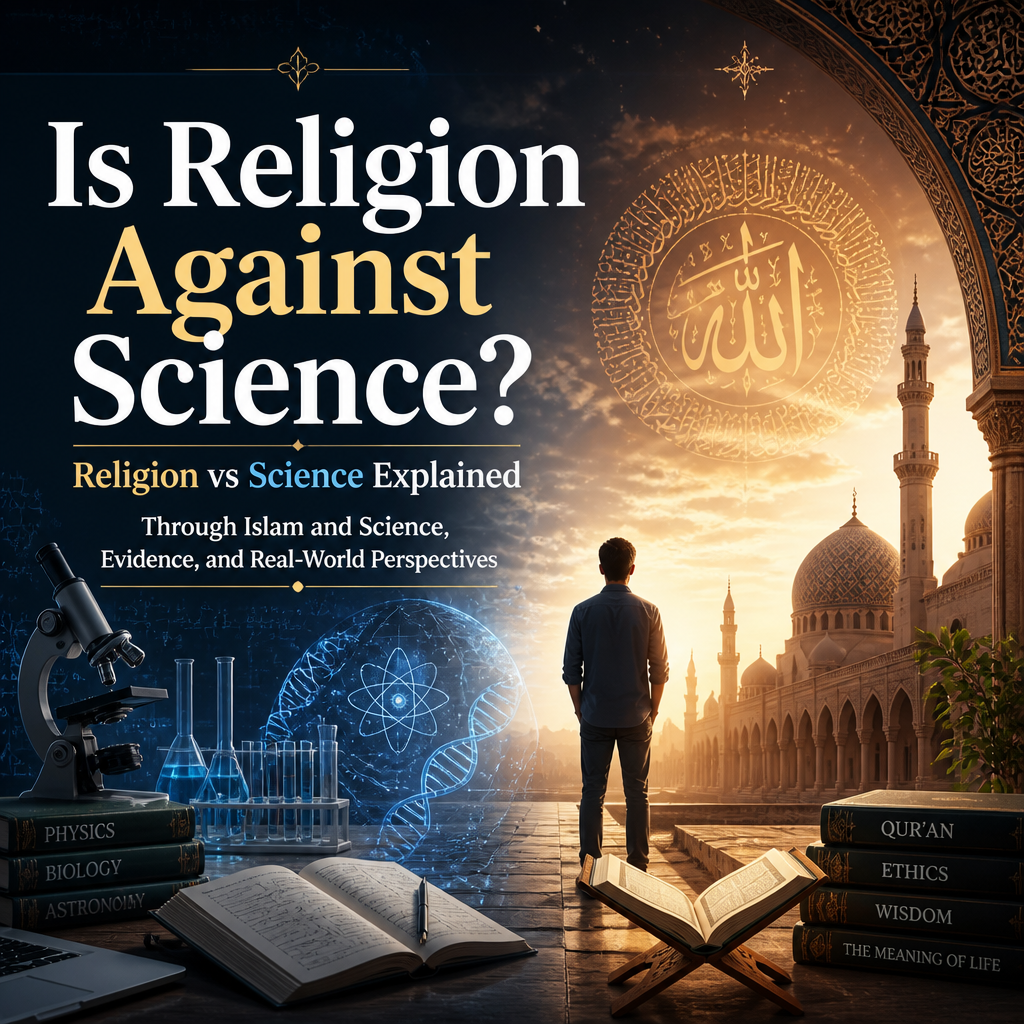
Is Religion Against Science? Religion vs Science Explained Through Islam and Science, Evidence, and Real-World Perspectives + (banner)
Is Religion Against Science? Religion vs Science Explained Through Islam, Evidence, and Real-World Perspectives
Every few months, the internet seems to resurface the same dramatic question: is religion against science? The “religion vs science” framing is persuasive because it captures real disagreements—especially around evolution, medicine, and the ethics of new technology. But when you look closely, the picture becomes more complicated (and much more interesting) than a simple war story.
In this article, we’ll slow down the debate. We’ll define what science is (and isn’t), clarify what religion typically does, and examine why conflict often shows up only when claims overlap. Then we’ll add a grounded perspective on Islam and science by looking at how different Muslim communities understand compatibility and where tensions tend to arise.
1) The question behind “religion vs science”: why the conflict story feels persuasive
The conflict narrative sounds convincing because it’s easy to spot moments of disagreement:
- A public argument about evolution or cosmology
- A court case or school-board dispute
- A controversy around genetic engineering, cloning, or reproductive technologies
- A headline announcing a “battle” between believers and scientists
These events are real. But a key problem is that disagreement is not the same thing as incompatibility.
Many conflicts are actually about:
- Different interpretations of religious texts
- Different judgments about what counts as evidence
- Different boundaries between spiritual meaning and natural explanation
- Different ethical priorities when technology outpaces moral debate
2) What science is (and what it isn’t): testable claims, models, and methods
To compare religion and science fairly, we need to be clear on what science does.
Science, in practice
Science is a method for producing and testing empirical claims—claims about the natural world that can be observed, measured, or otherwise investigated. Scientific knowledge grows through:
- Hypotheses that can be tested
- Predictions that can be checked
- Evidence that can be replicated or challenged
- Models that explain patterns and help us make sense of data
Science is not a worldview that answers everything
Science is incredibly powerful within its domain. But it is not designed to settle every question humans care about, such as:
- What is the ultimate meaning of life?
- What is good or bad, right or wrong?
- What is the spiritual purpose of human beings?
- Why is there something rather than nothing?
This doesn’t mean those questions are “unscientific” in a contemptuous way. It means they often operate at a different level: more philosophical, moral, or spiritual than experimental.
3) What religion is for: meaning, moral guidance, ultimate explanations, and the spiritual realm
Religion is typically not a laboratory program. Instead, it offers frameworks for:
- Meaning (purpose, identity, ultimate realities)
- Moral formation (how to live, how to treat others)
- Community (shared practices, rituals, and support)
- Spiritual understanding (God, revelation, worship, and transcendence)
- Ultimate explanations (why the universe exists and what it means)
Religious traditions differ widely in how they interpret texts and how they relate to education and public life. But religion generally aims at more than natural-world prediction.
4) Reconcilable differences: when “religion vs science” is really a boundary issue
Many people find religion and science compatible because they see them as addressing different domains.
Complementary realms: the Berkeley framing
Berkeley’s Understanding Science explains this idea clearly: science and religion can be reconcilable when they focus on different types of questions. In that view:
- Science investigates the natural world through evidence and testable claims.
- Religion addresses spiritual realities, meaning, and moral guidance.
Most of the time, there’s little direct overlap. Trouble tends to appear only when religious claims are presented as making strong statements about the natural world (for example, literal readings that conflict with well-supported scientific findings).
Real-world evidence: scientists aren’t automatically “anti-religion”
Surveys also challenge the simplistic conflict story. One 2005 survey (reported by Understanding Science) found that:
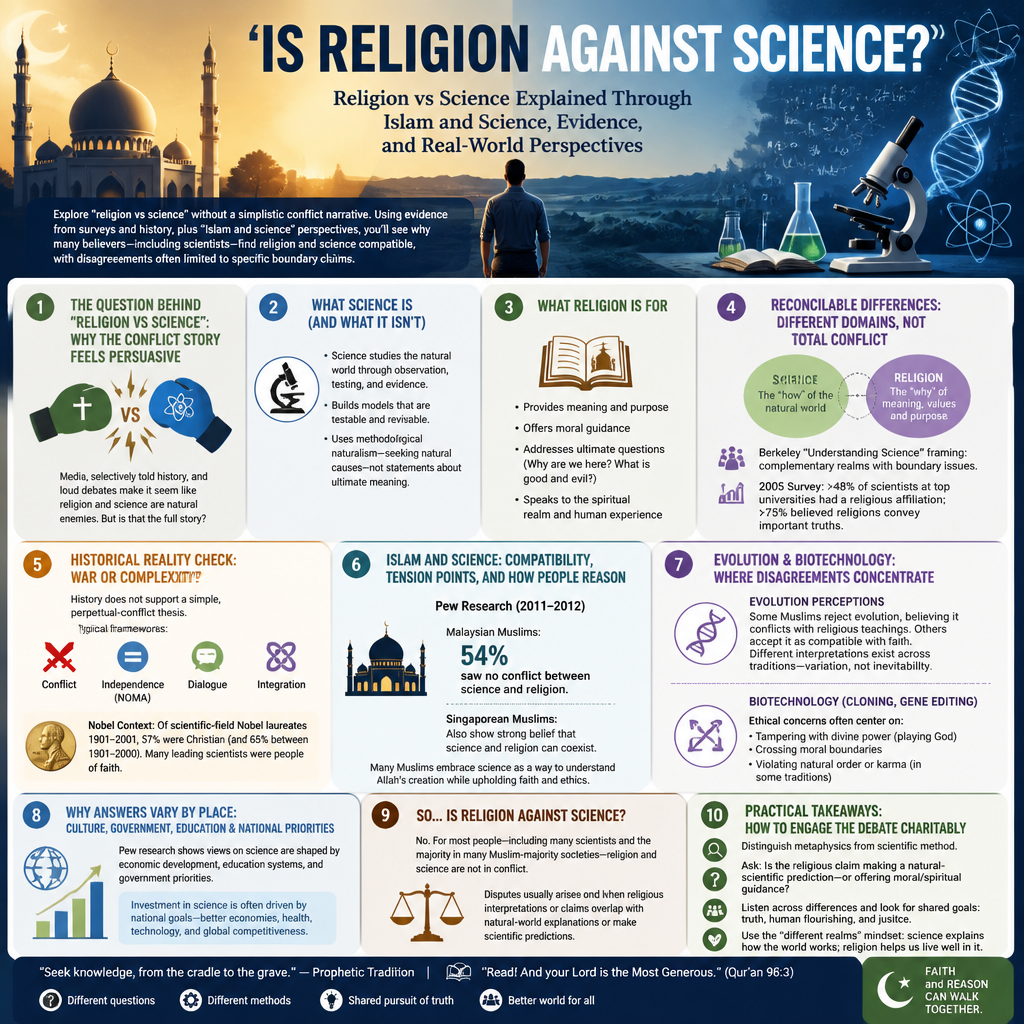
>48% of scientists at top research universities had a religious affiliation, and >75% believed religions convey important truths.
That doesn’t mean there are no disagreements. It means the category “scientist” does not equal “person who must reject religion.”
5) Historical reality check: does history look like war—or complexity?
If religion were inherently against science, you’d expect history to show a near-constant pattern: religion blocking scientific progress everywhere, all the time.
But when historians look broadly at the relationship between science and religion, they generally reject the idea of perpetual conflict. The relationship is better described as complex, with multiple patterns across time and place.
Common frameworks
A helpful way to categorize the interaction is through frameworks often discussed in overviews of the “relationship between science and religion,” including:
- Conflict (when claims clash directly)
- Independence / NOMA (“non-overlapping magisteria,” meaning different teaching domains)
- Dialogue (engagement where each can inform the other)
- Integration (attempts to unify religious worldview with scientific understanding)
Quantitative context from Nobel laureates
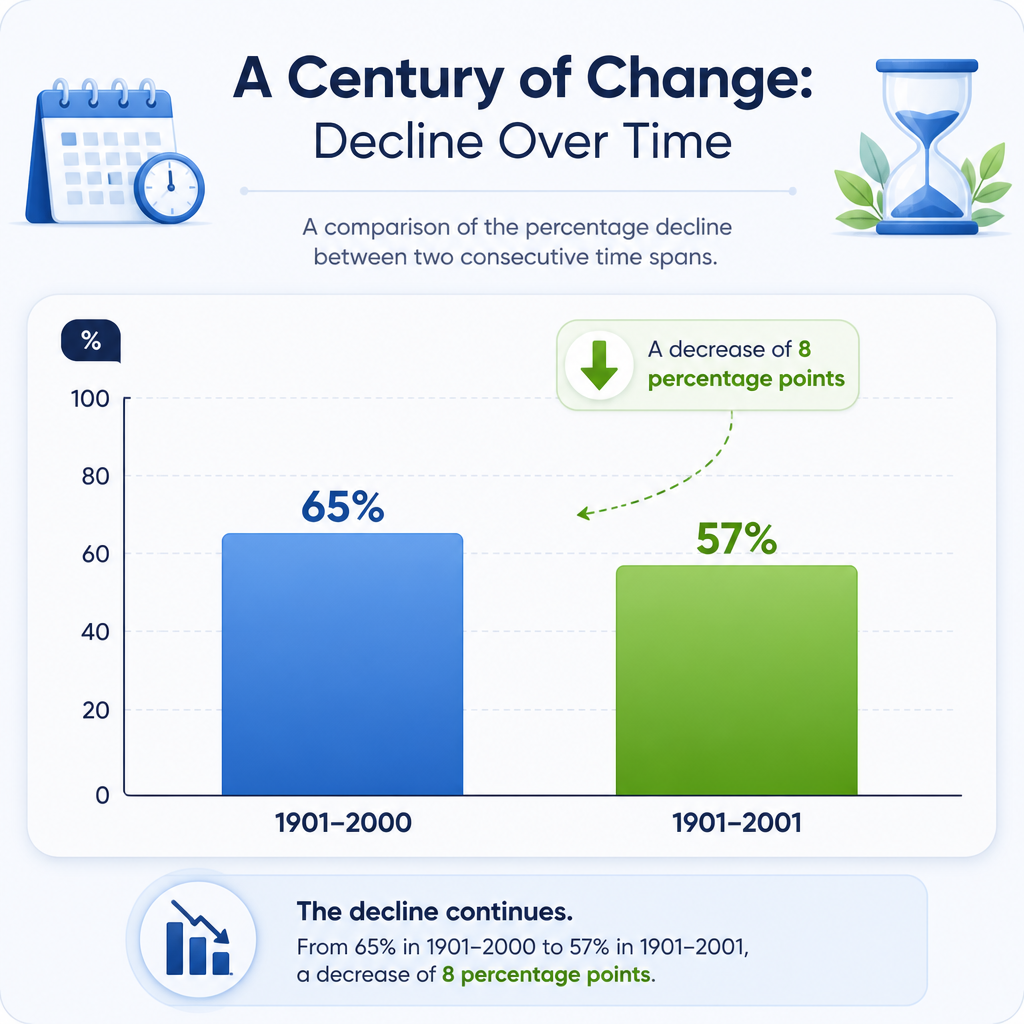
It’s also worth noting that many major scientific contributors historically identified with religion. One often-cited statistic (summarized in general references on the topic) notes that between 1901–2000, 65% of Nobel laureates in scientific fields identified as Christian, and in 1901–2001, 57% of scientific-field Nobel laureates were Christian.
These numbers don’t prove any philosophical conclusion by themselves. But they do undermine the idea that religion and serious scientific work must be incompatible.
6) Islam and science: compatibility, tension points, and how people reason
Since the topic includes Islam and science, let’s look at how people actually perceive the relationship in the real world.
Pew’s data: varied Muslim perspectives
Pew Research Center examined views in Malaysia and Singapore and found that the relationship is not uniform across all Muslim communities. Their findings highlight different patterns of thinking about compatibility—some see overlap, others see tension.
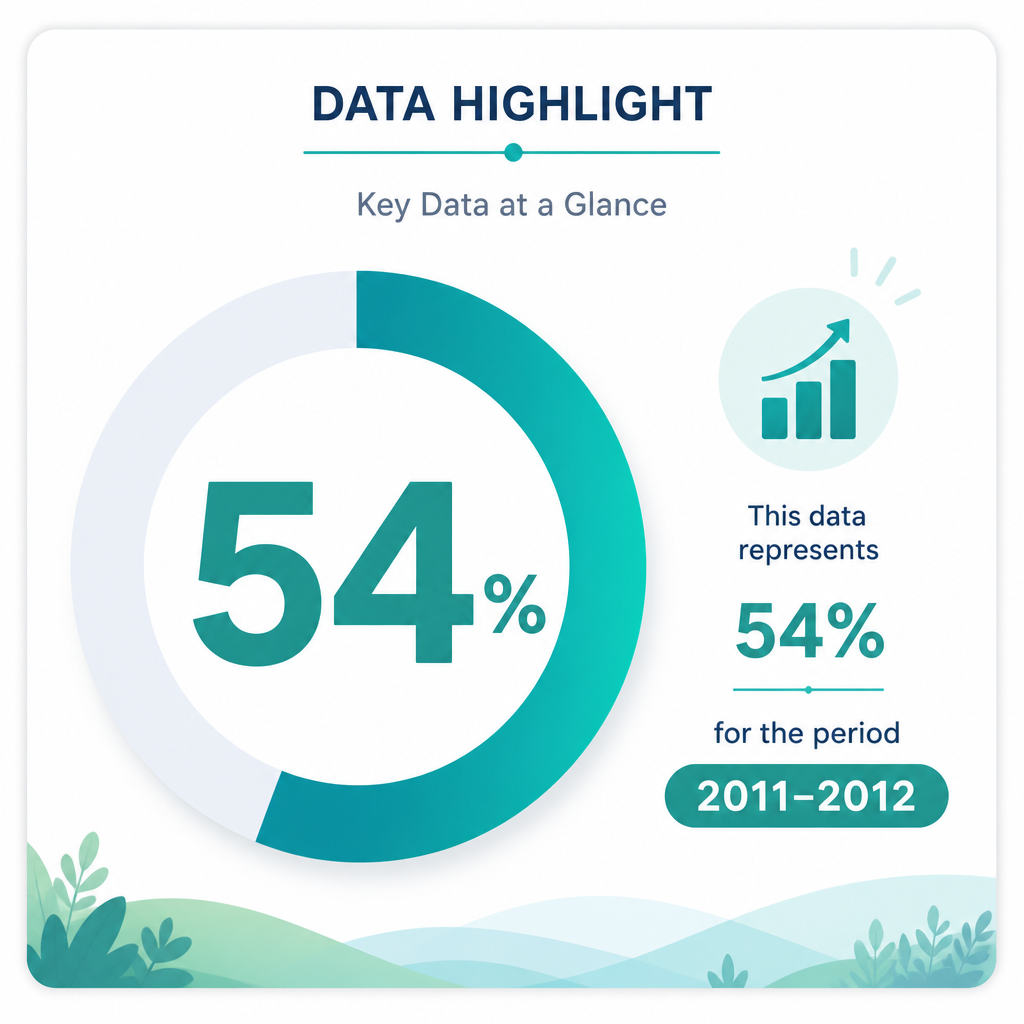
One particularly relevant result: in 2011–2012, 54% of Malaysian Muslims surveyed reported no conflict between science and religion.
Important note: perceptions can vary by tradition, education, and how people interpret specific scientific topics—especially evolution and biotechnology.
Why evolution can become a flashpoint
Some Muslim believers reject evolution because they interpret creation in a way that conflicts with evolutionary explanations. Others do not experience such conflict, often because of:
- Different interpretive approaches to scripture
- Different views about what religious texts are intended to teach
- Different emphasis on the compatibility between divine causation and natural processes
So when you hear “Islam and science disagree,” it’s usually not an automatic rule—it’s often a disagreement about how to understand particular claims at the boundary between religious interpretation and scientific description.
7) Evolution and biotechnology: where disagreements often concentrate
Even when people accept that religion and science can coexist, the most frequent disputes tend to cluster around two areas:
Evolution perceptions
Not everyone evaluates evolution the same way. Some people treat evolution as a direct substitute for creation narratives, while others treat it as a description of how biological complexity can emerge through natural processes.
That difference in framing often explains why some believers see conflict and others see compatibility. The key takeaway is that disagreement is not inevitable; it is often interpretive.
Biotechnology: ethics and “tampering” concerns
Pew also reports that biotechnology raises ethical concerns across groups. Issues like cloning and gene editing can be understood through lenses such as:
- Humans “overstepping” moral limits
- Fear of manipulating life in ways that contradict divine intention
- Concerns about social consequences and justice
Importantly, ethical disagreements are not the same as scientific disagreement. Even if someone accepts scientific findings about what biotech can do, they may still debate whether and how it should be used.
8) Why the answers vary by place: culture, government, education, and national priorities
One of Pew’s broader insights is that public discussions about science-religion compatibility often reflect more than theology. They can be influenced by:
- Local culture and educational systems
- Government priorities (for example, investing in science for economic development)
- How “conflict” is portrayed in media and politics
- Whether scientific debates are framed as identity threats or as tools for progress
In other words, the “religion vs science” debate is sometimes about science policy and identity, not only about scientific facts or religious truth claims.
9) So… is religion against science?
A fair conclusion is more nuanced than either slogan.
What we can say with confidence
- Many religious people—including scientists—do not experience conflict.
- Many disagreements happen at boundaries where religious interpretations make claims about natural-world explanation.
- Science and religion often address different domains: empirical description vs spiritual meaning and moral guidance.
- Islam and science are not inherently incompatible; perceptions vary widely by community and interpretive approach, as Pew’s data illustrates.
A practical way to summarize it
When people say “religion is against science,” they may mean:
- “Some religious interpretations oppose certain scientific claims.”
- “Some religious leaders discourage scientific thinking.”
- “Some debates become politicized.”
Those are different from saying:
- “Religion as a category cannot coexist with science.”
Across history and across surveys, the second statement is simply too strong.
10) Practical takeaways: how to engage the debate charitably
If you want to discuss religion vs science (including Islam and science) in a way that reduces heat and increases understanding, try these steps:
1. Distinguish metaphysics from method
Science can describe mechanisms and patterns. Religion can address ultimate meaning, values, and spiritual reality. Ask what kind of claim is being made—empirical or interpretive.
2. Ask whether a religious claim is meant to predict nature
Some religious statements are not meant to function as testable natural-science predictions. If a person treats a sacred text as a literal scientific description, conflict is more likely.
3. Separate “what is” from “what should be”
Biotechnology debates often mix factual questions with ethical questions. Clarifying the difference helps each side speak to the right problem.
4. Use “different realms” thinking
One of the most constructive frameworks is the idea of complementary realms: science for the natural world through evidence, religion for meaning and moral formation. That approach doesn’t erase disagreements—it gives you a better map for where disagreements actually belong.
Conclusion: a better question than “Is religion against science?”
Instead of asking whether religion is against science, a more productive question is:
When do religious interpretations overlap with scientific questions—and how can both sides clarify what each is trying to answer?
Many people—across faith traditions and including many Muslims—find that religion and science can coexist because they operate in different domains, or because they interpret shared topics (like evolution and biotechnology) in ways that don’t require direct contradiction. Where conflicts occur, they are often about boundaries, interpretations, or ethics—not about science itself being hostile to faith.
References (Top Resources Used)
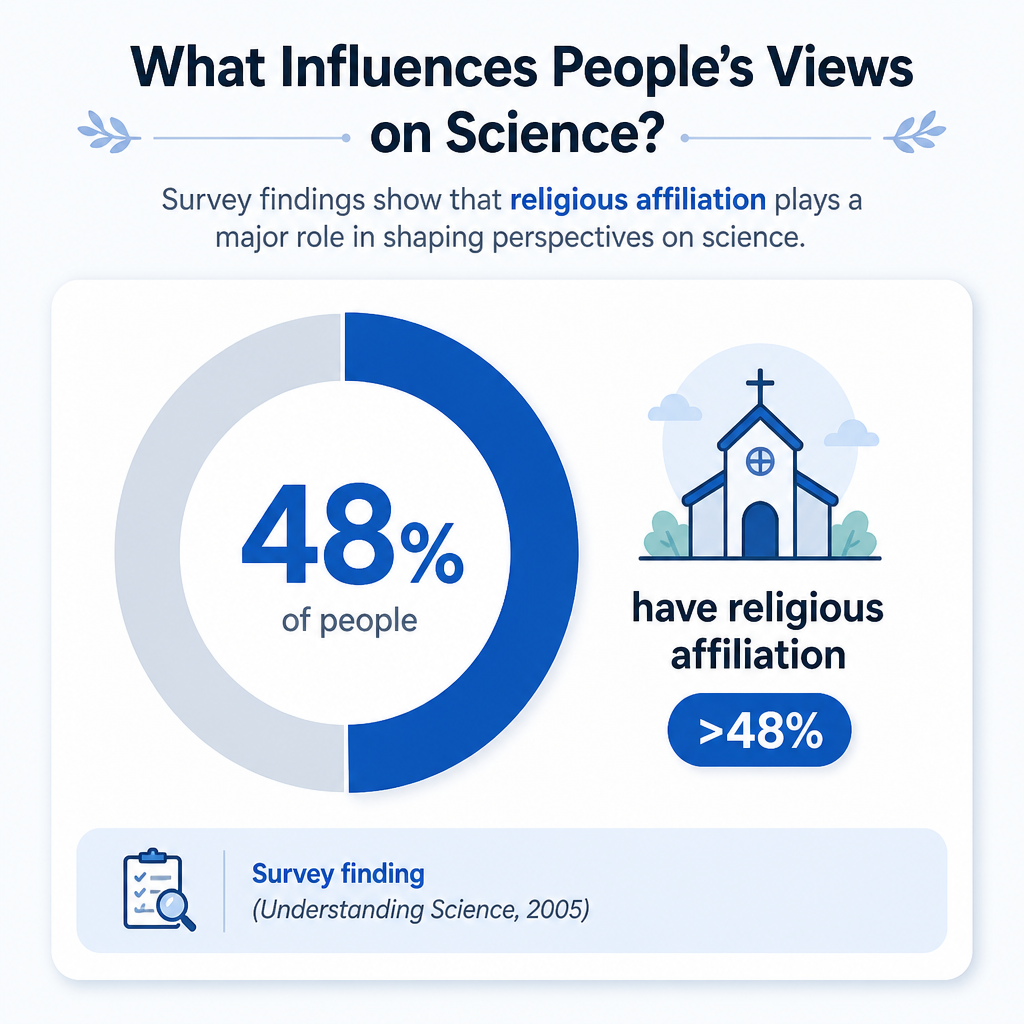 Scientists at top research universities with religious affiliation (>48%) vs believe religions convey important truths (>75%)