Is Islam the Fastest Growing Religion? Here’s Why
It’s a question that keeps coming up in news headlines, debates, and social media arguments: Is Islam the fastest growing religion? The honest answer is: yes—based on widely cited demographic research—but the “why” matters just as much as the headline.
In this article, we’ll use Islam growth statistics from the Pew Research Center to explain what “fastest-growing” actually means (growth in adherents and share), what the data shows for 2010–2020, and what longer-run projections suggest for the 2060 horizon. We’ll also clarify conversion trends, because many claims about conversions are often exaggerated or misunderstood.
Quick takeaway
- Fastest-growing (demographically): Pew reports Islam added more adherents than any other religion during 2010–2020.
- Growth is mostly demographic: fertility and age structure explain much of the momentum.
- Conversions are not “the main engine” globally: switching into and out of Islam appears to roughly balance on net worldwide.
- Longer-run outlook: projections suggest Islam could surpass major Christian groups in global share by the end of the century.
1) What “fastest-growing” means (in demographic terms)
“Fastest-growing religion” can be misleading if it’s treated like a contest of popularity in a single country. Demographic research typically looks at several measures:
- Absolute growth: the number of new adherents added over time.
- Share of the total population: whether the religion’s proportion of the world population rises or falls.
- Net change from switching: the difference between people joining and leaving a religion (often called a conversion balance).
When people ask whether Islam is the fastest growing religion, they usually mean: Which religion gains the most adherents worldwide over a given period? On that definition, Pew’s findings are clear.
2) The strongest evidence: Pew Research Center (2010–2020)
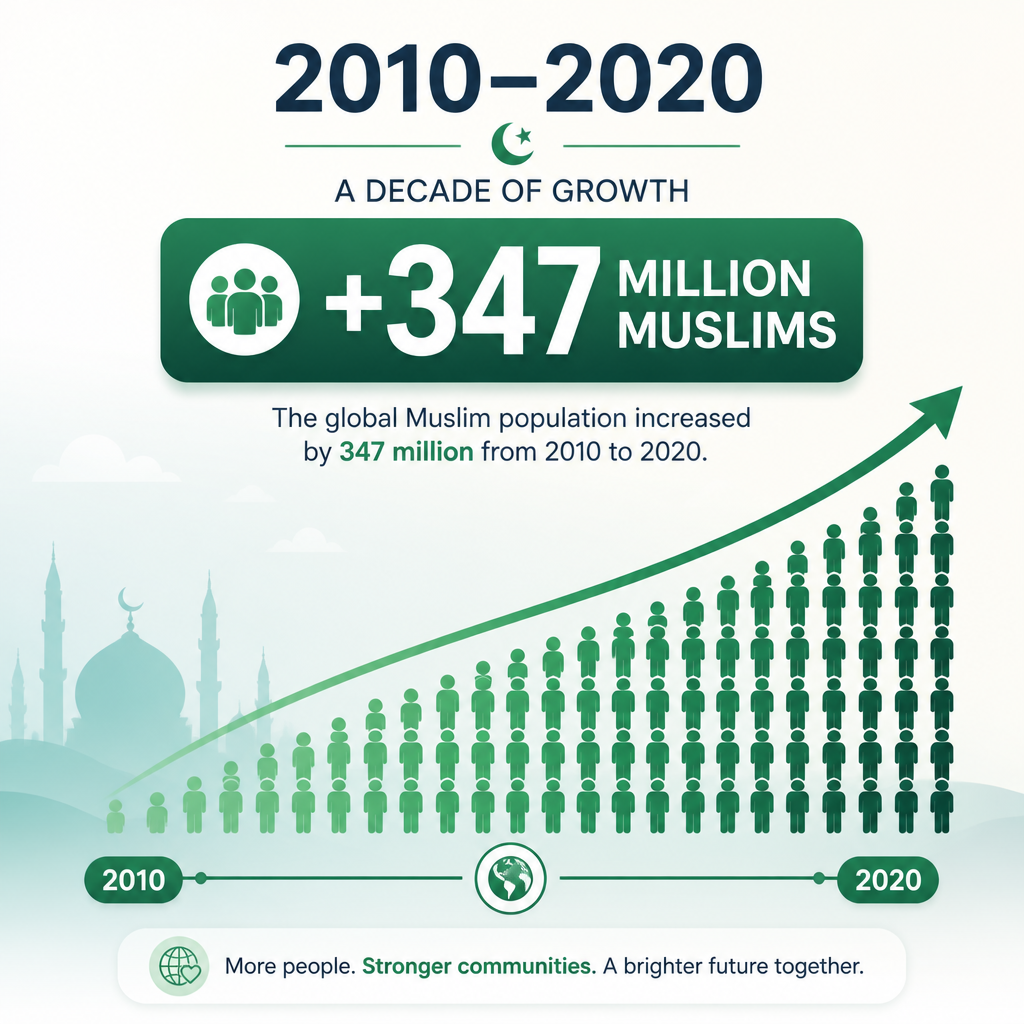
According to a Pew Research Center update on global religious change, Islam was the world’s fastest-growing religion from 2010 to 2020.
How many new Muslims were added?
Pew estimates that Muslims worldwide increased by 347 million between 2010 and 2020.
That figure matters because Pew compares religious growth across the globe—not just within one region. Pew reports that this increase exceeded the gains of all non-Muslim religions combined during the same decade.
How did Islam’s share change?
Pew also reports a change in Islam’s share of the world population:
- 2010: about 23.9%
- 2020: about 25.6%
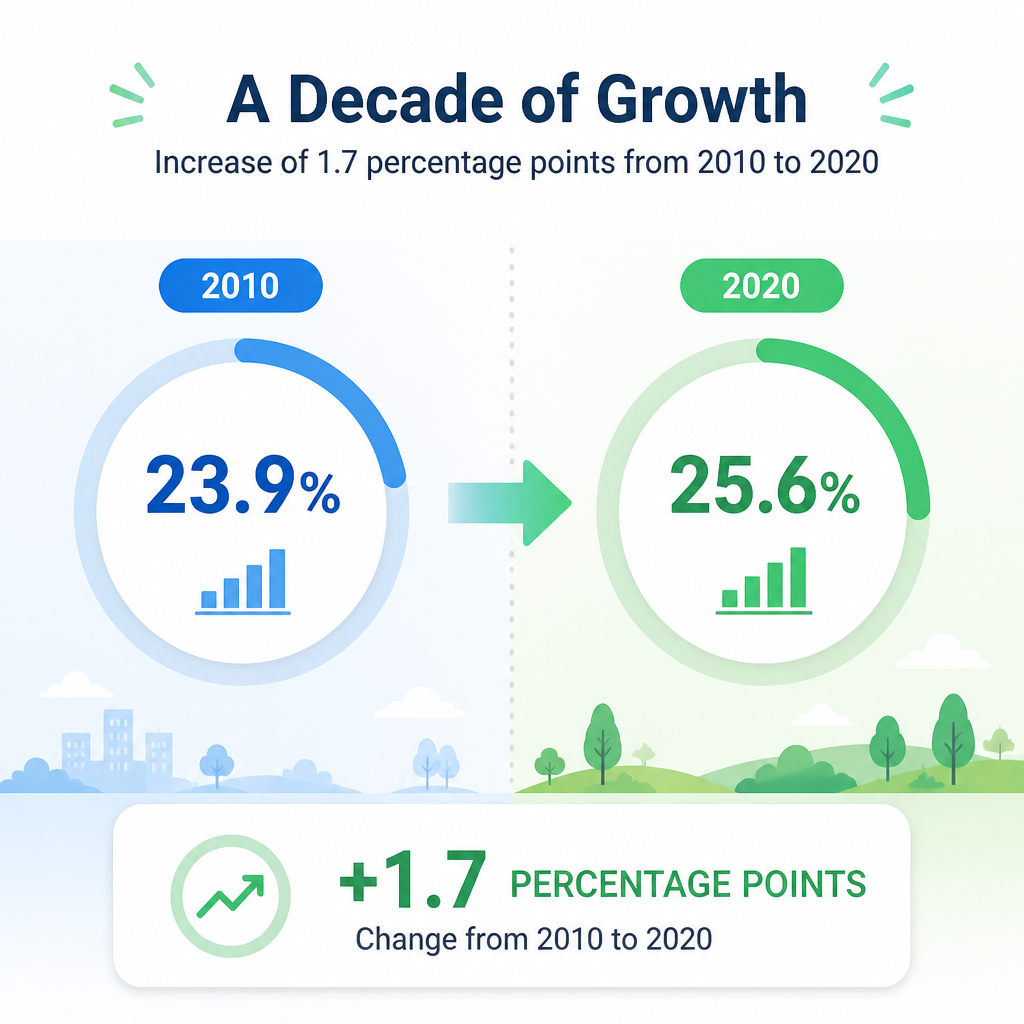
That’s a meaningful rise in just ten years—especially when the world’s overall population is growing.
Is that growth unique to Islam?
Pew’s comparison highlights the contrast:
- Christians: grew by about 122 million (2010–2020)
- Buddhists: declined by about 19 million
So while many religions are growing in certain places, Pew’s point is that Islam’s global net increase outpaced every other non-Muslim religious tradition over that specific decade.
3) Why the growth is so fast: the demographic drivers
If you want to understand islam growth statistics without the confusion that often follows, it helps to focus on the “demographic engine.” In broad terms, the faster a population grows, the more it tends to have:
- Higher fertility (more births per woman)
- Younger age distribution (more people entering childbearing years)
- Regional concentration in places where population growth is high
Driver #1: Fertility advantage
Pew cites an important fertility difference:
- Muslim women average ~2.9 children
- Non-Muslim women average ~2.2 children
When fertility is consistently higher over time, it compounds naturally. Even if conversion patterns were flat, births alone can make a religion’s population grow faster.
Driver #2: A younger population structure
Another reason Islam’s share rises is its age structure. Pew reports that Muslims have a younger median age.
- Median age (approx.): around 24 for Muslims
- Median age (approx.): around 32–33 for non-Muslims
Why this matters: a younger median age usually means a larger share of the population is in the “future parents” group. That creates stronger momentum for future births.
Driver #3: Growth concentrated in high-growth regions
Religious populations are not evenly distributed across the planet. Pew notes that large Muslim populations are concentrated in regions that experience faster demographic growth, including parts of Africa and the Middle East and large portions of Asia-Pacific.
This geographic concentration can make Islam’s global growth faster even if rates vary locally.
4) Conversion trends: does switching explain the rise?
Conversion is the part of this topic that often becomes political or sensational. A more careful reading of demographic research helps.
Pew’s “conversion balance” idea
Pew’s analysis suggests that on a global scale, the net effect of people converting into Islam and people converting out of Islam roughly balances out.
In other words, conversion trends do not appear to be the main driver of Islam’s overall growth worldwide.
That doesn’t mean conversions are rare or irrelevant in every country. It means that when researchers aggregate globally, the biggest part of the increase is explained by:
- births within Muslim communities, and
- age structure that supports continued growth.
Cross-check: what other compiled sources indicate
For readers looking for additional context, compiled overviews such as Wikipedia summarize that global conversion effects have been modest compared to demographic momentum. For example, one overview notes net gains through switching are relatively small compared to population growth.
Important: compiled sources can be helpful for orientation, but the most rigorous figures typically come from primary demographic analyses—like those by Pew.
5) Longer-run projections: will Islam surpass Christianity?
Another reason this question is so popular is that it connects to projections about future religious landscapes. Pew has published long-range estimates suggesting that Islam’s global share could continue rising.
What Pew projects to 2060
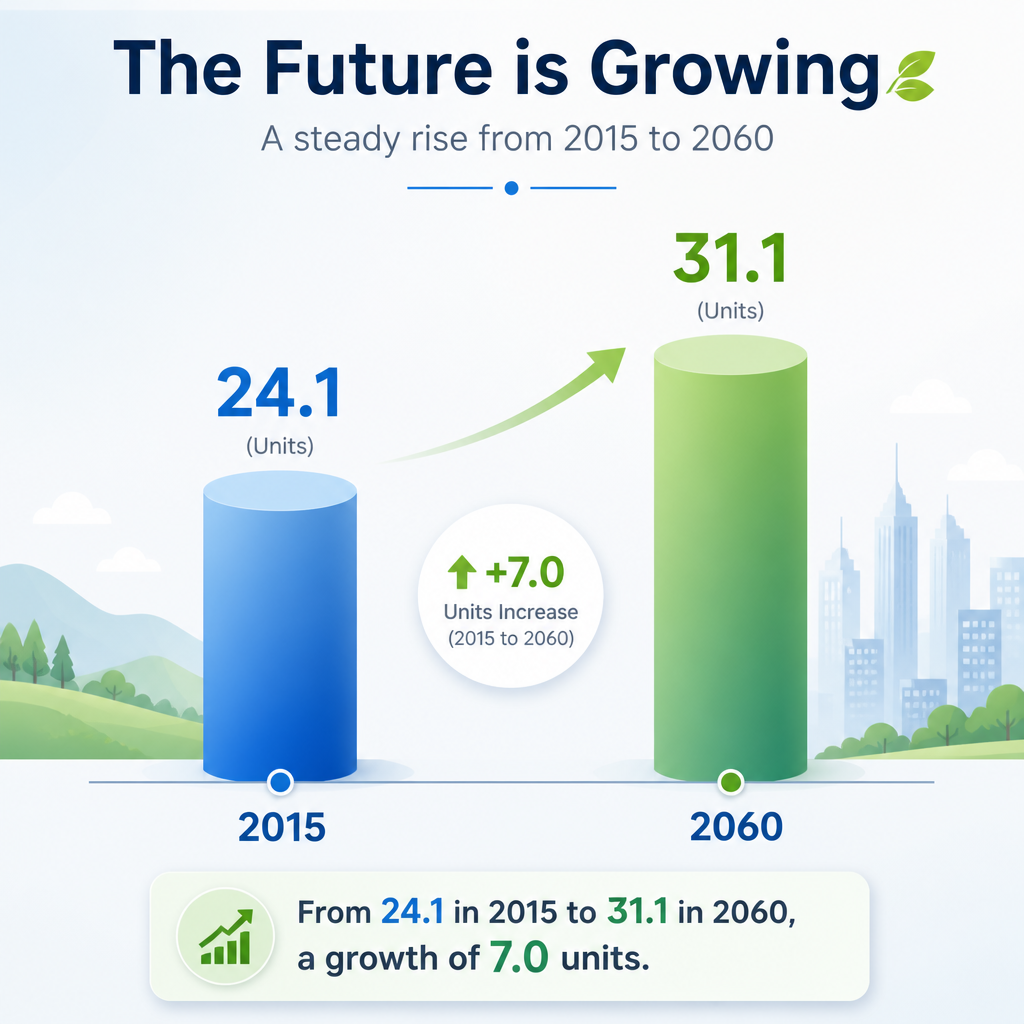
In Pew’s earlier projection work (often cited alongside the 2010–2020 update), Pew estimated that Muslims could increase by about 70% from 2015 to 2060, reaching nearly 3 billion.
Pew’s projection also indicates share movement such as:
- Muslim share: roughly 24.1% to about 31.1% (by 2060 in the cited projection)
What does that imply? If those trajectories hold, Islam could come to represent a larger share of the world population than major Christian groups by the end of the century (depending on the specific comparison and scenario).
6) Regional snapshots that help interpret the stats
Global averages can hide important regional differences. Here are two snapshots that often come up when discussing islam growth statistics and conversion trends.
Europe: growth is often linked more to immigration than conversion
Many European countries have Muslim communities that have grown primarily due to immigration and broader demographic patterns, rather than mass conversion.
So if someone argues that Europe’s Muslim population is “growing because people are rapidly converting,” the demographic research perspective is usually more nuanced: migration and birth rates are frequently emphasized over sensational conversion narratives.
Largest-population countries: growth is driven by where the people already are
Countries with very large Muslim populations—such as Indonesia, Pakistan, India, and Bangladesh—have a huge influence on global totals simply because of their baseline size.
This is why “fastest-growing religion” at the world level often reflects demographic trends across highly populated regions.
7) Common misconceptions (and how to interpret responsibly)
Misconception #1: “Fastest-growing” means “growing everywhere”
Not necessarily. A religion can be the fastest growing globally while individual countries may experience different trends—sometimes slower growth, sometimes stagnation, sometimes decline.
Misconception #2: “Conversion” is the main story everywhere
Demographic research often finds that worldwide net conversion effects are limited relative to births and age structure. Conversions can be significant locally, but not always globally.
Misconception #3: Statistics are the whole picture
Numbers tell you how populations change, not why people practice a faith or how individuals experience it. If you want to understand Islam’s growth culturally and spiritually, demographic data should be only one part of the conversation.
8) Conclusion: a careful answer to “Is Islam the fastest growing religion?”
So, is Islam the fastest growing religion? Based on major demographic research, yes: Pew Research Center reports Islam was the world’s fastest-growing religious group from 2010 to 2020, adding 347 million Muslims and increasing share from 23.9% to 25.6%.
But the most important “here’s why” is that the speed comes primarily from demographics—higher fertility (about 2.9 vs. 2.2 children) and a younger population (median age around 24 vs. 32–33 for non-Muslims). Meanwhile, conversion trends appear to be roughly neutral on net globally, meaning switching into and out of Islam does not drive most of the rise in worldwide totals.
In short: the fastest-growing label makes sense, but it’s best understood as the outcome of births, age structure, and regional demographic momentum—not as a single dramatic “conversion wave.”
References (3 sources)
-
Pew Research Center — “Why Muslims are the world’s fastest-growing religious group” (2017). https://www.pewresearch.org/short-reads/2017/04/06/why-muslims-are-the-worlds-fastest-growing-religious-group/
-
Pew Research Center — “Islam was the world’s fastest-growing religion from 2010 to 2020” (2025). https://www.pewresearch.org/short-reads/2025/06/10/islam-was-the-worlds-fastest-growing-religion-from-2010-to-2020/
-
Wikipedia — “Muslim population growth” (compiled overview). https://en.wikipedia.org/wiki/Muslim_population_growth