Finding Peace in Islam: How Dhikr, Prayer, and Submission Bring Spiritual Fulfillment
When people search for peace in islam, they often imagine a future state—calmness that arrives only when life finally becomes “easy.” But Islam teaches something deeper: peace is not merely an outcome. It is a way of life—a steady road built from worship, remembrance, reflection, and mercy. And because peace touches the heart, the mind, and the community, it can be practiced daily, even in difficult seasons.
In this article, we’ll explore what peace means in Islam, why it’s connected to spiritual fulfillment, and how practical routines like dhikr and prayer can transform anxiety into tranquility.
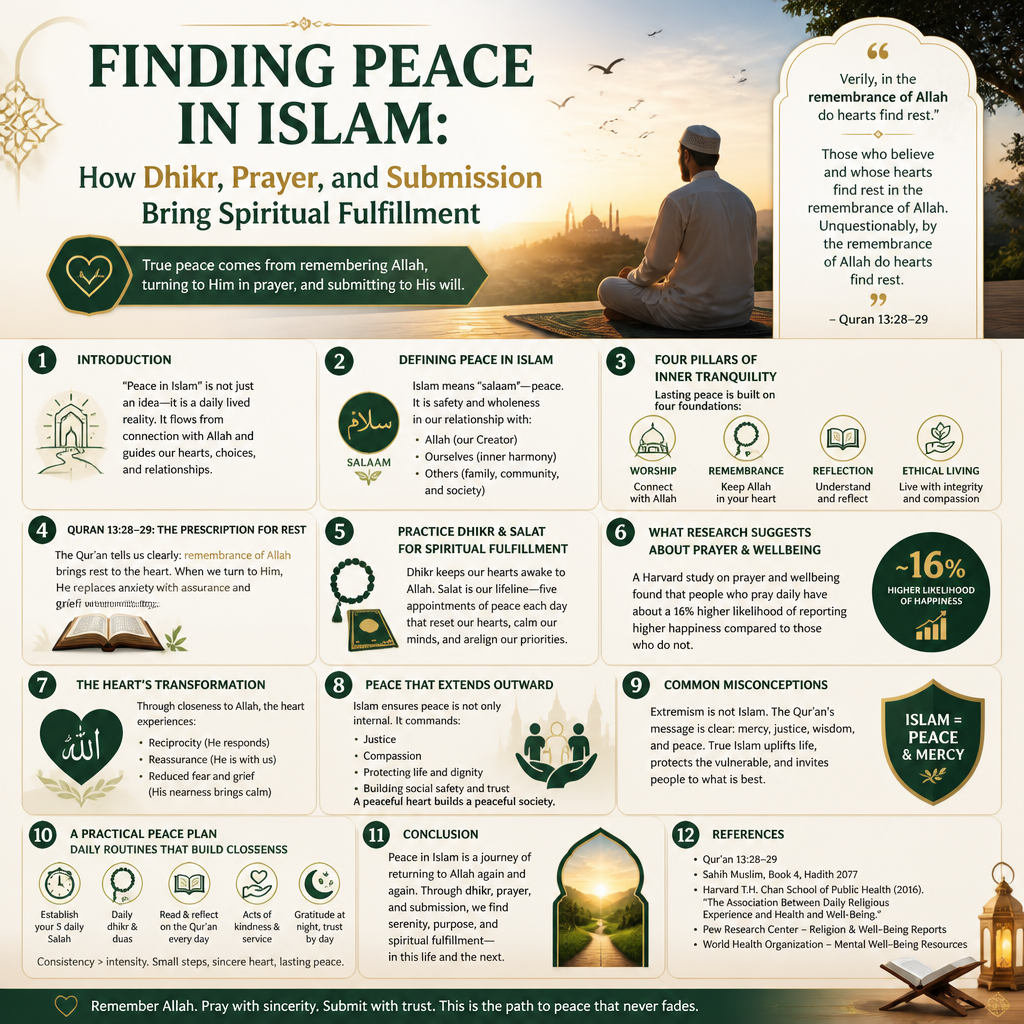
1) “Peace in Islam” is meant to be lived, not waited for
Islam is deeply relational. It begins with recognizing Allah, then responding with sincerity—so that the heart finds rest in its Creator. This rest is not escape from reality; it is the ability to face reality without losing your spiritual center.
So if peace feels far away, it doesn’t mean Islam is missing. It may mean you haven’t yet found the rhythm of worship and remembrance that your heart was created to receive.
2) What does “peace” mean in Islam?
In Arabic, salaam (peace) carries more than the idea of “no conflict.” It also implies safety, wholeness, and wellbeing. In Islam, that wholeness is experienced across three levels:
- Peace with Allah (a trusting heart, answered by remembrance and submission)
- Peace within the self (a balanced soul: calm, resilient, and purposeful)
- Peace in community (justice, compassion, and protection for others)
Islam doesn’t promise comfort at the expense of truth. Instead, it promises wholeness—the kind that makes life steadier, decisions wiser, and relationships more humane.
3) The four pillars of inner tranquility
Many seekers notice that Islamic spirituality is not one single technique, but a connected system. One practical way to describe it comes from a “four core elements” approach that highlights how spiritual closeness and peace are built together:
Pillar 1: Worship that orients the heart
In Islam, worship is not only ritual—it’s re-orientation. Salat (prayer) repeatedly brings the believer back to Allah, breaks distraction, and resets priorities.
Pillar 2: Remembrance (dhikr) that calms the mind
Dhikr is like mental and spiritual breathing. It slows fear, redirects attention, and reconnects the heart to Divine presence.
Pillar 3: Reflection that creates meaning
Peace grows when your actions make sense. Reflection—on Allah’s signs, on your intentions, and on the Qur’an’s guidance—turns routine into purpose.
Pillar 4: Ethical living that protects others
True peace is not private only. It expresses itself in how you treat people: honesty, mercy, patience, and justice. When you live ethically, your conscience relaxes because your life is no longer divided against itself.
Together, these four pillars create spiritual fulfillment—a sense that your life is held, guided, and morally aligned.
4) Begin with the Qur’an: “Verily, in the remembrance of Allah do hearts find rest” (13:28–29)
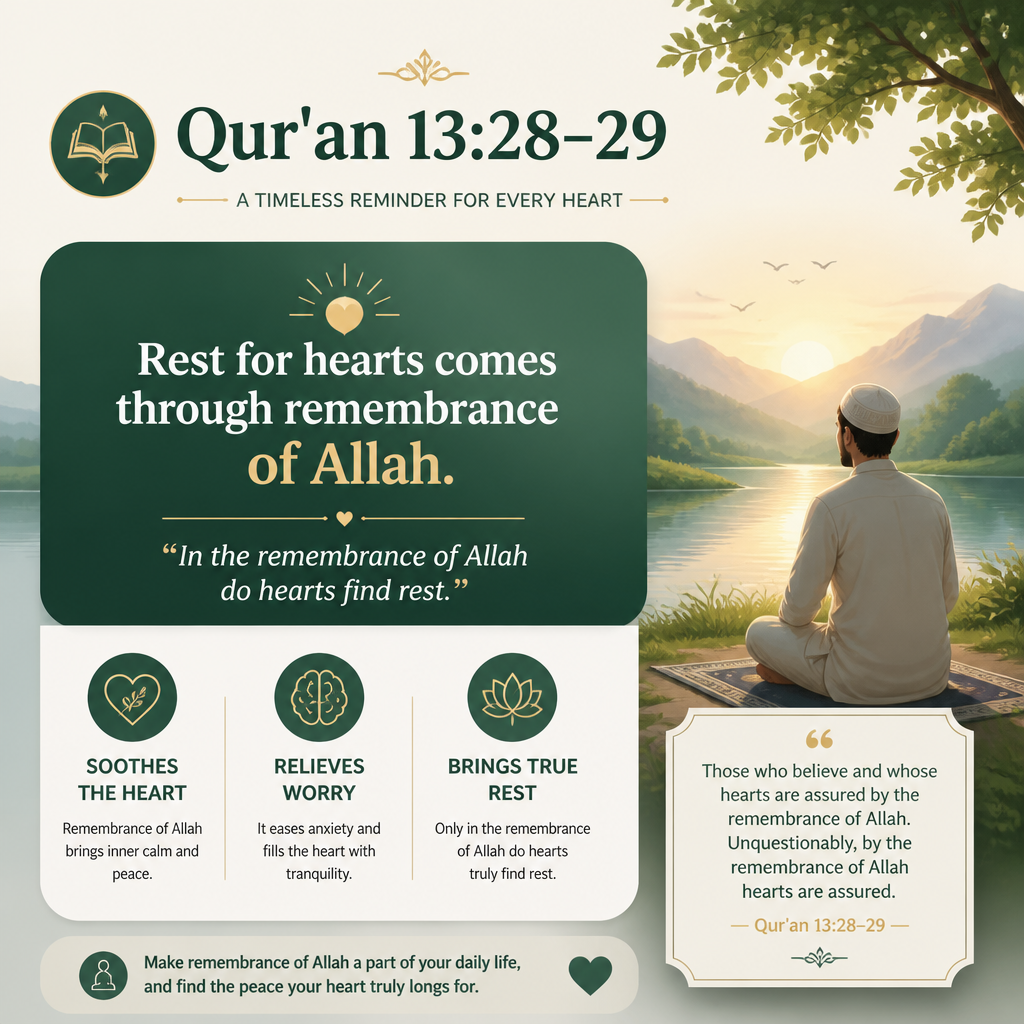
One of the clearest Islamic prescriptions for serenity appears in Qur’an 13:28–29. The Qur’an reminds believers that when hearts feel strained, the answer is remembrance—not denial, not obsession, but returning to Allah.
The principle: the heart finds rest when it remembers Allah.
This matters because anxiety often comes from forgetting your real source of safety. The Qur’an does not ask you to pretend you aren’t stressed. It offers a method: return to remembrance.
5) Practice dhikr and salat for spiritual fulfillment—and a calmer heart
It’s easy to think peace requires changing everything at once. Islam starts where you are, with repeatable practices that build spiritual muscle over time.
Dhikr: turning “thought spirals” into spiritual presence
Dhikr helps you notice what’s happening inside you. Instead of being fully swallowed by worry, you learn to place your attention where it belongs.
You don’t need complicated schedules. Start with consistency:
- Morning and evening remembrances
- Short phrases of glorification and praise
- Remembering Allah between tasks, not only during “religious time”
Salat: the daily anchor that trains stability
Prayer is peace with structure. Each salat helps you leave behind the chaos of “me vs. the world” and return to “Allah is closer than my fear.” Over time, salat strengthens emotional resilience.
As the Qur’an and the scholars explain, worship is both spiritual and transformative. It reshapes the heart through sincerity, humility, and remembrance.
6) What modern research suggests about prayer and wellbeing
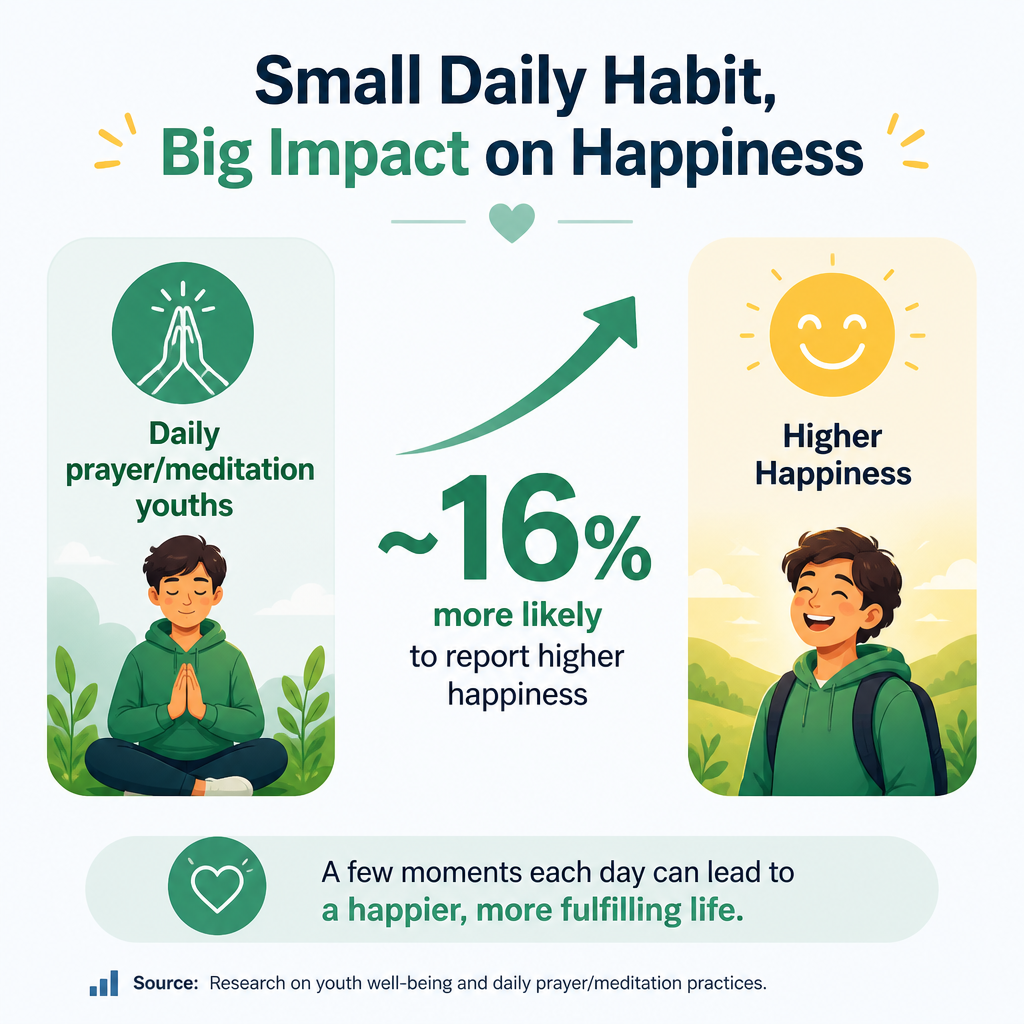
While Islam’s guidance is not dependent on modern studies, it is encouraging when research confirms the psychological benefits people experience through prayer. For example, a widely cited Harvard study found that youths who prayed or meditated daily were about ~16% more likely to report higher happiness. This aligns with the Islamic idea that remembrance strengthens the heart’s sense of rest.
How can prayer support wellbeing?
- It reduces rumination by shifting attention toward meaning and trust.
- It increases emotional regulation through steady routine.
- It builds hope—a core buffer against despair.
In Islamic language, these effects are not merely “psychological.” They are linked to divine reciprocity: the believer remembers Allah, and Allah’s nearness brings reassurance.
7) The heart’s transformation: reciprocity, reassurance, and reduced fear
Peace in Islam is not only internal calm. It is reassurance—a sense of being supported. When you remember Allah consistently, the heart begins to receive a different kind of security:
- Reciprocity: your devotion responds to a reality—Allah is present.
- Reassurance: fear is softened when hope is grounded in worship.
- Reduced grief and overwhelm: because the heart is no longer carrying everything alone.
This is why remembrance changes behavior. A peaceful person becomes more patient, more forgiving, and more stable under pressure.
8) Islam prevents peace from being only “internal”: justice and compassion matter
One misconception about spirituality is that it’s purely private—something you feel, without responsibility toward others. Islam rejects that. Peace is holistic.
Islam teaches that the believer’s relationship with Allah must show itself in:
- Justice (putting things in their rightful place)
- Compassion (mercy as a lived habit)
- Safety (others should feel protected from your harm)
As scholars often explain, a true Muslim is one whose tongue and hand cause no harm to others. That social safety is part of peace—so peace is measured not only in mood, but in character.
9) Islam vs. extremism: why peace-based spirituality is the real Qur’anic path
When people hear distorted claims about Islam, they may assume “peace” is not central to the faith. Yet Islam’s core message—especially in the Qur’an—is mercy, guidance, and moral responsibility.
Islamic texts are sometimes misread when people extract verses without context. The Qur’an repeatedly calls believers toward harmony, justice, and restraint, and it describes true faith through submission to Allah and ethical living.
The key difference is this: extremism replaces worship with ideology, while Islam places worship at the center and draws ethical behavior from it.
10) A practical peace plan: routines that build closeness to Allah

If you want peace in islam to become real in your day-to-day life, use routines that are small enough to sustain and structured enough to deepen.
Step 1: Protect your salat (start with consistency)
- Pray on time as your first priority.
- Focus on sincerity, even if your mind wanders.
- After prayer, spend 1–3 minutes in reflection or dhikr.
Step 2: Add dhikr like “spiritual seasoning”
- Use simple remembrances during transitions (before meals, before sleep, when changing tasks).
- Repeat phrases with meaning, not only motion.
Step 3: Reflect daily for 5 minutes
- Ask: “What did I do today that brought me closer to Allah?”
- Ask: “What can I change gently tomorrow?”
Step 4: Choose one ethical action that protects peace
- Be truthful when it’s inconvenient.
- Respond with patience instead of reactivity.
- Give charity or help someone quietly.
Over weeks, these practices build spiritual fulfillment: a sense of direction, steadiness, and inner safety that outlasts temporary circumstances.
11) Conclusion: living Islam as a steady road to serenity
Peace in islam is not luck. It is something Allah has placed within reach through remembrance, prayer, reflection, and ethical living. When you return your heart to Allah—especially through dhikr and salat—you begin to experience the Qur’anic promise: rest for the heart.
And as your inner world becomes calmer, your relationships become healthier too. That’s the full meaning of salaam: safety and wholeness with Allah, within yourself, and among others.
References
- Human Appeal UK — “Here’s the four core elements to achieve absolute spirituality, peace, and closeness to Allah” (Facebook post). https://www.facebook.com/HumanAppeal.UK/posts/heres-the-four-core-elements-to-achieve-absolute-spirituality-peace-and-closenes/1148711500628735/
- The Glorious Quran and Science — “Peace of Mind through Prayer and Remembrance: A Commentary on Quran 13:28–29.” https://thequran.love/2025/10/24/peace-of-mind-through-prayer-and-remembrance-a-commentary-on-quran-1328-29/
- Islamic Guru — “Islam: A Religion of Peace, Compassion, and Unity.” https://www.islamicguru.com/islam/