Finding a Muslim Support Network Abroad: How Mosque Communities Help You Belong, Heal, and Thrive
Moving abroad can feel like arriving at a new country with your life neatly packed—yet your support system is missing. You may have a job, a home, even a routine. But when Eid comes, when Ramadan is quiet at home, when you’re sick, stressed, or simply homesick… there’s a different kind of loneliness that doesn’t show up on paperwork.
That’s where a muslim support network becomes more than social—it’s spiritual, emotional, and practical. In many places, the mosque community functions like a “first home”: a place where you can belong, recover, and gradually build relationships that carry you through real life.
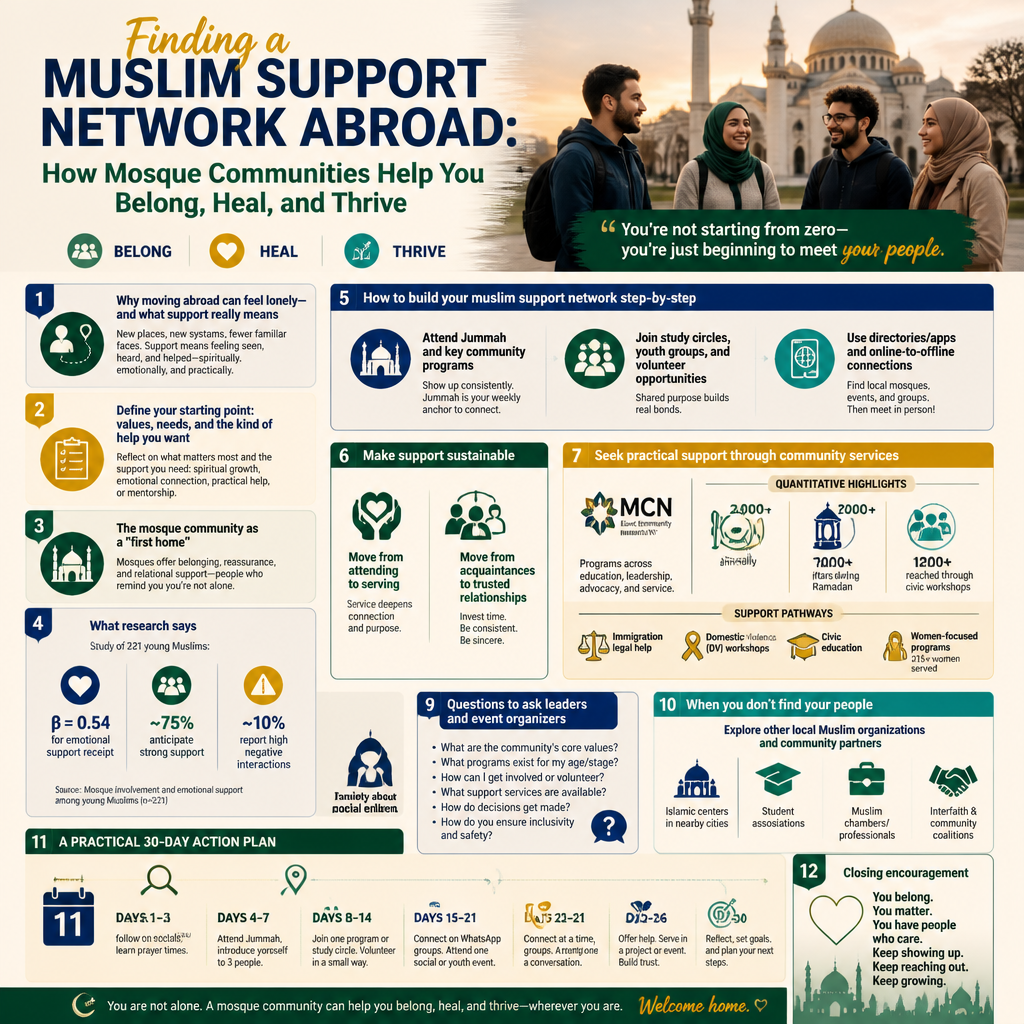
1. Why moving abroad can feel lonely—and what support really means
Abroad, you might experience:
- Culture shock (new norms, different communication styles)
- Language barriers (even basic conversations can be exhausting)
- Religious routine disruption (no nearby Jummah, unclear community calendars)
- Emotional fatigue (you’re “fine” on the outside, but tired on the inside)
Support doesn’t only mean someone helping you fill out paperwork. It also means:
- Emotional support (being heard, reassured, and cared for)
- Relational support (friendships that grow into trust)
- Spiritual support (companionship in worship and reminders of Allah)
- Practical support (resources for family, safety, legal/immigration guidance, learning)
2. Define your starting point: values, needs, and the kind of help you want
Before you search for a community, get clear on what “support” means for you. Ask:
- Spiritual: Do you want consistent Jummah, Quran circles, halaqah, youth programs?
- Emotional: Are you looking for someone to talk to when life is hard?
- Practical: Do you need help with immigration processes, education resources, parenting, or safety concerns?
When you define your needs, you’ll know which mosque community to try first—and you’ll stop mistaking “quiet” for “unavailable.” Some communities are small but deeply relational. Others are large and program-heavy. Both can help; the key is fit.
3. The mosque community as a “first home”: belonging, reassurance, and relational support
A mosque is more than a building. For many Muslims abroad, the mosque community becomes the place where the first honest “welcome” happens—where you can finally exhale.
Here’s what mosque involvement often provides:
- Belonging through worship: standing in the same rows, learning the same du‘as, attending the same congregational moments
- Reassurance through routine: seeing familiar faces every week reduces anxiety
- Relational support through repeated contact: relationships grow when you show up consistently
- Help through service: volunteering turns “I’m new” into “I’m part of something”
In other words: you don’t just find people—you build people around you.
4. What research says: mosque involvement and emotional support among young Muslims
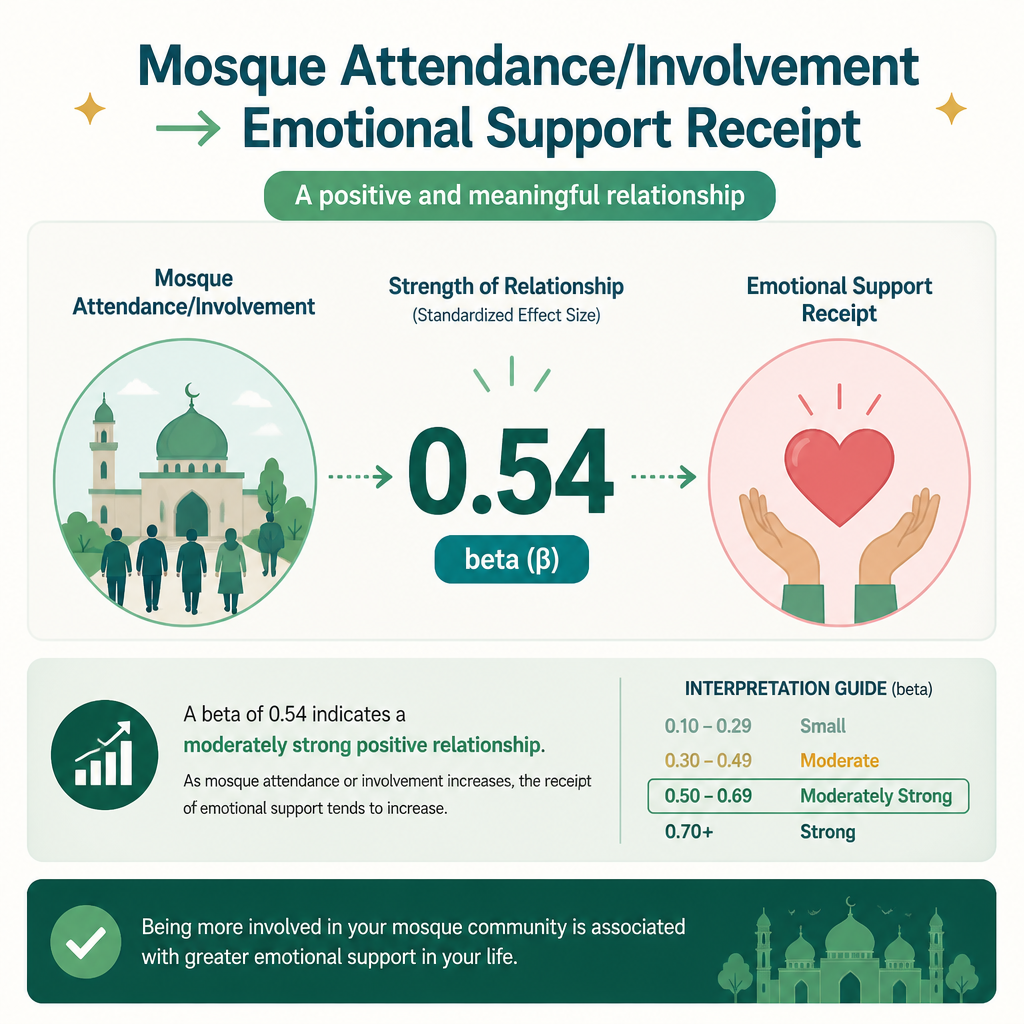
We don’t have to guess. A study published by PMC (with a sample of 231 young Muslim Americans) examined mosque-based emotional support. The findings were clear:
- Mosque attendance and involvement strongly predicted emotional support exchanges—receiving, giving, and anticipating support.
- Attendance showed a positive relationship with emotional support receipt (reported as β = 0.54).
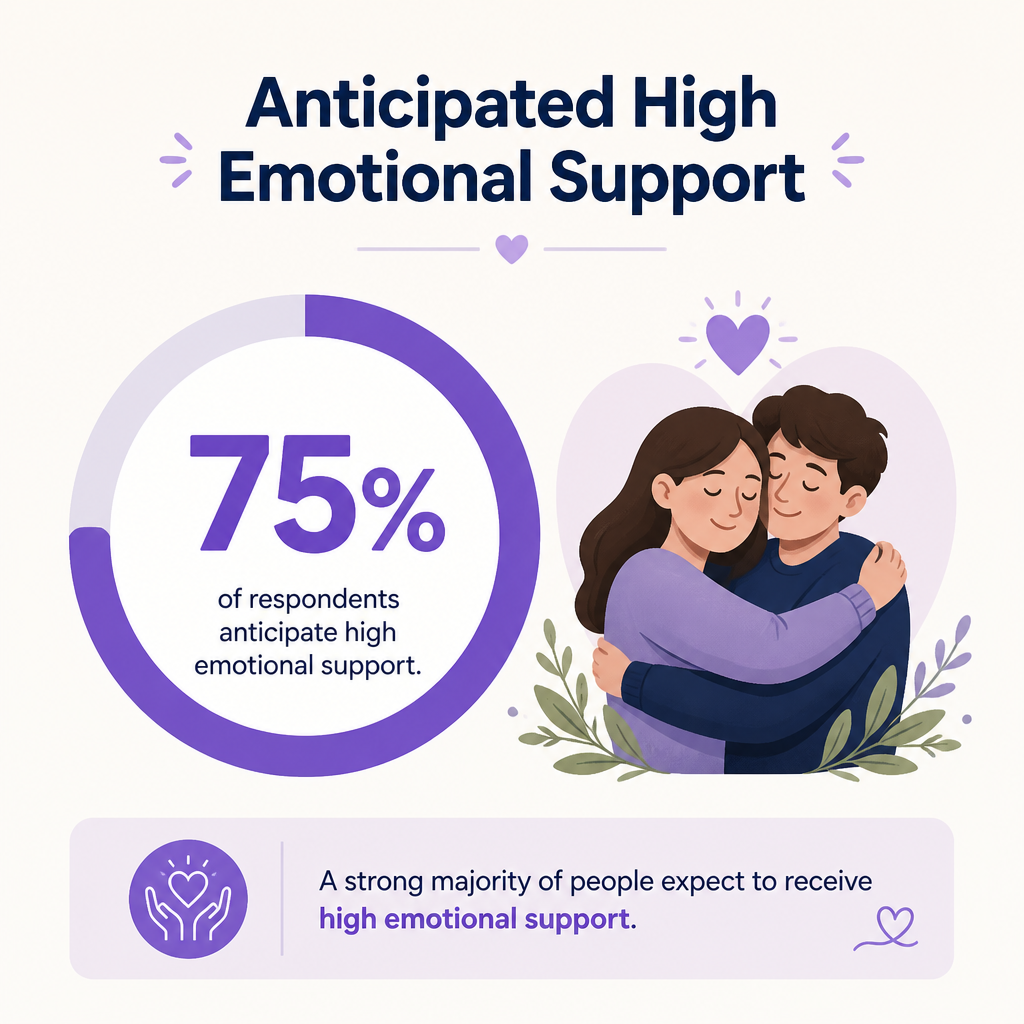
- About ~75% anticipated high levels of emotional support when needed.
- Only about ~10% reported high negative interactions.
Why is this important for you abroad? Because it reframes community-building from “hope” into a practical strategy: show up, get involved, and the support you’re looking for is statistically more likely to come.
5. How to build your muslim support network step-by-step
If you’re starting from zero, don’t try to “figure it all out” in one week. Use a simple pathway—repeat what works, expand gradually.
Step 1: Attend Jummah and key community programs
- Go to Jummah consistently for at least a month if possible.
- Stay after prayer when people gather—introduce yourself to one person (not ten).
- Ask where newcomers can participate (volunteering, Quran classes, youth events, women’s circles).
Step 2: Join study circles, youth groups, and volunteer opportunities
- Study circles create shared identity and conversation topics.
- Youth groups help families connect faster when children have a community too.
- Volunteering gives you structured interaction—support grows naturally when you serve together.
Step 3: Use directories/apps and online-to-offline connections
Sometimes the hardest part isn’t motivation—it’s finding your people. A guide from the Muslim Directory App highlights practical ways to connect using:
- mosque/Islamic center listings
- community events calendars
- online groups that transition into in-person meetups
- professional and service networks
Tip: Don’t only browse. Choose one listing and commit to attending one event within 7–14 days.
6. Make support sustainable: move from attending to serving, and from acquaintances to trusted relationships
It’s common to attend for a while and remain “friendly but not close.” Sustainable community usually follows a sequence:
- Attending → familiar faces
- Participating → shared activities
- Serving → trust and reliability
- Connecting intentionally → deeper support
One practical way to deepen relationships: invite someone to something small and specific.
- “I’m new here—would you join me for the next halaqah?”
- “Do you know who I should talk to about volunteering?”
- “I’d love to learn more about the women’s program—can I get the details?”
7. Seek practical support through community services
Spiritual comfort is essential, but abroad, practical help matters too. Many mosque-affiliated or Muslim nonprofits provide services that reduce stress and protect families.
Example: Muslim Community Network NY (MCN)
One strong example is Muslim Community Network NY (MCN). Their mission emphasizes education, leadership development, advocacy, and service—helping Muslims shape their own narrative and build inclusive communities.
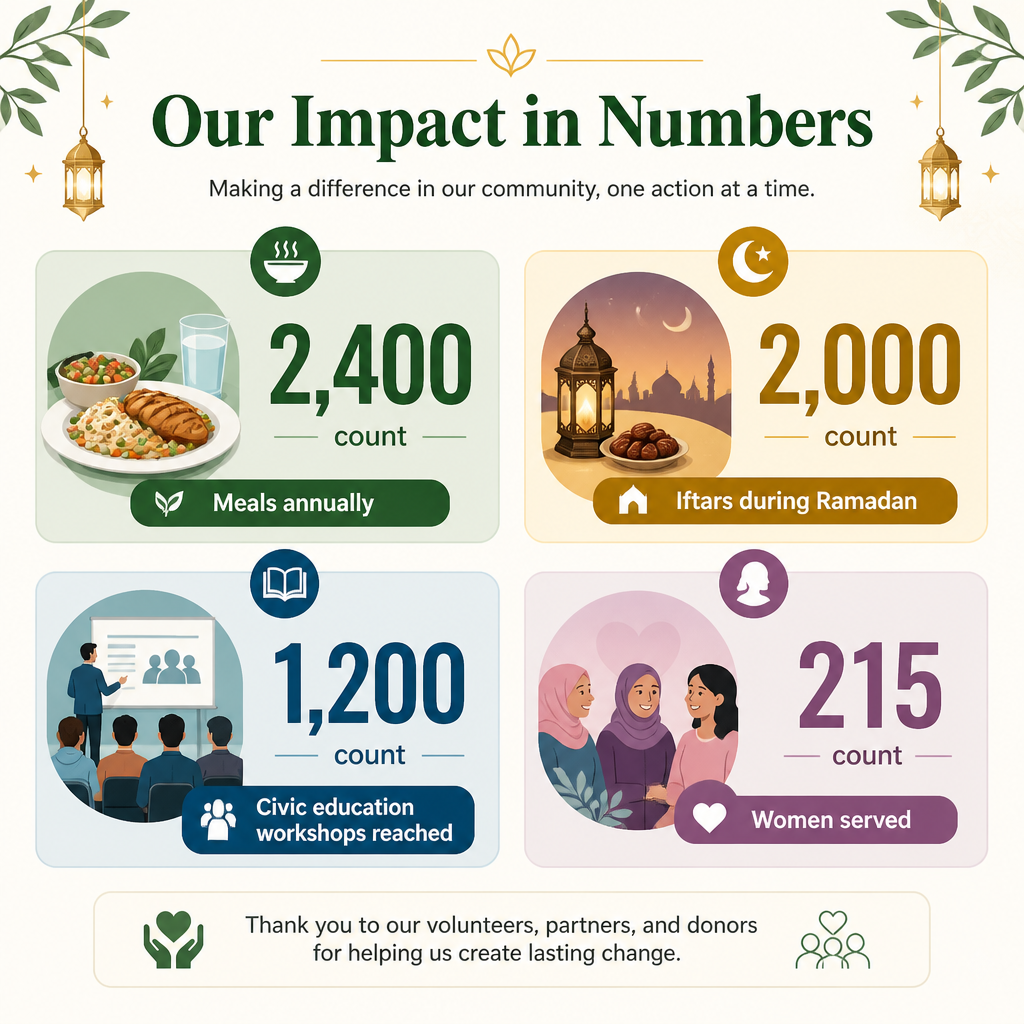
MCN’s reported impact highlights the kind of practical support that can reduce isolation:
- 2400+ meals annually
- 2000+ iftars during Ramadan
- 1200+ civic education workshops reached
- 215+ women served through programs such as DV workshops and financial literacy
They also emphasize long-term community infrastructure, including a capital campaign for a permanent home (with $4M raised so far and an additional target remaining).
If you’re looking for a muslim support network abroad, don’t limit yourself to one institution—look for the combination of:
- a mosque community for belonging and worship
- a community organization for services, advocacy, and practical resources
8. Joining (or creating) community for your life stage
Your “right fit” depends on your stage of life.
Families and children
- Ask about Sunday/after-school programs, youth groups, and parent circles.
- Children can become your social bridge—while you build your own network too.
Language barriers
- Look for bilingual events or classes with diverse attendance.
- Don’t be ashamed to start with simple participation—consistent attendance matters.
Anxiety about social entry
If you feel nervous walking in, start with low-pressure steps:
- attend for Jummah/prayer and observe
- join one class (no pressure to “network”)
- volunteer for a small, time-limited task
9. Questions to ask leaders and event organizers (to find the right fit quickly)
To avoid wasting months, ask practical questions early:
- “What programs are best for newcomers?”
- “Are there women’s circles, youth halaqah, or English-language classes?”
- “Is there a volunteering option for someone new?”
- “How do you help new community members meet each other?”
- “If someone needs practical help, who should they contact?”
Good organizers won’t be offended. They expect newcomers.
10. When you don’t find your people: strategies for other local Muslim organizations and community partners
Sometimes the first mosque you try won’t feel like home. That doesn’t mean you’ll never find community—it means you need a wider map.
Try:
- another nearby Islamic center
- Muslim nonprofits offering education, volunteering, or family support
- local interfaith organizations that host community meals or cultural events
- professional Muslim associations (especially helpful for career-related connection)
Also remember: you can be respectful and still choose what’s healthy for you. A supportive environment should reduce anxiety, not increase it.
11. A practical 30-day action plan to connect with a mosque community abroad
Here’s a realistic plan you can follow even if you’re busy:
Week 1: Identify and attend
- Find one mosque community and check its calendar.
- Attend Jummah once.
- Introduce yourself to one person and ask about newcomer participation.
Week 2: Participate
- Attend one class or halaqah (Quran, fiqh basics, youth tutoring, etc.).
- Join one event or women’s/men’s circle if available.
- Ask one question about volunteering or mentorship opportunities.
Week 3: Volunteer
- Volunteer for a small role (setup, hospitality, meal prep, check-in).
- Meet two people with the intention of following up.
- Send one message: “I enjoyed being part—when is the next session?”
Week 4: Deepen trust
- Attend again and stay a bit longer after.
- Invite someone to a small activity (coffee after class, walk, study session).
- Join (or create) a recurring routine: weekly study, monthly service, or youth support.
Goal by day 30: you should know who to contact when you need something—emotional, spiritual, or practical.
12. Closing encouragement: you’re not starting from zero—you’re just beginning to meet your people
If you feel alone abroad, please hear this: you’re not “too late” and you’re not “hard to love.” You’re just at the beginning of a process that requires repetition and proximity.
Research suggests mosque involvement is closely connected to emotional support—meaning your efforts are not wasted. And practical community organizations, like MCN, show how Muslim communities can provide real services while also rebuilding belonging.
Keep showing up. Choose one program. Volunteer once. Ask one question. In time, your muslim support network will stop being an idea and start being a reality.
Resources (Top references)
- Muslim Community Network NY (MCN): https://www.mcnny.org/
- PMC Study – Mosque-Based Emotional Support Among Young Muslim Americans: https://pmc.ncbi.nlm.nih.gov/articles/PMC4255340/
- Muslim Directory App – 12 Ways to Connect With Your Local Muslim Community: https://muslimdirectoryapp.com/blog/find-local-muslim-community-guide/