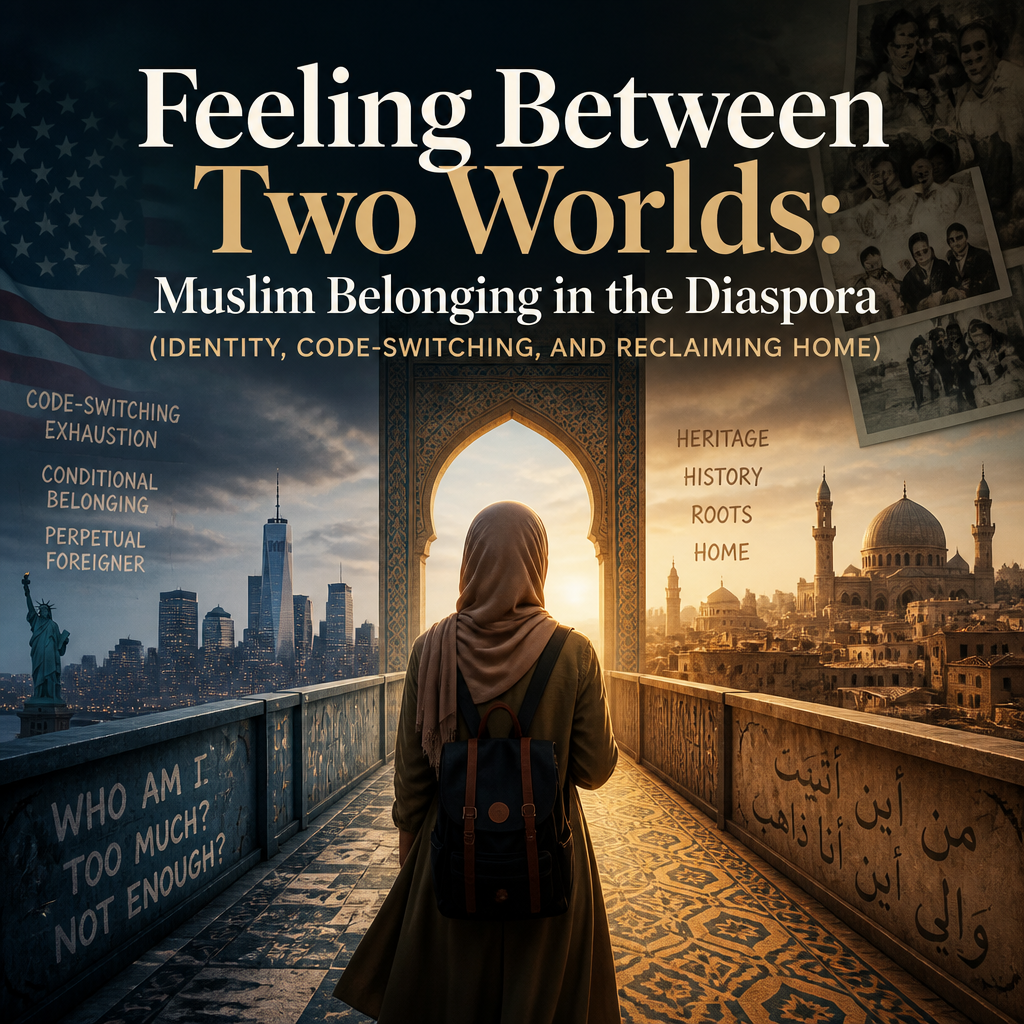
Feeling Between Two Worlds: Muslim Belonging in the Diaspora (Identity, Code-Switching, and Reclaiming Home)
“Where are you really from?” It’s a question diaspora Muslims hear often—sometimes with curiosity, sometimes with suspicion. But for many, it points to something deeper than geography: the sensation of living “in-between.” Between the language at home and the language outside. Between family memory and national storytelling. Between what you know about your people and what others assume about you. This is what belonging can feel like in diaspora identity—an ongoing practice, not a finish line.
In this article, we’ll explore how muslim belonging is shaped by conditional acceptance, cultural translation labor, and daily othering—then we’ll move into practical steps that help you reclaim agency, steadiness, and home inside your own story.
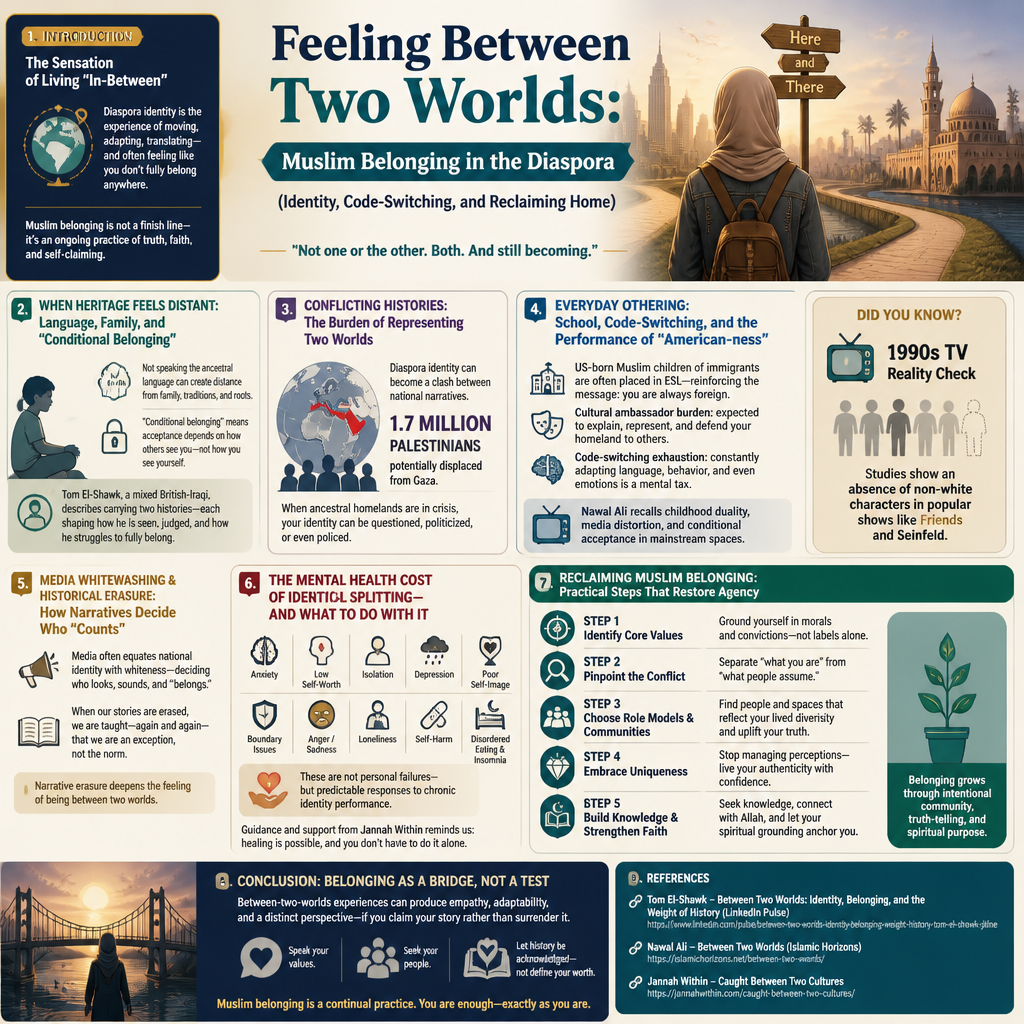
1) Introduction: the sensation of living “in-between”
For many Muslims living in diaspora communities, identity is not just something you “have.” It’s something you manage—across contexts, expectations, and often changing rules of visibility.
- Diaspora identity asks you to carry heritage while also navigating the present realities of your country of residence.
- Code-switching isn’t only about language; it can involve tone, humor, clothing choices, what you share publicly, and how you interpret others’ reactions.
- Muslim belonging becomes conditional when acceptance depends on how others perceive you—rather than on your own self-claim.
None of this means you’re “confused.” It means you’re doing translation work—sometimes literally, often emotionally. And translation work has a cost.
2) When heritage feels distant: language, family, and “conditional belonging”
One of the sharpest forms of distance is language. If you don’t speak the ancestral language, your heritage can feel like it exists “behind a glass wall.” You might understand the meaning of stories, foods, and traditions, but you can’t always enter the full texture of how those traditions speak to you.
This is the kind of disconnection reflected in stories like Tom El-Shawk’s reflection on being between two worlds—mixed British-Iraqi heritage, language barriers, and the way history can weigh on personal belonging. In his account, heritage is not merely cultural—it’s tied to feeling rooted, understood, and included.
But even when you’re near your family geographically or emotionally, you may experience what we can call conditional belonging: acceptance that depends on how others frame you.
Conditional belonging can sound like:
- “We see you, but…” (followed by an expectation to explain yourself)
- “You’re ‘one of the good ones’” (with an implied category you’re never allowed to fully leave)
- “You don’t seem that Muslim” (as if Muslim identity must look a certain way)
In practice, this can make muslim belonging feel less like a home you inhabit and more like a standard you must pass.
3) Conflicting histories and the burden of representing two worlds
Another layer of “between two worlds” is history. Diaspora communities often live with two (or more) historical narratives that don’t match neatly.
For example, when your country of residence has played a role in events affecting your ancestral homeland, your identity may become a space where politics gets rehearsed socially—whether you asked for it or not.
El-Shawk’s reflection highlights how awareness of colonial impacts and national identity can clash in everyday life. That clash becomes even harder when ancestral homelands are in crisis.
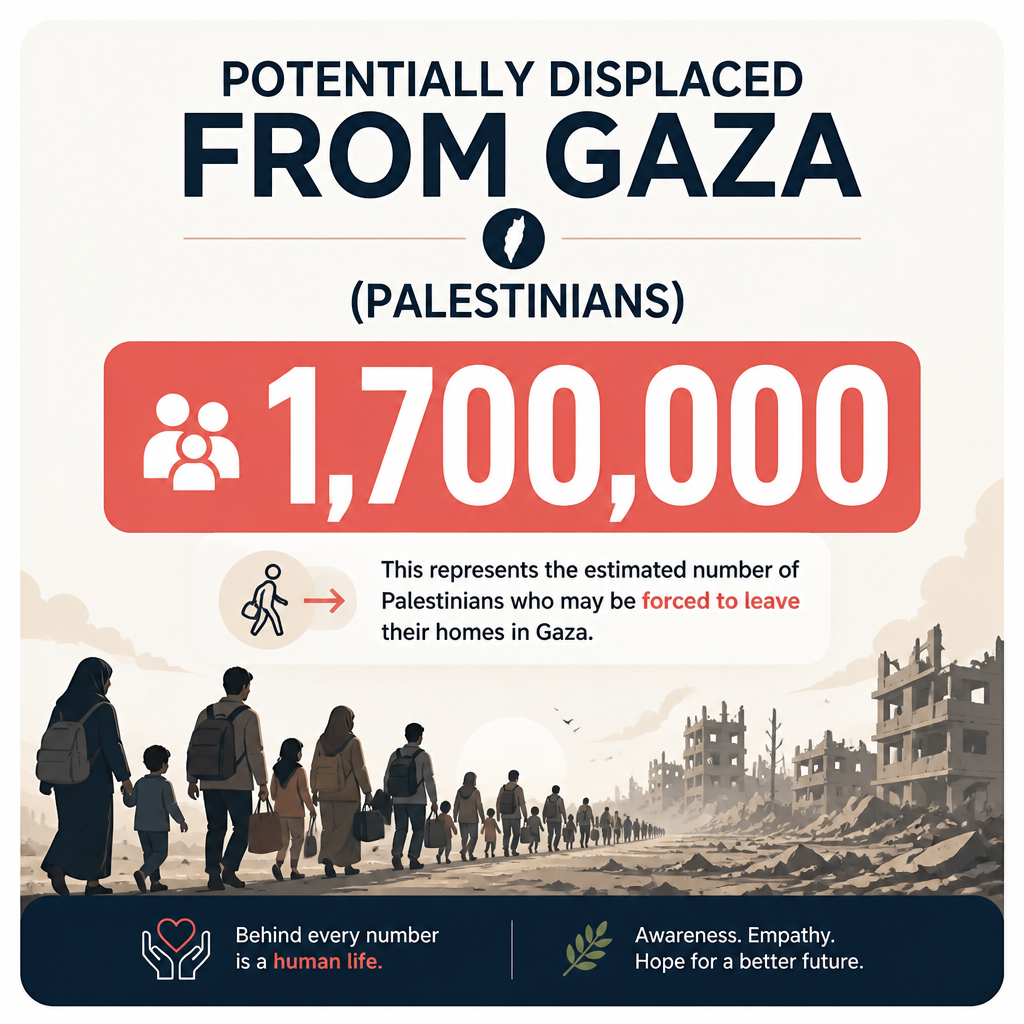
There’s also a quantitative reality that many diaspora families carry in the background: displacement. As one reference notes, “1.7 million Palestinians potentially displaced from Gaza.” When media cycles and public narratives focus on conflict, diaspora Muslims can feel that their belonging is constantly being evaluated through that lens.
As a result, you may feel pulled into a role you didn’t choose—part citizen, part representative, part storyteller, part defender. Sometimes people ask you to carry their understanding of global events for them, as if your life is a public briefing.
4) Everyday othering: school categorization, code-switching, and the “performance” of belonging
For children of immigrants—especially American Muslim children—belonging can be shaped early, often through the subtle mechanisms of institutions.
Nawal Ali’s account in Between Two Worlds – Islamic Horizons describes childhood duality where identity isn’t treated as a lived reality but as a problem to be sorted. One example: being placed into ESL despite being born in the country. The message isn’t only about language; it’s about perceived foreignness.
That kind of sorting creates a repeating pattern:
- You must prove you belong.
- You must translate yourself—often publicly.
- You may have to act as a “cultural ambassador” even though you’re just trying to learn, grow, and exist.
This is where code-switching exhaustion enters the picture. Code-switching can be conscious, but it often becomes automatic:
- Which jokes are safe?
- How direct can I be?
- What should I hide to avoid assumptions?
- Which parts of my faith am I expected to defend today?
Media can intensify the effect. Ali notes a form of media distortion, where national identity is portrayed as synonymous with whiteness—shaping what people think a “real” member of society looks like. One statistic from that analysis points to an “absence of non-white characters in 1990s shows like Friends and Seinfeld.” When your images are missing, your belonging can feel like it’s always in doubt.

None of this is your fault. But it does mean you deserve tools—not just patience.
5) Media whitewashing and historical erasure: how narratives decide who “counts”
Beyond school and everyday conversations, there’s the larger question of narrative. Who gets centered? Who gets erased? Who gets to be ordinary?
When media equates national identity with a single racial or cultural image, Muslims often get forced into a narrow set of roles:
- symbolic (either threat or exotic difference)
- educational (you exist to be explained)
- conditional (your acceptance depends on staying within expectations)
Historical erasure works similarly. If the public story ignores Muslim contributions, complexity, or humanity, then “belonging” becomes a debate rather than a reality.
This is how feelings of being between two worlds can deepen: you don’t just feel misunderstood—you feel misnamed by the culture around you.
6) The mental health cost of identity splitting—and what to do with it
Identity strain doesn’t stay only in the mind. When code-switching becomes constant and conditional belonging becomes routine, the body keeps score.
Jannah Within’s Caught Between Two Cultures: How To Solve Identity Crisis offers a mental-health-aware lens on the outcomes of chronic identity conflict. Reported effects can include:
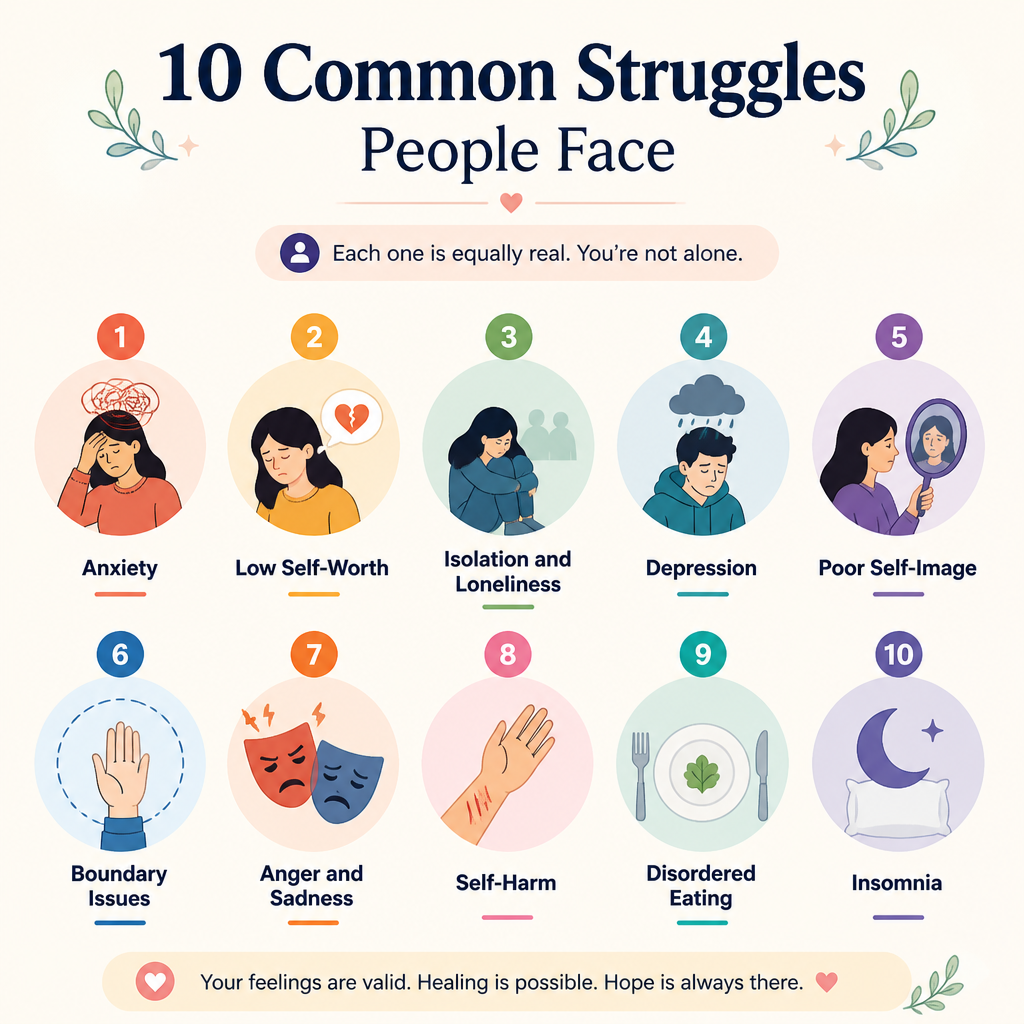
- anxiety
- low self-worth
- isolation and loneliness
- depression
- poor self-image
- boundary issues
- anger and sadness
- self-harm
- disordered eating
- insomnia
That list might feel heavy—because it is. But it’s also clarifying. These are not merely personal failures. They’re often predictable responses to living with a constant internal split: the part of you that exists safely and the part of you that must perform.
So what helps? Not “being tougher.” Not suppressing feelings until they go away. Instead, the path usually involves restoring agency:
- Grounding in values
- Pinpointing what’s actually at conflict (assumptions vs. reality)
- Choosing role models and communities that reflect lived diversity
- Strengthening spiritual grounding
Belonging becomes steadier when you stop outsourcing your identity to other people’s expectations.
7) Reclaiming Muslim belonging: practical steps that restore agency
If diaspora identity can feel like you’re constantly translating, then reclamation begins with choosing what you will not keep translating for others. Here are practical steps—value-based, not performative.
Step 1: Identify core values (not just labels)
Ask yourself: What do I stand for? Values are less fragile than labels. Jannah Within emphasizes grounding in morals and convictions. When you know your values, you don’t feel as pressured to fit someone else’s definition of what “Muslim” should look like.
Step 2: Pinpoint the conflict (separate “what you are” from “what people assume”)
A helpful exercise is to write two columns:
- What I am (your lived reality)
- What they assume (the narrative imposed on you)
When you see the gap clearly, the problem becomes less about your worth and more about the other person’s assumptions.
Step 3: Choose role models and communities that match your lived diversity
Belonging grows where your presence is normal. Look for communities—online and offline—where Muslims don’t have to “perform” authenticity to be taken seriously.
Role models matter because they show you what is possible: a life where Muslim identity isn’t a constant explanation.
Step 4: Embrace uniqueness instead of managing perceptions
Code-switching can teach you how to survive. But belonging requires something more: the right to exist as yourself. You can decide which contexts require adaptation and which ones deserve boundaries.
In other words: adapt as an act of wisdom, not as an act of self-erasure.
Step 5: Build knowledge and strengthen spiritual grounding
Knowledge is protective. So is spirituality. When you understand your faith and your history, you’re less likely to absorb harmful external narratives.
Spiritual grounding can also turn “between two worlds” into something different: not a prison of split identities, but a bridge—an opportunity for deeper purpose, reflection, and service.
8) Conclusion: belonging as a bridge, not a test
Living between two worlds can be exhausting. Yet diaspora identity can also produce qualities that are genuinely powerful: empathy, adaptability, multilingual insight, and a unique awareness of how narratives shape reality.
The goal isn’t to become someone else. The goal is to claim your story—so muslim belonging becomes less like a test you pass and more like a home you build.
Start small: speak your values, seek your people, and let history be acknowledged without letting it define your worth. Your life is not a debate. Your presence is belonging.
References
- Tom El-Shawk, “Between Two Worlds: Identity, Belonging, and the Weight of History” (LinkedIn). https://www.linkedin.com/pulse/between-two-worlds-identity-belonging-weight-history-tom-el-shawk-jklne
- Nawal Ali, “Between Two Worlds – Islamic Horizons.” https://islamichorizons.net/between-two-worlds/
- Jannah Within, “Caught Between Two Cultures: How To Solve Identity Crisis.” https://jannahwithin.com/caught-between-two-cultures/