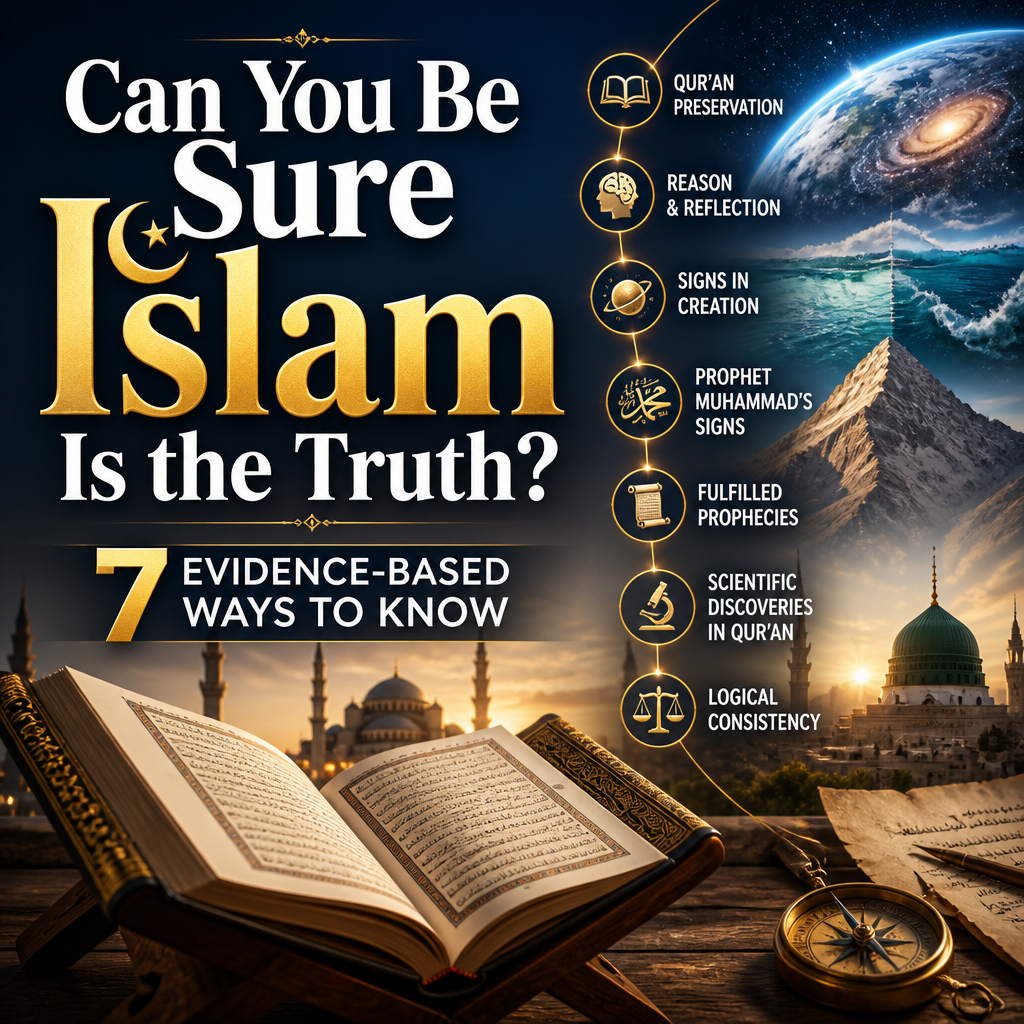
Can You Be Sure Islam Is the Truth? 7 Evidence-Based Ways to Know
It’s a serious question—and a respectful one. If you’re wondering how to know Islam is true, you’re already doing something many people avoid: you’re taking truth seriously enough to investigate it rather than guessing.
Islam itself invites reflection and seeking knowledge. The goal is not to shame doubt, but to use doubt as a starting point for inquiry, prayer, and honest study.
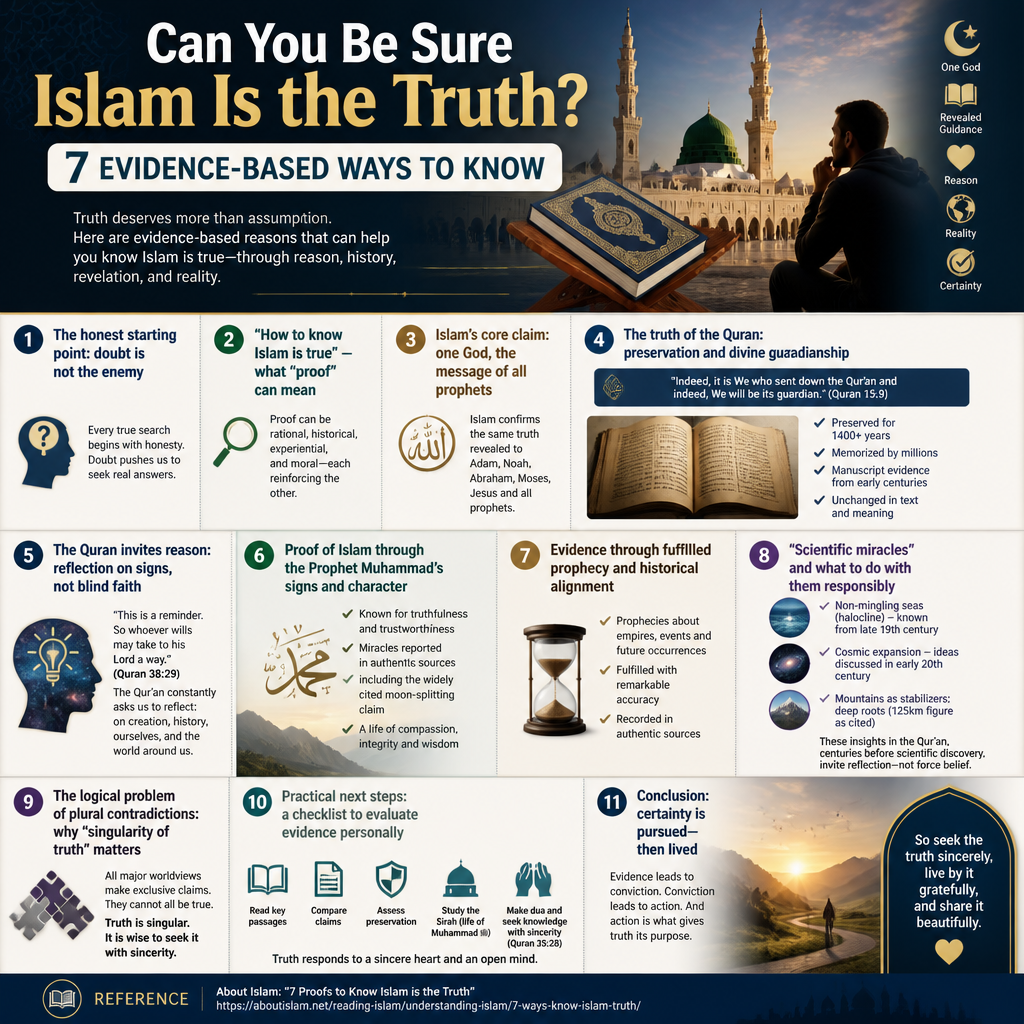
1) The honest starting point: doubt is not the enemy
Doubt can be a signal: “I don’t want a belief system I didn’t examine.” In Islamic ethics, seeking clarity is part of being responsible before God.
Instead of treating doubt as something to suppress, treat it as a reason to ask better questions:
- What would count as evidence?
- Is there a coherent message?
- Are there verifiable historical claims?
- Does the faith align with human nature?
In other words: if God is real, then truth should be pursued with the same seriousness you’d apply to any other major matter.
2) “How to know Islam is true” — what “proof” can mean
People often ask for “proof” as if they want math-level certainty for everything. But different types of claims call for different types of assessment:
- Historical evidence: what happened, when, and how reliably can it be reconstructed?
- Linguistic evidence: does a text show characteristics that are hard to imitate?
- Theological coherence: does the worldview avoid contradictions?
- Fulfilled claims: are there predictions that came to pass?
- Transformational evidence: does the worldview produce real moral/spiritual fruit?
Islamic authors commonly present evidence in layers—so you’re not left with only one argument, but a cumulative case.
3) Islam’s core claim: one God, the message of all prophets
Islam is not built around “random spiritual vibes” or one person’s ideas. Its core claim is tawhid—pure monotheism—and the idea that earlier prophets taught the same fundamental message.
If you’re evaluating “the truth of Islam,” one starting question is:
Is Islam’s central message consistent with the religious core found across prophetic history?
Islam frames the divine message as unified:
- One Creator (not multiple gods)
- Human accountability
- Worship that shapes character
- Guidance through revelation
That doesn’t settle every historical issue by itself—but it tells you what Islam is claiming to be: a continuation and completion of a single divine direction.
4) The truth of the Quran: preservation and divine guardianship
For many people asking how to know Islam is true, the Quran is the most central place to look. Islam presents the Quran as the preserved word of God.
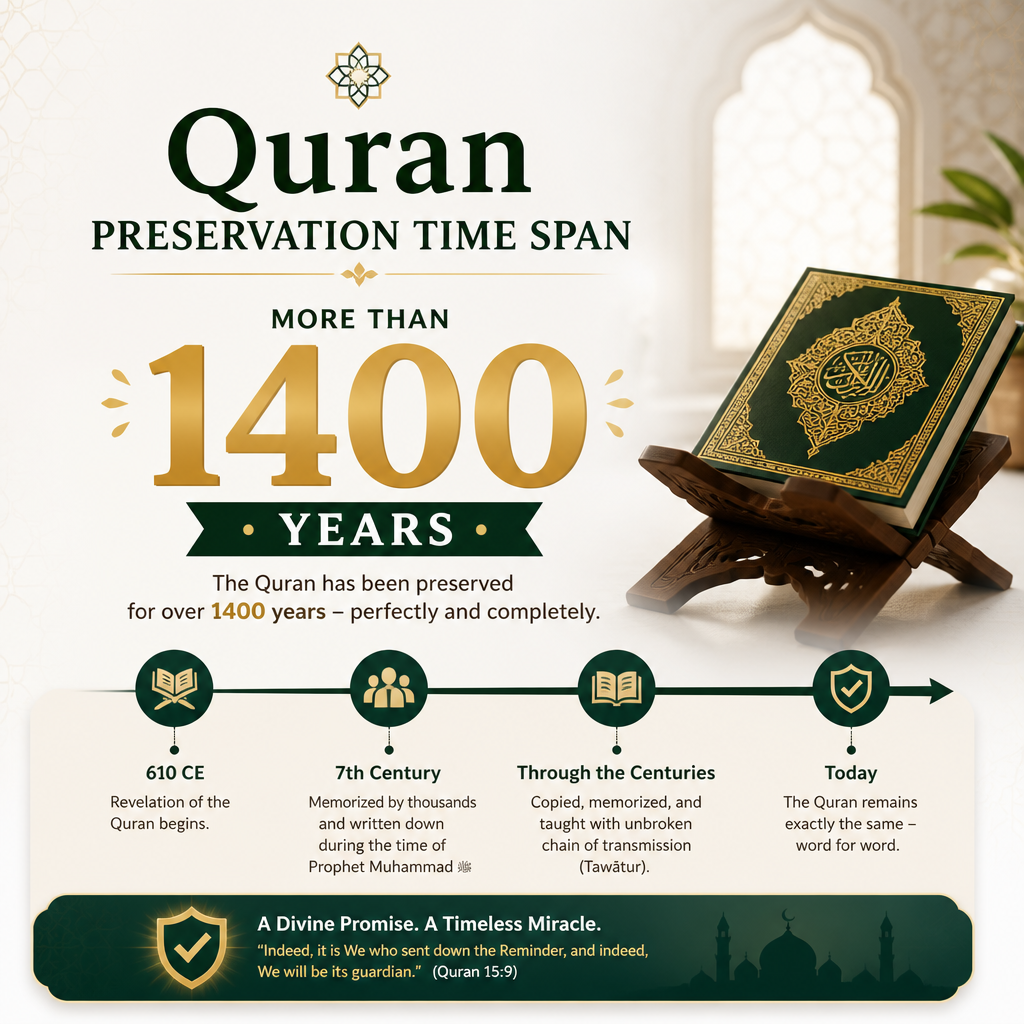
Quran 15:9 as a promise of protection
One of the widely cited Quranic promises is Quran 15:9, which is understood by Muslims as a statement of preservation (“surely We have sent down the Reminder, and We will surely preserve it”).
Historically, Islamic belief points to a remarkable chain of continuity:
- Early memorization by a large community
- Widespread recitation over generations
- Textual transmission with scholarly attention to accuracy
People interpret this differently, but the basic argument is straightforward: the Quran remained consistent over 1400+ years, and that continuity is seen as a sign of divine guardianship.
5) The Quran invites reason: reflection on signs, not blind faith
Islam doesn’t teach that you must reject thought. It repeatedly encourages reflection on what is around you.
Quran 38:29 and the “signs” mindset
Muslims often cite Quran 38:29—a call to reflect—paired with the broader Islamic idea that revelation is not asking you to suspend reason, but to use it.
So what does this look like practically?
- Read key passages and ask what they claim.
- Compare claims across different topics: God, human nature, morality, worship.
- Observe whether the message makes sense as a unified worldview.
The goal is not to hunt for random quotations. The goal is to see whether the Quran’s invitation to reflection produces a coherent and truthful worldview.
6) Proof of Islam through the Prophet Muhammad’s signs and character
Beyond the Quran itself, Islamic evidence also points to the Prophet Muhammad ﷺ—both in terms of moral character and reported signs.
Miracles and widely cited reports
Islam’s strongest claims are not only “feelings.” Muslims often appeal to reported miracles and prophetic knowledge, such as:
- extraordinary events attributed to Muhammad ﷺ
- prophetic predictions reported in Islamic sources
- testimony from people who lived through or closely witnessed early events
A widely discussed example is the claim of moon-splitting. You’ll find it mentioned in Islamic literature and often cited as a sign of prophethood. Readers who are investigating Islam should study how scholars understand these reports, and what authentication discussions exist.
Even if you don’t accept every detail immediately, the broader approach is important: Islam offers verifiable historical study, not only slogans.
Moral and social transformation
Another kind of evidence is the impact of the message:
- From tribal conflict toward communal ethics
- Emphasis on justice, honesty, and worship
- Formation of a moral community with enduring institutions
For many sincere readers, transformation becomes part of the “proof of Islam,” because truth should produce light, not confusion.
7) Evidence through fulfilled prophecy and historical alignment
Islamic arguments often include fulfilled prophecies. The logic is simple:
If a claim about the future is made with specific content and later appears to come true, that increases credibility.
Muslims cite examples that—depending on scholarly interpretation—are presented in the Quran and in reports connected to early Islamic events. This isn’t meant to be a magic trick. It’s meant to show that Islam’s claims are not purely abstract.
When evaluating, it helps to:
- compare different scholarly explanations
- read primary sources where possible
- avoid taking every claim at face value without context
“Scientific miracles” and what to do with them responsibly
Some people like the “scientific miracle” approach because it can make Islam feel testable. Others worry it can be misused. A wise approach is balance:
- Use them as supportive, not as your only foundation.
- Avoid overclaiming: not every verse is a scientific textbook.
- Read responsibly through credible scholarship.
Non-mingling seas (halocline)
One commonly cited example is the Quran’s description of two bodies of water that do not fully mix. Modern ocean science discusses layers where mixing is limited—often referenced in discussions of the halocline phenomenon, known more clearly to Western science from the late 19th century.
The argument is not “science proves God in one verse.” The argument is: Islam’s descriptions align with later scientific understanding in a way that believers view as meaningful.
Cosmic expansion ideas
Another frequently discussed area concerns large-scale cosmic descriptions. Some writers argue that certain Quranic language resonates with later ideas about the cosmos expanding—developments that became clearer in modern astrophysics in the 20th century.
Here, caution matters: cosmology is complex, and verse interpretation varies. Still, the main point believers make is that the Quran’s language is not childish or scientifically crude.
Mountains as stabilizers (and deep roots)
Mountains are described in Islamic sources as having stabilizing qualities. Some popular presentations cite a figure that mountain roots may extend extremely deep—commonly referenced as around 125 km—to illustrate that mountains are not merely “piles of rocks,” but part of a larger geological system.
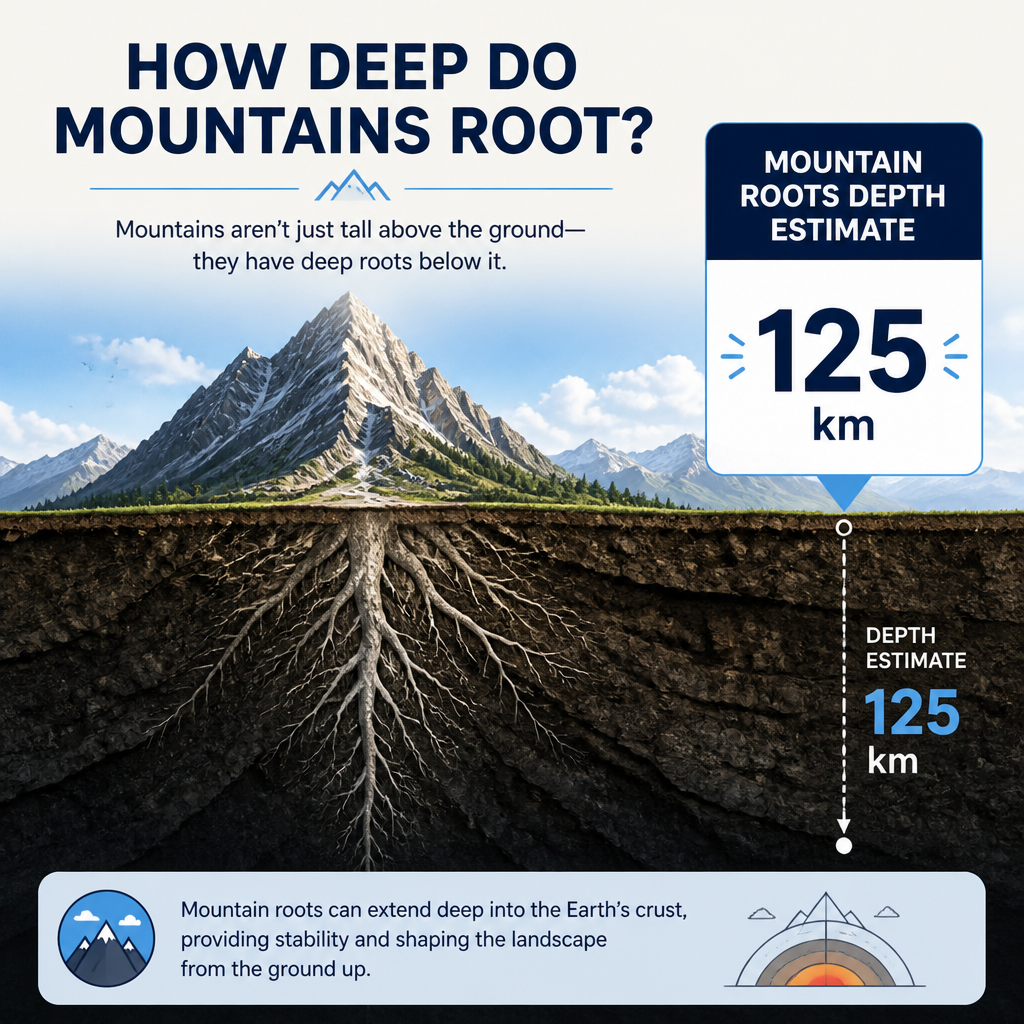
Again: treat “scientific miracles” as potential support. The stronger core remains the Quran’s guidance, preservation claims, and the historical reality of Islam’s emergence.
The logical problem of plural contradictions: why “singularity of truth” matters
Sometimes the question “how to know Islam is true” becomes emotional—people argue, compare communities, or try to force certainty from feeling alone.
But at a basic level, there is a logical question:
Can every mutually exclusive religious claim be “true” in the same sense?
Believers argue that “truth” is not plural in the way people sometimes assume. If religions contradict at their core—about God, revelation, and salvation—then one must be closer to reality.
So the “singularity of truth” idea becomes a reason to investigate Islam seriously rather than treating all outcomes as equivalent.
Practical next steps: a checklist to evaluate evidence personally
If you want to pursue certainty (not just curiosity), here’s a simple checklist you can actually follow.
1) Read key passages with an open mind
- Start with the Quran’s repeated themes: God, accountability, guidance, signs.
- Look for coherence: do the core claims hold together?
2) Compare preservation claims
- Study how Muslims explain Quran preservation (and why memorization mattered).
- Ask: what evidence is given for “truth of Quran” and continuity?
3) Study the sirah (the Prophet’s life) responsibly
- Don’t rely only on modern debates.
- Read balanced introductions and ask scholars for explanations.
4) Evaluate the moral fruit
- Look at how Islamic practice aims to shape character.
- Ask whether the faith produces peace, justice, and humility.
5) Make dua and seek knowledge sincerely
In Islam, knowledge is not separated from sincerity. A practical step is to pray for guidance while you study.
If the Quran is truly divine, then seeking it with sincerity should not leave you empty.
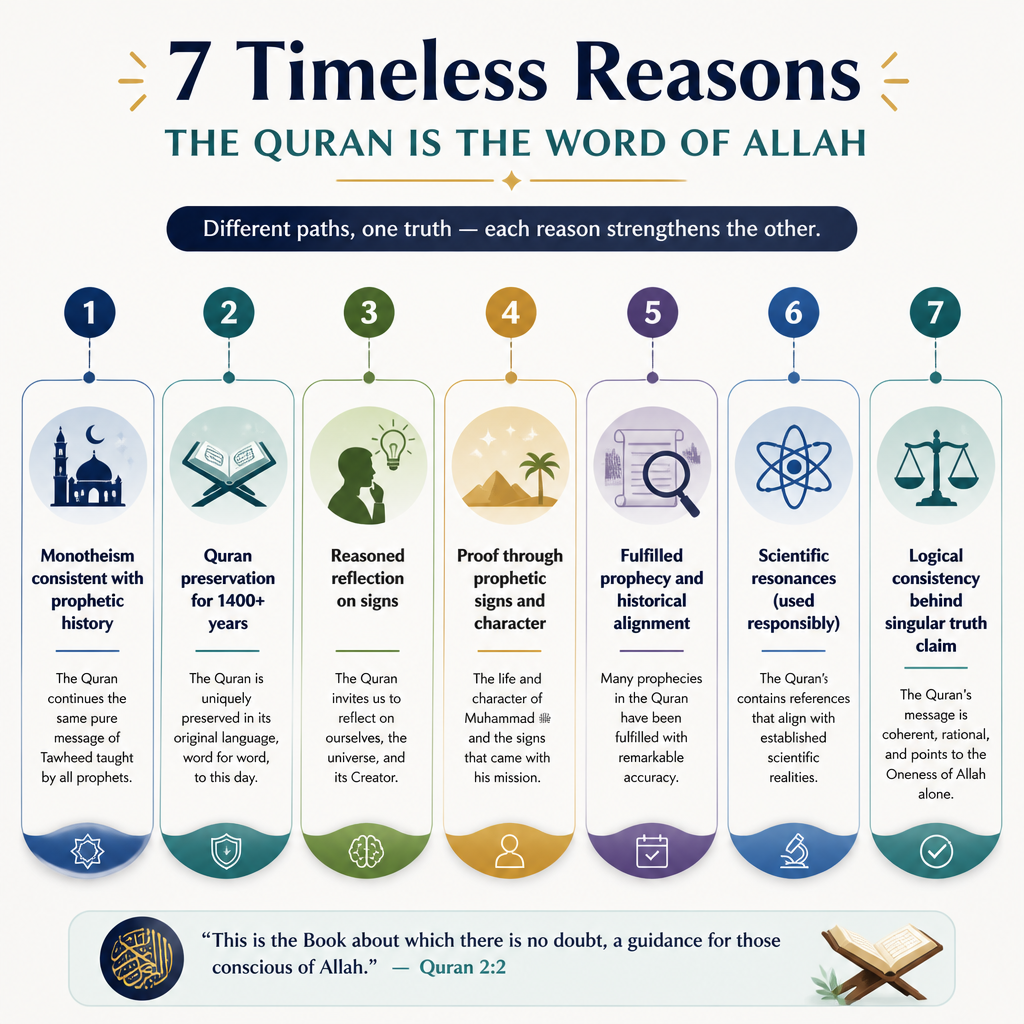
Conclusion: certainty is pursued—then lived
So, can you be sure Islam is the truth? Certainty in faith is not usually the result of one “instant moment.” It comes from a process: reading, researching, comparing, and letting evidence accumulate.
Believers commonly point to seven main lines of reasoning:
- Monotheism consistent with prophetic history
- Quran preservation for 1400+ years (truth of Quran)
- Reasoned reflection on signs
- Proof of Islam through prophetic signs and character
- Fulfilled prophecy and historical alignment
- Scientific resonances (used responsibly)
- Logical consistency behind the singular truth claim
The most important step is to stop asking only “Is it true?” and start asking “How does this worldview speak to reality?” Then test it with honesty.
Call to action: If you’d like to keep exploring, choose one track for the next week—read a portion of the Quran, study a chapter of the sirah, and write down the questions that remain. Then seek answers with patience and sincerity.
Reference
- About Islam: 7 Proofs to Know Islam is the Truth
“}}