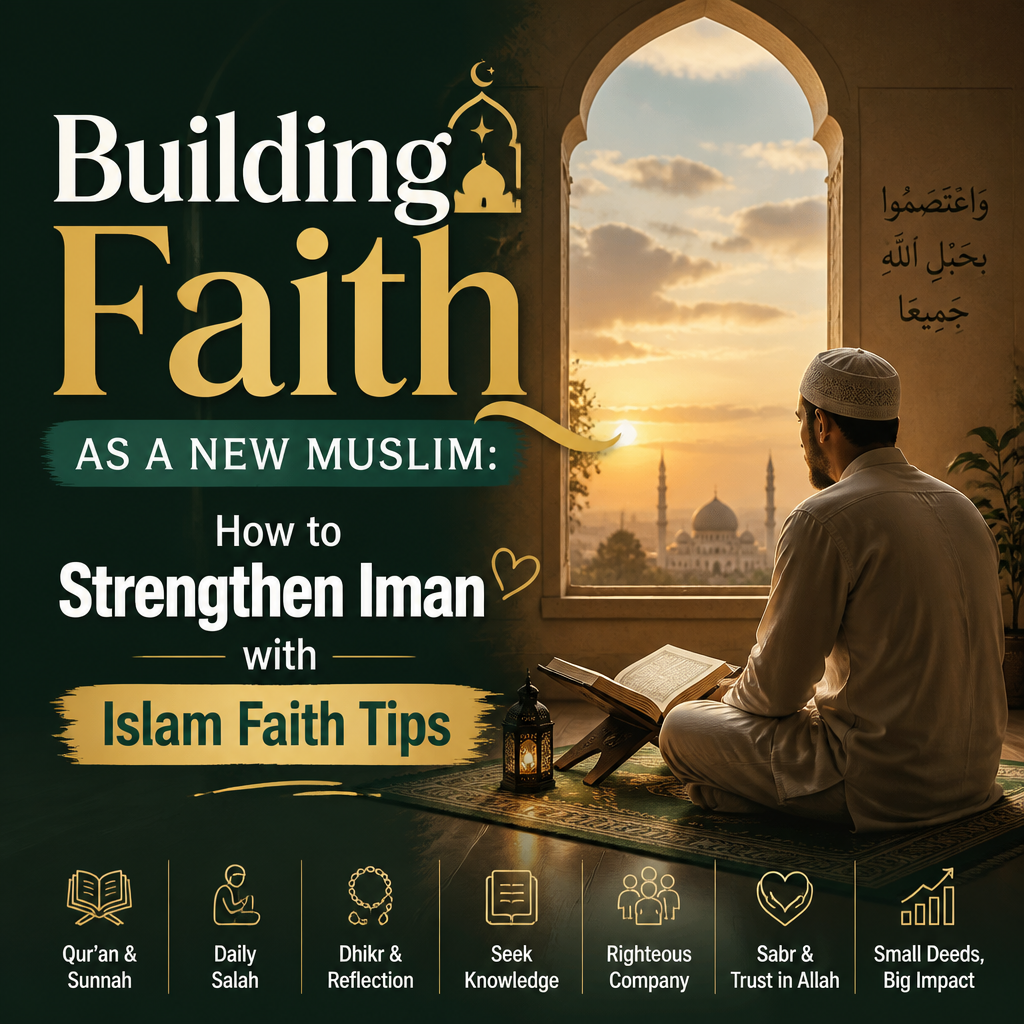
Building Faith as a New Muslim: How to Strengthen Iman with Islam Faith Tips
Strengthen iman—especially after becoming Muslim—is one of the most beautiful goals you can have. Yet it’s also one of the most challenging. Your heart may feel new, your mind may have questions, and your worship may not yet feel “automatic.” That’s normal. Building faith is not an instant event; it’s a journey Allah teaches you step by step.
In this guide, you’ll find clear, practical islam faith tips designed for new Muslims: how to understand iman, spot when your spirit needs care, return to the basics of Qur’an and Sunnah, stabilize your heart with dhikr and reflection, seek authentic knowledge, choose the right company, and respond to hardship with sabr and hope.
1) Introduction: Why building iman takes time
Many new Muslims expect a “mountain-top” feeling all the time. But iman grows like a living plant. It needs water (worship), sunlight (knowledge and Qur’an), and protection (good company, avoiding spiritual harm). Sometimes you will feel strong; sometimes you will feel dry or distracted.
The good news? Dry periods don’t mean you’re failing. They often mean you need a different approach: more consistency, more learning, more dua, and sometimes removing what drains you spiritually.
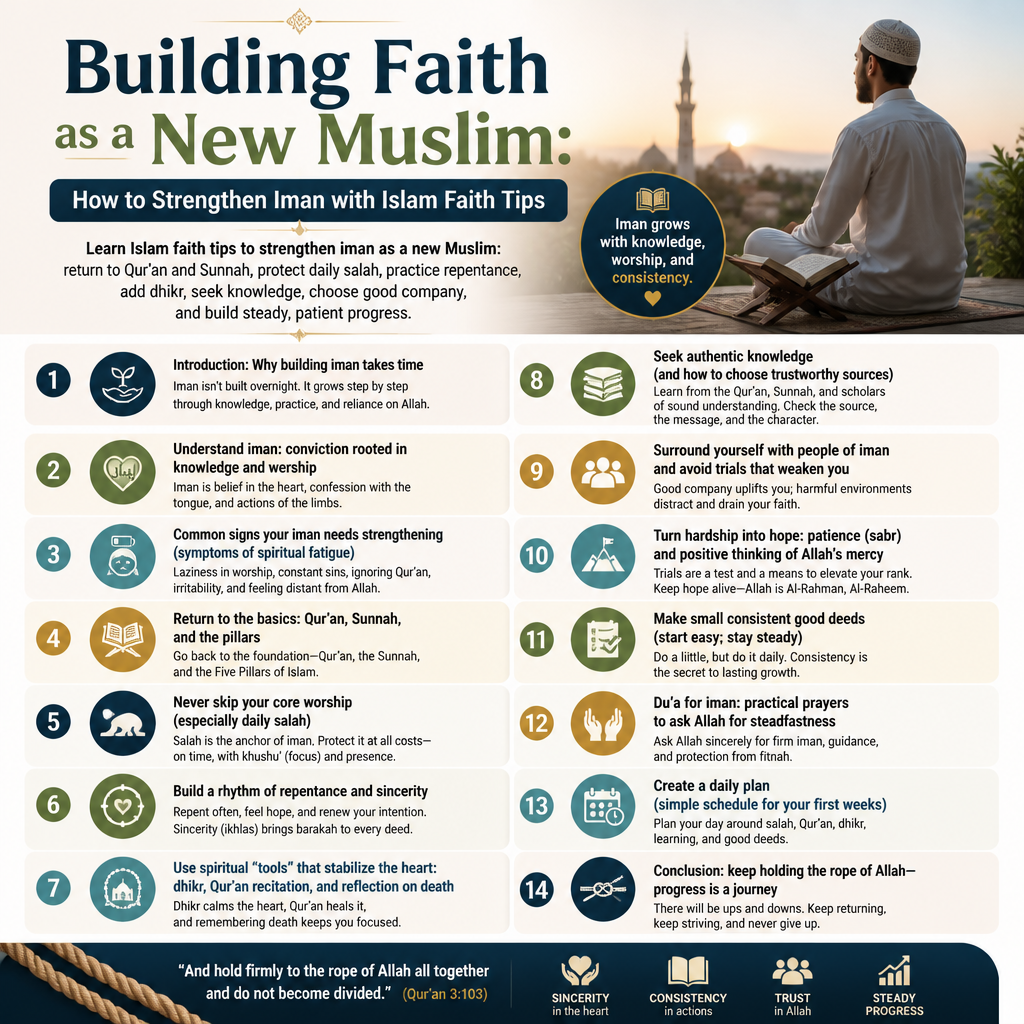
2) Understand iman: conviction rooted in knowledge and worship
Iman is not only emotion. True faith is conviction—a belief that shapes how you think, worship, and act. When iman is connected to knowledge, it becomes stronger under pressure. When iman is connected to worship, it becomes more alive day by day.
A helpful way to think about iman is:
- Knowledge gives your heart reasons to trust Allah.
- Worship trains your body and soul to obey Allah.
- Repentance keeps you from losing hope after mistakes.
When these three move together, your iman becomes stable—even when life is unstable.
3) Common signs your iman needs strengthening (symptoms of spiritual fatigue)
Recognizing weakness is part of strengthening. Here are signs many people experience as they learn:
- You feel numb when reading Qur’an or listening to reminders.
- You commit sins, then repeat them without real regret.
- Salah becomes heavy, rushed, or inconsistent—especially Fajr and Isha.
- You lose patience during trials and start thinking badly about Allah.
- You avoid learning because you feel overwhelmed or ashamed.
- You compare yourself to others in a way that either discourages you or makes you arrogant.
If you notice these signs, don’t panic. Use them like a spiritual checklist: what needs attention today—prayer, Qur’an, repentance, knowledge, or du’a?
4) Return to the basics: Qur’an, Sunnah, and the pillars
When iman feels shaky, go back to the fundamentals. Not because you’re “behind,” but because fundamentals are where Allah places healing.
Focus on these first:
- The Qur’an: read it daily, even if it’s only a little.
- The Sunnah: learn simple practices of the Prophet ﷺ (manners, dua, worship basics).
- The 5 Pillars: ensure you understand what you must do.
- Core beliefs: strengthen your understanding of Allah, angels, the books, messengers, the Last Day, and Qadar.
For new Muslims, this “return to basics” is often the fastest path to stability.
5) Never skip your core worship (especially daily salah)
If you want one practical islam faith tip that consistently strengthens iman, it’s this: protect your daily salah.
Salah is not only a ritual—it’s a connection. It resets your heart. It trains you to obey Allah even when feelings change.
Practical tips to stay consistent with salah
- Don’t wait for motivation. Pray when it’s time, not when you “feel like it.”
- Keep it simple. Learn the basics of wudu and the shortest surahs you can.
- Prioritize Fajr and Isha. Many people find these hardest—so they’re also the most powerful to protect.
- Make salah a routine, not a debate. If you can’t do everything perfectly, do what you can—consistency beats perfection.
When salah becomes steady, iman usually follows.
6) Build a rhythm of repentance and sincerity
New Muslims are learning; learning includes mistakes. Repentance is the mercy pathway that keeps you close to Allah.
How to practice repentance effectively
- Stop the sin as much as you can in that moment.
- Regret it sincerely.
- Resolve not to return to it (even if you’re still weak—try again).
- Make up the right time if it involves missed obligations.
Then—crucially—avoid the trap of despair. Shaytan loves two extremes: “I’m too far” or “It doesn’t matter.” Islam teaches that sincere repentance truly turns your heart back to Allah.

7) Use spiritual “tools” that stabilize the heart: dhikr, Qur’an recitation, and reflection on death
Sometimes your iman doesn’t weaken because you made a huge error. It weakens because your heart loses nourishment. Spiritual tools help you stay steady.
Tool #1: Dhikr (remembrance of Allah)
Dhikr trains your attention. Even a few minutes daily can refresh your spiritual focus.
Start with simple phrases you can repeat consistently, such as:
- SubhanAllah
- Alhamdulillah
- Allahu Akbar
- Astaghfirullah (ask for forgiveness)
Tool #2: Qur’an recitation (with meaning if possible)
Recite daily—even short passages. If you can, add meaning (tafsir or translations) so your heart understands what it’s saying.
If reading alone is hard, consider listening to a Qur’an recitation while you read the same verses from a translation. That combination helps many new Muslims.
Tool #3: Reflection on death and the meeting with Allah
For many people, thinking about death isn’t about fear—it’s about clarity. It breaks the illusion that life is endless and helps you choose what matters.
Try a gentle practice: once a week, reflect on your goals—what you want your life to stand for in the hereafter. Then make one change that supports that goal.
8) Seek authentic knowledge (and how to choose trustworthy sources)
Iman strengthens when you learn. But new Muslims often face a problem: too many opinions, not enough authentic guidance.
How to choose trustworthy Islamic knowledge
- Prefer scholars who are known for correct teaching and good character.
- Use resources rooted in Qur’an and authentic Sunnah.
- Avoid content that creates confusion, anger, or extreme claims without evidence.
- Learn basics first: belief, worship, morals, and practical sunnah.
Also, keep it realistic: learning is not a race. A small, consistent learning routine strengthens iman more than a big burst of information followed by long gaps.
9) Surround yourself with people of iman and avoid trials that weaken you
Righteous company helps your heart stay alive. When you spend time with people who fear Allah, you naturally feel more motivated to improve.
Seek good company by:
- Joining a local masjid community (classes, halaqah, reminders).
- Finding a mentor who is kind and grounded in Qur’an and Sunnah.
- Building friendships with practicing Muslims who are sincere—not performative.
Avoid what weakens you
Sometimes trials are not “bad people” only—they can be environments that normalize sin, mock worship, or keep you away from learning. Identify what drains you and put protective boundaries in place.
10) Turn hardship into hope: patience (sabr) and positive thinking of Allah’s mercy
Trials are part of faith. In fact, hardship often reveals what’s inside your heart.
How to practice sabr as a new Muslim
- Be patient with yourself. You’re learning; Allah knows your effort.
- Stay consistent in worship during difficulty—don’t abandon salah because you feel overwhelmed.
- Make du’a for ease and strength, not only for comfort.
- Don’t despair. Keep hope in Allah’s mercy, especially after mistakes.
One of the strongest ways to strengthen iman during hardship is to remember: Allah is not only testing you—He is also preparing your heart for better closeness to Him.
11) Make small consistent good deeds (start easy; stay steady)
Many people try to become “very religious” overnight, then burn out. A better approach is to choose small, easy, consistent deeds.
Examples of “small but powerful” habits
- Read a page of Qur’an daily.
- Pray sunnah prayers when you can (start with what’s easy).
- Give a small charity regularly.
- Set a few minutes for dhikr after salah.
- Replace one bad habit with one good habit each week.
Consistency creates faith momentum. Momentum creates confidence. Confidence reduces anxiety.
12) Du’a for iman: practical prayers to ask Allah for steadfastness
Nothing strengthens iman like turning to Allah directly. Du’a is not a “last resort”—it’s part of worship.
Use these meanings in your own du’a routine:
- “O Allah, increase my iman and make my heart firm upon Your guidance.”
- “O Allah, help me protect my salah and keep me consistent in worship.”
- “O Allah, forgive me, purify my intentions, and guide me to what pleases You.”
- “O Allah, protect me from the whispers of Shaytan and from trials that destroy my faith.”
Try making a short du’a after Fajr or after salah every day for one month. Track how your heart responds.
13) Create a daily plan (simple schedule for your first weeks)
If you want a plan that actually works, make it small enough to succeed and structured enough to reduce decision fatigue.
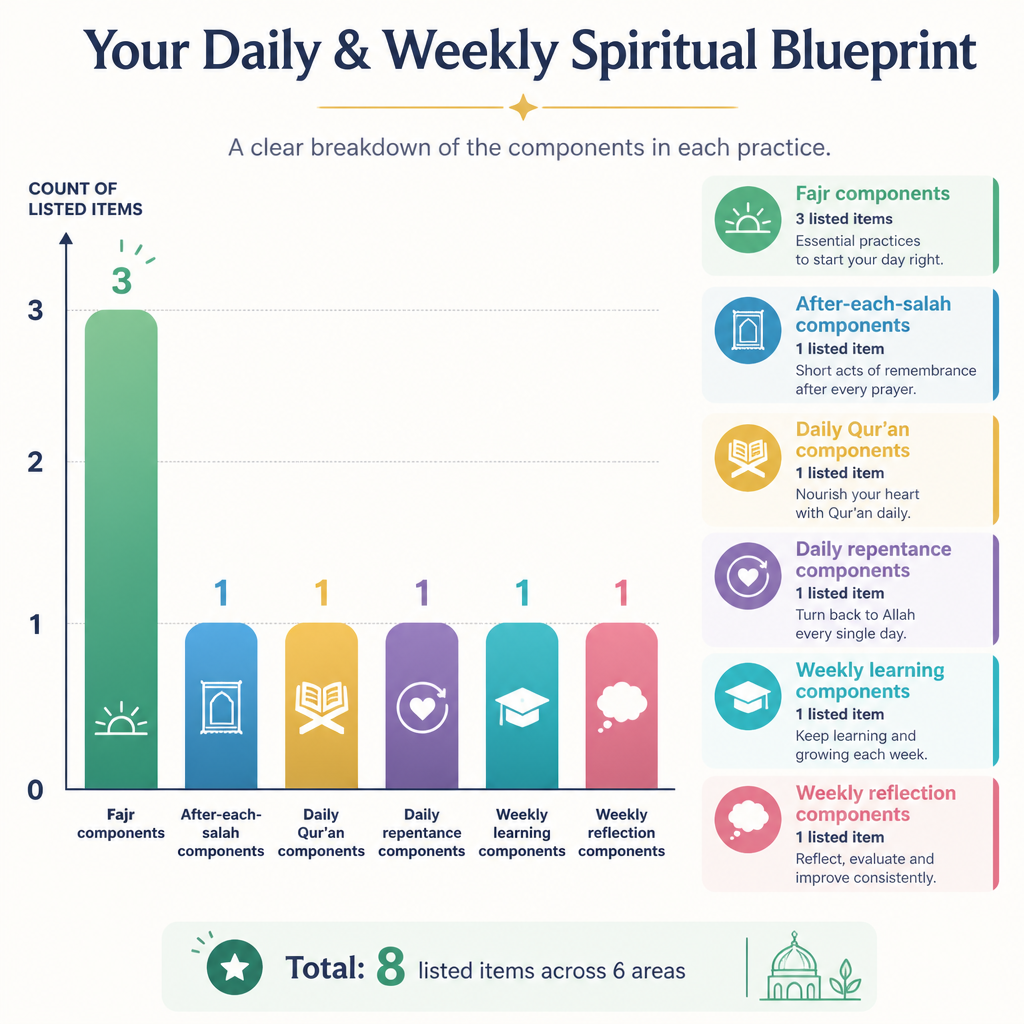
Your first 14 days (simple schedule)
- Fajr: Salah + 5 minutes dhikr + a short dua for steadfastness.
- After each salah: 1–3 minutes Qur’an or dhikr (even just a few verses or phrases).
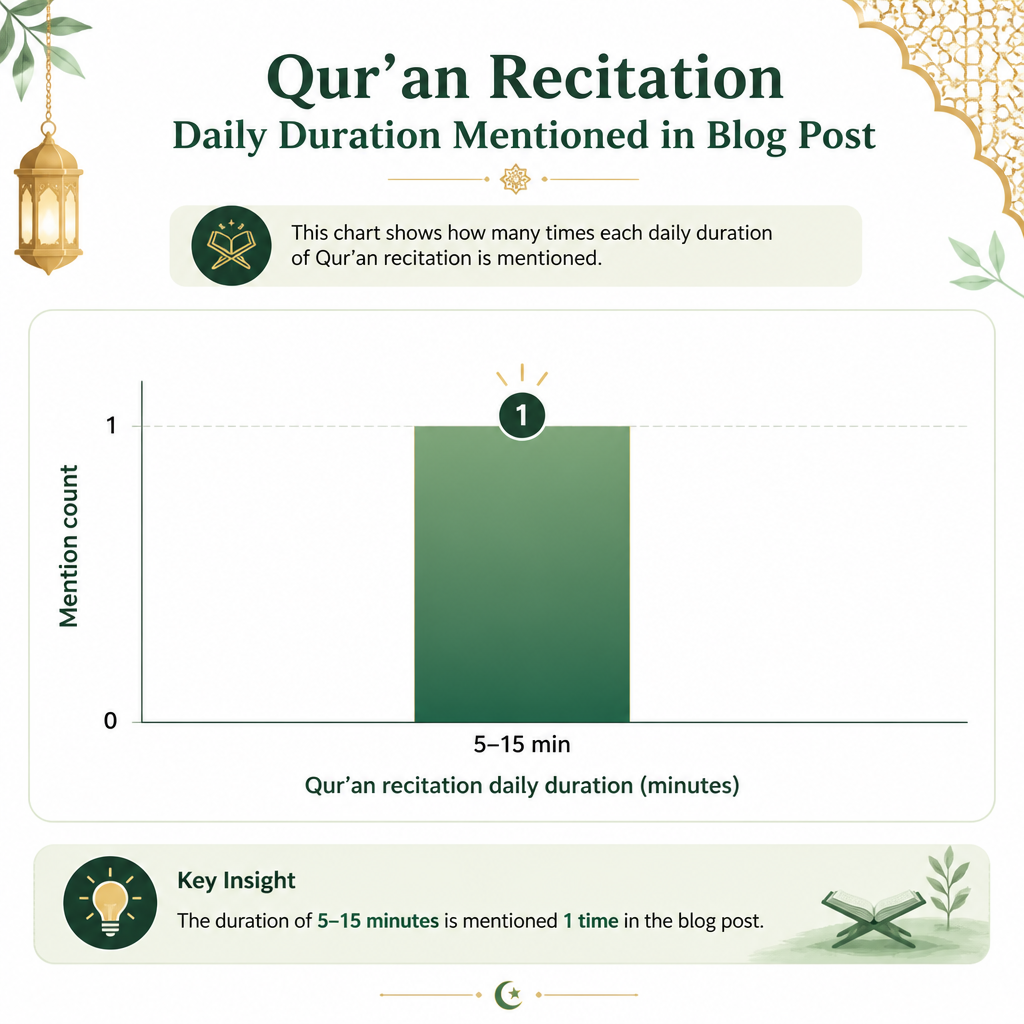
- Daily Qur’an: 5–15 minutes recitation with a translation if needed.
- Repentance: one sincere istighfar session (10–50 times) daily, especially if you slip.
- Weekly learning: one short class or one chapter of basic learning from a credible source.
- Weekly reflection: 10 minutes thinking about death, accountability, and your next step.
If you miss a day, return the next day. Don’t stop for “one missed day.” That’s how iman is lost—not by small mistakes, but by quitting after them.
14) Conclusion: keep holding the rope of Allah—progress is a journey
Building faith as a new Muslim is not about becoming perfect immediately. It’s about becoming consistent and becoming closer. If you want a clear path to strengthen iman, follow these anchors:
- Return to Qur’an and Sunnah.
- Protect daily salah, especially Fajr and Isha.
- Repent sincerely and avoid despair.
- Use dhikr and Qur’an recitation to stabilize the heart.
- Seek authentic knowledge and good company.
- Use sabr and hope when hardship comes.
- Choose small, consistent good deeds.
Your iman will fluctuate at times. That doesn’t mean you’re broken. It means your heart is alive—and Allah is shaping it through worship, effort, and return.
Now take action today: choose one iman-building habit from this list and do it for 7 days. Then choose the next.
May Allah strengthen your iman, make your worship easy, and keep you firm on His straight path.