From Doubt to Faith: Is Islam True? Logical Proofs Behind the Truth of Islam
There is a particular kind of doubt that isn’t rebellion—it’s honest searching. You read, you question, you weigh claims. You ask: is Islam true, not just emotionally true, but meaningfully true—true in a way that survives reason, evidence, and scrutiny.
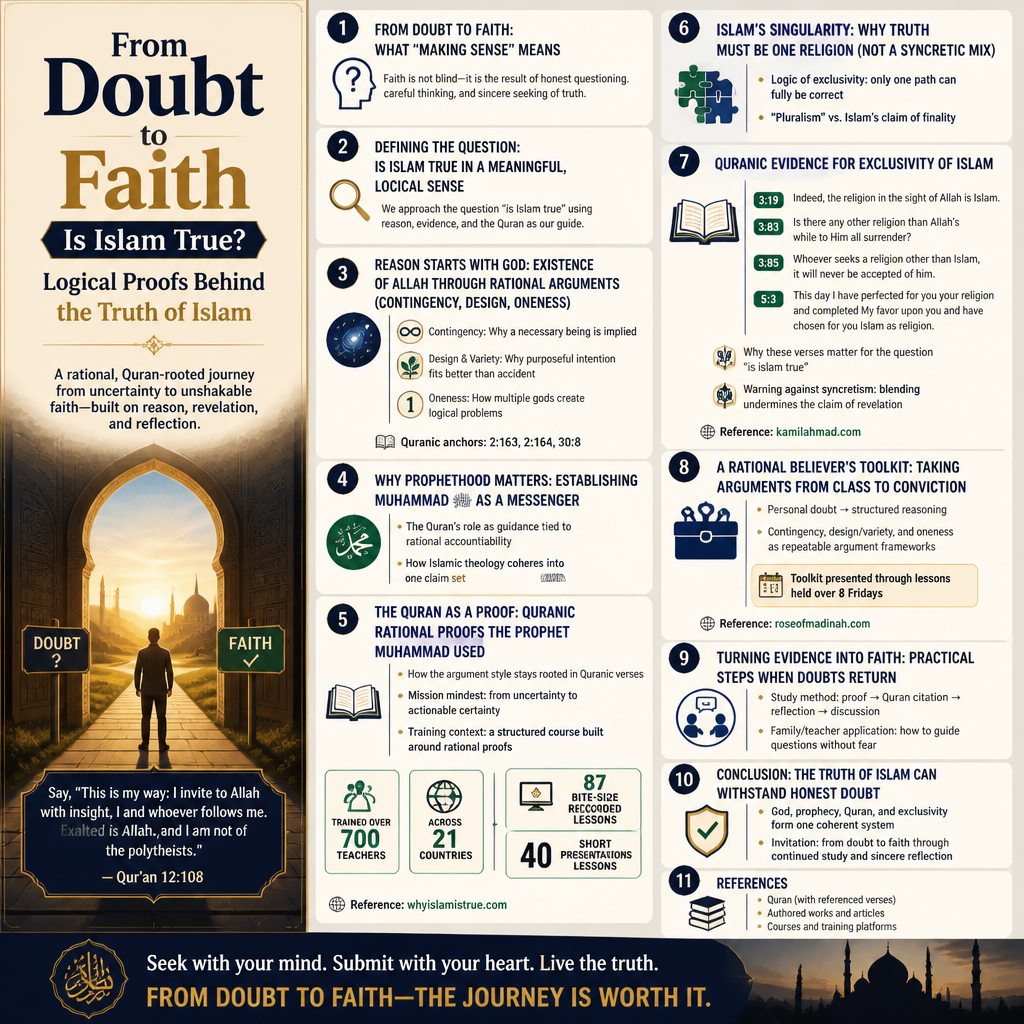
This article “makes sense” of Islam in a logical, Quran-anchored way: God (through rational arguments), prophethood (why messengers matter), the Qur’an (as guidance and rational miracle), and Islam’s singular truth-claim (why the truth must be one—not a syncretic blend). Along the way, we’ll also give practical steps for when doubts return.
1) From Doubt to Faith: What “Making Sense” Means
Faith is often discussed like it’s the opposite of thought. But in Islam, faith is tied to certainty—and certainty is not usually produced by slogans. It is produced by a process: evidence → understanding → reflection → action.
When people ask “is Islam true,” they’re really asking four connected questions:
- Is there a God? (or at least: is the universe best explained without God?)
- If God exists, did He communicate?
- If communication exists, is the Qur’an from that communication?
- Does Islam make sense as “the final” or “singular” path, not just one option among many?
The approach here is not to ask you to “feel” convinced. It’s to show you how Islam builds a coherent case—what some call the truth of Islam—using rational frameworks consistently rooted in Quranic language and themes.
2) Defining the Question: Is Islam True in a Meaningful, Logical Sense
Truth isn’t a mood. “True” means: reality matches the claim. So when we talk about whether Islam is true, we need claims that can be evaluated.
Islam’s central claims are not scattered. They form a system:
- Allah is One—no partners, no competing authorities.
- Human life has purpose, and humans are accountable.
- Prophets are sent with guidance that fits human reason and fit human need.
- The Qur’an is guidance from Allah and a proof of revelation.
- Islam’s message is final in the sense that it completes and corrects the claim of prior revelations.
So “logical religion Islam” means not only “faith-based,” but reason-respecting. The question becomes: do these claims cohere better than alternatives?
3) Reason Starts with God: Existence of Allah Through Rational Arguments
In many arguments, rationality begins with a simple observation: there is something rather than nothing, and the world is not self-explaining. Islam argues that the best explanation points to a necessary Being behind contingent existence.
3.1) Contingency: Why a Necessary Being Is Implied
The universe (and everything in it that begins, changes, and depends) is contingent: it could have been otherwise, and it relies on conditions. If everything is contingent, then what explains the overall system?
Islamic rational presentations often use this structure:
- The world is made of things that are dependent and changeable.
- A fully dependent chain struggles to explain why it exists at all.
- Therefore, reason points toward something that does not depend—a necessary source of existence.
Quranic themes support this logic. The Qur’an repeatedly invites reflection on how creation is a sign of a willful Creator—not random drift.
3.2) Design & Variety: Why Purpose Fits Better Than Accident
Another rational observation is that reality shows structure, order, and meaningful variety. Not everything is chaotic; not everything is uniform. There is a kind of intelligibility in nature.
Design and variety arguments often go like this:
- Complex, ordered systems are better explained by intention than by blind chance.
- Human experience recognizes patterns that guide choices and understanding.
- Thus, a designer-will fits better than a universe without intention.
From an Islamic perspective, this points to Allah not only as a cause but as a Knowing and Willing Creator.
3.3) Oneness: How Multiple Gods Create Logical Problems
Islam’s insistence on tawhid (Allah’s oneness) is not merely cultural. It’s presented as logically coherent.
A multiple-gods scenario often faces questions:
- If gods are competing authorities, whose will ultimately determines reality?
- If they disagree, does the universe become inconsistent?
- If they are limited, what makes them necessary?
Islam claims that a consistent cosmos points toward one supreme source—one Lord.
3.4) Quranic Anchors: 2:163, 2:164, 30:8 (Integrated Throughout)
Rational proofs become stronger when they are tied to Quranic language. For example, Islamic rational-argument teaching frequently references verses like:
- Qur’an 2:163 and 2:164 — reflections on signs in creation leading to understanding Allah.
- Qur’an 30:8 — how creation is a sign and that understanding points back to One who guides.
These are not presented as “detached proof texts.” Rather, they shape the mindset: the universe is meaningful, intelligible, and designed—therefore the heart can move from doubt to recognition.
4) Why Prophethood Matters: Establishing Muhammad ﷺ as a Messenger
Many people accept the possibility of God but wonder: Why prophets? Why revelation? Why not just reason?
Islam’s argument is that reason can point toward God, but guidance requires more than a general conclusion. Human beings need specific direction: what worship looks like, how morality is grounded, and what accountability means in everyday life.
Prophethood matters because revelation addresses questions reason alone cannot settle with certainty:
- What exactly does God want?
- How should humans orient their lives?
- How should moral and spiritual realities be translated into practice?
- How do earlier messages relate to the final message?
In Islam, prophethood also links rational accountability to lived responsibility. This is why Islamic theology tries to form one coherent claim set: God → purpose → revelation → prophet → Qur’an → Islam’s guidance.
5) The Quran as a Proof: Quranic Rational Proofs the Prophet Muhammad Used
If you’ve ever asked “is Islam true,” you might have noticed that many debates become emotional. But Islam often returns the conversation to a different method: reason paired with revelation.
One of the most practical ways to see this method is to look at rational-argument courses and “toolkits” that explicitly teach how to reason from Quranic verses, not by importing logic from unrelated systems.
5.1) How the Argument Style Stays Rooted in Quranic Verses
Islamic rational proofs often share a distinctive feature: they are not just arguments “about” Islam; they are arguments guided by the Qur’an’s own invitations to reflect. The goal is to build certainty through repeatable reasoning anchored in Quranic themes.
5.2) Mission Mindset: From Uncertainty to Actionable Certainty
Certainty is not only for the individual. It becomes a confidence that can be communicated with clarity. That is why some teaching efforts emphasize building a believer who can explain—not merely believe.
5.3) Training Context: A Structured Course Built Around Rational Proofs
For example, the resource Why Islam Is True – Quranic Rational Proofs the Prophet Muhammad Used (whyislamistrue.com) presents a structured course aimed at Quran-based rational proofs: God’s existence, prophethood of Muhammad, and the truth of the Qur’an.
Reported impact: trained over 700 teachers across 21 countries, including 87 bite-size recorded lessons and 40 short presentations.

Reported course impact: teachers trained

Reported course reach: countries
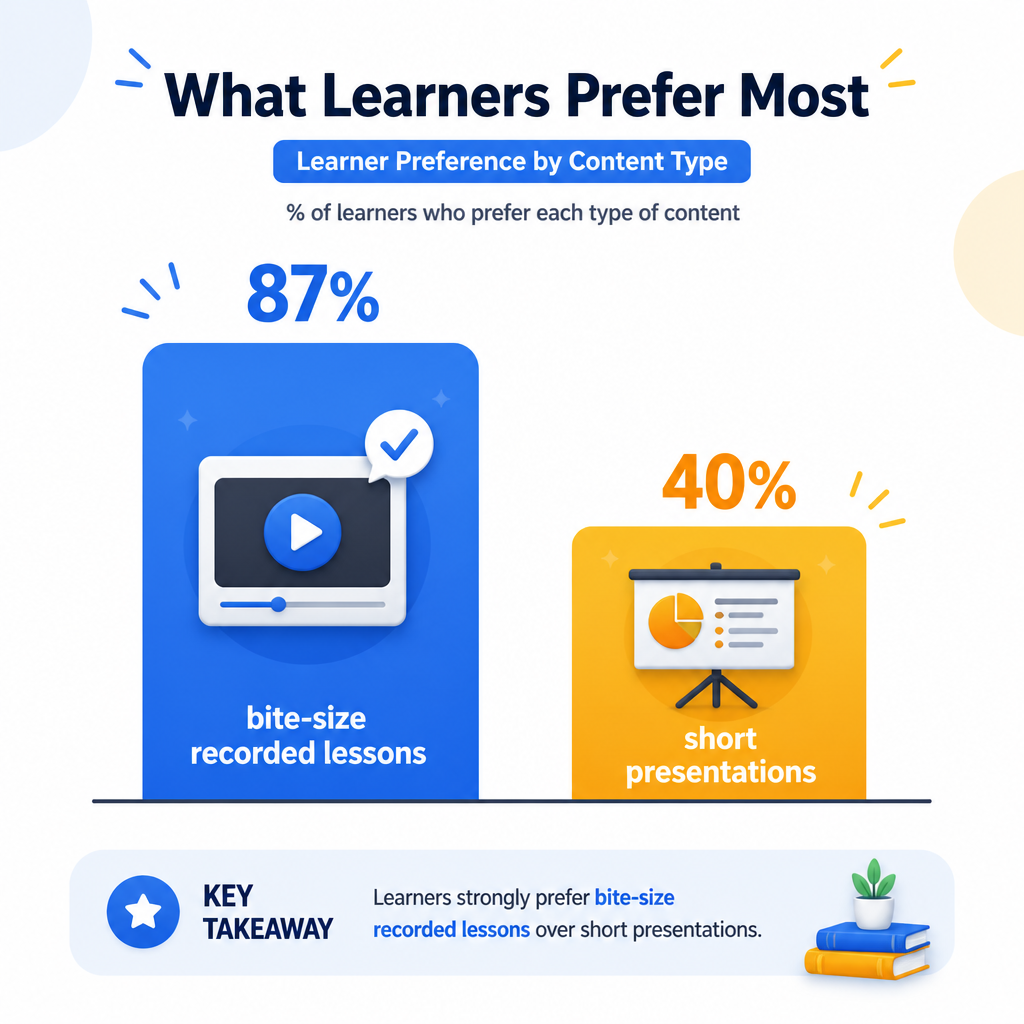
Reported course content pieces
5.4) Reference
6) Islam’s Singularity: Why Truth Must Be One Religion (Not a Syncretic Mix)
One of the hardest ideas for modern minds is exclusivity: the claim that truth is singular, not a blended compromise.
But logically, if revelation is real, then it either:
- reveals the same truth consistently, or
- contradicts itself in essential ways.
If two religions contradict at core points (about God, worship, accountability, or divine authority), then “both are equally true” becomes difficult to justify as logical truth.
So “is islam true” becomes, at least partly, a question of whether one final guidance could coherently complete what came before—rather than being one path among many equally valid options.
Islam argues that God is not inconsistent with Himself. Therefore, the truth of guidance should be coherent and unified.
7) Quranic Evidence for Exclusivity of Islam
Islam doesn’t hide its truth-claim. Many arguments for the truth of islam highlight Quranic verses that speak directly to exclusivity and the invalidity of syncretism.
7.1) Key Verses Frequently Used
A common set of verses referenced in exclusivity arguments includes:
- Qur’an 3:19
- Qur’an 3:83
- Qur’an 3:85
- Qur’an 5:3
These verses are presented as evidence that Islam is not a “religious flavor” among others; it is a revealed correction of deviations and a final clarity about worship and divine guidance.
7.2) Why These Verses Matter for “Is Islam True?”
If God’s revelation is meant to guide humanity, then essential guidance cannot be endlessly adjustable without losing its function as direction. Islam argues that blending revelations undermines the core claim of revelation: that Allah sends guidance with specific meaning and specific accountability.
7.3) Warning Against Syncretism
Syncretism (mixing claims without resolution) often creates a moral and theological ambiguity: Which authority do you follow? Whose law? Which truth-criterion?
Islam’s exclusivity claim aims to resolve that ambiguity. It says: the truth of worship and guidance must be traceable to revelation, not assembled by preference.
7.4) Reference
8) A Rational Believer’s Toolkit: Taking Arguments From Class to Conviction
Arguments are only helpful if they become personal conviction. That’s where structured “toolkits” help: they turn difficult topics into repeatable steps.
8.1) Personal Doubt → Structured Reasoning
One reason people get stuck is that doubt arrives without a plan. You feel uncertain, then you chase random answers. But a toolkit provides a map:
- What am I doubting?
- What type of claim is being made (God, prophethood, Qur’an, guidance)?
- What are the rational frameworks supporting it?
- What Quranic verses anchor the reasoning?
8.2) Contingency, Design/Variety, and Oneness as Repeatable Frameworks
Many “logical religion Islam” toolkits teach three core argument families:
- Contingency → why a necessary Being is implied.
- Design/variety → why intention fits better than random accident.
- Oneness → why multiple gods create logical inconsistency.
These frameworks help you evaluate claims consistently instead of treating religion as a collection of disconnected opinions.
8.3) Quranic Integration: Verses Like 2:164 and 30:8
Toolkits often cite verses that encourage reflection on creation as signs. For example:
- Qur’an 2:164
- Qur’an 30:8
The point is not to “copy” arguments mechanically. The point is to train the mind to align with Quranic thinking.
8.4) Reference
roseofmadinah.com/2024/04/16/why-islam-is-true-a-rational-believers-toolkit/
Reported teaching context: the resource describes a toolkit presented through classes held over 8 Fridays and emphasizes the argument style rooted in Quranic citations.
9) Turning Evidence Into Faith: Practical Steps When Doubts Return
Doubt can return. That doesn’t mean you’ve failed; it means you’re human. The difference is what you do next.
9.1) A Simple Study Method: Proof → Qur’an Citation → Reflection → Discussion
- Start with one rational proof. (e.g., contingency)
- Find the Quranic anchor. Look for verses that point to creation as signs.
- Reflect. Ask: does this explain reality better than alternatives?
- Discuss with care. Ask questions respectfully; seek clarity, not “gotchas.”
9.2) Keep the Tone Honest, Not Defensive
Many people sabotage their own certainty by turning curiosity into conflict. But genuine inquiry is compatible with sincere submission. Your goal is not to win arguments; your goal is to align with truth.
9.3) Family/Teacher Application: Guide Questions Without Fear
If you’re guiding someone else—especially family—avoid shutting down questions. Instead:
- Confirm the question: “That’s a good question.”
- Answer with both reason and Qur’an.
- End with a next step: “Let’s read this verse together” or “Let’s revisit the logic.”
When doubts are met with structure and compassion, they often become stepping-stones rather than stumbling blocks.
10) Conclusion: The Truth of Islam Can Withstand Honest Doubt
So, is Islam true? If you approach truth honestly—using reason, Quranic anchors, and a coherent system of claims—Islam becomes more than a label. It becomes a logic of meaning.
Put together, the case looks like this:
- God is rationally intelligible through arguments like contingency, design/variety, and oneness.
- Prophethood matters because human purpose and accountability require revealed guidance.
- The Qur’an provides the central invitation: reflection, reasoning, and certainty—rooted in revelation.
- Islam’s singularity fits the logic of divine guidance and the meaning of revelation.
Doubt doesn’t have to be the end. It can be the beginning of a journey where the mind is respected and the heart is invited.
Invitation: If you’re currently in doubt, keep going—one proof, one verse, one reflection at a time. The goal is not blind certainty; it’s earned certainty.
References
-
Why Islam Is True — “Quranic Rational Proofs the Prophet Muhammad Used”
https://whyislamistrue.com/ -
Kamil Ahmad — “Islam: The One and Only Religion”
https://kamilahmad.com/islam-the-one-and-only-religion/ -
Rose of Madinah — “Why Islam is True? A Rational Believer’s Toolkit”
https://roseofmadinah.com/2024/04/16/why-islam-is-true-a-rational-believers-toolkit/