Can Muslims Integrate Without Losing Faith?
The question is often framed as a dilemma: if someone is deeply Muslim, can they truly integrate into their new society—while keeping their beliefs, worship, and identity intact? Or will integration inevitably require an assimilation islam path that pushes faith out of public life or even into the background of personal conviction?
In reality, “integration” and “assimilation” are not the same thing. Integration usually means participating in the civic, economic, and social life of a country while maintaining meaningful aspects of one’s identity. Assimilation Islam, by contrast, implies a more forceful expectation of cultural blending where religious distinctiveness is treated as a problem to be solved.
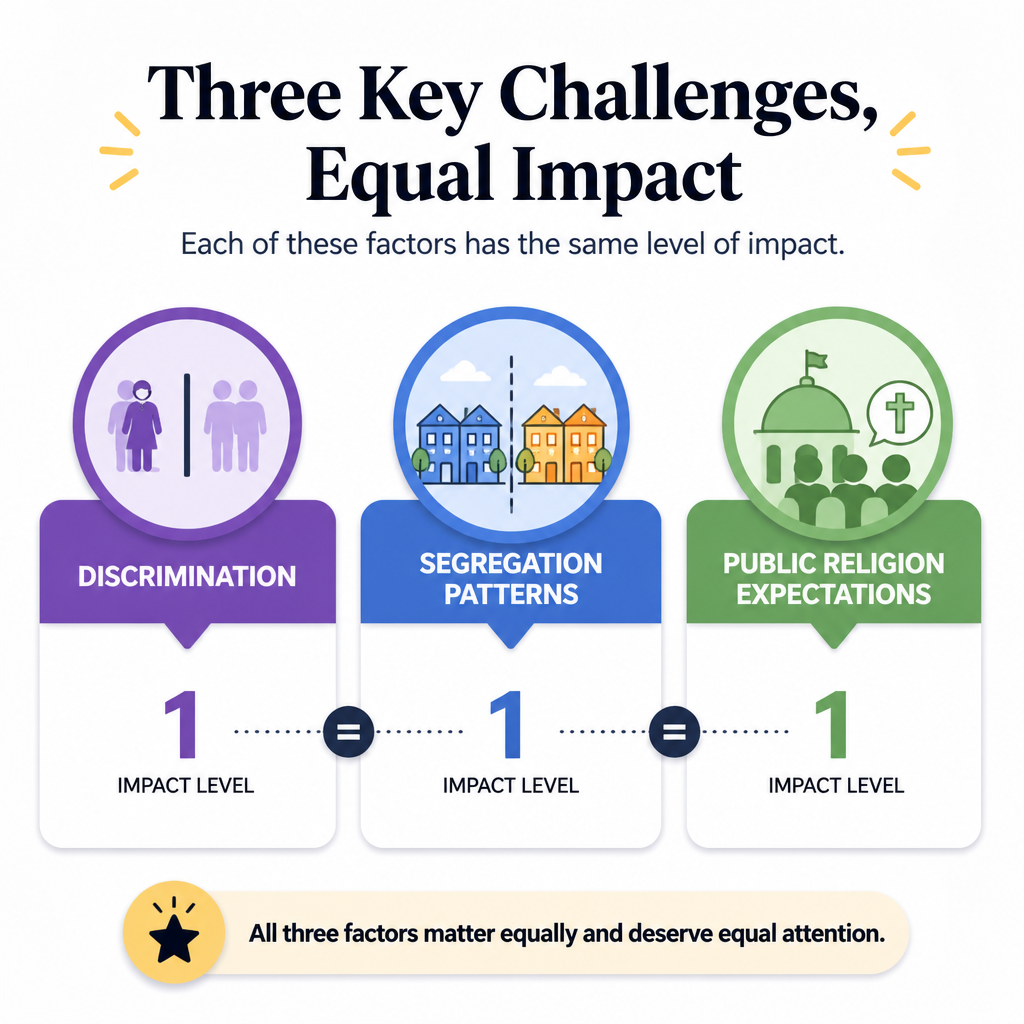
So what do the best data say? Looking across the US and Europe, research suggests that muslim integration is possible without Muslims abandoning faith. Where progress is slower, the evidence often points toward institutional barriers—such as discrimination, segregation patterns, or “public religion” expectations—rather than Islam itself functioning as a permanent obstacle.
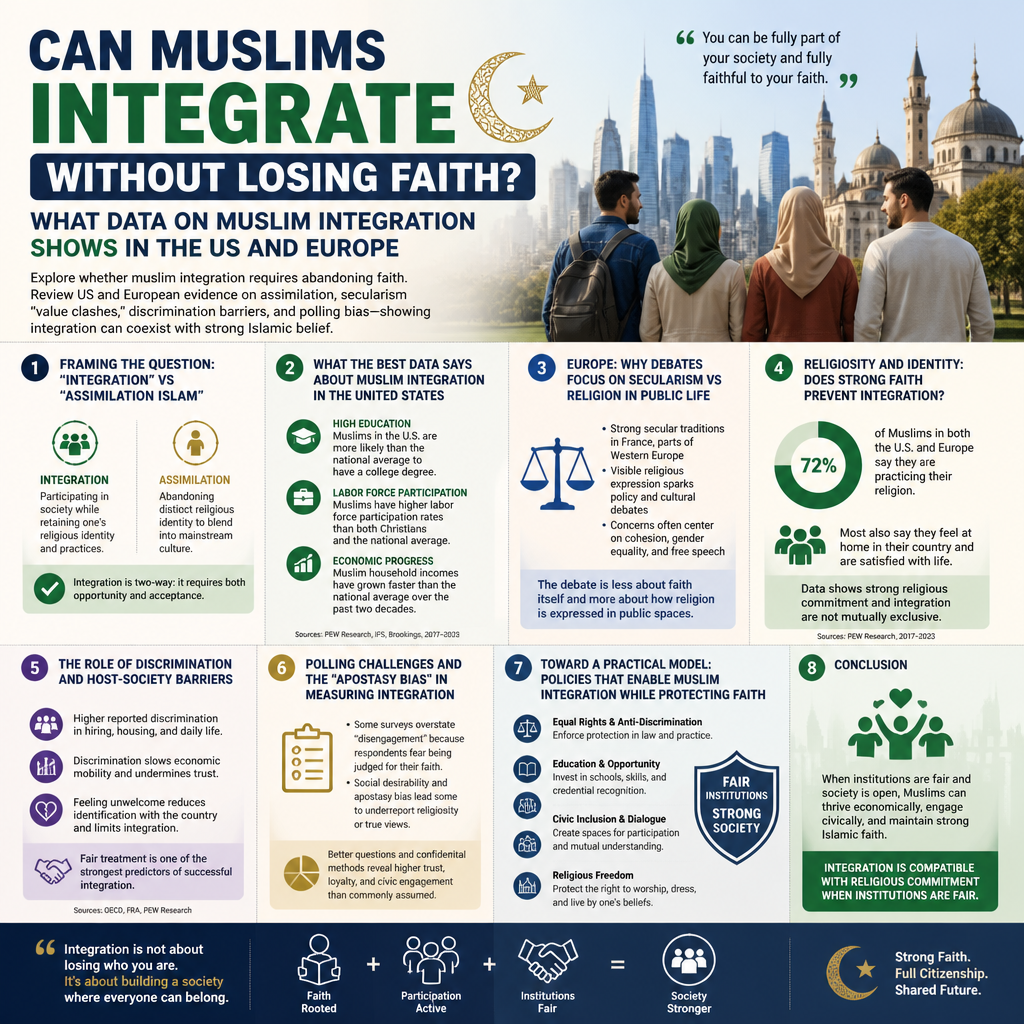
1. Framing the Question: “Integration” vs “Assimilation Islam”
Before looking at numbers, it’s important to clarify terms:
- Integration: becoming part of society through schooling, work, language learning, political participation, and social interaction—without demanding total cultural or religious erasure.
- Assimilation islam: a stronger requirement that immigrants’ practices (including religion) become less visible or less distinct, often by privatizing or minimizing religious identity.
Many public debates collapse these definitions. That makes it easy to confuse “religious difference” with “lack of integration.” A person can maintain faith and still integrate in many measurable ways.
2. What the Best Data Says About Muslim Integration in the United States
For decades, US research has examined whether Muslim immigrants and their children “catch up” to the broader society. A key theme in these studies is that Muslims in the United States often integrate comparably to other immigrant groups, including in education, employment trajectories, language use, and changing attitudes across generations.
One reason the topic is so contentious is that some claims—especially political claims—have suggested that Muslims “do not assimilate.” However, analyses of US data point in the opposite direction: Muslim Americans show evidence of successful integration.
What this looks like in practice:
- Generational change in identity and attitudes (first generation differs from second generation).
- Civic and economic participation patterns that track broader immigrant assimilation trends.
- Religious distinctiveness that does not automatically block educational and social advancement.
A major takeaway is that integration does not require “switching religions.” Instead, it often involves learning how to live in the civic framework of the host country while maintaining religious belief.
Source anchor: Research discussions drawing on Pew findings and US assimilation evidence appear in Niskanen Center’s review of the question “Do Muslim Immigrants Assimilate?” (see reference list below).
3. Europe: Why Debates Focus on Secularism vs. Religion in Public Life
Europe’s debate is often different. Instead of primarily asking about jobs, education, or language, many arguments focus on how religion is expressed in public.
Brookings highlights a key driver: a perceived “value clash” between European secularism—which expects religion to be privatized—and the Islamic tradition in which public religion can be meaningful and visible.
In other words, the concern is not only whether Muslims participate in society, but whether Muslims’ religious expression fits the host country’s model of how faith should appear in public life.
How secularism becomes a barrier:
- Some European contexts favor the idea that religion should remain “out of sight” in institutions and public roles.
- Islamic practice sometimes includes visible religious commitments (for example, modest dress or religious authority structures), which can trigger conflict when the host society insists on religious neutrality in public culture.
That does not mean Muslims “cannot integrate.” It means that integration may be harder in systems that demand uniform behavior as the price of belonging.
In fact, policy and social conditions can shape outcomes: if people face barriers to employment, education, or equal treatment, they can be pushed toward disengagement or toward stronger in-group identity.
Source anchor: Brookings’ article “The Major Roadblock to Muslim Assimilation in Europe” emphasizes secularism expectations and identity persistence as central issues.
4. Religiosity and Identity: Does Strong Faith Prevent Integration?
A common claim is that strong religious commitment necessarily slows integration. But the research picture is more nuanced.
Religiosity can sometimes correlate with identity strength—so Muslims may identify strongly with Islam. Yet strong identity does not automatically translate into lower economic participation or civic progress. In many cases, religiosity coexists with adaptation to the host society’s institutions.
Also, not all “integration” is measured in the same way. Someone may keep religious beliefs and still show:
- improved language proficiency over time
- higher educational attainment
- greater economic participation
- more nuanced social attitudes across generations
Moreover, religiosity itself changes across generations. Even when individuals remain religious, their interpretations, boundaries, and social practices can shift.
Important distinction: keeping faith is not the same as rejecting the host society’s laws and civic framework. Muslim integration can mean living as a law-abiding participant in a plural society while maintaining religious identity.
5. The Role of Discrimination and Host-Society Barriers
When integration stalls, one frequent explanation is “cultural incompatibility.” But research reviews point to another factor: discrimination and institutional bias in the host society.
If people experience unequal opportunities—especially in hiring, housing, schooling, or everyday interactions—they may rationally respond by retreating to networks that provide support. This can look like “non-integration,” even when the underlying cause is unequal access.
In French context discussions, for example, scholars have examined how bias can reduce assimilation opportunities and reinforce identity boundaries.
Source anchor: Niskanen Center’s research summary includes findings from work such as Adida and related studies arguing that systemic bias can be a primary barrier rather than Islam itself.
6. Polling Challenges and the “Apostasy Bias” in Measuring Integration
Some critics measure integration using surveys about attitudes on sensitive topics (for example, sexual ethics). The problem is that polls can mislead if they fail to account for an important demographic process: apostasy bias.
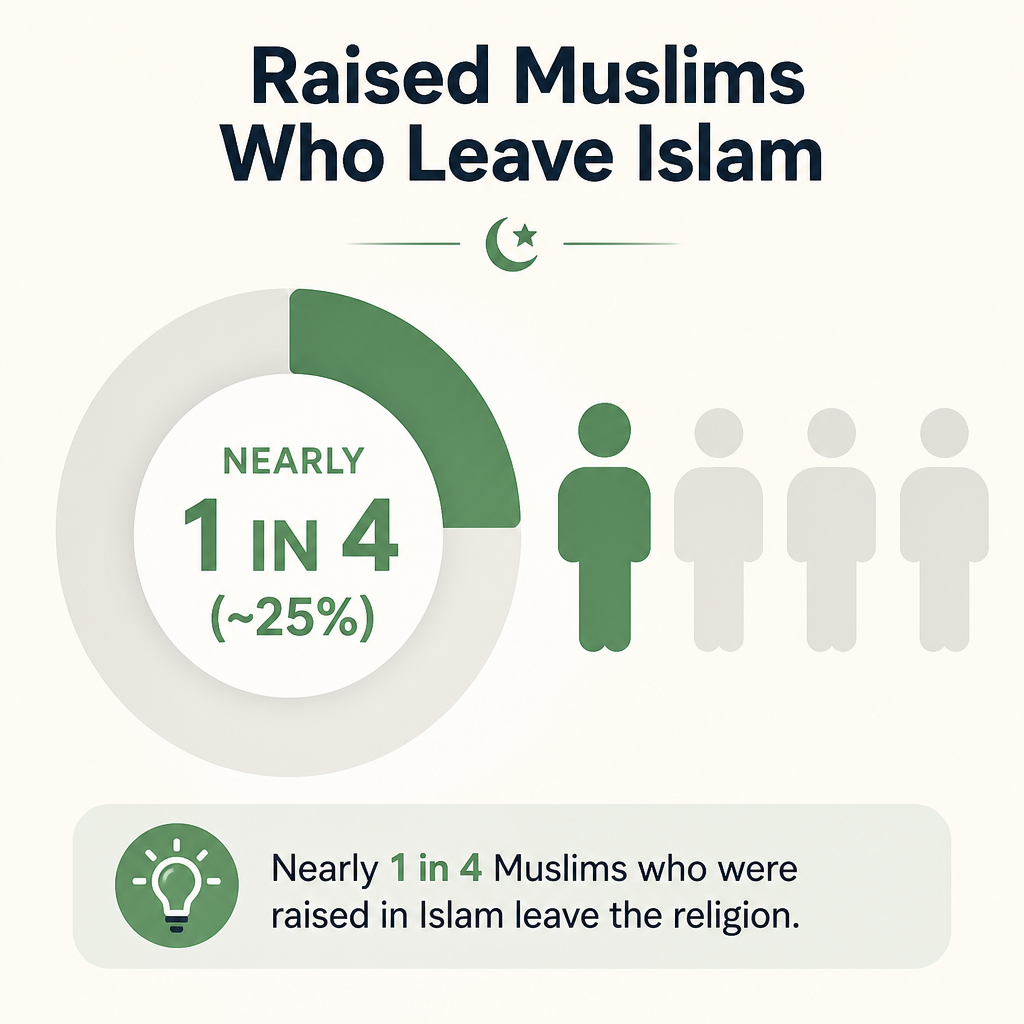
What is apostasy bias? If a substantial share of people who were raised Muslim leave Islam, and polls only capture current Muslims, then the sample may appear more conservative than the full population of “raised Muslims.”
This matters because generational change and liberalization may show up more clearly when you include those who left the faith.
One analysis (Cato Institute) argues that polling may understate liberalization among people raised Muslim, because disaffiliation can shift attitudes and survey results. In some cases, “net disapproval” changes notably when ex-Muslims are considered.
Why this changes the integration debate:
- It suggests that some “integration failure” conclusions rely on incomplete measurement.
- It implies that Muslims who remain Muslims are not the only relevant group when tracking long-term social change.
- It reinforces the idea that integration is a broader process than single-issue attitude comparisons.
Source anchor: Cato’s “Muslim Immigrants Assimilate Even More Than Polls of Muslims Indicate” discusses how nearly one in four raised Muslims leaving Islam can bias results.
7. Toward a Practical Model: Policies That Enable Muslim Integration While Protecting Faith
If muslim integration can coexist with religious commitment, what policies best support that reality? The evidence points toward a practical approach: fairness, equal opportunity, and civic inclusion.
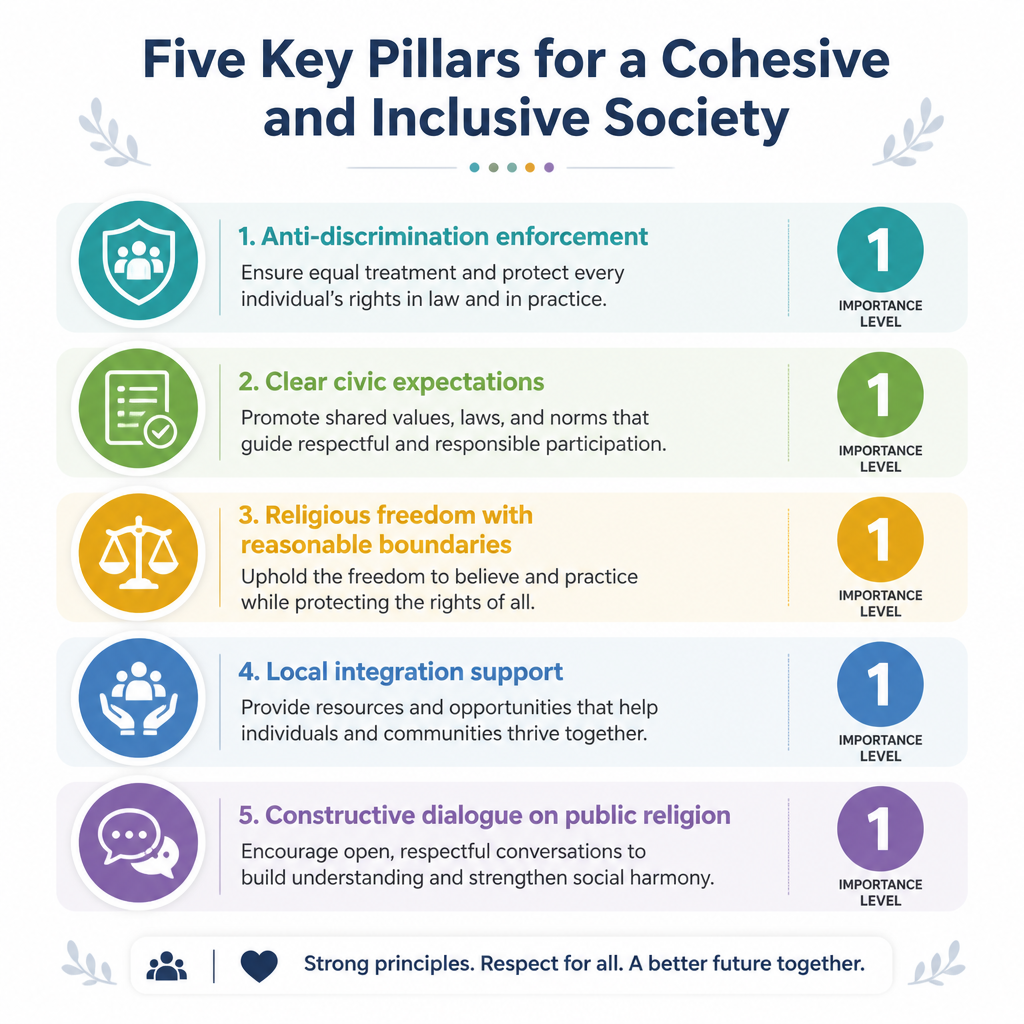
A working model includes:
- Anti-discrimination enforcement: Ensure equal access to jobs, housing, and education.
- Clear civic expectations: Emphasize that law-abiding civic participation is the standard, not cultural conformity.
- Religious freedom with reasonable boundaries: Protect rights to worship and to express faith, while maintaining public safety and equal rights for others.
- Local integration support: Language training, school bridging programs, and community mentorship that do not require abandoning identity.
- Constructive dialogue on public religion: Reduce “status anxiety” where communities feel singled out for visibility.
This model aims to support integration outcomes without forcing believers to choose between faith and belonging.
8. Conclusion: Integration Is Compatible With Religious Commitment
So, can Muslims integrate without losing faith? Based on the research themes reviewed from US and European contexts, the answer is: yes.
The clearest points are:
- Muslim integration does not require abandoning Islam. Many measures show successful adaptation, especially across generations.
- Europe’s central tensions often involve how religion is managed in public life, not a simple “Islam cannot integrate” claim.
- Discrimination and host-society barriers can be major obstacles that look like cultural resistance.
- Polling can underestimate integration by ignoring selection effects like apostasy bias.
When societies offer equal opportunity and treat religious identity as compatible with civic belonging, muslim integration becomes not only possible but sustainable—without demanding loss of faith.