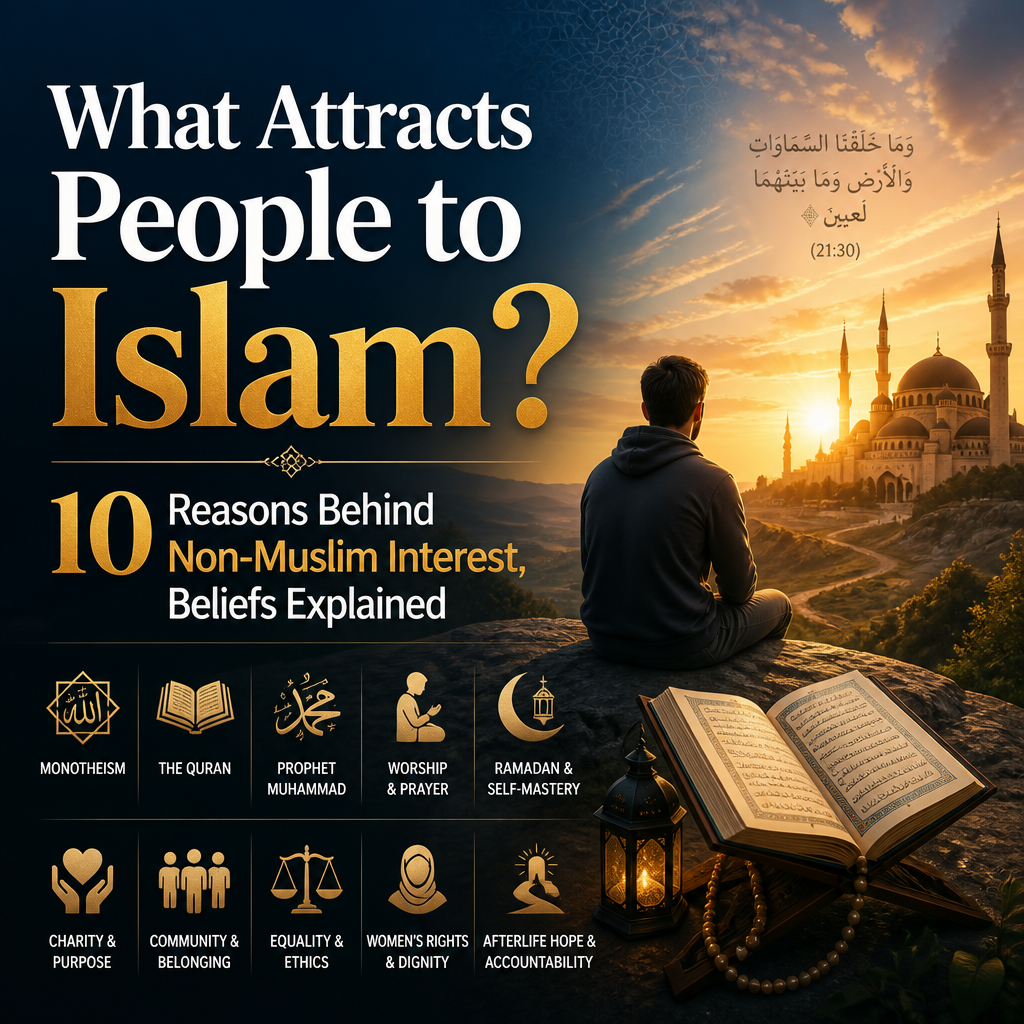
Introduction: “Why I’m curious” begins long before conversion
If you’ve ever wondered, “what attracts people to Islam?”—you’re not alone. For many non-Muslims, interest in Islam starts years before any formal decision. It may begin with a question about God, a sense that life needs more meaning, an encounter with Muslim neighbors, or a search for spirituality that feels both truthful and transformative.
Across many personal journeys and discussion threads, a pattern emerges. People are often not attracted to Islam because it is mysterious, but because it feels clear, coherent, and lived. In this article, we’ll explore 10 recurring reasons that explain why so many non-Muslims are drawn to Islam—using Islam beliefs explained in practical, approachable terms.
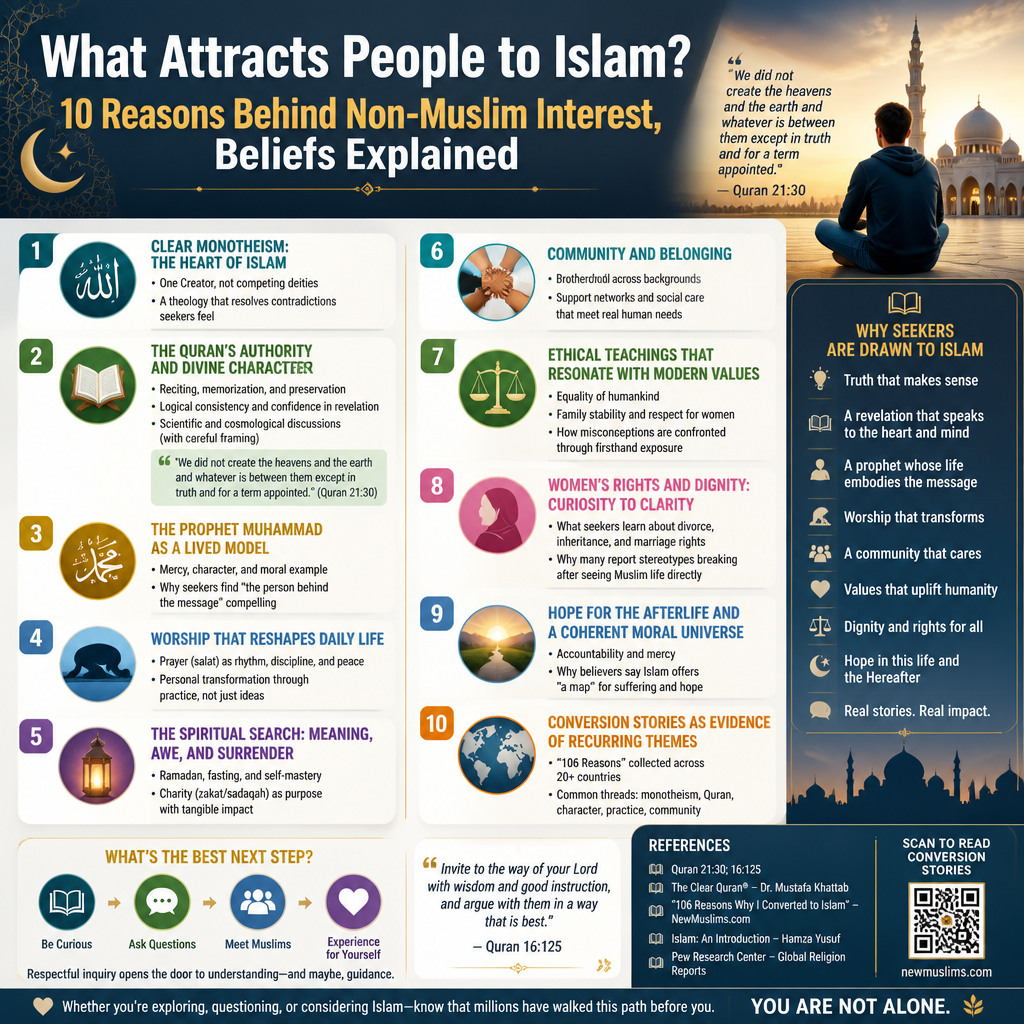
1) Clear monotheism: the heart of Islam beliefs explained
a) One Creator, not competing deities
One of the most frequently mentioned attractions is Islam’s strict devotion to tawhid, the oneness of God. Many seekers feel that this message is simple without being simplistic: there is one Creator who is worthy of worship, and no competing gods or divided authority.
b) A theology that resolves contradictions seekers feel
People also describe relief when they encounter a theology that feels logically consistent. When someone has questioned earlier religious claims—about God’s nature, human purpose, or divine authority—Islam’s monotheism can function like a “reset,” giving the search for truth a stable center.
2) The Quran’s authority and divine character
a) Reciting, memorization, and living transmission
Non-Muslims often notice that the Quran isn’t treated as a dead text. It is recited, memorized, studied, and sought for guidance daily. For many converts and lifelong learners, that creates confidence: the revelation is not merely “believed,” it is practiced.
b) Logical consistency and confidence in revelation
Seekers frequently report being drawn to the Quran’s internal coherence—its insistence on worshiping the Creator alone, its moral clarity, and its seriousness about accountability. This is a major part of the answer to what attracts people to Islam: not only the content, but the confidence that Muslims place in its origin and message.
c) Scientific and cosmological discussions (with careful framing)
Some conversion stories mention Quranic references to cosmology. A widely cited example is:
“Do not the unbelievers see that the heavens and the earth were a joined entity, then We separated them…” (Quran 21:30)
People often bring this up when exploring questions about origins and the structure of the universe. Importantly, serious readers approach these verses responsibly—seeking understanding through scholarship and not reducing Islam to “science trivia.” Still, the fact that the Quran addresses cosmic order in a way that many find compelling is a recurring reason behind interest.
3) The Prophet Muhammad as a lived model
a) Mercy, character, and moral example
While some traditions emphasize ideas, seekers are often deeply moved by the Islamic portrayal of the Prophet Muhammad (peace be upon him) as a moral and practical guide—someone whose character translated into mercy, justice, and honesty in daily life.
b) Why seekers find “the person behind the message” compelling
Many conversion narratives include a turning point that isn’t only theological. People say they began to respect Islam more once they felt they knew who delivered the message and what that person’s life demonstrated. In other words: Islam is not only a system of beliefs; it is connected to a real human exemplar.
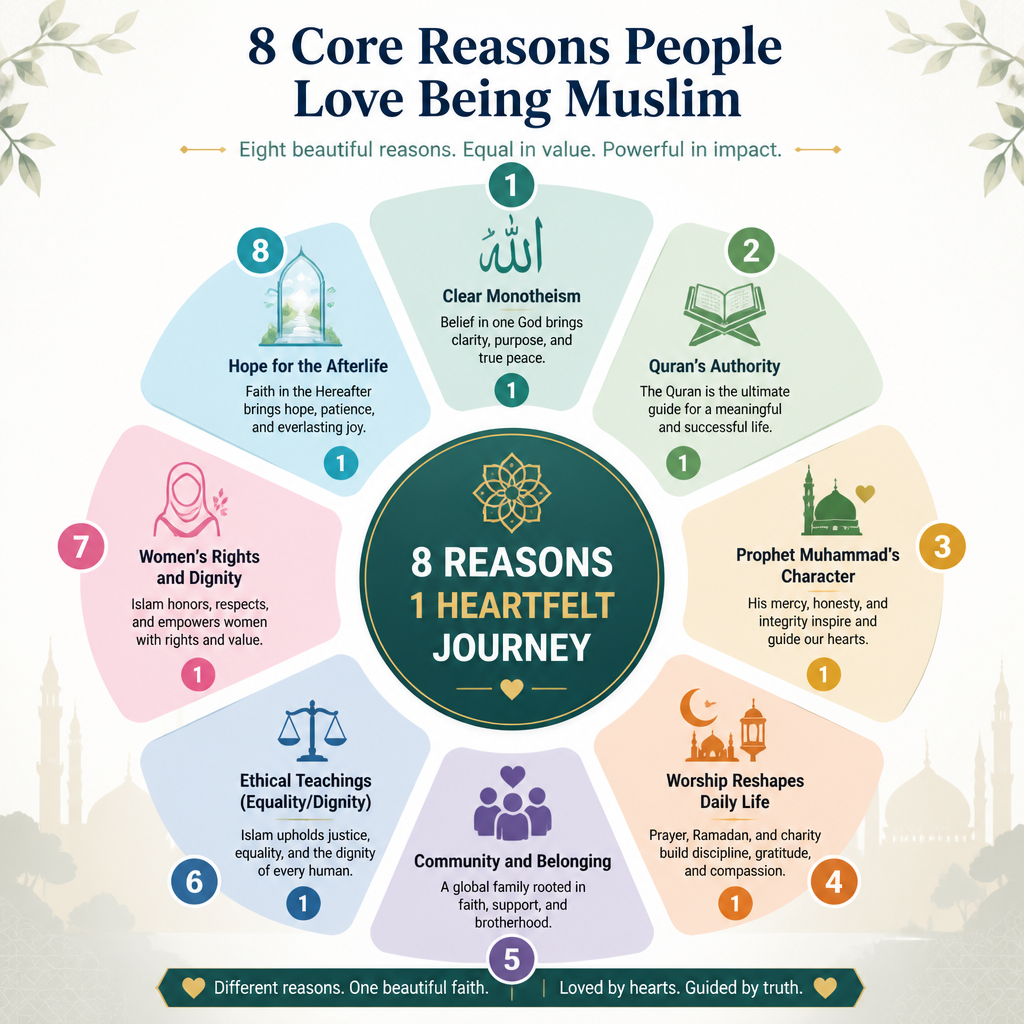
4) Worship that reshapes daily life
a) Prayer (salat) as rhythm, discipline, and peace
Non-Muslims who visit a mosque or speak with practicing Muslims often remark on one thing: Islam doesn’t remain “inside the head.” Worship builds a rhythm. The five daily prayers (salat) create regular moments to remember God, reset priorities, and reflect on conduct.
b) Personal transformation through practice, not just ideas
This is another major answer to what attracts people to Islam: people discover that faith is not only belief—it becomes a way of training the heart. Many converts describe inner steadiness after learning prayer, even before they fully mastered everything about Islam.
5) The spiritual search Islam people often describe: meaning, awe, and surrender
a) Ramadan and self-mastery
Ramadan is frequently highlighted as a turning point for non-Muslims. Fasting teaches discipline, empathy, and awareness of dependence on God. More importantly, Ramadan often creates a sense that the spiritual world is not far away—it is something one can enter through practice.
b) Charity (zakat/sadaqah) as purpose with tangible impact
Islam also emphasizes charity as worship. Zakat and voluntary charity (sadaqah) are not presented as vague kindness; they are structured acts that create direct benefits for families and communities. Seekers often find this both motivating and sensible: spirituality expresses itself through action.
6) Community and belonging
a) Brotherhood across backgrounds
Many people discover that Islam offers a community that is diverse yet united. New arrivals often experience welcome, mentorship, and a culture of learning—especially in places where visitors are guided rather than judged.
b) Support networks and social care that meet real needs
When seekers observe how Muslims look after one another—financially, socially, and spiritually—it can challenge assumptions that religion is only private belief. Islamic community often feels like a support system built around mutual care.
7) Ethical teachings that resonate with modern values
a) Equality of humankind
Islam teaches that human worth comes from God’s creation and guidance—not from ethnicity, class, or power. For many non-Muslims, this resonates strongly because it matches an intuition about dignity and fairness.
b) Family stability and respect for women
Islamic teachings also address family life, responsibility, and respectful conduct. People often find that Islamic ethics aim to protect individuals from exploitation while building healthy relationships.
Sometimes interest grows simply because misconceptions begin to break down after direct interaction—when someone sees Muslim families living out their values in real life.
8) Women’s rights and dignity: curiosity to clarity
a) What seekers learn about divorce, inheritance, and marriage rights
One of the most common questions among non-Muslims involves women in Islam. In many documented journeys, seekers report a shift from stereotype to understanding after reading relevant Quranic guidance and Islamic legal principles.
Conversion stories shared by researchers and platforms often mention that Islamic sources describe rights regarding marriage, divorce, and inheritance in ways that shocked people when they compared them with historical Western legislation.
b) Why firsthand exposure often changes perceptions
In addition to reading texts, many non-Muslims find their views change after spending time around practicing Muslim women—observing faith, confidence, and dignity. When stereotypes collide with reality, clarity becomes possible.
9) Hope for the afterlife and a coherent moral universe
a) Accountability and mercy
Another recurring attraction is Islam’s view of a meaningful afterlife: human choices matter, justice is real, and God’s mercy is not blind but purposeful. That combination—accountability plus mercy—can feel like a moral “map” for living.
b) Why believers say Islam offers “a map” for suffering and hope
Non-Muslims who are drawn to spiritual search Islam often seek something that explains why suffering exists and what to do with it. Islamic belief offers a framework: trials can be endured with faith, and life has direction beyond immediate circumstances.
10) Conversion stories as evidence of recurring themes
Personal testimonies are not “proof” by themselves, but they are useful evidence of what themes repeatedly move hearts. In research and compilation articles about conversion to Islam, several common threads show up again and again:
- Monotheism that feels clear and consistent
- The Quran’s authority through preservation and living recitation
- Prophet Muhammad’s character as a lived model
- Practice (prayer, Ramadan, charity) that changes daily life
- Community that provides belonging and support
For example, “106 Reasons Why I Converted to Islam” compiles diverse accounts across more than 20 countries, showing how different people can be drawn for similar reasons. Other resources also highlight how curiosity can grow through theological research, firsthand exposure, and reflection on spiritual peace.
Conclusion: what attracts people to Islam—and the best next step
So, what attracts people to Islam? Often it is not one single factor. It’s the combination of:
- Clear monotheism (one God)
- Trust in revelation (the Quran)
- A moral exemplar (the Prophet’s character)
- Worship that transforms (prayer, Ramadan)
- Purposeful ethics (equality, dignity)
- Hope for the afterlife
- A real community that supports growth
If you’re exploring Islam—whether you’re curious, questioning, or seriously considering conversion—the best next step is often simple: seek respectful, informed inquiry. Read the Quran (translated), ask questions, observe how Muslims practice, and allow your understanding to grow step by step.
References and further reading (top conversion-related resources):
References
-
106 Reasons Why I Converted to Islam – https://islammessage.org/en/article/12885/106-Reasons-Why-I-Converted-to-Islam-
-
Why I Converted to Islam from Christianity: Scientific and Rational Reasons – https://medium.com/@muhammadsaribali/why-i-converted-to-islam-from-christianity-scientific-and-rational-reasons-68ae42d6503
-
Why I Converted to Islam – Part 1 (Sarah Price) – https://quran-for-all.com/blog/why-i-converted-to-islam-part-1-2/