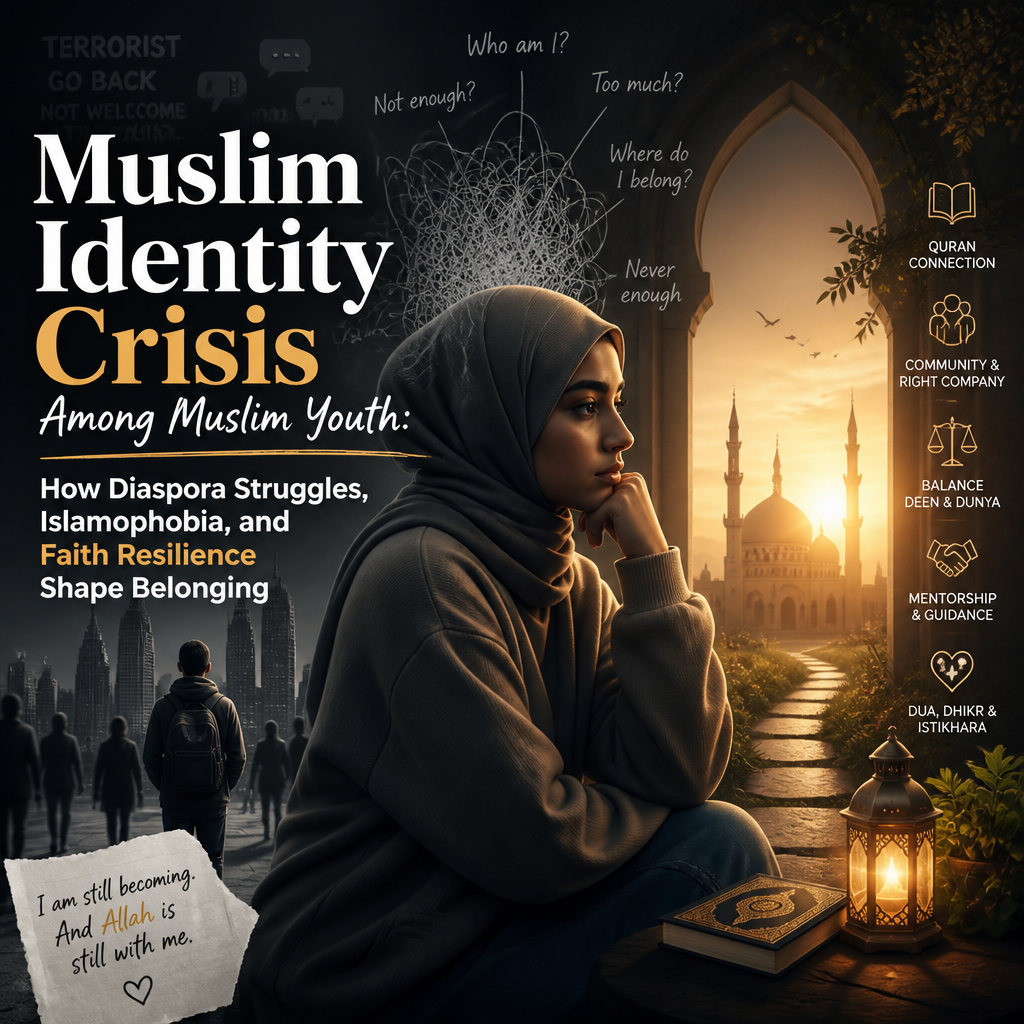
Muslim Identity Crisis Among Muslim Youth: How Diaspora Struggles, Islamophobia, and Faith Resilience Shape Belonging
1. Introduction: When identity feels split
For many Muslim youth growing up in diaspora—whether in Europe, North America, or elsewhere—religious identity can feel like a balancing act. It’s not simply about belief; it’s about how belief is perceived, how it’s practiced in public, and whether one feels welcomed or judged. The result can be a muslim identity crisis: a sense of “Am I truly Muslim?” alongside “Can I still be Muslim and belong here?”
This crisis is rarely a sudden collapse. More often, it develops slowly—through repeated microaggressions, hostile media narratives, confusing cultural expectations, and experiences inside (or outside) Muslim spaces such as mosques. When young people feel unseen or unsafe, their heart starts protecting itself by questioning, hiding, or distancing.
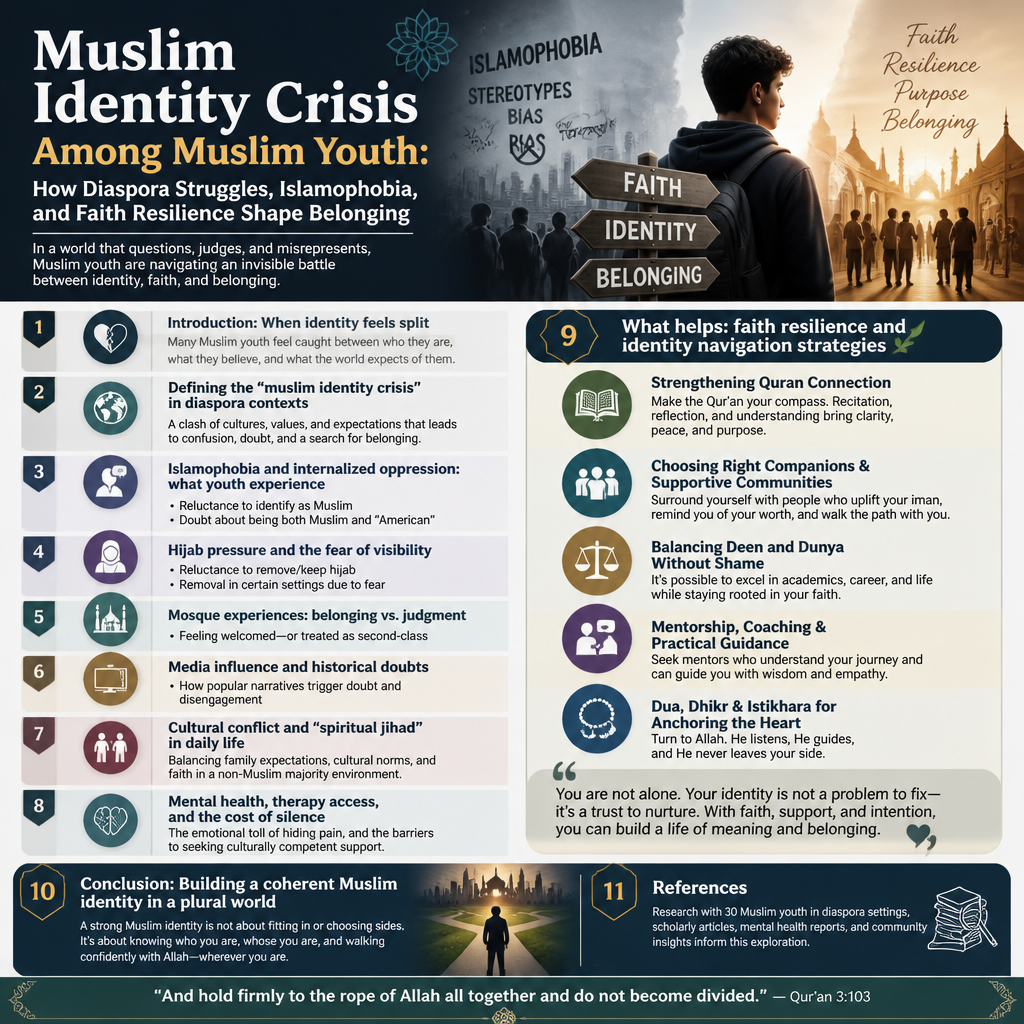
2. Defining the “muslim identity crisis” in diaspora contexts
In a diaspora context, identity is not only inward; it’s relational. A young Muslim may carry multiple “audiences”: family, peers, school, media, and the broader public. A muslim identity crisis often appears as:
- Reluctance to identify openly as Muslim, even when faith is sincere.
- Uncertainty about compatibility—for example, believing one has to choose between being “American/Canadian/British” and being Muslim.
- Emotional disconnection from Islamic spaces (mosques, youth groups) when those spaces feel judgmental or silent.
- Spiritual and intellectual doubt triggered by public stereotypes or “historical” questions absorbed from media.
Importantly, this isn’t a “phase” for everyone. For some youth, it becomes a long-term wound—because the cost of speaking up is high, and the cost of staying silent can be even higher.

3. Islamophobia and internalized oppression: what youth experience
One of the most consistent themes in research on Muslim youth identity is the impact of Islamophobia—not only as overt harassment, but as repeated social pressure that reshapes self-perception.
Reluctance to identify as Muslim
In a study by Yaqeen Institute exploring the faith and identity crisis of American Muslim youth, researchers interviewed 30 young Muslims (19 girls, 11 boys). The findings show that internalized Islamophobia is real: approximately 1 in 3 children were reluctant to identify as Muslim, and nearly half were unsure whether they could be both Muslim and American.
When identity feels risky, young people may think, “If I don’t say I’m Muslim, maybe I’ll be treated normally.” That coping mechanism can look like calm maturity from the outside—yet internally it often creates confusion and shame.
Doubt about being both Muslim and “American”
Islamophobia frequently frames Islam as incompatible with “Western values.” Young Muslims absorb this message and begin testing themselves: “Am I really the kind of Muslim people say I am?” “Is there something wrong with me for wanting two worlds?”
Over time, doubt can become disengagement. Not because Islam is untrue, but because the young person is tired of defending their existence.
4. Hijab pressure and the fear of visibility
For many Muslim youth—especially girls—the crisis can intensify through hijab pressure. Visibility becomes a vulnerability: school environments, public spaces, and even community interactions can feel unpredictable.
Reluctance to remove/keep hijab
In the same Yaqeen Institute research, the story of hijab emerged powerfully. The study reported that all 15 hijab-wearing girls considered removing it at some point. Many did not remove it immediately, but the thought itself reveals a deeper struggle: hijab is not only fabric—it is identity, worship, and belonging.
Removal in certain settings due to fear
The study also found that 8 of the 15 girls removed hijab in certain situations due to fear. This “conditional faith” can create a spiritual cost. When people hide their religious practice to survive socially, their heart may start asking: “Is this obedience—or performance?” That question can haunt a young person for years.

5. Mosque experiences: belonging vs. judgment
Mosques are not just buildings; they can be home. Yet for some Muslim youth, mosque experiences do not automatically create comfort. Instead, those spaces can sometimes mirror the judgment they face outside.
Yaqeen Institute’s research reported that only 3 of 30 participants felt welcomed in mosques. Many felt judged or treated as second-class.
This matters because youth do not separate “community tone” from “spiritual meaning.” If a mosque feels unwelcoming, it may unintentionally teach the young person that belonging is conditional—something Islamophobia already has the habit of doing.
Conversely, when youth are welcomed with warmth, mentorship, and patience, it becomes a form of spiritual healing. The mosque becomes the place where identity stops feeling like a negotiation.

6. Media influence and historical doubts
Another powerful driver of identity crisis is the way media narratives shape what youth think Muslims “should be” and what Muslims “can’t be.”
In Yaqeen Institute’s study, researchers noted that popular narratives triggered doubt and disengagement. For example, 25 of 28 participants were bothered by Aisha (RA)’s story being first heard through media narratives—leading to doubt rather than understanding.
This highlights a common diaspora reality: many youth encounter Islam first through arguments, scandals, or stereotypes—not through the Quran, lived practice, and trusted scholarship. When the first “Islam lessons” come from conflict-driven content, the heart naturally reacts with defensiveness.
7. Cultural conflict and “spiritual jihad” in daily life
Living as a Muslim in Western societies can require constant vigilance. As discussed in Al Hakam, the struggle is not only social; it becomes a form of everyday spiritual effort often described as jihad—not violence, but perseverance against erosion, assimilation, and discouragement.
In practice, cultural conflict shows up in small decisions:
- How to speak about faith without being mocked.
- How to hold Islamic values in school environments that treat them as “backward.”
- How to navigate relationships, dating culture, or peer pressure without feeling singled out.
- How to remain consistent when everyone expects you to compromise.
That ongoing effort can be exhausting. Yet it also means that identity rebuilding is possible—because young people are not merely surviving; they can be strengthened.
8. Mental health, therapy access, and the cost of silence
Identity crisis often brings emotional weight: anxiety, self-doubt, anger, loneliness, and stress. However, many Muslim youth hesitate to seek help due to stigma, fear of being misunderstood, or the belief that “religious problems” should be handled only with religious answers.
Silence can become an invisible burden. When youth feel they can’t speak honestly, they may internalize the crisis until it affects confidence in worship, trust in community, and motivation to learn.
While Islam offers spiritual tools (dua, reflection, patience), mental health support can also be valuable. The key is to create safe pathways where young people feel both spiritually grounded and emotionally supported.
9. What helps: faith resilience and identity navigation strategies
There is no single “magic fix” for a muslim identity crisis. But research-backed themes and practical guidance converge on the same idea: belonging plus guidance reduces confusion.
Strengthening Quran connection
One of the most reliable anchors is direct, consistent connection to the Quran. As suggested by practical youth-focused guidance (such as Ihsan Coaching), daily Quran reflection helps youth move from reacting to the world to responding with truth.
- Start with short, regular recitation and reflection.
- Learn themes (identity, patience, trust in Allah) rather than only answering debates.
- Use stories of the prophets to process emotion—such as learning from Yusuf (AS) when dealing with loss of trust and misunderstanding.
Choosing right companions and supportive communities
Identity grows in community. Youth need peers who normalize faith and do not treat Islam as embarrassing. Supportive companions counter diaspora loneliness and reduce the pressure to “perform” normalcy.
Practical steps include:
- Joining youth circles where questions are safe and respectful.
- Finding mentors who listen before correcting.
- Creating friendships where faith is lived, not merely defended.
Balancing deen and dunya without shame
Many youth experience shame when they aim for modern success while maintaining religious commitments. They are pushed into a false binary: “If you’re serious about dunya, you’re not serious about deen.”
Faith resilience means building an identity where ambition and worship coexist—without guilt. This is a healthier framework for young Muslims to grow into adulthood with confidence rather than fear.
Mentorship/coaching and practical guidance
Mentorship helps because it replaces vague advice with lived steps. When youth feel “lost,” they need concrete tools: how to study, how to handle social pressure, and how to respond to doubt with learning rather than panic.
Mentorship can also help youth see that questions are not betrayal. Doubt can become a doorway to deeper understanding—if guided well.
Dua, dhikr, and Istikhara for anchoring the heart
Finally, spiritual practices anchor the heart. Guidance for Muslim teens frequently emphasizes dua, dhikr, and Istikhara as ways to regain clarity and calm.
Simple examples:
- Make dua during moments of fear about visibility and judgment.
- Use dhikr to break spirals of anxiety and self-criticism.
- Use Istikhara when identity decisions feel overwhelming—especially when choosing how to practice publicly.
10. Conclusion: Building a coherent Muslim identity in a plural world
A muslim identity crisis among youth is not evidence that Islam is failing. Often, it is evidence that the young person is carrying too much pressure without enough support. Diaspora struggles—Islamophobia, hijab pressure, mosque disconnect, media narratives, and cultural conflict—can fracture identity unless the heart is anchored.
The good news is that identity can be rebuilt. When youth receive Quran-based grounding, welcoming community, mentorship, and spiritual tools like dua and dhikr, they can move from fear-based identity to truth-based identity.
In a plural world, a coherent Muslim identity is not just possible—it is a path of resilience, growth, and belonging.
References
- Yaqeen Institute: “Exploring the Faith and Identity Crisis of American Muslim Youth” — https://yaqeeninstitute.org/read/paper/exploring-the-faith-and-identity-crisis-of-american-muslim-youth
- Al Hakam: “Opinion: Identity crisis? Living as a Muslim in the West” — https://www.alhakam.org/opinion-identity-crisis-living-as-a-muslim-in-the-west/
- Ihsan Coaching: “Muslim Teenage Identity Crisis: 5 Ways to Stay True to Your Deen” — https://ihsancoaching.com/muslim-teenage-identity-crisis/