
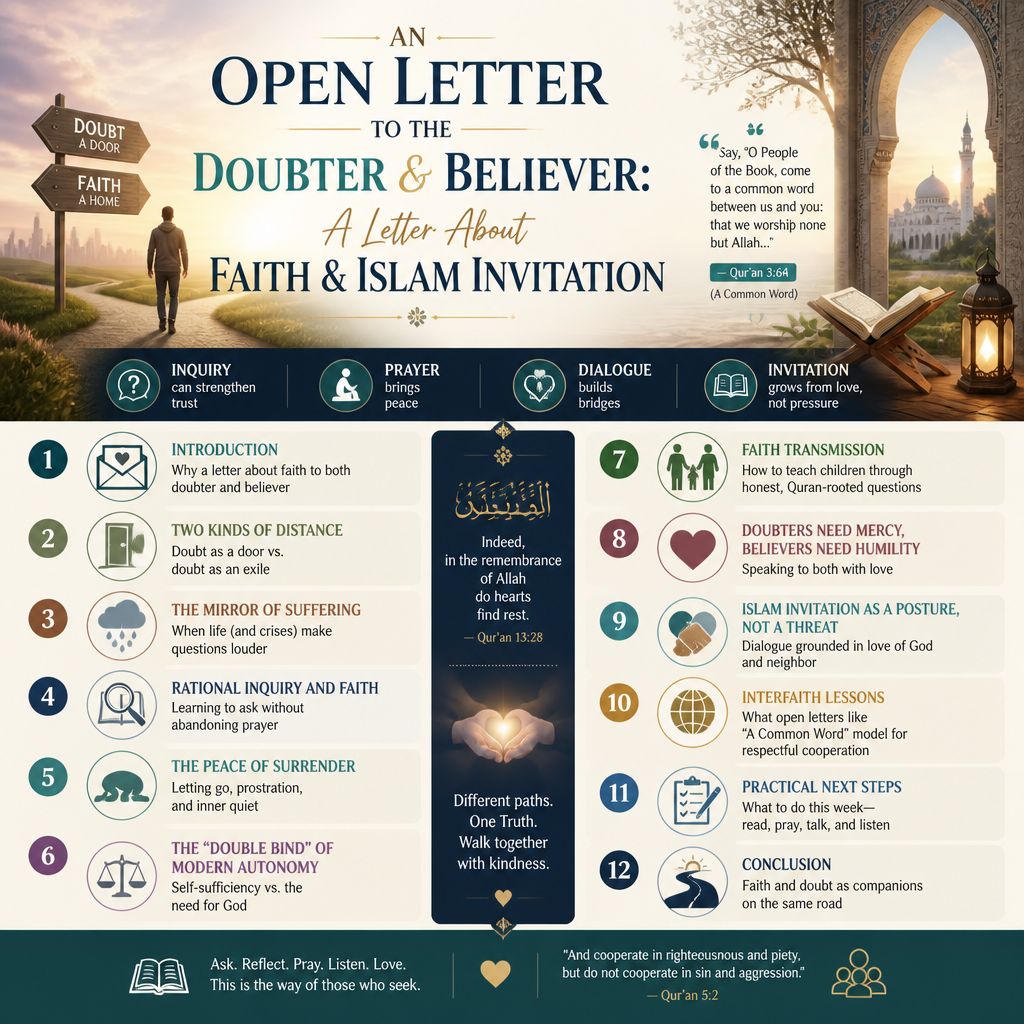
An Open Letter to the Doubter and the Believer: A Letter About Faith & Islam Invitation
Dear doubter. Dear believer.
Let me write to you as one traveler writing to fellow travelers—because the road of faith is rarely a straight line. Sometimes it feels like a doorway: you step through questions and discover that belief can breathe. Sometimes it feels like an exile: the more you search, the more distant God appears. Whatever your season, this is a letter about faith—and, in particular, a gentle Islam invitation that begins with love, not pressure.
1) Introduction: Why a letter about faith to both doubter and believer
Many people imagine faith and doubt as enemies. But often they are companions wearing different clothes. Faith without inquiry can become brittle. Doubt without prayer can become cold. In the best versions of both, belief is examined and strengthened; doubt is purified and given a direction.
This letter is not meant to win an argument. It is meant to offer a posture—an inner stance—so that your questions do not become a wall, and your conviction does not become a shield that hides humility.
2) Two kinds of distance: doubt as a door vs. doubt as an exile
There is doubt that knocks.
It asks, “Is this true?” and “Is it reasonable to trust?” It seeks clarity. It can be honest and courageous—like a light turning on in a dark room.
And there is doubt that drags.
It says, “Nothing will ever satisfy you.” It uses your pain to justify cynicism. It can feel like being exiled from peace.
So let me offer a simple diagnostic: What does your doubt produce?

- If it produces bitterness, numbness, and isolation, it may be exile.
- If it produces deeper reverence, more prayer, more careful thinking, it may be a door.
3) The mirror of suffering: when life (and crises) make questions louder
For many people, doubt becomes loudest in seasons of suffering. Illness, grief, unanswered prayers, betrayals—these events do not just hurt the body or the heart. They challenge the narratives we used to lean on.
I have seen how quickly the mind can race when fear takes the steering wheel. A person may start with questions like:
- “Where is God when I need Him?”
- “Why does faith feel so heavy right now?”
- “What kind of love is this, if my pain stays?”
In such moments, doubt is not always a rejection. Sometimes it is a mirror—forcing you to confront what you’re actually carrying.
And if you are in that season, please hear this: you are not wrong for feeling shaken. The most faithful people are not those who never feel fear; they are those who learn to hold fear honestly without letting it become the final interpreter of reality.
4) Rational inquiry and faith: learning to ask without abandoning prayer
There is a myth that questions inevitably destroy faith. But many believers would tell you the opposite: asking can strengthen what you thought you had to swallow blindly.
In Islam, the heart is invited to remember, and the mind is invited to understand. Faith is not merely a feeling; it is also a relationship with truth. That relationship can survive examination.
Here is what I would like you to try:
- Ask questions, but don’t abandon prayer. Keep a thread of worship even when your emotions wobble.
- Let inquiry be humble. True understanding rarely comes from pretending you already know everything.
- Seek sources, not slogans. Read, learn, talk—don’t just argue online.
Doubt can be a teacher. But it should not be your only teacher.
5) The peace of surrender: letting go, prostration, and inner quiet
If doubt is sometimes exile, then prayer can become the path back to peace.
In the tradition of Islam, salah—especially in moments of prostration—functions like a reset for the spirit. Not because life suddenly becomes easy, but because the heart remembers who is in control.
When you stop demanding that everything be explainable right now, you begin to breathe differently. You are still honest about your questions, but you stop making yourself the judge of all outcomes.
Surrender does not mean denial. It means trust.
6) The “double bind” of modern autonomy: self-sufficiency vs. the need for God
Modern life often trains us to believe that we must be self-sufficient. The world praises competence, independence, and control. But the human condition resists that fantasy—because everyone eventually faces limits: illness, aging, uncertainty, death.
This creates what can feel like a double bind:
- You are told to “handle everything yourself.”
- But life keeps introducing moments where you can’t.
Faith is not the enemy of responsibility. It reorders responsibility. It says: do what you can—then place the rest into the hands of God.
That is why surrender is not weakness. It is clarity.
7) Faith transmission: how to teach children through honest, Quran-rooted questions
If you have children—or if you influence younger hearts in any way—you may wonder: How do we teach faith without crushing questions?
One of the greatest gifts is not silence. It is honest conversation—the kind that tells a child: “You can ask. You can explore. God is not afraid of your questions.”
Here is a child-friendly rhythm that many families find helpful:
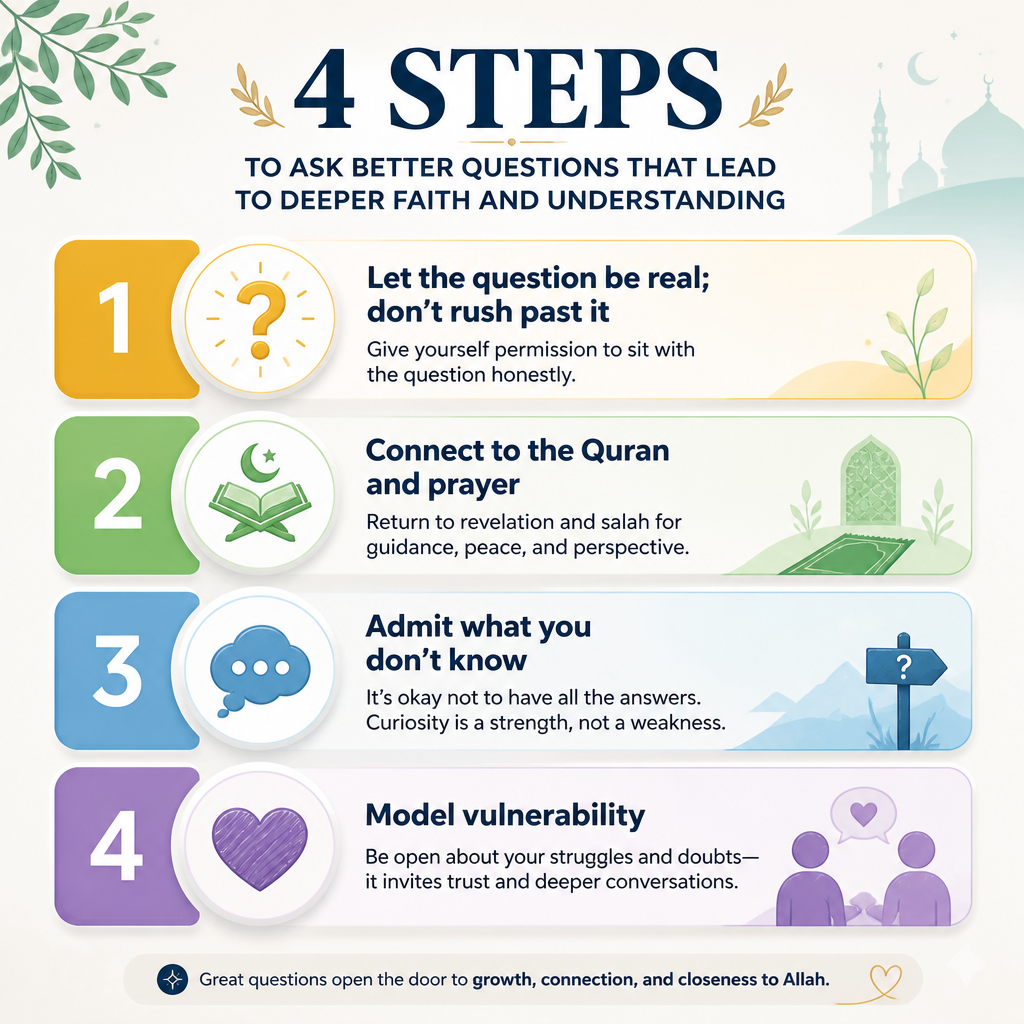
- Let the question be real. Don’t rush past it.
- Connect to the Quran and prayer. Show them that faith has both words and practices.
- Admit what you don’t know. Faith grows with integrity.
- Model vulnerability. Children learn what you normalize.
When doubt appears in a child’s mind, it doesn’t always signal rebellion. Sometimes it signals curiosity. And curiosity can be redirected toward wisdom.
8) Doubters need mercy, believers need humility: speaking to both with love
So let me address you directly, whether you are doubting or believing.
If you are a doubter
Please don’t make your pain into an accusation against God. You can be honest without being cruel—to yourself, to others, and to whatever you still hold sacred.
You are allowed to struggle. You are allowed to say, “I don’t understand.” What matters is what you do next: Do you isolate? Or do you seek, pray, and talk?
If you are a believer
Please don’t treat doubt like a defect to be mocked. Doubt can be a moment of formation. Your role is not to shame the questioner—it is to accompany them.
Humility is the strongest witness. It says: “I believe, and I also remember that I am human.”
9) Islam invitation as a posture, not a threat: dialogue grounded in love of God and neighbor
Now, to the practical heart of this letter: the Islam invitation.
An invitation is not a weapon. It is not a threat. It is a door held open with respect.
In Islam, the Quran repeatedly returns to the theme of guidance, mercy, and sincerity. But the manner matters. If you approach someone with anger, they will defend themselves. If you approach with love, they may listen.
One of the most powerful examples of respectful interfaith communication is the initiative known as “A Common Word”, an open letter issued in 2007 by Muslim leaders calling Christians to dialogue. Its core message emphasizes shared commandments: love of God and love of neighbor.
That letter models something essential for this moment in your life too: cooperation in righteousness, not competition in hostility.
10) Interfaith lessons: what open letters like “A Common Word” model for respectful cooperation
Why mention interfaith letters at all in a letter about faith?
Because they teach us how to speak when we disagree.
- Begin with the shared foundation. Don’t start with what separates.
- Make it a dialogue, not a debate. Ask questions; listen to answers.
- Ground words in ethics. Loving God and neighbor is not abstract—it is a practical posture toward people.
So if you are a doubter watching religious people argue online, don’t generalize from conflict. Seek the quieter voices: those who pray, read, and treat others as human beings.
11) Practical next steps: what to do this week—read, pray, talk, and listen
Faith grows when it becomes a practice, not just a topic.
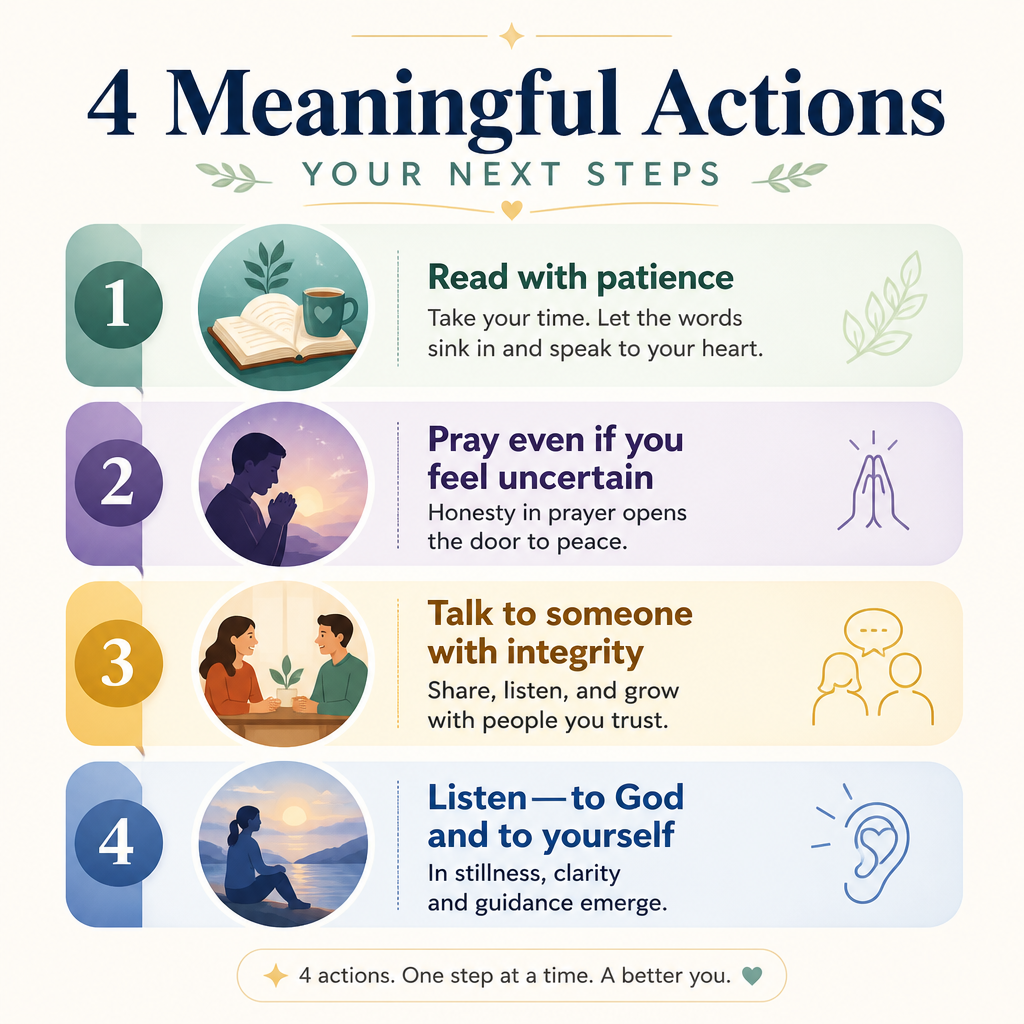
Here are simple steps you can take this week—whether you are leaning toward doubt or leaning toward belief:
1. Read with patience
Choose one reliable source about Islam or about prayerful spirituality. Don’t binge. Don’t argue. Read slowly and take notes: “What resonates? What challenges me? What do I need to understand?”
2. Pray even if you feel uncertain
Your prayer doesn’t have to be perfect. It has to be honest. Say what you can: “Guide me. Teach me. Give me peace.”
3. Talk to someone with integrity
Find a person who can listen without scoring points. Ask questions that are sincere. A good conversation is one where you leave feeling more human, not smaller.
4. Listen—to God and to yourself
Notice what changes in you after prayer. Notice whether your doubt moves toward curiosity or toward bitterness. Both matter; one helps you grow.
If you do these things consistently, you’ll begin to see how faith and doubt can share the same road.
12) Conclusion: faith and doubt as companions on the same road
Dear doubter. Dear believer.
May this be your takeaway: faith is not the denial of questions, and doubt is not proof of meaninglessness. In a healthy spiritual life, doubt becomes a mirror that pushes you toward deeper honesty; faith becomes the peace that helps you continue walking.
And may the Islam invitation you encounter—whether from others or from your own investigation—arrive as love of God and love of neighbor. A door, not a fence. A conversation, not a confrontation.
On the same road, we can move together—toward truth, toward mercy, and toward a peace that prayer alone can place inside the heart.