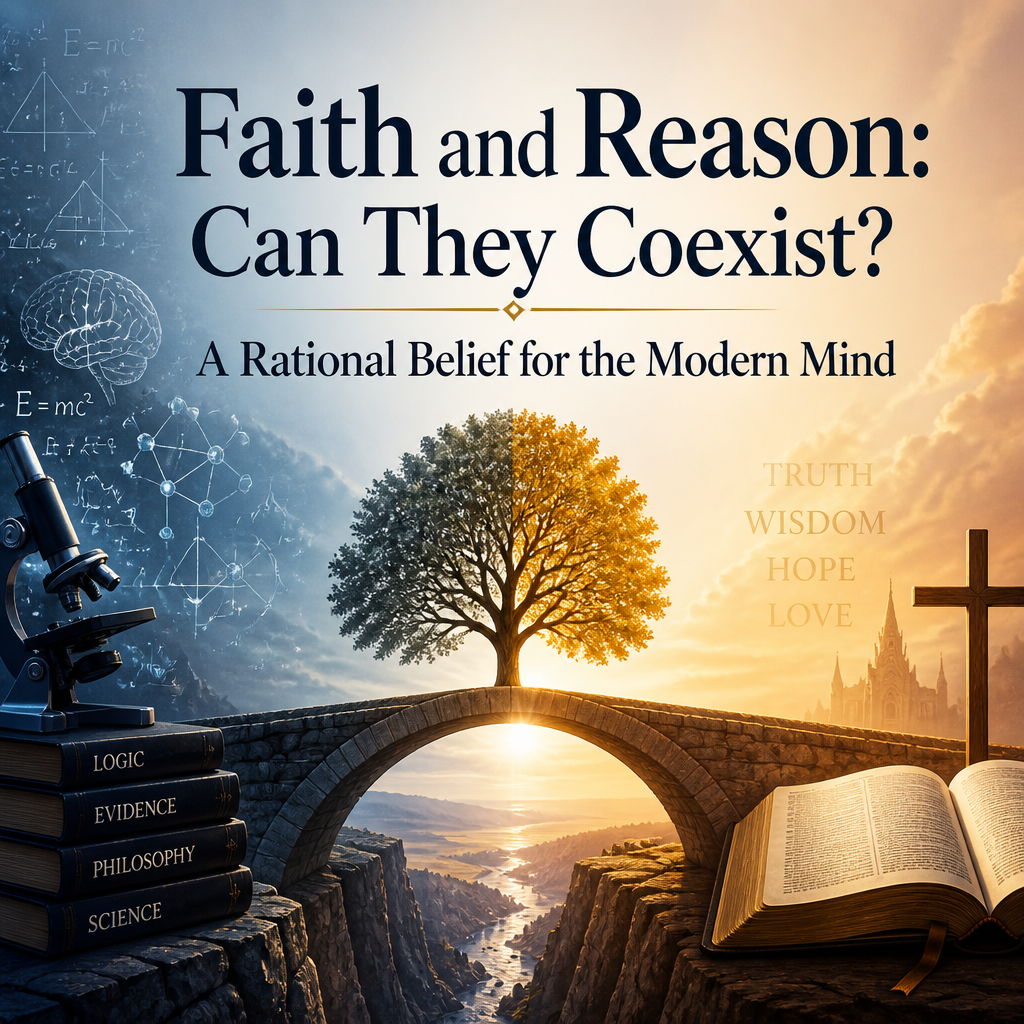
1. The false dilemma: why “faith vs reason” is such a tempting setup
Few phrases are as persuasive—or as misleading—as “faith versus reason.” It sounds tidy: either you trust without evidence, or you think with evidence. Either you belong in the dark, or you belong in the light.
But this setup often hides the real issue. What’s usually at stake is not whether faith and reason are incompatible, but what people mean by each word. If we define “reason” as only one narrow kind of thinking, and “faith” as only blind acceptance, then conflict becomes easy to imagine. Yet when terms are clarified, the opposition collapses.
A better question is: Can faith be rational? And can reason include more than calculation? Once you ask those questions, faith and reason begin to look less like enemies and more like partners.
2. Define the terms: what do we mean by “faith” and “reason”?
To avoid arguing past each other, we need workable definitions.
What “reason” usually means
Reason is our capacity to evaluate claims: to weigh justification, assess trustworthiness, test coherence, and understand how beliefs connect to reality. It doesn’t merely mean skepticism; it includes discernment, explanation, and intelligibility.
What “faith” usually means
Faith is not a refusal to think. In everyday life, faith is what we place in people, promises, and reliable commitments. When translated into religious terms, faith involves trust—often grounded in what has been established as trustworthy.
That means faith is not “belief without reasons.” It is better described as rational belief that includes commitment.

3. A marriage, not a divorce: how reason assesses and faith commits
A helpful metaphor is not war but “marriage.” In a healthy marriage, the spouses support different roles:
- Reason evaluates: What is the evidence? Is the claim coherent? Is the source credible?
- Faith responds: Given the assessment, will I trust, commit, and live accordingly?
In other words, reason helps determine whether something is worthy of trust. Faith is the human response that says, “I will stake my life on what I find trustworthy.”
So the opposite of faith is not reason. The opposite of faith is more like unbelief or refusal to trust—something different from rational assessment itself.
4. Faith’s anatomy: object, content, and trust/commitment
Faith becomes clearer when you break it down into components. Many Christian thinkers describe faith in at least three parts:
- Object: Faith has something it’s about (e.g., God, Christ, a promise).
- Content: Faith includes what is believed (the claims or truths you assent to).
- Trust/commitment: Faith is not only mental assent but personal reliance—moving from “I think it’s true” to “I will trust it.”
Once faith is understood this way, it becomes easier to see how reason can participate. Reason can examine the object (Who are we trusting?), the content (What exactly is being claimed?), and even the credibility of the evidence behind those claims.
5. Reason’s job description: justification, evidence, and intelligibility
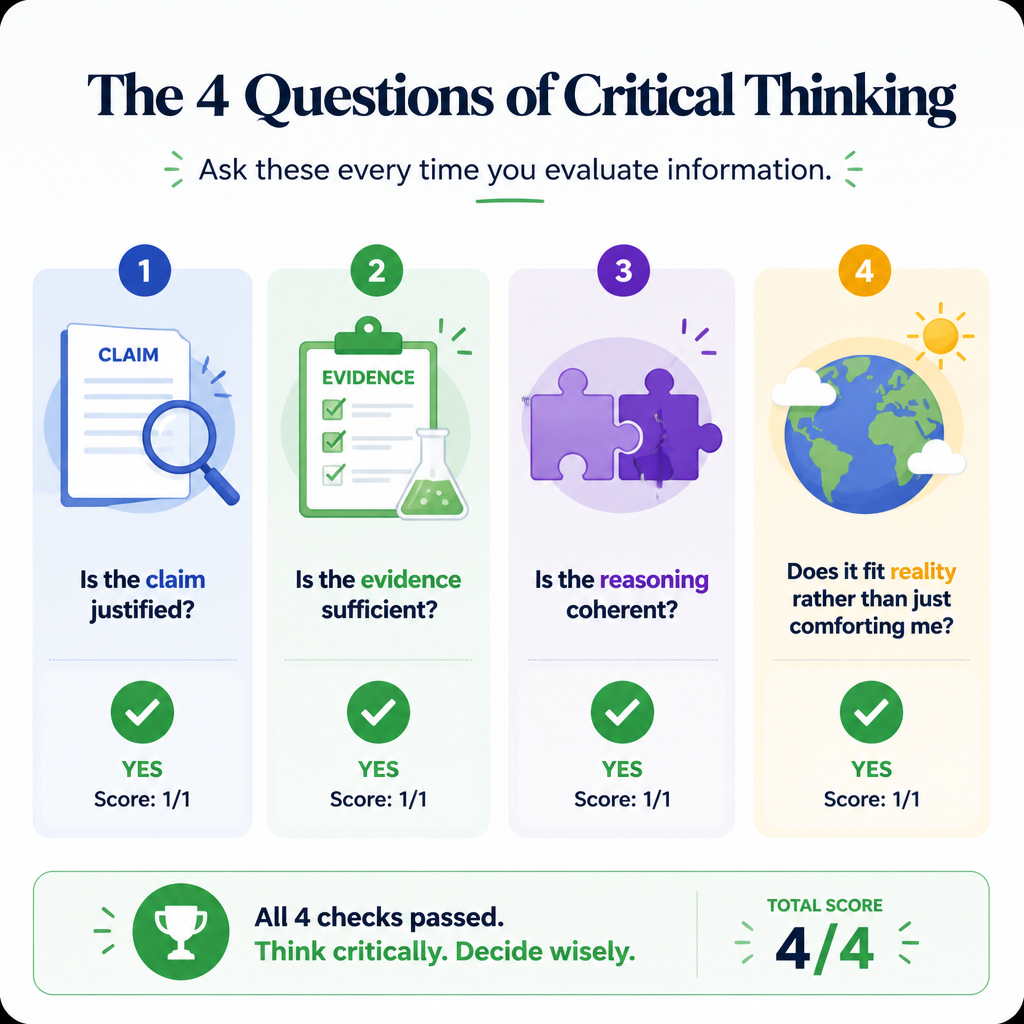
Reason has a specific role in the formation of beliefs. It asks:
- Is the claim justified?
- Is the evidence sufficient?
- Is the reasoning coherent?
- Does it fit reality rather than just comforting me?
Notice what reason is not doing. Reason is not required to produce certainty about everything. Sometimes the goal is not “I can prove it like a math theorem,” but “this appears trustworthy, coherent, and deserving of commitment.” That kind of rational belief is not irrational—it’s how humans actually navigate most of life.
6. Faith seeking understanding: a historic Christian approach (Augustine, Anselm, Aquinas)
One of the most influential Christian themes across history is faith seeking understanding. Rather than treating faith as something that stops thought, Christianity has repeatedly portrayed faith as a starting point for deeper learning.
Think of traditions associated with Augustine, Anselm, and Thomas Aquinas. Their goal wasn’t to replace Scripture with philosophy, but to pursue clarity: to show that belief in God can be intellectually serious—faithful without being anti-reason.
This approach suggests a vital point for modern readers: the person of faith is often the person who asks more questions, not fewer. Belief becomes a reason to explore, not an excuse to stop.
7. Four ways Christianity stays rational: (1) a rational God for knowledge, (2) no conflict with logic, (3) biblical wisdom, (4) evidential support
Christianity’s compatibility with reason is not merely claimed; it has been argued through several recurring themes.
(1) A rational God for knowledge
If God is personal and rational, then reality is not arbitrary. The world is intelligible enough for humans to understand it at least in part. In that setting, reasoning isn’t a threat to faith; it’s a way of engaging the order God has made.
(2) No conflict with logic
Christianity doesn’t have to be irrational to contain mysteries. A doctrine can be beyond full human comprehension without being incoherent or logically contradictory. “Mystery” can mean “we don’t yet understand fully,” not “the truth is illogical.”
(3) Biblical wisdom
Scripture repeatedly encourages wisdom and discernment—virtues that naturally belong to reason. The Bible doesn’t treat understanding as optional; it treats it as valuable. A faithful life is expected to grow in insight, discernment, and wise judgment.
(4) Evidential support
Christian belief has often been presented as supported by facts, historical claims, moral plausibility, and experiential relevance. This doesn’t mean every person will find identical proofs, or that faith requires lab-grade certainty. But it does mean faith can be tethered to reasoned grounds rather than blind leaps.
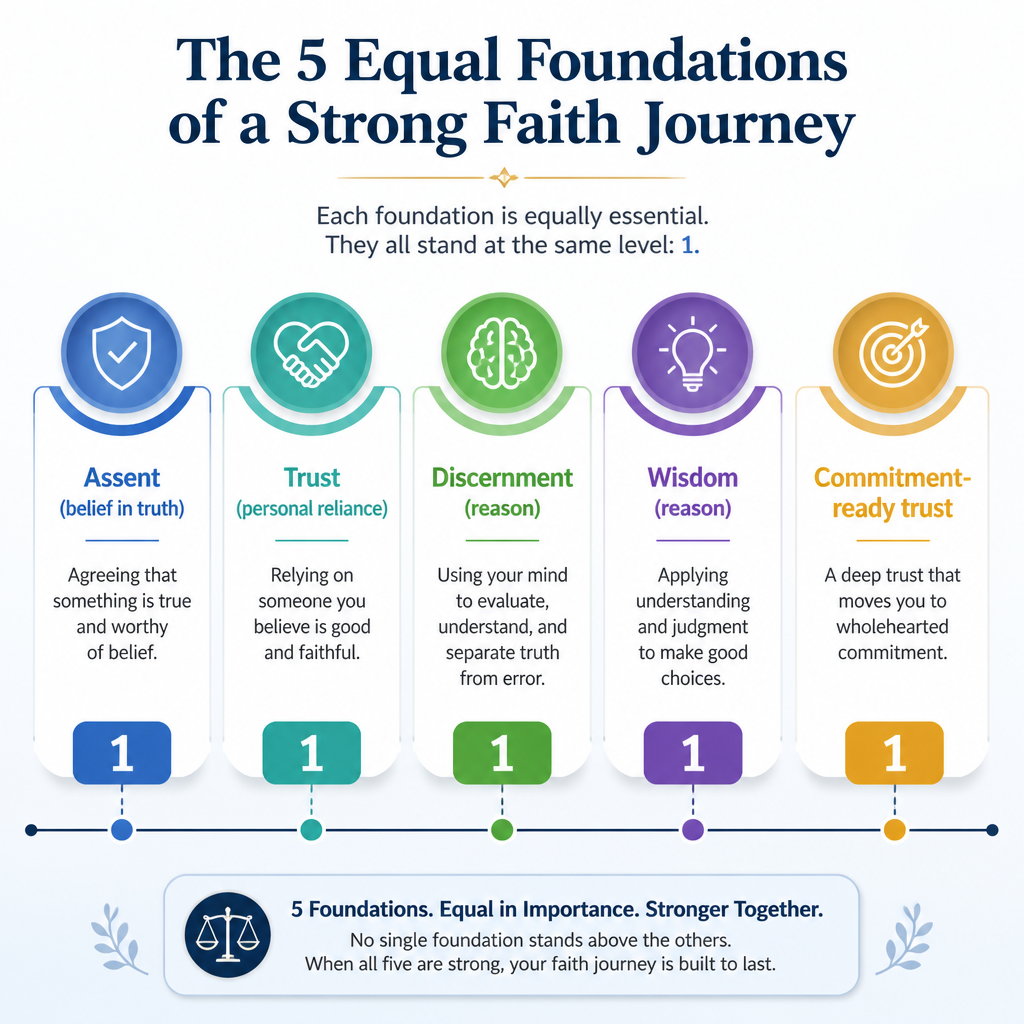
8. What Scripture actually encourages: faith that includes assent and trust, and reason that includes discernment and wisdom
When people speak as if the Bible teaches “blind faith,” they usually forget that biblical faith includes both:
- Assent (an element of belief in truth—what God has said)
- Trust (personal reliance—responding to God with commitment)
In the same way, biblical reason is not just calculation. It includes discernment, wisdom, and careful reflection about what is true and how to live.
So Scripture supports a “both/and” rhythm: trust grounded in truth, and understanding that deepens trust.
9. Where people go wrong: misusing “faith alone” or demanding “blind” faith
Two common errors distort the conversation.
Error #1: Misusing “faith alone”
Some people hear “faith alone” as permission to detach belief from reasons entirely. But “faith alone” is not always the same as “belief without any justification.” In many contexts, it means salvation depends on trust in God rather than earning status through moral performance.
That is different from saying, “Never think.” Christianity can emphasize faith as the means of relating to God while still encouraging serious intellectual engagement.
Error #2: Demanding “blind” faith
On the other side, some critics assume faith must be irrational because they imagine it as “ignoring evidence.” But if faith is trust based on what is credible, then criticizing it for not being blind misses the target.
The modern mind doesn’t need to be asked to surrender reason. It needs a vision of rational belief that can hold wonder and conviction together.
10. Rational belief in practice: how to evaluate claims without shutting down wonder
If faith and reason coexist, what does it look like week to week?
- Test claims fairly: Ask what’s actually being claimed, not what you wish were being claimed.
- Consider sources: Who is saying this? Are they credible? Are there relevant reasons to trust them?
- Look for coherence: Does the worldview explain life, morality, and meaning without collapsing into contradictions?
- Allow for mystery without panic: Some questions won’t be resolved immediately. That doesn’t mean truth is impossible.
- Practice humility: Being reasoned doesn’t mean being arrogant.
This approach keeps the heart engaged. Faith becomes more than argument; it becomes a way of living—while reason keeps the mind honest.
11. Faith and reason with science and Genesis: humility, genre-awareness, and avoiding needless offense
One of the most practical battlegrounds today is the relationship between Christianity, science, and the interpretation of Genesis.
Here’s a wise principle: people get driven away from Christianity when believers treat every question as a test of obedience or dismiss evidence too quickly. God gave minds to inquire. If Christianity is true, it should be able to withstand honest investigation.
At the same time, interpretation matters. Genesis is not a modern science textbook. It is a form of inspired ancient literature with theological goals—teaching who God is and who humans are. Genre awareness helps prevent unnecessary conflict.
Humility is essential: you can hold convictions about creation while also making room for sincere discussion. The goal is not to win debates, but to love seekers and to tell the truth without needless friction.
12. Conclusion: reasonable faith, not unreasonable unbelief—both/and for a coherent life
Faith and reason do coexist. The “faith versus reason” model is tempting because it simplifies human belief into two categories. But when we define our terms, a different picture emerges:
- Reason assesses justification and evidence.
- Faith trusts and commits in response to what is credible.
- Christian tradition has long practiced faith seeking understanding.
- Scripture encourages both trust and wisdom.
So the coherent conclusion is not “either/or,” but both/and: reasonable faith that seeks understanding, and reason that serves wonder rather than strangling it.