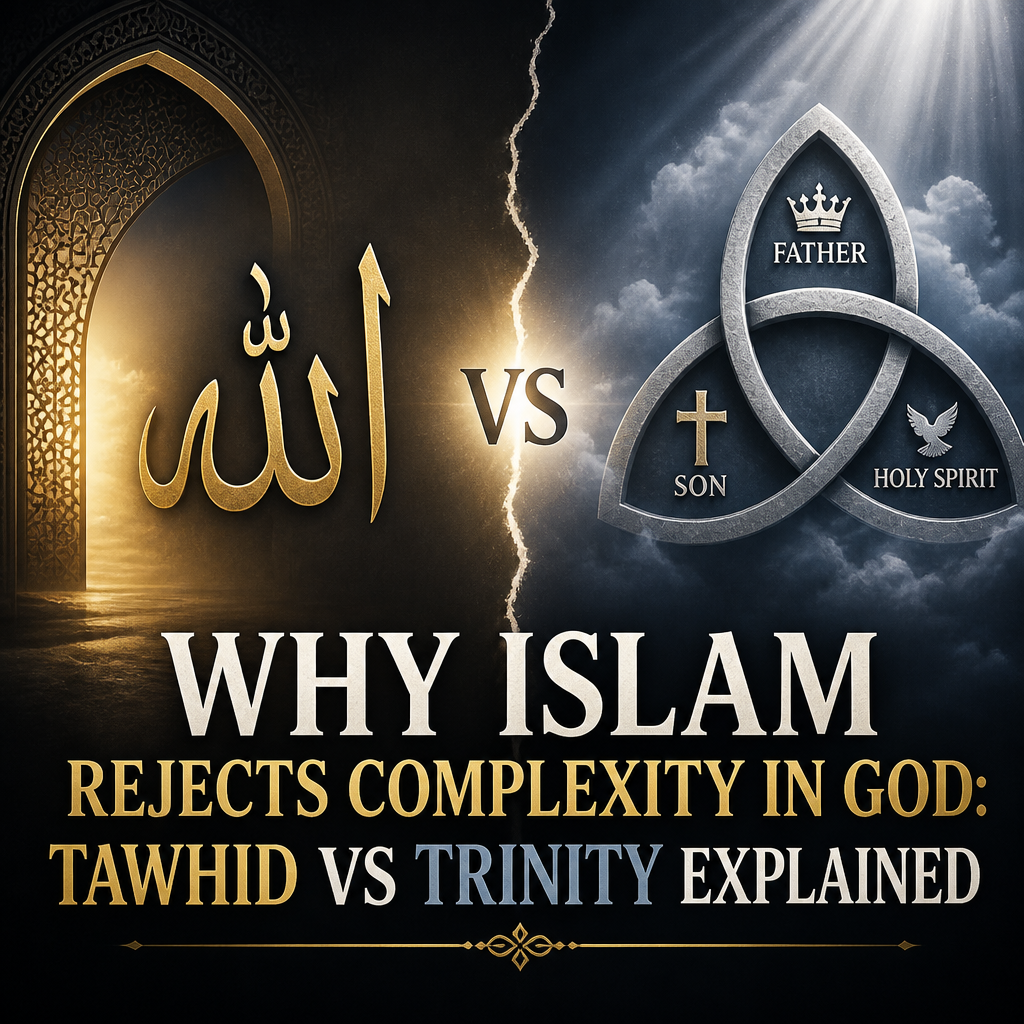
1. Introduction: why “simple monotheism” matters in faith
One of the most intense (and often misunderstood) points of difference between Muslims and Christians is the question of God’s oneness. Muslims affirm monotheism islam through tawhid, the belief that Allah is absolutely one—without partners, without division, and without “begetting.” Christians affirm monotheism through the doctrine of the Trinity, teaching one God who is known as Father, Son, and Holy Spirit.
In popular debate, Islam is frequently described as rejecting “complexity” in God. But the real claim is more specific: Islam rejects anything that looks like multiple deities, partners, or a divided divine essence. In Islamic terms, what Christians call the Trinity is often viewed as approaching shirk—the association of partners with God—because it seems to place real multiplicity within the divine being.
This article explains the logic behind Islam’s critique, clarifies what the Qur’an teaches about tawhid, and compares it with the Christian way of describing tawhid vs trinity.
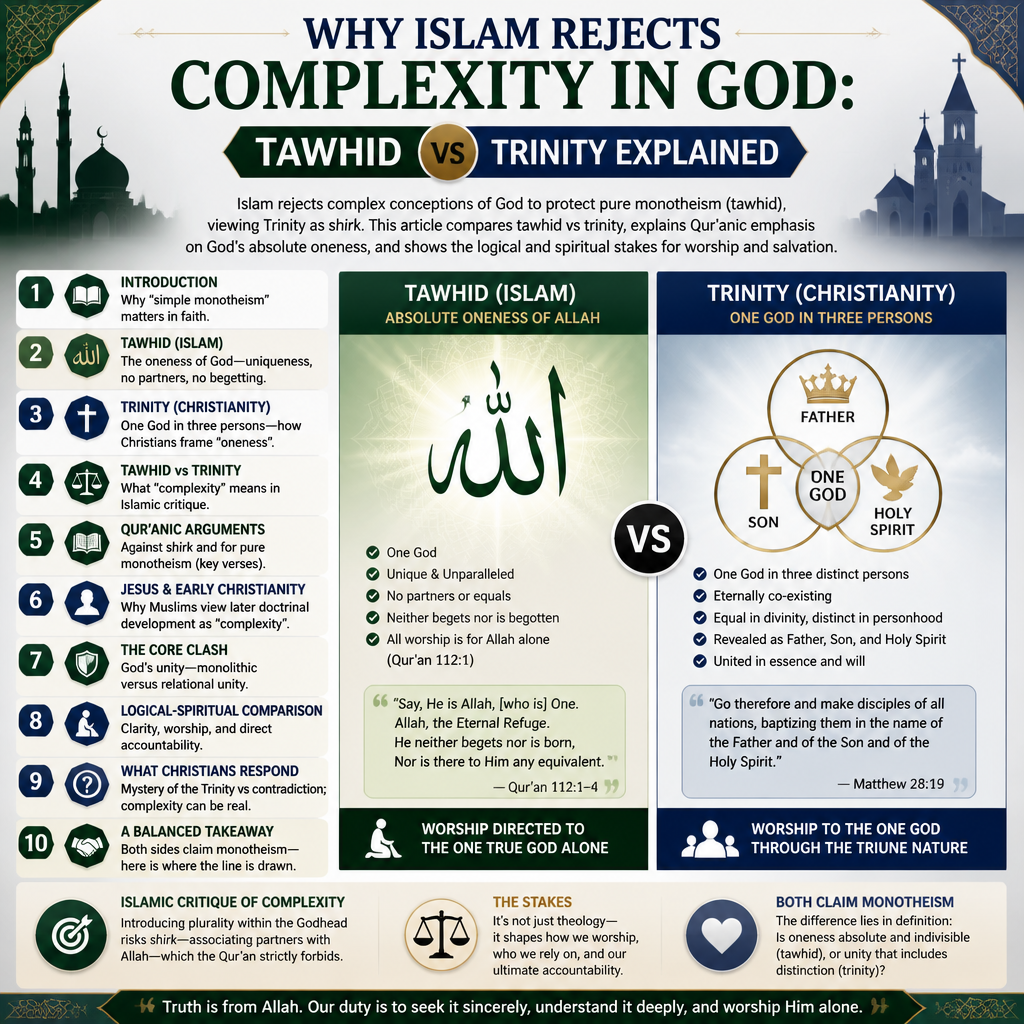
2. Tawhid (Islam): the oneness of God—uniqueness, no partners, no begetting
Tawhid is the central Islamic creed: Allah is One. That oneness is not only numerical (there is no “second god”); it is also metaphysical and devotional. Tawhid means:
- God is unique—no partners or equals.
- God does not beget—no divine “offspring.”
- Worship belongs to God alone.
- No rival claim competes with God’s exclusive authority.
Islam’s fear is not “complexity” in the abstract—it is any concept that undermines exclusive worship. If God is truly one, then how can divine glory be shared as if God were multiple? Islam answers: it cannot.
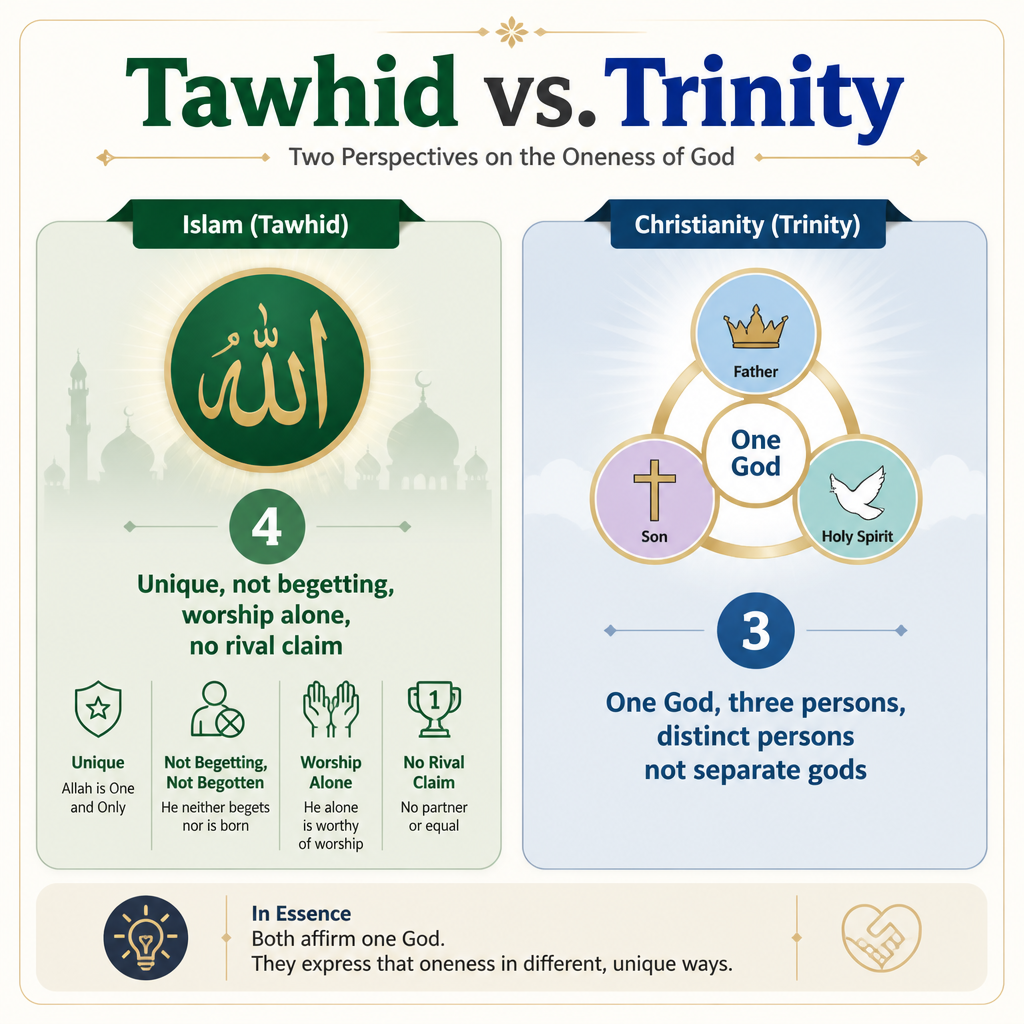
3. Trinity (Christianity): one God in three persons—how Christians frame “oneness”
Christians also claim strict monotheism. The Trinity is usually summarized as:
- One God
- Three Persons (Father, Son, Holy Spirit)
- Distinct persons who are not separate gods
Christians generally argue that the Trinity is not polytheism because the Father, Son, and Spirit are not three competing gods. Instead, they are one divine reality known in relationship—Father relates to Son, Spirit relates to both, and yet God remains one.
So the Christian view is: God can be “relational” and “personal” eternally, without becoming multiple deities. This is why the Trinity can sound “complex,” but Christians insist it is internally consistent and anchored in their understanding of God’s revelation—especially through Christ.
4. Tawhid vs Trinity: what “complexity” means in Islamic critique
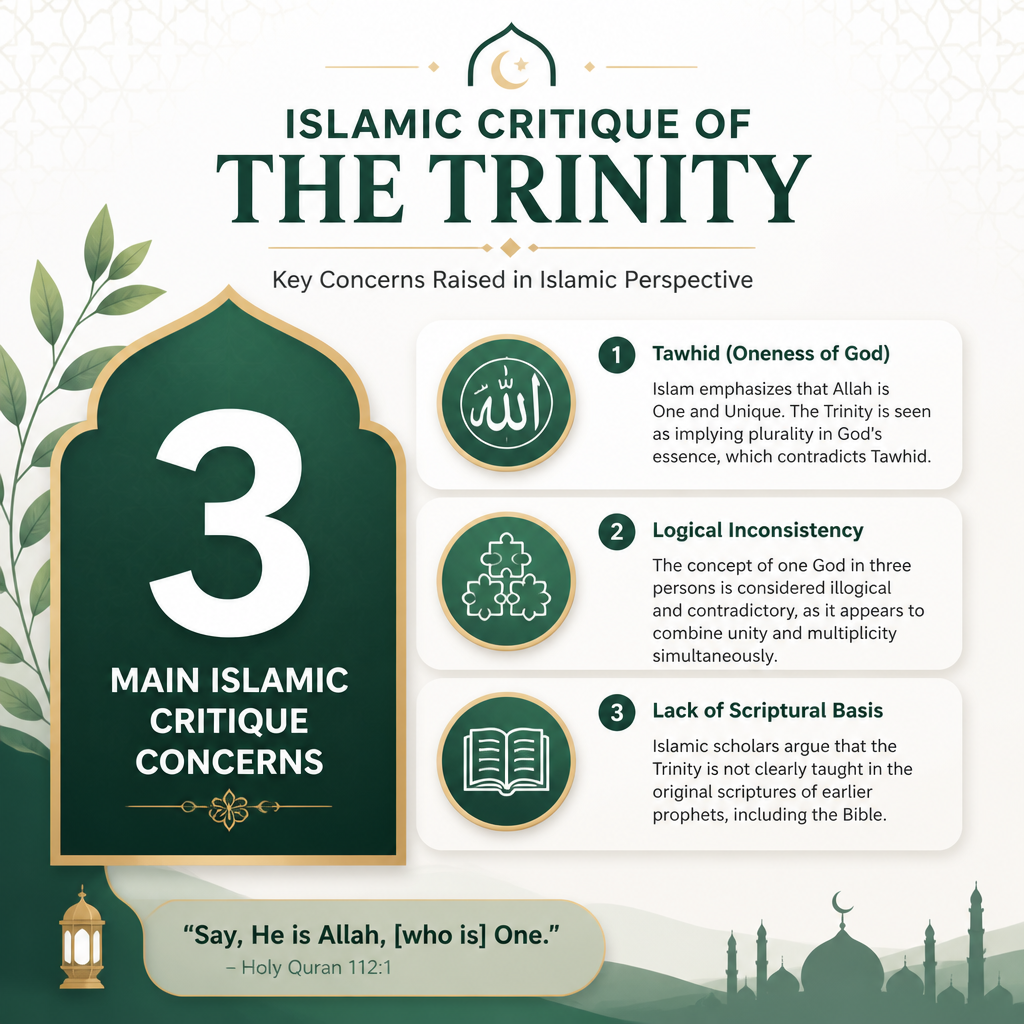
When Islam rejects the Trinity as “complex,” the critique often includes three main concerns.
4.1 Complexity that appears to break God’s oneness
For many Muslims, “three persons” sounds like a division of God’s being. Even if Christians say they are not separate gods, Islam argues that the divine reality is still being described in a way that resembles internal plurality too strongly.
4.2 The risk of shirk through divine association
Islam teaches that associating partners with God is the greatest spiritual danger. If someone treats the Son or the Spirit as sharing God’s honor in a way that suggests more than one “center of worship,” Islam sees that as crossing into shirk—even unintentionally.
4.3 A concern about origins and doctrinal development
Another Islamic argument is historical: Muslims often claim that the Trinity is a later doctrinal formulation, not the original message of earlier prophets. The Qur’an emphasizes God’s oneness repeatedly, so Muslims ask: why would God’s final and clearest revelation (the Qur’an) need to correct a doctrine that was never truly clarified in earlier revelation?
5. Qur’anic arguments against shirk and for pure monotheism (key verses)
The Qur’an repeatedly emphasizes that God is one and that shirk is rejected. While Muslim scholars may differ in how they argue specifically about Trinity terminology, the Qur’an’s themes are consistent:
- Calling God “one” and unique (for example, themes like God’s oneness appear throughout the Qur’an).
- Rejecting “association” as a category of belief.
- Rejecting the idea of divine sonship—God is above “begetting.”
In debates with Christians, verses commonly cited include passages where the Qur’an denounces the claim that God has a son and condemns the idea that God can be shared among different divine roles.
In short, Islam’s logic is devotional and spiritual: pure monotheism protects pure worship. God’s oneness is not merely a philosophy; it is the foundation of worship, accountability, and salvation.
6. Jesus and early Christianity: why Muslims view later doctrinal development as “complexity”
Many Muslims argue that Jesus (peace be upon him) taught strict monotheism and that early Christians, though sincere, did not formulate (in the way later theology did) the full doctrine of the Trinity as an explicit “system.” Muslims therefore interpret later councils and creeds as attempts to explain mystery—and as such, they see “explanation” becoming “complexity.”
Islam does not deny that sincere Christians may have sought to honor God; rather, it insists that the safest path is to keep the message of God’s oneness simple and unambiguous. If a doctrine requires layers of philosophical framing, Muslims may conclude that it increases confusion rather than clarifies worship.
7. The core clash: God’s unity—monolithic versus relational unity
This is the heart of tawhid vs trinity: what does it mean for God to be one?
7.1 Islamic emphasis: unity without internal division
Tawhid stresses that God’s oneness is unshared. God is not “one plus another”; God is one without partners and without division in divinity. Therefore, anything that implies real internal multiplicity in God’s identity is treated with suspicion.
7.2 Christian emphasis: unity that is relational
The Trinity is Christian’s way of affirming that God is eternally relational (not dependent on creation for love and relationship). Christians argue that the Trinity is not a “three-headed God” but one divine reality expressed in three persons.
This leads to a major interpretive difference:
- Islam tends to interpret “three persons” as risking division that undermines worship.
- Christianity tends to interpret “simple monotheism” as risking a God who would become relational only when creation begins.
8. Logical-spiritual comparison: clarity, worship, and direct accountability
Beyond theology, Islam often frames the issue in terms of how doctrine shapes life.
8.1 Clarity in worship
When Islam calls for God’s absolute oneness, it aims to keep worship directed toward a single object: Allah. This reduces confusion about who receives ultimate honor and prayer.
8.2 Direct accountability
Islam emphasizes direct human responsibility to God. If God is one, then allegiance, fear, hope, and obedience are straightforward: they are directed to God alone.
8.3 Spiritual peace through unshared divinity
Islamic teachings strongly guard against any form of “divine partnership.” From this perspective, the Trinity appears to blur that boundary.
9. What Christians respond: mystery of the Trinity vs contradiction; complexity can be real
Christians have a set of replies to the Islamic critique.
9.1 Trinity is not contradiction
Christians argue that “complex” does not necessarily mean “false” or “illogical.” God may be beyond human categories, and yet be faithful to revelation.
9.2 Mystery can exist without being shirk
Christian theology often says the Trinity is mysterious but not polytheistic. The Son is fully God, the Spirit is fully God, and yet there is one divine being—so no worship goes to another god.
9.3 Scripture and Christ as the foundation
Christians typically emphasize the revelation of God through Christ and the apostolic understanding. For them, the Trinity is not a late invention but a doctrinal articulation of what was already worshiped and confessed.
10. A balanced takeaway: both sides claim monotheism—here is where the line is drawn
It’s important to be fair. Both Islam and Christianity claim to be rooted in monotheism. The conflict is not that one side believes in multiple gods while the other believes in one god. The conflict is about what kind of oneness God has.
- Islam’s line: God’s oneness must be exclusive and unshared—no divine partners, no begetting, and no structure that compromises worship (tawhid).
- Christianity’s line: God’s oneness can be relational and personal—one being, three persons—without being three gods (tawhid vs trinity).
So when people say “Islam rejects complexity in God,” the most accurate meaning is: Islam rejects any doctrine that appears to split God’s oneness or introduce shirk-like worship concerns. Christians, in return, reject the idea that their doctrine compromises monotheism, arguing that God is greater than human logic and that the Trinity is a faithful account of divine revelation.
Conclusion
Islam rejects the Trinity not because it dislikes thinking, but because it treats God’s unity as the foundation of worship and salvation. The Qur’an emphasizes tawhid to prevent shirk and to keep divine honor undivided. Christians affirm monotheism through the Trinity, insisting that the doctrine is consistent with one God and rooted in God’s self-revelation.
If you want to explore this responsibly, the best approach is to compare each side’s definitions: What does “one” mean? What counts as “partners”? And how does each tradition protect the worship of the one true God?