1. Introduction: Why the Concept of God in Islam Matters
When Muslims speak about God, they are not describing a distant idea or a vague force. The Islamic concept of God is anchored in one central belief: Tawhid—the absolute oneness of Allah. This belief is not only theological; it shapes how a person thinks, prays, makes choices, and connects to the Creator.
That’s why understanding Islam’s view of God is important: it explains what Muslims mean by worship, why prayers have meaning, and why devotion must be directed to one Lord alone.
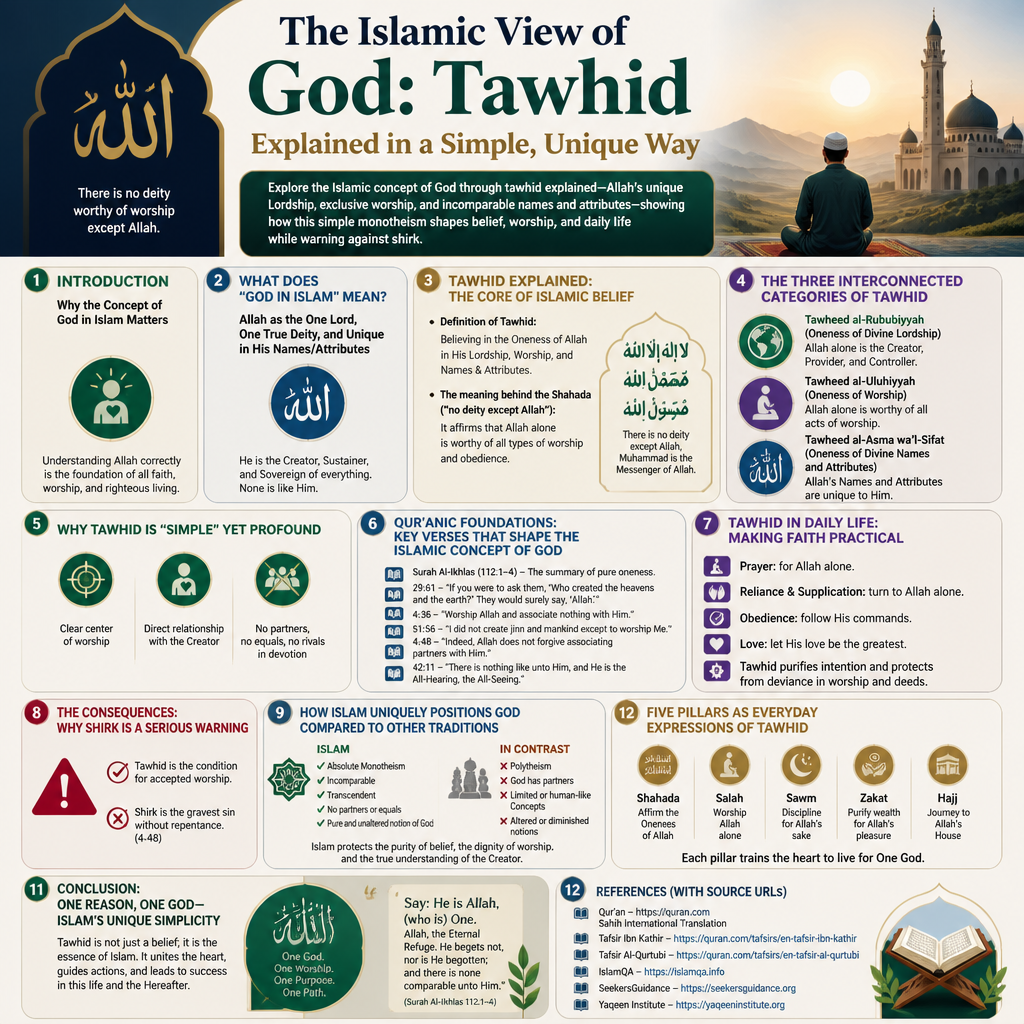
2. What Does “God in Islam” Mean?
In Islam, God is known as Allah—the One Lord, the True Deity, and the uniquely describable Creator. Allah is not one “god among many,” nor is He a created being. Allah is:
- One Lord—the only Creator, Sustainer, and Controller of affairs.
- One True Deity—no partner in divinity.
- Unique in His Names and Attributes—perfectly described by revelation, without being compared to creation.
Islam’s message is simple: God is One—and worship must reflect that oneness.
3. Tawhid Explained: The Core of Islamic Belief
3.1 Definition of Tawhid
Tawhid (often spelled tawhid) means to affirm Allah’s oneness in who He is and in how He is worshiped. It includes believing that Allah has:
- No partners in Lordship (creation and control)
- No partners in worship
- No equal or likeness in His names and attributes
3.2 The meaning behind the Shahada (“no deity except Allah”)
The Islamic creed, the Shahada, declares: “There is no deity worthy of worship except Allah.” The phrase “no deity” is not meant to reduce God to a slogan—it is a clear boundary:
- Worship belongs to Allah alone
- Devotion, fear, hope, reliance, and submission are directed to Him
- No created thing—no matter how great—takes the place of the Creator
This is why the concept of God in Islam is both profound and practical: it guides the entire life of faith.
4. The Three Interconnected Categories of Tawhid
Scholars often explain Tawhid through three connected categories. Think of them as three lenses on the same truth: Allah is one in reality, and that oneness must be reflected in belief and worship.
4.1 Tawheed al-Rububiyyah (Oneness of Divine Lordship)
This means believing Allah alone is the Lord—the One who creates, sustains, and governs the universe. The Quran affirms this clearly: “If you ask them who created the heavens and the earth, they will surely say, ‘Allah.’” (see Quran 29:61).
Even if people recognize Allah as Creator, Islam teaches that recognition alone is not the full meaning of Tawhid. Lordship must lead to worship.
4.2 Tawheed al-Uluhiyyah (Oneness of Worship)
This category is where worship becomes the center. It means Allah alone is worthy of worship. The Quran commands this in meaning: “Worship Allah and do not associate anything with Him.” (see Quran 4:36).
When worship is offered to someone or something besides Allah, that is shirk—associating partners with Allah.
4.3 Tawheed al-Asma wa’l-Sifat (Oneness of Divine Names and Attributes)
Allah has names and attributes that are described in the Quran and Sunnah. Tawhid in this area means:
- Affirming what Allah revealed about Himself
- Without distortion or denial
- Without comparing Allah to creation
The Quran also emphasizes that nothing is like Him: “There is nothing like Him.” (see Quran 42:11).
5. Why Tawhid Is “Simple” Yet Profound
Many people assume true religion must be complicated. Islam offers a different idea: the foundation can be simple, and that simplicity can produce deep spiritual life.
- Clear center of worship: one Lord, one direction for devotion.
- Direct relationship with the Creator: prayers, supplication, and reliance are directed to Allah.
- No partners, no equals, no rivals: the heart learns purity in its love and fear.
In Islam, simplicity does not mean shallowness; it means faith has a strong and stable core.
6. Qur’anic Foundations: Key Verses That Shape the Islamic Concept of God
Islam’s Tawhid is not built on guesswork. The Quran presents Allah’s oneness repeatedly and in memorable ways.
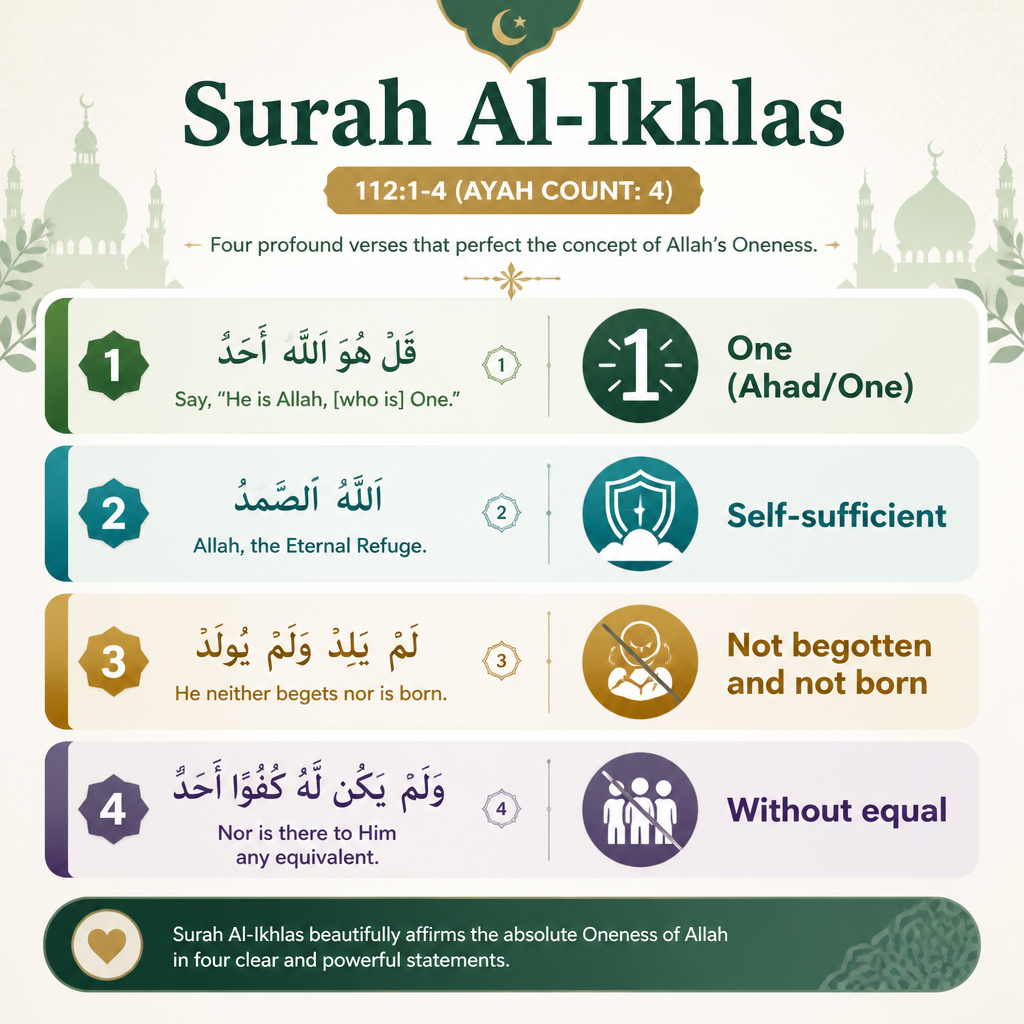
6.1 Surah Al-Ikhlas (112:1–4) as a summary of pure oneness
Surah Al-Ikhlas is often described as a concise statement of Tawhid. It emphasizes that Allah is:
- One
- Self-sufficient
- Not begotten and not born
- Without equal
This chapter serves as a powerful anchor for understanding the Islamic view of God.
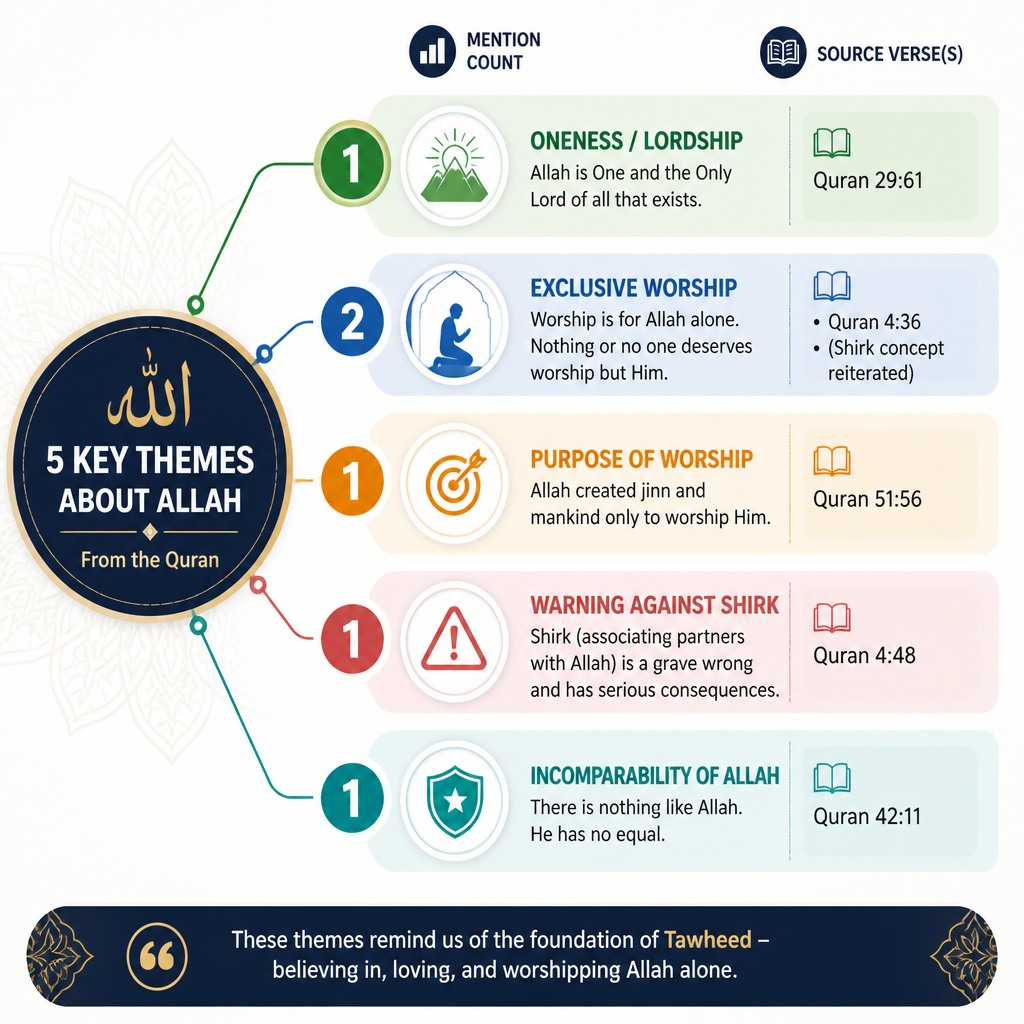
6.2 Other examples emphasizing creation, worship, and uniqueness
Several Quranic verses reinforce Tawhid from different angles. For example:
- Creation and Lordship: Quran 29:61
- Exclusive worship: Quran 4:36
- Purpose of worship: Quran 51:56 (“I did not create jinn and mankind except to worship Me.”)
- Grave warning against shirk: Quran 4:48
- Allah’s incomparability: Quran 42:11
7. Tawhid in Daily Life: Making Faith Practical
Tawhid is not only something Muslims recite; it is something Muslims live. When you truly believe Allah is one, your relationship with Him becomes consistent.
- Prayer (Salah) becomes a regular reminder that worship belongs to Allah alone.
- Reliance (Tawakkul) means placing your trust in Allah, not in helpless hope.
- Supplication (Dua) is directed to the One who answers.
- Obedience reflects love and submission to the Creator.
- Intention (Niyyah) is purified when actions are meant for Allah’s sake.
This is part of what makes the concept of God in Islam uniquely practical: Tawhid trains the heart away from drifting into misplaced devotion.
8. The Consequences: Why Shirk Is a Serious Warning
Islam treats Tawhid with seriousness because worship is serious. If worship is directed to anyone besides Allah, the heart is giving something that belongs only to the Creator.
The Quran warns about shirk in strong terms. For example: “Indeed, Allah does not forgive associating partners with Him, but He forgives what is lesser than that for whom He wills.” (Quran 4:48).
This warning does not only communicate fear; it communicates clarity. Islam teaches that the condition for accepted worship is Tawhid, and that the gravest wrong is to make Allah’s rights shared with another.
9. How Islam Uniquely Positions God Compared to Other Traditions
To explain the uniqueness of Islam’s God concept, it’s helpful to look at what Islam protects against: anything that dilutes Allah’s oneness.
Islam’s Tawhid rejects:
- Polytheism (multiple deities competing for devotion)
- Divine association (partners, equals, rivals in worship)
- Images or likenesses that treat the Creator as comparable to creation
At its core is a simple protective principle: Allah is incomparable and transcendent, and worship must remain exclusive. This protects the believer from confusion and spiritual dilution.
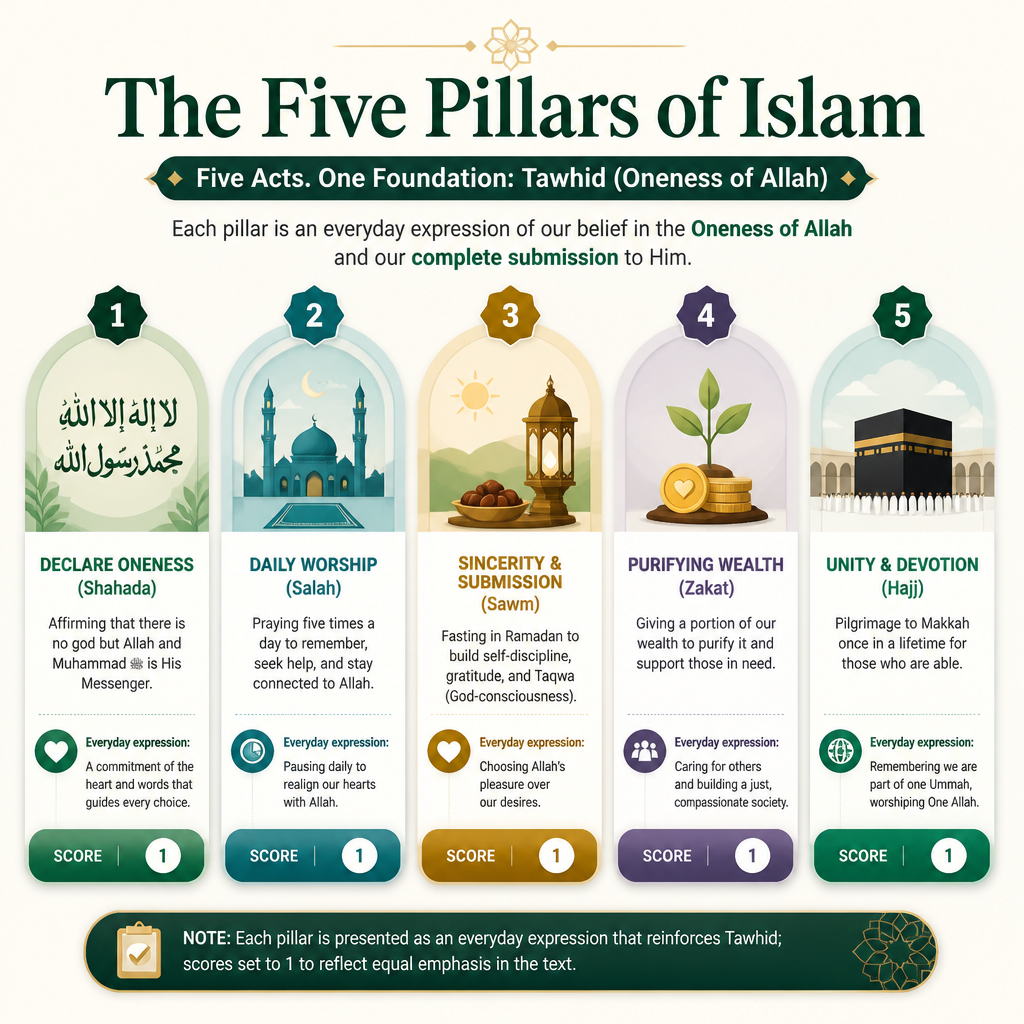
10. Five Pillars as Everyday Expressions of Tawhid
Muslims don’t just believe in Allah—they worship Him in a structured way. The five pillars reinforce Tawhid by making worship consistent and embodied.
- Shahada — declaring Allah’s oneness
- Salah — daily worship focused on Allah alone
- Sawm — fasting that trains sincerity and submission
- Zakat — purifying wealth and strengthening responsibility toward creation
- Hajj — an act of unity and devotion at the House of Allah
In this way, tawhid explained is not merely an idea—it becomes a daily discipline that shapes worship, character, and community.
11. Conclusion: One Reason, One God—Islam’s Unique Simplicity
The Islamic view of God can be summed up in one word: Tawhid. It is simple because it centers everything on Allah alone—one Lord, one deity worthy of worship, and one unique reality beyond comparison.
But it is profound because this belief reorganizes the entire life of worship: prayer, intention, ethics, and love all become connected to the One Creator.
12. References (Selected)
- Hikmah Boutique – Basics of Tawheed: Core of Islamic Belief Explained
- Studio Arabiya – Tawheed Meaning: Understanding Oneness in Islam
- IslamiCity – Islamic Concept Stands Out among the Understanding of God
Note: Quran references in this article include Surah Al-Ikhlas (112:1–4) and examples such as Quran 29:61, Quran 4:36, Quran 51:56, Quran 4:48, and Quran 42:11.