Does God Exist? A Rational Exploration of the Best Arguments and Scientific Clues
One of the oldest questions in philosophy is also one of the most practical: does god exist? People ask it for intellectual honesty, for personal hope, and sometimes because suffering—our own or someone else’s—forces the question into the open.
This article offers a rational exploration of the most influential arguments for god, along with scientific clues that often enter the conversation. We’ll also clarify what “proof” means, because many debates become confused simply by using that word differently.
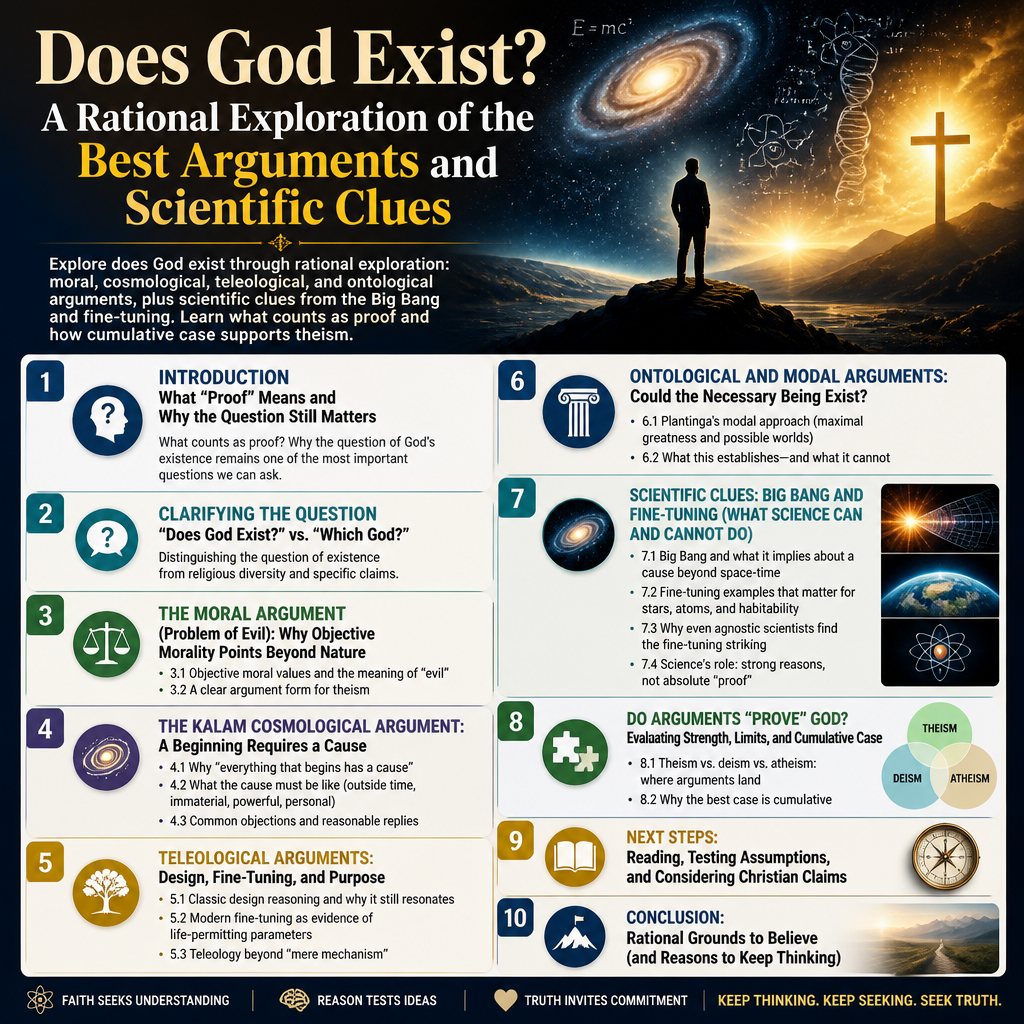
1. Introduction: What “Proof” Means and Why the Question Still Matters
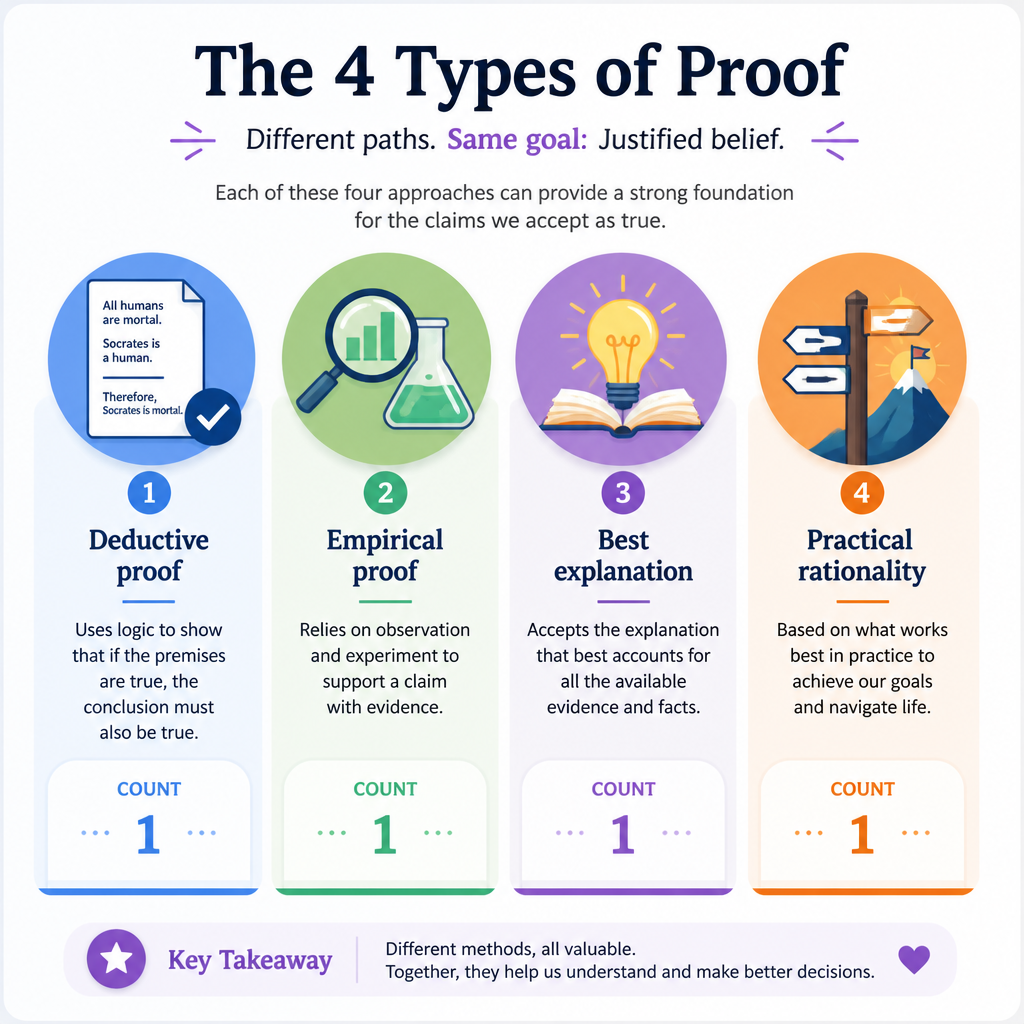
When people ask does god exist, they may be asking for one of several things:
- Deductive proof (certainty from logical necessity).
- Empirical proof (direct measurement or observation).
- Best explanation (the strongest reasoned account given the evidence).
- Practical rationality (whether belief is reasonable for a person who faces the world as it is).
Most real-world questions—especially about ultimate reality—rarely have the kind of proof we expect in math problems or lab experiments. Instead, the debate often turns on strength of reasoning and how well an explanation fits the whole picture.
That’s why many philosophers and thinkers focus on a cumulative case: several arguments that, together, make theism more rational than its main alternatives.
2. Clarifying the Question: “Does God Exist?” vs. “Which God?”
Even if a person concludes “yes” to does god exist, that doesn’t automatically settle which religion is correct or what God is like in every detail.
So it helps to distinguish:
- God of theism (generic): a mind-like reality, perhaps personal, who grounds existence and morality.
- Deism: often a purposeful creator but not necessarily a providential or miracle-working God.
- Specific religions: Christianity, Islam, Judaism, and others make additional claims about revelation, history, and doctrines.
When we examine arguments for god, we are usually aiming at the first layer: the rational acceptability of theism. Christianity and other traditions can then build on that foundation with historical and theological arguments.
3. The Moral Argument (Problem of Evil): Why Objective Morality Points Beyond Nature
One reason the moral argument is so influential is that it begins with something almost everyone recognizes: the world contains real wrongness, not merely preferences.
3.1 Objective moral values and the meaning of “evil”
Many people experience evil as more than a subjective feeling. Consider:
- Some actions seem truly wrong, even when no one dislikes them.
- Some outcomes are devastating in a way that calls for moral judgment, not just opinion.
- Our moral language (“cruel,” “injustice,” “shouldn’t happen”) often implies standards, not just emotions.
On a naturalistic view, you can often explain why humans evolved moral sentiments, but critics ask whether that fully accounts for objective moral truth. If morality is only produced by blind processes, then “evil” may become a label for what we happen to resist—not a genuine feature of reality.
3.2 A clear argument form for theism
A commonly used structure (often associated with the moral argument) goes roughly like this:
- If there is no God, then there is no objective moral order—no transcendent source of moral obligation.
- There is objective moral order (the reality of evil and moral duty).
- Therefore, God exists.
Even when a skeptic objects to particular premises, the argument forces a sharp question: what makes “evil” more than a social or biological phenomenon?
Of course, the problem of evil is also a challenge for theism. Yet many philosophers argue that the moral argument doesn’t ignore evil—it treats it as evidence that morality is deeper than matter, even while the “why evil exists” question remains difficult.
4. The Kalam Cosmological Argument: A Beginning Requires a Cause
The Kalam cosmological argument has become popular because it is relatively accessible and closely tied to modern cosmology.
4.1 Why “everything that begins has a cause”
Philosophers often start from a simple principle: if something begins to exist, then it requires an explanation for why it exists rather than not.
Applied to the universe, the argument notes that many contemporary models (commonly associated with the Standard Big Bang framework) suggest that the universe had a beginning—not necessarily “creation from nothing” in a simplistic way, but a point where the universe’s expansion and its known physical conditions emerge.
4.2 What the cause must be like (outside time, immaterial, powerful, personal)

If the universe began to exist, then—on the Kalam model—the cause of the universe must be:
- Outside time (since time itself is part of the physical universe).
- Not purely material (since matter begins as part of the universe).
- Powerful enough to ground the existence of space, matter, and time.
- Intelligent or personal (a further inference in many versions, though not all versions insist on this).
This is one reason the Kalam is often presented as supporting theism rather than merely deism.
4.3 Common objections and reasonable replies
Skeptics raise objections such as:
- “Maybe the universe doesn’t have a beginning.” Some cosmologies are interpreted as avoiding a beginning. Responses vary, but theists often argue that the burden shifts: our best evidence still points to a beginning or at least something like one in physical terms.
- “The cause could be another universe.” Then the question remains: why does the “multiverse” exist, and why is it the way it is?
- “Causation doesn’t apply to the universe as a whole.” Theists typically reply that we’re using causation as an explanatory notion for what makes existence intelligible, not as a description of a mechanism inside space-time.
Whether one accepts every step, the Kalam argument presses a rational demand: why there is something at all rather than nothing familiar.
5. Teleological Arguments: Design, Fine-Tuning, and Purpose
Teleological arguments ask whether the structure of the universe looks arranged for life.
5.1 Classic design reasoning and why it still resonates
Classic design reasoning moves from complex order to a designer: just as the structure of a watch implies an intelligent maker, so too does the apparent intelligibility and order of the cosmos suggest purpose.
Critics respond that “similarity to a watch” may overreach, since we don’t have the same kind of reference class. Theists, however, often reply that the core issue is explanatory fit: what best accounts for fine-grained life-permitting order?
5.2 Modern fine-tuning as evidence of life-permitting parameters
Fine-tuning arguments focus on specific features of physics and cosmology. While debates exist over exact formulations, the general point is:
- Small changes in certain constants or conditions would likely make stable stars, complex chemistry, and long-term habitability impossible.
- The universe appears to have values that permit the existence of observers.
For example, if gravity were significantly stronger or weaker, the formation of stars and the stability of chemistry would be drastically altered. Similar sensitivity is often discussed regarding parameters tied to the expansion rate and other aspects of the early universe.
5.3 Teleology beyond “mere mechanism”
Even if natural processes explain how structures form once conditions exist, teleological questions remain about the origin and selection of the conditions. If life depends on a narrow range of possibilities, why is the universe in that range?
Common replies include chance, necessity, or some multiverse-like selection mechanism. Theists and skeptics dispute the details. But the fact that many non-theist scientists and philosophers acknowledge the “remarkableness” of fine-tuning is part of why this line of reasoning persists.
6. Ontological and Modal Arguments: Could the Necessary Being Exist?
Ontological and modal arguments differ from cosmological and teleological arguments because they focus less on the physical origin of the universe and more on what might be logically necessary for a greatest conceivable being.
6.1 Plantinga’s modal approach (maximal greatness and possible worlds)
One influential form of this approach (associated with philosophers such as Alvin Plantinga) uses modal reasoning: it asks what would follow if a maximally great being is possible.
In simplified terms:
- If “maximal greatness” is coherent, then it might be possible that such a being exists.
- From there, modal logic suggests that if it is possible, it exists in every relevant possible world scenario—including ours.
Theism is then presented as a rationally stable belief option rather than a mere leap.
6.2 What this establishes—and what it cannot
These arguments are controversial and can be difficult to evaluate quickly. Critics question whether “maximal greatness” is coherent or whether the modal steps are justified.
Still, supporters see the modal approach as showing something important: it may be rationally possible for theism to be internally grounded, not only inferred from the universe’s empirical features.
7. Scientific Clues: Big Bang and Fine-Tuning (What Science Can and Cannot Do)
Science plays a crucial role in modern arguments for god, but it’s worth being precise: science typically provides explanations within nature. The question of whether the ultimate cause of nature is personal God goes beyond what experiments measure directly.
7.1 Big Bang and what it implies about a cause beyond space-time
The Big Bang is a model describing how the universe evolved from an early hot and dense state. Many presentations of the model emphasize that it includes space, matter, energy, and time emerging in the physical sense used by cosmology.
Even if one avoids the word “nothing” in a simplistic way, the broad philosophical inference is that the universe does not seem to have a physical eternity into the past. That supports the idea of a cause beyond the physical system.
7.2 Fine-tuning examples that matter for stars, atoms, and habitability
Fine-tuning arguments focus on the sensitivity of physical constants and initial conditions. When the values are within a narrow range, the universe allows:
- stable atoms and chemistry
- star formation and heavy element creation
- long-term conditions suitable for life
When values drift, those outcomes become unlikely or impossible.
7.3 Why even agnostic scientists find the fine-tuning striking
Some physicists and commentators have expressed that the fine-tuning looks like an unexpected “fit” for life-permitting realities. While they may offer naturalistic alternatives (like multiverse hypotheses), the key point remains: fine-tuning is not easily dismissed.
7.4 Science’s role: strong reasons, not absolute “proof”
Science gives strong reasons to treat the universe as intelligible and life-permitting. But it rarely gives metaphysical certainty about God. That’s why the best approach is often integration: science informs the evidence base, while philosophy evaluates what the evidence means.
8. Do Arguments “Prove” God? Evaluating Strength, Limits, and Cumulative Case
A key question behind does god exist is whether any single argument can be decisive.
8.1 Theism vs. deism vs. atheism: where arguments land
Different arguments may support different conclusions:
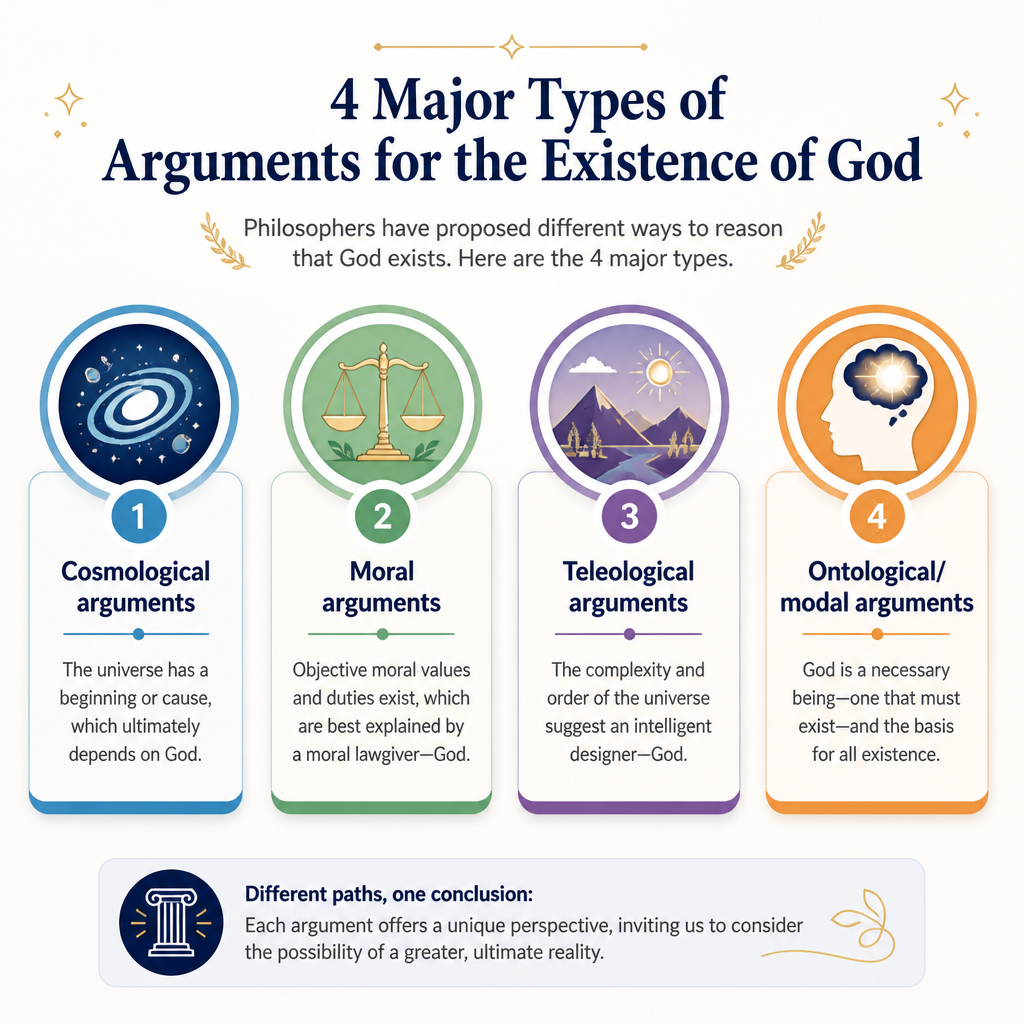
- Cosmological arguments often support a foundational cause.
- Moral arguments often support objective moral truth and thus a deeper moral ground.
- Teleological arguments often support purpose or design-like explanation.
- Ontological/modal arguments can support the rational coherence of a necessary being.
But atheists may still argue that alternative explanations could exist, or that premises don’t support the strongest theistic conclusion. Likewise, deists may accept some evidence while rejecting personal providence or specific revelations.
8.2 Why the best case is cumulative
This is why many thinkers emphasize accumulation: even if each argument has limits or objections, the combined force of independent lines can shift what is reasonable.
Think of it like building a case in court: one witness can be doubted; several independent, converging witnesses can create a different picture. Similarly, proof of god in practice often comes not from a single “magic bullet,” but from the way multiple arguments fit together.
9. Next Steps: Reading, Testing Assumptions, and Considering Christian Claims
If you want to keep exploring, here are productive next steps:
- Define your terms: What counts as “God,” “proof,” “objective morality,” “cause,” and “design”?
- Check premises: Which claims are doing the most work in each argument?
- Consider objections fairly: Best critics often challenge where an argument is weakest.
- Compare worldview-level explanations: Which worldview best accounts for morality, reason, and the intelligibility of nature?
- If interested in Christianity, note that theism is often treated as a stepping stone. Christianity then adds claims about revelation, resurrection, and the coherence of its central story.
If you’re looking for a practical test: ask yourself what kind of world each view makes sense of. A rational worldview should explain more than one domain—physics, morality, and meaning.
10. Conclusion: Rational Grounds to Believe (and Reasons to Keep Thinking)
So, does god exist? The honest answer is that reason does not always produce mathematical certainty. Yet it can produce strong rational grounds.
The moral argument highlights the depth of moral reality and the intelligibility of evil. The Kalam cosmological argument pushes us to explain why a universe that begins exists at all. Teleological reasoning and fine-tuning draw attention to life-permitting order in physics. Ontological and modal approaches attempt to show that theism may be more than an inference—it may be logically coherent and rationally possible.
When combined with scientific clues like the Big Bang and fine-tuning, the result is not a simplistic “slam dunk,” but a cumulative case that many find compelling.
Next step? Keep thinking, keep testing assumptions, and—if you are open to it—consider what it would mean for reality to be grounded in a personal, moral source.