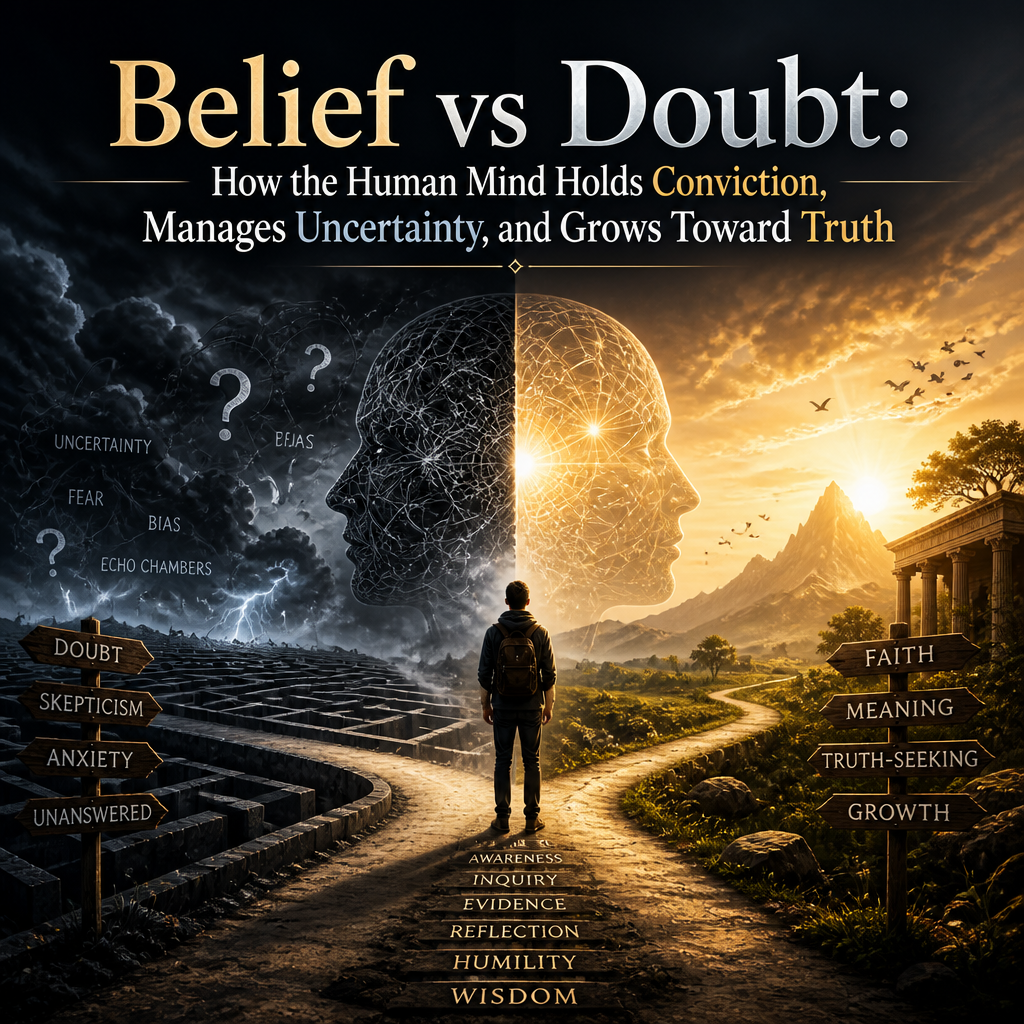
Belief vs Doubt: How the Human Mind Holds Conviction, Manages Uncertainty, and Grows Toward Truth
Belief vs doubt is one of those themes we talk about like it’s simple—either you “believe” or you “doubt.” But the human mind doesn’t really work that cleanly. What we call belief is often a mental framework for predicting reality. What we call doubt is often a psychological response to threat, uncertainty, or identity risk. And underneath the arguments, both sides can be driven by the same machinery: the brain’s need to make sense of the world efficiently and stay stable.
This article explores the psychology of belief—why convictions feel true, why doubt feels dangerous, and how faith and skepticism can become disciplined tools rather than ego-fueled camps.
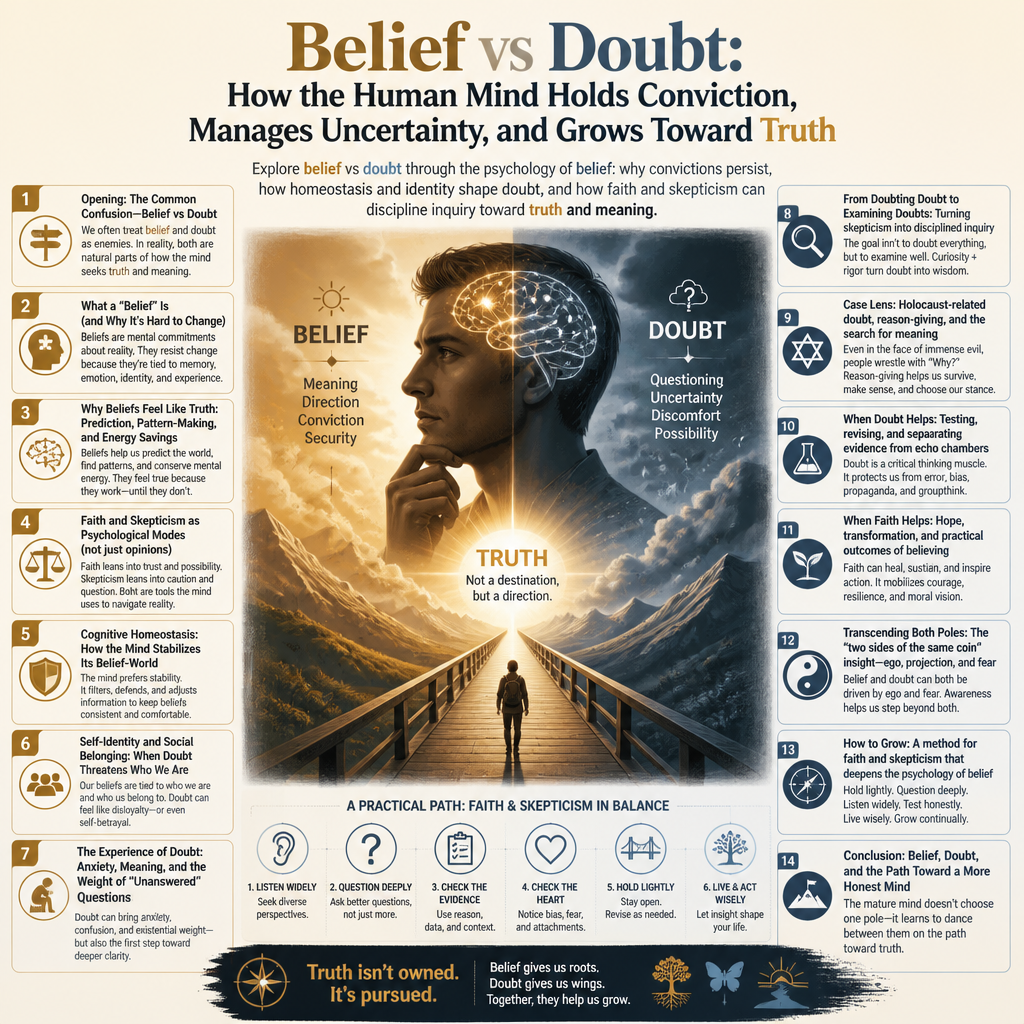
1. Opening: The Common Confusion—Belief vs Doubt
Most people treat belief and doubt as opposites. But in practice they often coexist:
- You can believe something strongly while still doubting its details.
- You can doubt while still assuming certain things (about how knowledge works, about what you trust, about who you are).
- You can be skeptical of one claim while being credulous toward another.
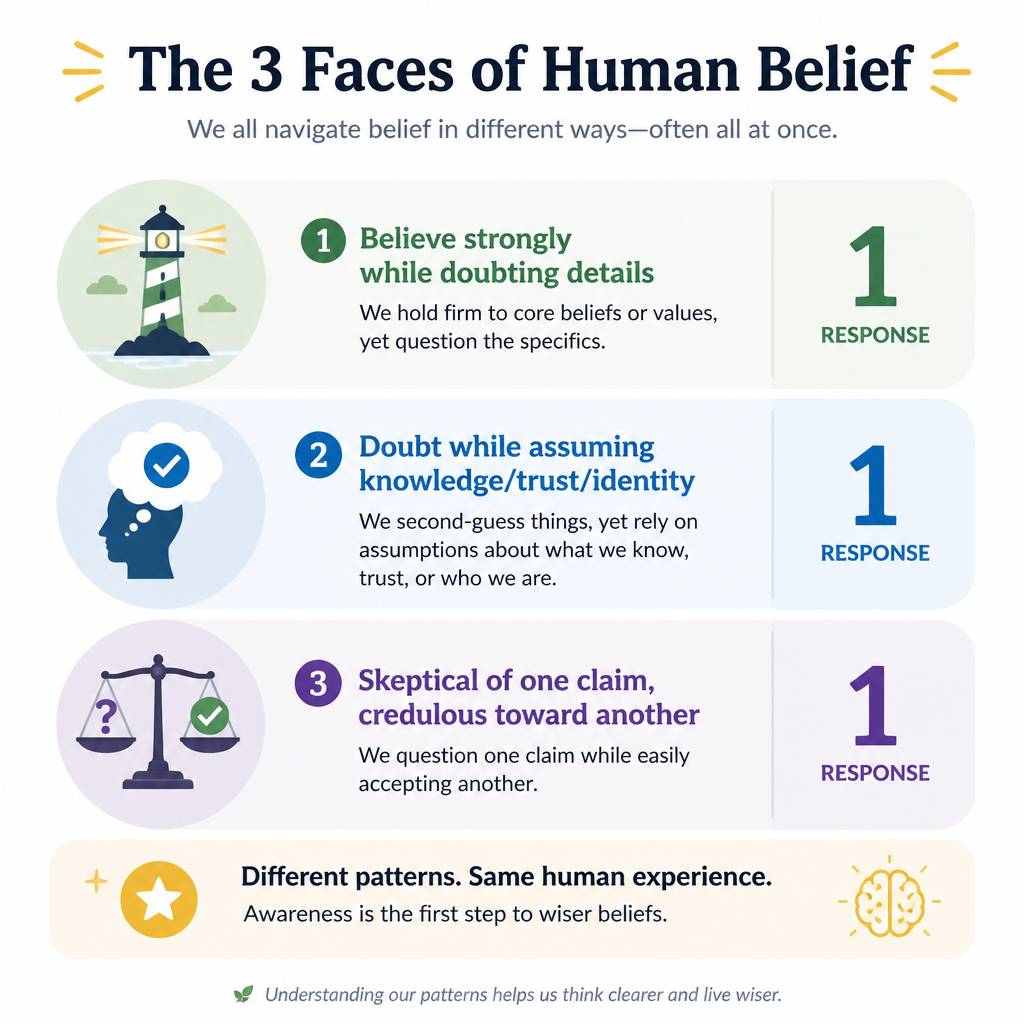
So the real question isn’t “Do you believe or doubt?” It’s what kind of mental process is running in you right now—and what evidence, identity, and emotion are shaping it.
2. What a “Belief” Is (and Why It’s Hard to Change)
A belief is not merely an opinion. Psychologically, beliefs function like models—shortcuts the mind uses to navigate an overwhelming world.
When we encounter information, the brain must decide quickly:
- What matters?
- What is likely?
- What fits my past understanding?
- What can be ignored for now?
This is why belief is surprisingly “sticky.” Changing a belief is not like changing a wallpaper. Often it feels like changing a piece of your world—and sometimes your self.
Research and neuroscience-informed writing suggest that beliefs help the brain conserve energy by predicting patterns rather than re-evaluating everything from scratch each day. Beliefs act like mental compression—a way to process reality without burning out.
Why it matters for belief vs doubt: if belief is a predictive template, then doubt may feel like an interruption—not just a new thought, but a threat to the system.
3. Why Beliefs Feel Like Truth: Prediction, Pattern-Making, and Energy Savings
Here’s the paradox: your brain often experiences its beliefs not as hypotheses, but as reality.
Humans are natural pattern-makers. The brain continuously forms expectations based on prior experience. When the world confirms those expectations—even partially—the belief feels “obvious.”
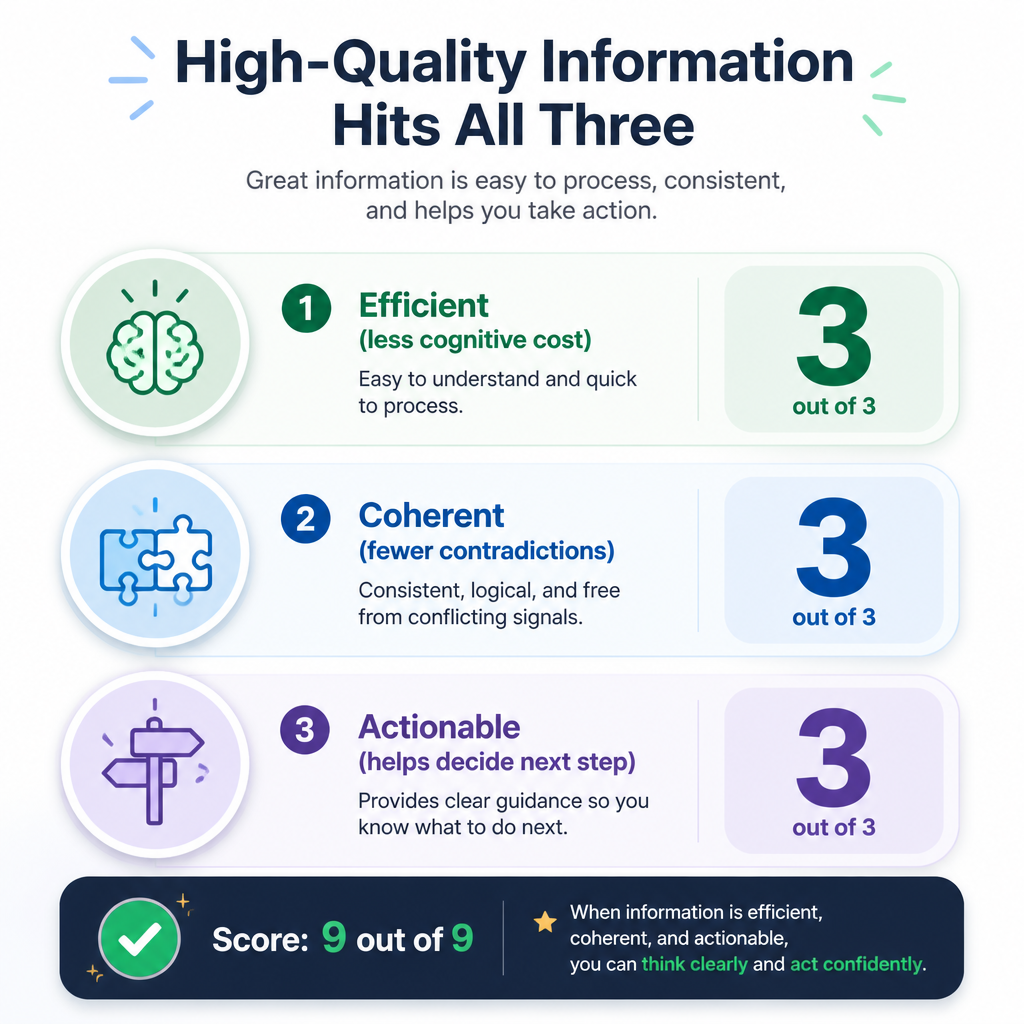
One reason beliefs persist is that the brain prefers stability over constant recalculation. Beliefs can be efficient:
- Efficient (less cognitive cost)
- Coherent (fewer contradictions to manage)
- Actionable (beliefs help you decide what to do next)
In that sense, believing is often how the mind survives day to day. The danger arises when the mind confuses the comfort of prediction with the certainty of truth.
4. Faith and Skepticism as Psychological Modes (not just opinions)
Let’s talk terms. Faith is frequently misunderstood as “belief without evidence.” But in real human life, faith can also mean trusting a person, a path, or a method before you have complete proof.
Skepticism isn’t automatically wisdom either. It can be:
- Disciplined skepticism: “Show me the evidence, test the claim, consider alternatives.”
- Anxious skepticism: “I don’t trust anything; I need to feel safe by rejecting.”
In other words, faith and skepticism are not merely content (what you believe). They’re also modes of attention—ways the mind handles uncertainty and risk.
That’s why belief vs doubt can be more than intellectual disagreement. Sometimes it’s a difference in what feels emotionally “secure” and what feels emotionally “dangerous.”
5. Cognitive Homeostasis: How the Mind Stabilizes Its Belief-World
The mind loves coherence. Once you have a belief framework, it tends to:
- interpret new information to fit existing models
- downplay disconfirming data
- prefer explanations that reduce cognitive dissonance
One helpful concept here is cognitive homeostasis: the mind maintains psychological stability, like a thermostat keeps a room at a chosen temperature.
If new information threatens your stable belief-world, the mind may protect itself through rationalization. That protection can look like:
- arguing harder instead of updating
- changing the definition of the question
- collecting “confirming” examples while ignoring the rest
Takeaway: belief is not only about what you know. It’s about what your mind is trying to keep intact.
6. Self-Identity and Social Belonging: When Doubt Threatens Who We Are
Here is a major reason doubt can feel intense: it can threaten identity.
Beliefs often become tied to:
- how you see yourself (“I’m the kind of person who knows/understands”)
- your reputation (“If I change, I look foolish”)
- your social group (“Our community believes this”)
- your moral commitments (“This belief supports how I live”)
So doubt isn’t always just doubt about a proposition. It can be doubt about your place in the story.
This is why belief vs doubt can escalate quickly in conversations: people are often defending more than an idea. They’re defending a self.
7. The Experience of Doubt: Anxiety, Meaning, and the Weight of “Unanswered” Questions
Doubt can be psychologically heavy. It can produce:
- anxiety (“What if I’m wrong and it matters?”)
- restlessness (“I can’t rest until this is resolved”)
- meaning-fragility (“If this falls apart, what remains?”)
Some people respond to this weight by rejecting uncertainty altogether. Others respond by researching intensely. Still others respond by clinging to a belief that promises stability.
The honest mind asks: Is my doubt a signal that I need more information? Or is it an alarm that my identity feels threatened?
8. From Doubting Doubt to Examining Doubts: Turning skepticism into disciplined inquiry
There’s a pattern in many skeptical movements: doubt grows strong enough to become its own identity. But skepticism can also be tested.
A useful approach is to “doubt the doubter,” not by becoming credulous, but by examining the quality of your skepticism:
- Are you doubting for reasons you can clearly state?
- Are you considering the strongest counterarguments, or only easy ones?
- Do you recognize when your doubts are emotional rather than evidential?
- Would you still hold your skepticism if your social incentives changed?
Disciplined skepticism is not cynicism. It’s a commitment to follow the evidence wherever it leads—even when it complicates your story.
9. Case Lens: Holocaust-related doubt, reason-giving, and the search for meaning
To understand belief vs doubt in its deepest form, consider how historical and moral trauma can shape skepticism.
In accounts of religious unbelief and later reconsideration, one recurring theme is doubt rooted in the enormity of suffering—especially experiences or reflections related to atrocities such as the Holocaust. When the world’s moral order seems broken, it becomes difficult to trust simplistic theodicies or shallow assurances.
One essay on skepticism and faith highlights how grief and moral injury can create persistent doubt, and how the person’s path toward belief involved both facing the problem and searching for what is solid enough to carry the weight of meaning.
Important: trauma-based doubt is not “just thinking.” It is a human response to moral reality. A serious inquiry must respect that—without turning truth into a mere emotional coping strategy.
10. When Doubt Helps: Testing, revising, and separating evidence from echo chambers
Doubt can be a virtue when it:
- insists on verifying claims
- checks for motivated reasoning
- compares sources across perspectives
- allows revision when evidence improves
Skepticism helps you avoid:
- intellectual pride (“I’m too rational to be wrong”)
- confirmation bias (“Only my side has the real facts”)
- echo chambers (“No need to hear the strongest opposing case”)
In a healthy form, doubt is a method of learning. It doesn’t merely say “I don’t know.” It says “Let’s find out responsibly.”
11. When Faith Helps: Hope, transformation, and practical outcomes of believing
Faith helps when it leads to:
- hope that is not naive
- moral transformation
- long-term endurance under uncertainty
- a life oriented toward something true rather than merely comfortable
Many believers will argue that faith is tested not only in arguments, but in lived reality: character growth, community fruit, and the capacity to endure suffering without collapsing into meaninglessness.
But: faith also needs accountability. Faith without inquiry can become blind loyalty. The best versions of faith are willing to ask hard questions and to learn.
12. Transcending Both Poles: The “two sides of the same coin” insight—ego, projection, and fear
Some spiritual-philosophical writing argues that belief and skepticism can be two sides of the same ego coin. In this view, each pole can accuse the other:
- Belief suspects doubt.
- Doubt suspects belief.
Both can be driven by fear: fear of being wrong, fear of humiliation, fear of losing community, or fear of being emotionally exposed.
This framework suggests a deeper freedom: transcend the duality by inquiring into the nature of knowing itself. Instead of treating belief vs doubt as a war, the mind can ask: What am I really doing when I claim certainty or reject it?
Some traditions even speak of direct knowing—an experience that does not require you to cling to either belief or disbelief as your final posture.
13. How to Grow: A method for faith and skepticism that deepens the psychology of belief
If you want a practical approach to belief vs doubt, try this method:
A. Identify your belief system
Write down the claim or worldview you’re dealing with. Then ask: What does this belief let me predict?
B. Locate the emotion beneath the cognition
When doubt spikes, what fear or need is underneath it? Safety? belonging? moral clarity? control?
C. Separate evidence from interpretation
Ask:
- What would count as strong evidence?
- What alternative explanations exist?
- Am I only consuming sources that make me feel correct?
D. Practice “steel-manning” your opposite
Before you reject another view, state it in its strongest form. If you can’t, you don’t yet understand what you’re rejecting.
E. Allow beliefs to earn trust over time
Beliefs can be graded rather than binary. You can move from “strong certainty” to “tentative confidence” as evidence improves. That’s psychological maturity.
This method doesn’t force you to abandon belief or live in perpetual doubt. It helps you align how you think with what is true.
14. Conclusion: Belief, Doubt, and the Path Toward a More Honest Mind
Belief vs doubt isn’t merely a debate between two positions. It’s a window into the psychology of belief—how the mind predicts, conserves energy, stabilizes itself, protects identity, and manages uncertainty.
When doubt is disciplined, it protects you from error. When faith is accountable, it can provide hope, moral transformation, and a path through unanswered questions. And when you transcend the ego duel between believer and skeptic, you can become more honest—more able to ask what your mind is doing, not just what you think.
In the end: the goal is not to win belief vs doubt. The goal is to move toward truth with both courage and humility.
Top Reference Resources (3)
-
Ralph Lewis, M.D. — What Actually Is a Belief? And Why Is It So Hard to Change? (Psychology Today). https://www.psychologytoday.com/us/blog/finding-purpose/201810/what-actually-is-belief-and-why-is-it-so-hard-change
-
Randy Newman — Between Faith and Doubt: Five Questions for Our Skepticism (Desiring God). https://www.desiringgod.org/articles/between-faith-and-doubt
-
Suresh Natarajan — Belief and skepticism. Two sides of the same coin (Medium). https://sureshn13.medium.com/belief-and-skepticism-132ce0a986f1