Do We Really Need God to Make Sense of Life? Purpose, Meaning, and Atheism vs Belief
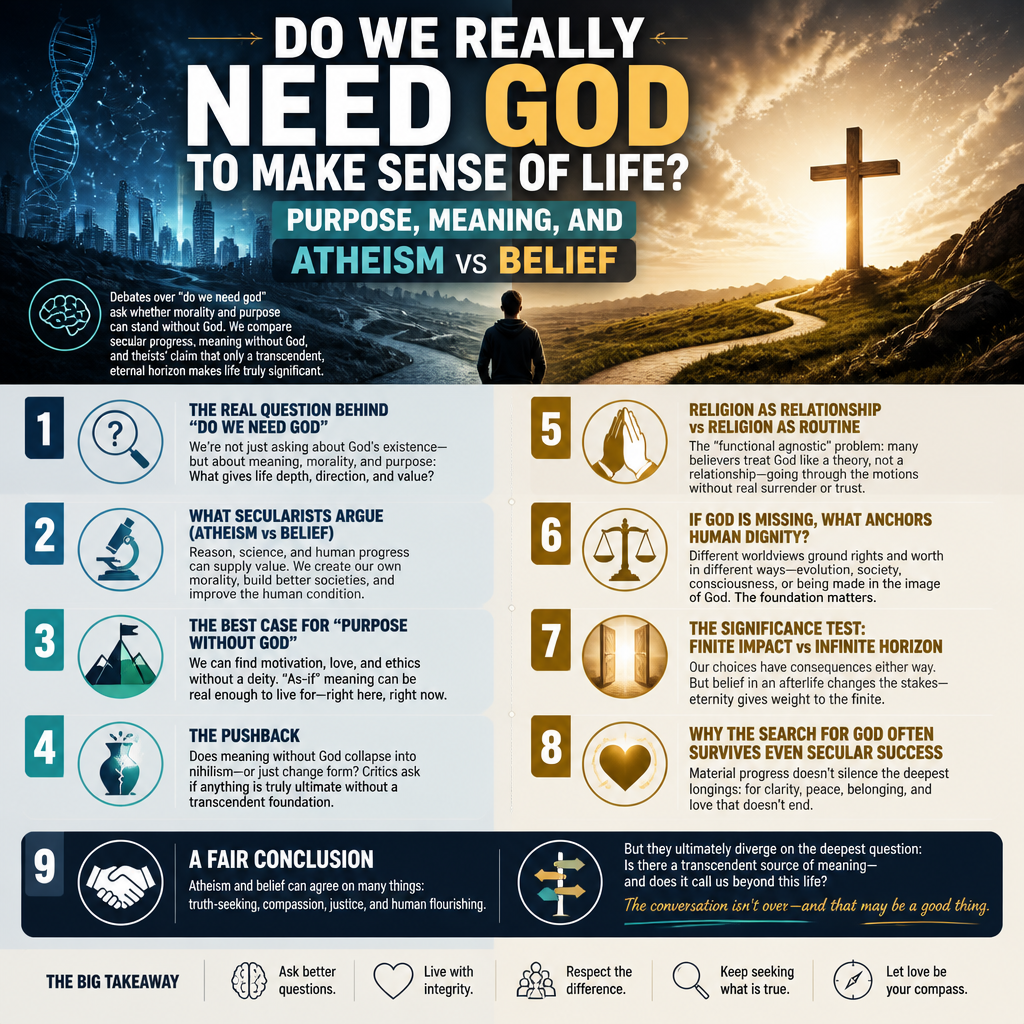
One of the most common questions in philosophy, theology, and everyday conversations is surprisingly simple: do we need god to make sense of life?
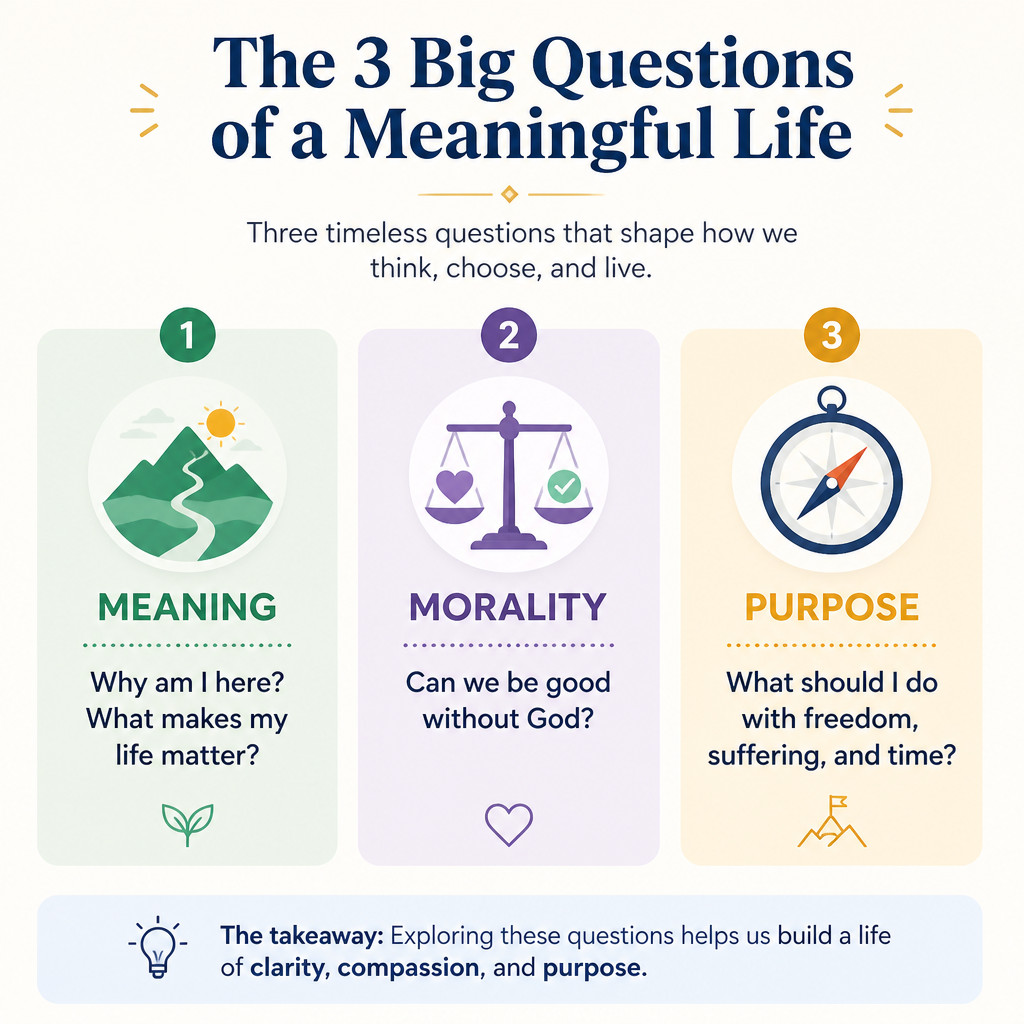
But the question often hides several different concerns. When people ask it, they may mean any of the following:
- Meaning: Why am I here? What makes my life matter?
- Morality: Can we be good without God?
- Purpose: What should I do with my freedom, suffering, and time?
This matters because arguments about God usually aren’t only about “belief” in the abstract. They’re about the framework that makes life intelligible: what counts as truth, what counts as dignity, and what ultimately happens to our choices.
1) The Real Question Behind “Do We Need God”
To move the debate forward, it helps to separate three overlapping topics:
Meaning
Meaning answers what life is “for.” It deals with ultimate significance, not just temporary satisfaction.
Morality
Morality answers how we should treat others and ourselves—right and wrong, justice and care.
Purpose
Purpose answers what we should do today, how we aim our lives, and why effort is worth it.
Some atheists argue that morality and purpose can be grounded in reason, empathy, and evidence. Some theists argue that the deepest meaning and the strongest moral foundation require a transcendent source.
2) What Secularists Argue: Atheism vs Belief
In contemporary debates—especially where religion is declining but progress continues—secularists often argue:
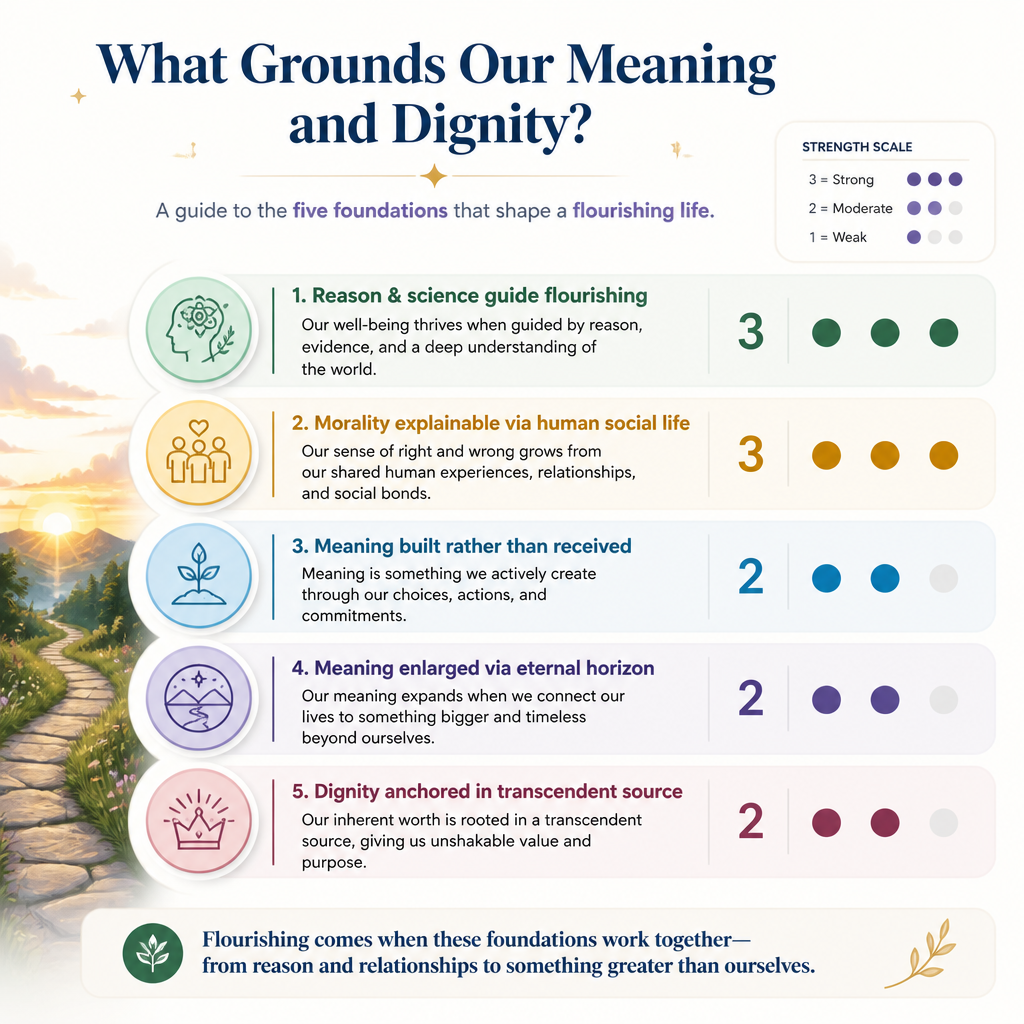
- Reason and science can guide human flourishing without supernatural assumptions.
- Morality is explainable through human social life, cooperation, and moral learning.
- Meaning can be “built” rather than received.
Consider the thrust of popular public debates: even in places with growing unaffiliation, societies have seen remarkable achievements—longer lifespans, major reductions in violence, and large improvements in living standards. The implication is not merely “God is unnecessary,” but that human progress doesn’t require theism.
From this angle, religion may function as a community tradition or a comfort system—but it is not required to explain how people live well or why societies can improve.
3) The Best Case for “Purpose Without God”
Strong arguments for purpose without god usually rely on “as-if” meaning: even if the universe is natural, we can still make life coherent and worth living.
Motivation and commitment
You don’t need an eternal reward to commit to honesty, love, or service. Human beings experience real goods—companionship, truth, courage, beauty—and can orient their lives toward them.
Ethics grounded in human realities
Even if moral rules are not “written in the sky,” they can still be rational and humane. Empathy, reciprocity, and respect for persons can be defended without appealing to God.
A practical framework, not a metaphysical system
Many secular thinkers do not claim that life is “meaningful because it is eternal.” They claim life can be meaningful because it is experienced, shared, and shaped by our choices.
On this view, “meaning” is not primarily a cosmic scoreboard; it’s something we learn to inhabit.
4) The Pushback: Does Meaning Without God Collapse into Nihilism?
The most serious theistic critique is not that atheists cannot do good. The pushback is sharper: if God is absent, does meaning ultimately become fragile?
Two worries often appear:
- Ultimate significance: If all lives end and history ends, does significance dissolve into insignificance?
- Motivational stability: Even if meaning works for some, can it withstand despair, loss, and moral outrage?
The best theists argue that meaning without an eternal horizon tends to shrink. Not always, but structurally. If the universe is indifferent and finite, then the question “Why does it matter?” never receives a final answer—only a temporary one.
That doesn’t prove nihilism. It suggests that the deepest layer of meaning may be missing: the “why” that holds when everything ends.
5) Religion as Relationship vs Religion as Routine: The “Functional Agnostic” Problem
Here is a hard but honest critique often raised within Christianity itself: many believers treat God like a theory rather than a living presence.
Some young believers—despite Christian upbringing—can go weeks or months without prayer, without reading Scripture, and without noticing any difference in their daily lives. They may appear to believe, yet live as if faith doesn’t touch what matters most.
This can create a version of religion as routine, where:
- faith becomes cultural identity rather than a relationship;
- God becomes an add-on for morality, comfort, or guilt-management;
- spiritual language becomes distant from lived experience.
In that case, the person is not “debating God’s existence” so much as testing God’s practical relevance. And when faith looks indistinguishable from non-belief in the day-to-day, the question “do we need god?” becomes emotionally and psychologically understandable.
So yes—believers are sometimes the first ones to make atheism feel plausible by living in a way that makes God seem optional.
6) If God Is Missing, What Anchors Human Dignity?
A central issue in atheism vs belief debates is the grounding of human worth.
If dignity is merely a human convention, it can still be defended—but it becomes dependent on collective agreement and social stability. Theists often argue that this makes dignity contingent.
On the other hand, many theists claim dignity is anchored in a transcendent source:
- humans have worth because they relate to God (made in His image);
- rights and obligations are not only social contracts but moral realities;
- people are not replaceable instruments.
Atheists can and do defend human rights passionately. The question is not whether atheists care, but whether their worldview can offer a final metaphysical reason for why dignity is more than a negotiated preference.
7) The Significance Test: Finite Impact vs Infinite Horizon
One of the most illuminating ways to compare worldviews is a “significance test.”
Under naturalism, life is finite
If everything ends—if consciousness, memory, and earthly influence eventually perish—then all human actions lose their ultimate hold on the universe.
Even if impact spreads for centuries, naturalism typically treats final disappearance as the ultimate endpoint. The “last word” belongs to extinction.
Under theism, choices may echo beyond death
Theists argue that meaning becomes dramatically larger when actions persist in an eternal horizon. If there is an afterlife, then your choices are not sealed in time. They keep carrying consequences.
Philosophers sometimes frame this as a magnitude gap: the difference between a finite timeline and an infinite one can be immense—even if the “local” experience of life feels similar.
This is not meant to mock secular people who find meaning in family, art, justice, or discovery. It’s to ask a deeper question:
When your life is over, what will meaning finally mean?
8) Why the Search for God Survives Even Secular Success
Societies can become materially advanced and still have existential hunger. Secular success often improves some things:
- health outcomes;
- technological capacity;
- economic comfort.
But comfort is not the same as clarity. Many people continue to search for:
- peace that doesn’t depend on circumstance;
- love that doesn’t collapse when feelings fade;
- moral certainty that doesn’t fluctuate with trends;
- an answer to suffering that isn’t reduced to randomness.
Sometimes new “tribal” identities, conspiracy thinking, or ideological fervor appear when a culture loses a shared sense of transcendent truth. The pattern isn’t proof of God. But it does suggest that human longing for ultimate grounding is not easily eliminated.
In that context, religion is not only a set of claims. It is a proposed home for the deepest questions.
9) A Fair Conclusion: Where Atheism and Belief Can Agree—and Where They Diverge
Where they can agree
- Life can be lived well with or without explicit God-belief.
- Morality matters, and cruelty is never justified.
- Many people want purpose, not just explanations.
Where they diverge fundamentally
- Meaning’s ultimate foundation: theism points to a transcendent source; atheism typically grounds value in human experience and commitments.
- Final horizon: theists argue that eternal life gives actions lasting significance; atheists typically treat impact as finite (even if long-lasting).
- Dignity’s grounding: theists claim dignity is objective in relation to God; atheists often claim dignity is objective in relation to human beings and their interests.
So, do we need god to make sense of life?
A practical answer is: many people live meaningful lives without explicit theism. But the deeper answer—what makes life ultimately significant, not just temporarily satisfying—depends on your view of reality’s horizon.
If life ends in nothingness, the ultimate “why” stays unanswered. If life is held within an eternal God, meaning is not only constructed—it is discovered, received, and carried forward.
Sources (Top References)
-
The Free Press: “DEBATE: Do We Need God?” (Steven Pinker vs. Ross Douthat) — https://www.thefp.com/p/debate-do-we-need-god
-
Trueface: “Do We Really Need God?” — https://www.trueface.org/blog/do-we-really-need-god
-
Wisdom & Folly: “Theism, Atheism, and the Significance of our Lives” — https://wisdomandfollyblog.com/theism-atheism-and-the-significance-of-our-lives/