Signs Islam Is True: 10 Spiritual, Intellectual, and Experiential Proofs for Seekers
Many people searching for God eventually ask a quiet but powerful question: “What signs show that Islam is true?” Some are coming from doubt after painful life events. Others are raised in different religions and feel the pull of something deeper. Many simply sense that truth should be more than wishful thinking—something grounded, coherent, and life-giving.
Islam does not ask people to accept blindly. It invites reflection on spiritual signs, history, revelation, and even the inner movements of the human heart. In this guide, we’ll walk through 10 common proofs—spiritual, intellectual, and experiential—that seekers often point to when they move from “Why?” to conviction.
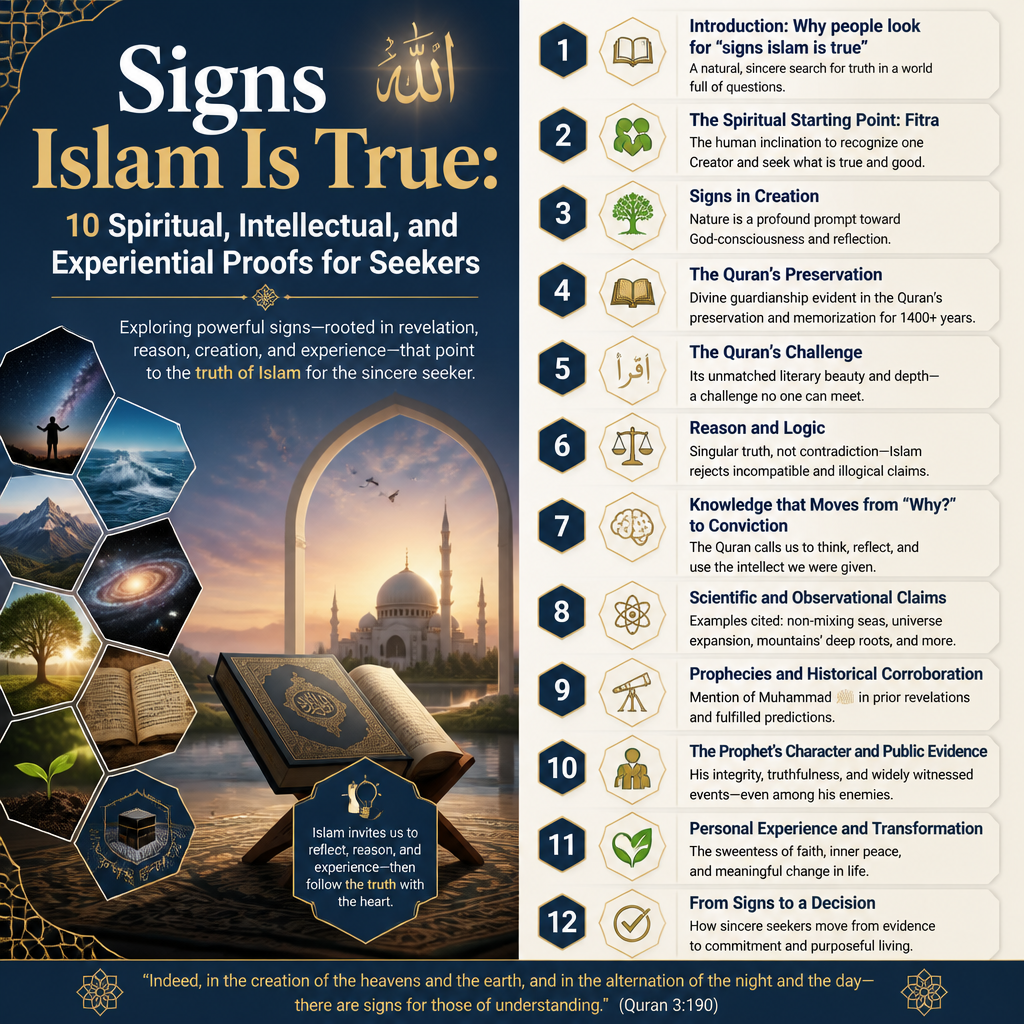
1) The Spiritual Starting Point: Fitra (Innate Recognition of One God)
Before books, before arguments, before culture—Islam emphasizes an inner disposition in every human being called fitra. The idea is that humans are naturally inclined toward recognizing the Creator and worshipping Him alone.
In the Qur’an, Allah reminds people of a primordial acknowledgment: “Am I not your Lord?” (Qur’an 7:172). Islam often interprets this as the soul’s original orientation toward God.
Seekers report a pattern: even in cultures that disagree about details, many people feel a real longing for meaning, moral accountability, and ultimate purpose. That shared yearning—sometimes called a “sensus divinitatis” (a sense of the Divine)—is often treated as one of the strongest spiritual signs Islam is true: it matches the way faith “fits” the human soul.
2) Signs in Creation: Nature as a Prompt Toward God-Consciousness
Another category of evidence is what people often experience when they look at the world carefully. Creation can awaken humility: the order of life, the precision of ecosystems, the vastness of space, and the persistence of natural law all point away from randomness for many readers.
Islam encourages reflection—not only study. The Qur’an repeatedly invites humans to look: at the alternation of day and night, at the paths of water, at the growth of plants, at patterns in the universe.
For a sincere seeker, these aren’t “proofs” in the lab sense—they are signs. But signs matter because they guide the heart. Many converts describe an unmistakable moment: “I can’t unsee how much points to an intelligent Creator.”
3) The Qur’an’s Preservation: Divine Guardianship Across 1400+ Years
One of the most frequently cited evidences for Islam’s authenticity is the Qur’an’s preservation. Islam teaches that Allah has guarded the Qur’an (Qur’an 15:9).
What does that look like in practice? The Qur’an’s text has been transmitted through rigorous scholarship and, crucially, through memorization by millions of Muslims worldwide. This memorization culture is often described as an extraordinary protection mechanism—especially considering the Qur’an was revealed long before printing presses or modern mass transcription.
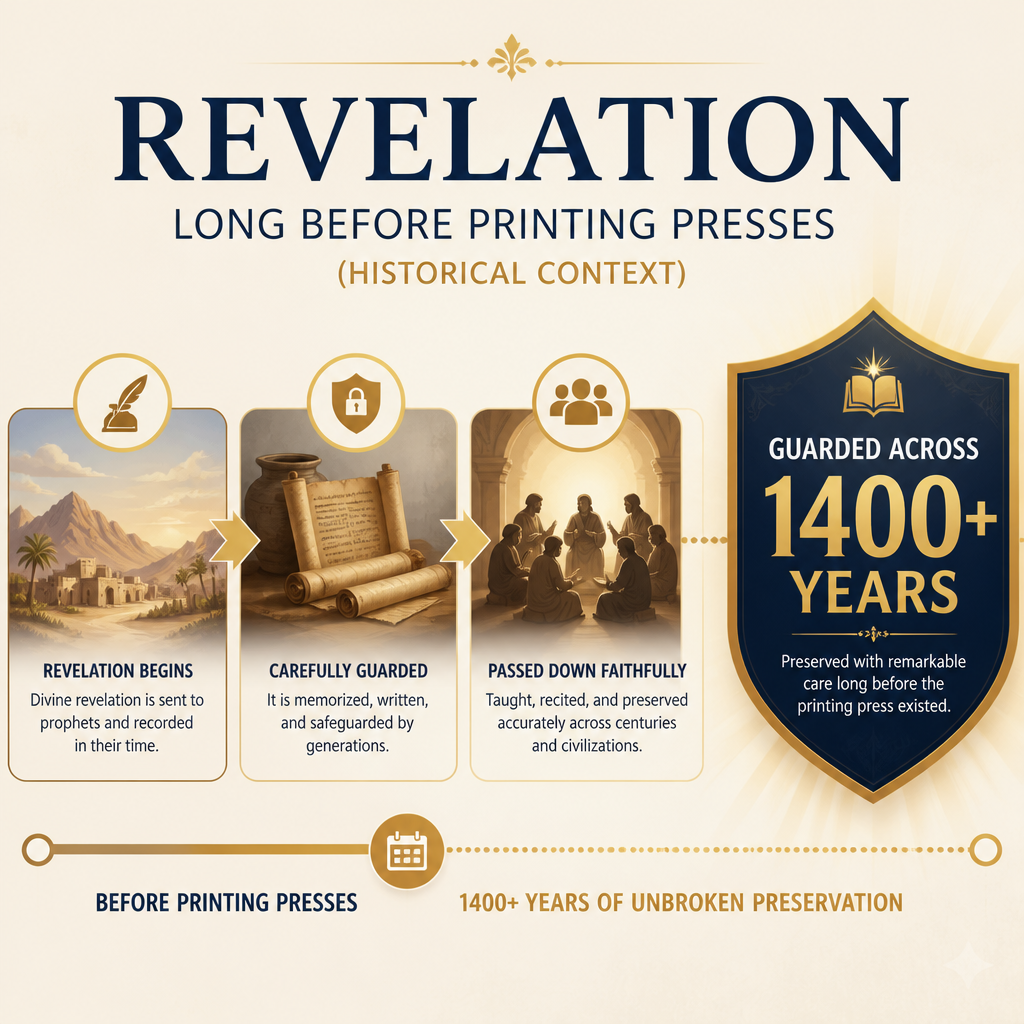
Seekers often view this as a “sign” not only because of preservation itself, but because it makes the Qur’an’s message available intact across generations. If the scripture were altered in any major way, the global community of memorization and recitation would struggle to maintain unity.
4) The Qur’an’s Challenge: Why Its Uniqueness Supports a Claim of Divine Origin
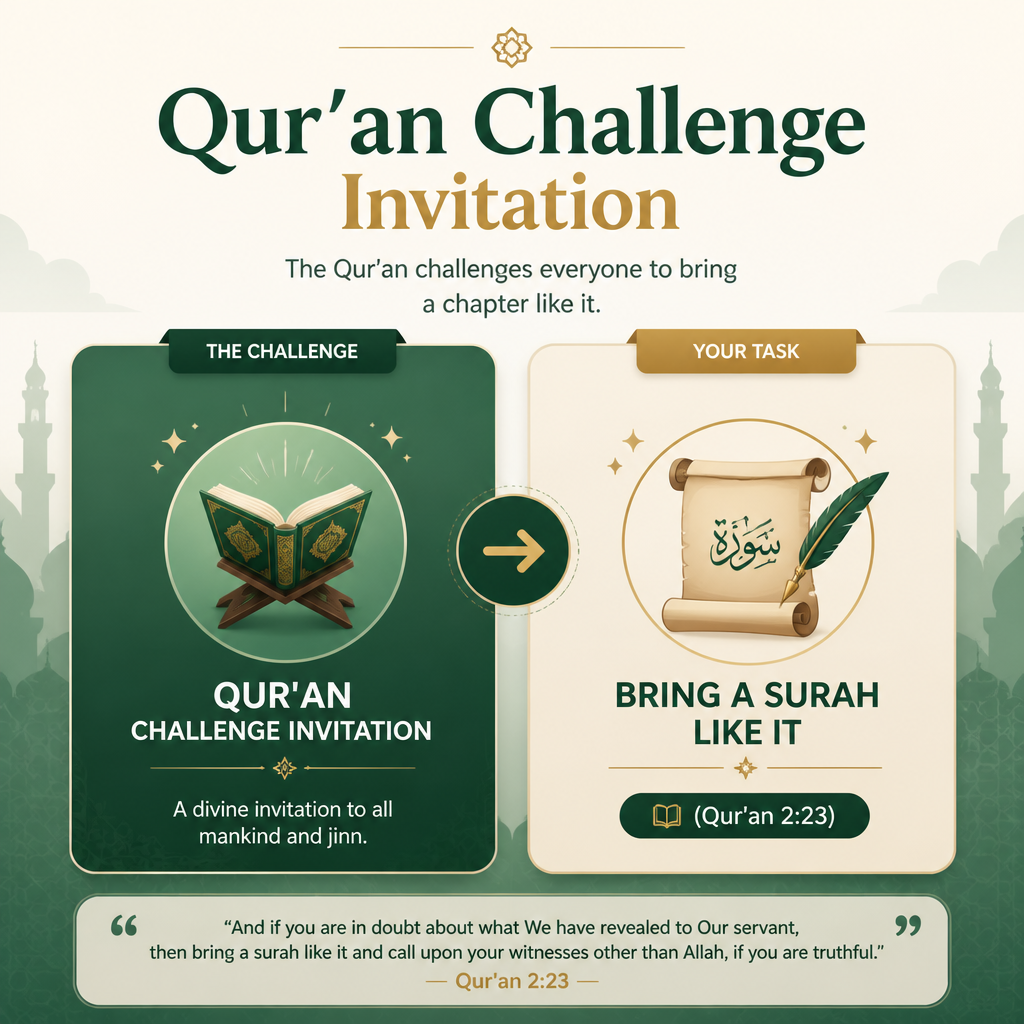
The Qur’an repeatedly issues a challenge: people are invited to attempt to produce something like it. This appears in different forms, including the well-known invitation: “Bring a surah like it …” (Qur’an 2:23).
Islamic reasoning here is straightforward: if a human produced it, then humans should be able to match it—at least in a limited, comparable way. But no such match has emerged.
Beyond style, seekers also argue that the Qur’an’s combination of guidance—belief, ethics, worldview, worship, community laws—creates a unity that is difficult to explain as merely human invention.
5) Reason and Logic: Singular Truth, Not Contradictory Claims
Many arguments for Islam begin with a philosophical observation: not all religious claims can be true at the same time if they logically contradict each other. Islam’s core message is clear and singular: worship Allah alone, follow the divine guidance brought by the prophets—culminating in the final revelation to Muhammad.
When a religion claims certainty about ultimate realities—God, revelation, judgment, and salvation—it inevitably invites an “either/or” decision. For many seekers, Islam’s internal coherence feels like a sign of truth: it does not require believers to ignore contradictions; instead, it addresses them directly.
6) Knowledge Moves from “Why?” to Conviction: Reflecting on the Qur’an’s Call to Intellect
Islam repeatedly encourages thinking, learning, and reflecting. The goal is not cold analysis for its own sake; it’s knowledge that leads to God-consciousness.
Many seekers notice a transition: when they first start reading, questions are everywhere. But as the Qur’an’s worldview becomes clearer—who God is, why life exists, why suffering happens, what morality protects—doubt often begins to reorganize into understanding.
This is why Islamic da‘wah often emphasizes both evidence and character: knowledge is meant to reach the heart.
7) Scientific and Observational Claims: Examples Often Cited by Seekers
Some people searching for signs islam is true look at how the Qur’an describes aspects of nature—especially when those descriptions align with what modern research suggests.
Commonly mentioned examples include:
- Non-mixing seas: the Qur’an describes waters that meet without fully mixing (often associated with observable phenomena like density layers).
- Universe expansion: verses are interpreted by some scholars as pointing toward an expanding universe.
- Mountains with deep roots: the Qur’an describes mountains as having stabilizing roles, and some note that deep geological roots are consistent with modern findings.
Important note: believers and researchers usually emphasize that revelation is primarily guidance, not a textbook designed for modern scientific testing. Still, many seekers see these references as meaningful “signs”—especially when they appear in a revelation associated with an ancient audience.
8) Prophecies and Historical Corroboration: Confirmation Beyond Mere Opinion
Another category of evidence comes from reported prophetic statements and how history seems to reflect them. Islam points to fulfilled predictions as supportive signs.
In addition, some seekers examine how Muhammad’s description appears indirectly in earlier traditions. While details and interpretations vary widely across scholarly communities, the overarching idea is that Islam did not begin from nowhere—it continues a prophetic storyline centered on monotheism.
For example, many references cited in Islamic apologetics include comparisons between phrases in earlier texts and the Qur’anic or prophetic mission, along with the idea that Muhammad’s arrival is not purely an afterthought of later legend.
9) The Prophet Muhammad’s Character and Public Evidence
Evidence is not only textual. Islam also points to the character of the Prophet Muhammad (peace be upon him). Many people find this persuasive: could the foundation of a new religious movement be built on sincerity, or on deception?
Historically, Muhammad’s truthfulness is emphasized even by people who opposed him. His conduct, his integrity, and the way he lived are portrayed as signs that his claim was genuine.
Additionally, widely witnessed events are often cited in apologetics: not only “miracles” in the popular sense, but the public impact of his message, the coherence of his teachings, and the community that formed around him.
10) Personal Experience and Transformation: The Experiential Proof of Faith
Finally, there is what many call the “lived proof.” If a message is true, believers often say it should transform the human being: morally, emotionally, spiritually.
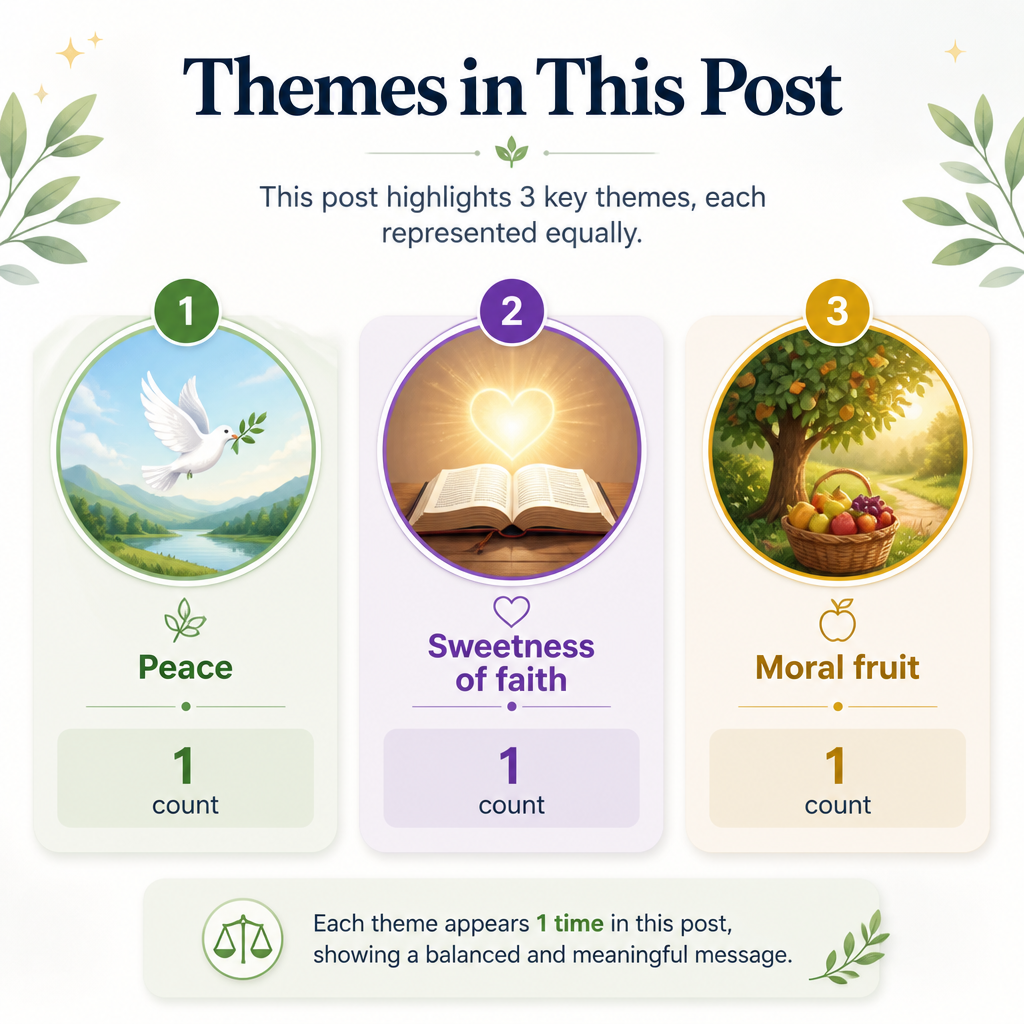
In Islamic terms, the experience of faith can include:
- Peace—a sense that life has meaning and direction.
- Sweetness of faith—a felt closeness to God.
- Moral fruit—habits that become more consistent with divine guidance.
Many converts describe a gradual realization: “The signs didn’t only convince my mind—they changed my life.” This isn’t meant to replace evidence; rather, it completes it. For many sincere seekers, moral clarity and spiritual stability become part of the answer to “Is Islam true?”
From Signs to a Decision: How a Seeker Moves Toward Commitment
Islamic proofs are often presented as a journey. You begin with questions. You notice signs in the world and within yourself. You study the Qur’an’s preservation and its uniqueness challenge. You reflect with reason on a singular truth claim. You consider historical and prophetic corroboration. You observe the character of the Prophet and the transformation in people’s lives.
Then, at some point, sincerity requires action. Not action to “earn” faith, but action to respond to it. Many seekers describe becoming Muslim as a moment of alignment: their conscience, intellect, and spiritual longing meet one reality—Allah’s guidance revealed through Islam.
Conclusion: When Signs Point in One Direction
No one sign alone may convince every person. But when spiritual longing, rational coherence, the Qur’an’s preservation, its challenge, historical corroboration, and lived transformation all point in the same direction, many believers conclude:
Islam is true—because the signs converge, and the guidance produces spiritual and moral fruit.
If you’re searching, don’t rush. Read with humility, ask honest questions, and seek guidance from knowledgeable Muslims. If you want, start with the Qur’an, then learn the basics of belief (iman) and practice (islam). And as you reflect, you may find that “signs islam is true” becomes less a slogan and more a conclusion you can feel in your heart.
Resources (Top References)
- AboutIslam.net – 7 Proofs to Know Islam is the Truth
- TheMuslimComic.com – 10 Reasons Why Islam is the True Religion
- IERANZ.com – Signs of Allah: Why Signs?
Disclaimer: This article summarizes common lines of reasoning and explanations found in Islamic resources and seeker-focused discussions. Personal certainty comes through sincere learning and reflection.